Deep Tech: Inside the Elite VC Playbook and Hard Tech Investing
Explore the elite VC playbook for Deep Tech and Hard Tech investing. Learn how firms like Lux Capital and DCVC back nuclear fusion and AI to engineer the future.
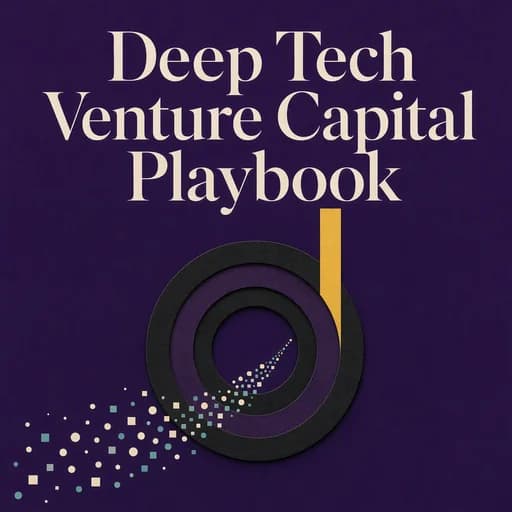
Лучшая цитата из Deep Tech: Inside the Elite VC Playbook and Hard Tech Investing
In software, your biggest risk is often just 'will people use this?' In deep tech, the risk is 'can this even be built?' It’s a move from market risk to technical risk.
Generated by Aditya
An audio lesson for an intelligent layperson explaining how elite venture capital works based on the 'VC_Portfolio_Intelligence_Database.md'. The lesson must follow the provided ANALYTICAL STANDARD (counterintuitive insights, confidence tagging, separating fact from inference). It should cover: 1) The mix of deep tech vs. general software logic. 2) The impact of entry price and investment stage (e.g., Coinbase, UiPath). 3) Venture consensus vs. genuine insight in AI and defense. 4) The components of a great bet (moats, switching costs, tech breakthroughs). 5) 'Picks and shovels' models (e.g., Applied Intuition). 6) Physical world vs. pure software risks and timelines. 7) The nature of moats beyond just technology. 8) Bottlenecks to viability. 9) The alignment of tech, market, and timing. 10) Cross-firm intelligence and portfolio overlap. 11) Risk-adjusted thinking. Critically evaluate the database's US bias and limitations. Source: VC_Portfolio_Intelligence_Database.md


Часто задаваемые вопросы
Deep Tech, often referred to as Hard Tech or Tough Tech, focuses on solving complex problems that have been stuck for decades. Unlike traditional venture capital that might prioritize social media apps or marketing, elite firms like Lux Capital and DCVC invest in fundamental shifts in physics, biology, and chemistry. This sector involves high-stakes bets on tangible innovations such as autonomous submarines and AI-driven drug design rather than just digital platforms.
According to the VC Portfolio Intelligence Database, firms such as Lux Capital, DCVC, and The Engine are at the forefront of the Deep Tech movement. These elite tier investors move the needle by backing companies that aim for massive breakthroughs rather than incremental improvements. Their portfolios reflect a commitment to engineering the future through ambitious projects that tackle global challenges in energy, transportation, and healthcare.
Elite portfolios often include companies like Commonwealth Fusion Systems, which is working on building a 'star' through nuclear fusion technology. Other examples of Hard Tech investments mentioned in the VC playbook include autonomous submarines and advanced AI systems designed for drug discovery. These companies represent a shift toward backing fundamental scientific advancements that have the potential to create entirely new industries and solve long-standing global issues.
Создано выпускниками Колумбийского университета в Сан-Франциско
"Instead of endless scrolling, I just hit play on BeFreed. It saves me so much time."


"I never knew where to start with nonfiction—BeFreed’s book lists turned into podcasts gave me a clear path."


"Perfect balance between learning and entertainment. Finished ‘Thinking, Fast and Slow’ on my commute this week."
"Crazy how much I learned while walking the dog. BeFreed = small habits → big gains."
"Reading used to feel like a chore. Now it’s just part of my lifestyle."

"Feels effortless compared to reading. I’ve finished 6 books this month already."
"BeFreed turned my guilty doomscrolling into something that feels productive and inspiring."

"BeFreed turned my commute into learning time. 20-min podcasts are perfect for finishing books I never had time for."
"BeFreed replaced my podcast queue. Imagine Spotify for books — that’s it. 🙌"

"It is great for me to learn something from the book without reading it."
"The themed book list podcasts help me connect ideas across authors—like a guided audio journey."
"Makes me feel smarter every time before going to work"
 Ask ChatGPT
 Ask Claude
Создано выпускниками Колумбийского университета в Сан-Франциско
"Instead of endless scrolling, I just hit play on BeFreed. It saves me so much time."
"I never knew where to start with nonfiction—BeFreed’s book lists turned into podcasts gave me a clear path."
"Perfect balance between learning and entertainment. Finished ‘Thinking, Fast and Slow’ on my commute this week."
"Crazy how much I learned while walking the dog. BeFreed = small habits → big gains."
"Reading used to feel like a chore. Now it’s just part of my lifestyle."
"Feels effortless compared to reading. I’ve finished 6 books this month already."
"BeFreed turned my guilty doomscrolling into something that feels productive and inspiring."
"BeFreed turned my commute into learning time. 20-min podcasts are perfect for finishing books I never had time for."
"BeFreed replaced my podcast queue. Imagine Spotify for books — that’s it. 🙌"
"It is great for me to learn something from the book without reading it."
"The themed book list podcasts help me connect ideas across authors—like a guided audio journey."
"Makes me feel smarter every time before going to work"
"Instead of endless scrolling, I just hit play on BeFreed. It saves me so much time."
"I never knew where to start with nonfiction—BeFreed’s book lists turned into podcasts gave me a clear path."
"Perfect balance between learning and entertainment. Finished ‘Thinking, Fast and Slow’ on my commute this week."
"Crazy how much I learned while walking the dog. BeFreed = small habits → big gains."
"Reading used to feel like a chore. Now it’s just part of my lifestyle."
"Feels effortless compared to reading. I’ve finished 6 books this month already."
"BeFreed turned my guilty doomscrolling into something that feels productive and inspiring."
"BeFreed turned my commute into learning time. 20-min podcasts are perfect for finishing books I never had time for."
"BeFreed replaced my podcast queue. Imagine Spotify for books — that’s it. 🙌"
"It is great for me to learn something from the book without reading it."
"The themed book list podcasts help me connect ideas across authors—like a guided audio journey."
"Makes me feel smarter every time before going to work"
"Instead of endless scrolling, I just hit play on BeFreed. It saves me so much time."
"I never knew where to start with nonfiction—BeFreed’s book lists turned into podcasts gave me a clear path."
"Perfect balance between learning and entertainment. Finished ‘Thinking, Fast and Slow’ on my commute this week."
"Crazy how much I learned while walking the dog. BeFreed = small habits → big gains."
"Reading used to feel like a chore. Now it’s just part of my lifestyle."
"Feels effortless compared to reading. I’ve finished 6 books this month already."
"BeFreed turned my guilty doomscrolling into something that feels productive and inspiring."
"BeFreed turned my commute into learning time. 20-min podcasts are perfect for finishing books I never had time for."
"BeFreed replaced my podcast queue. Imagine Spotify for books — that’s it. 🙌"
"It is great for me to learn something from the book without reading it."
"The themed book list podcasts help me connect ideas across authors—like a guided audio journey."
"Makes me feel smarter every time before going to work"