Глава 1
Voices from a Quarantined City: Wuhan's 76 Days of Isolation
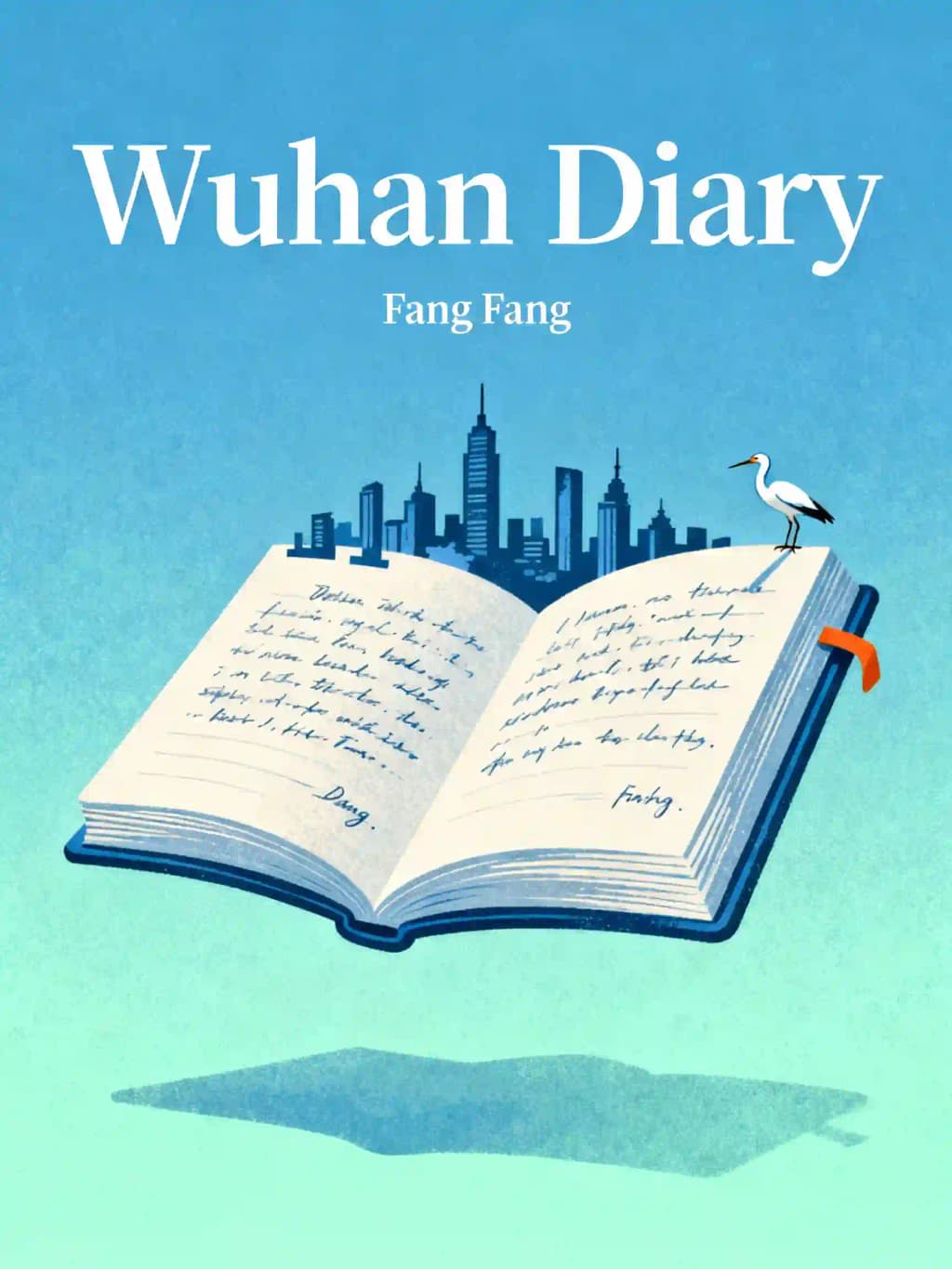
When Dr. Zhong Nanshan announced on January 20, 2020, that the novel coronavirus spread through human transmission, a wave of shock rippled through China. This revelation directly contradicted earlier official claims that the virus was "Not Contagious Between People; It's Controllable and Preventable." For Fang Fang, a celebrated Chinese writer living in Wuhan, this moment marked the beginning of what would become a remarkable literary chronicle. Her "Wuhan Diary," documenting 60 days under quarantine, would captivate millions of readers worldwide, with some staying up past midnight just to read her latest entry. The diary became a cultural phenomenon, praised by literary critics as one of the most important firsthand accounts of the pandemic and endorsed by prominent intellectuals. Yet it also sparked fierce controversy, with nationalist critics accusing Fang of providing ammunition to foreign critics of China. Through her unflinching gaze, Fang Fang captured not just a city in crisis, but a pivotal moment in global history that would reshape our understanding of public health, governance, and human resilience.
Глава 2
The Descent into Lockdown: Wuhan's Initial Days of Crisis
The days between January 20-23, 2020, were filled with mounting fear as Wuhan approached an unprecedented quarantine order. Though slightly delayed and extraordinarily difficult to implement, locking down a city of 11 million proved the correct decision to impede the virus's spread. During those first five terrifying days, panic reigned as the virus spread rapidly and even officials seemed lost about how to respond.
By January 25, Lunar New Year, reports that national leaders were addressing the outbreak and medical experts had arrived from Shanghai helped calm spirits. But true suffering followed as infections exploded, overwhelming hospitals. Patients wandered the city seeking treatment, with no public transit available after quarantine began. Videos emerged of desperate patients, endless hospital lines, and exhausted doctors working without adequate protective equipment.
"When I first logged on to my Sina Weibo account to write my initial diary entry," Fang Fang recalls, "I never imagined writing 59 more entries or that millions would stay up late just to read my next installment." Her early entries captured the surreal transformation of a vibrant metropolis into a ghost town. Streets that should have been filled with New Year celebrations stood empty, decorated lanterns swaying in the wind with no one to appreciate them.
The mask shortage quickly became a pressing concern. "I saw a video of a man in Shanghai confronting a pharmacy charging 30 yuan per mask," Fang writes. "N95 masks are most effective but impossible to find." She describes how her brother was forced to wash and reuse disposable masks, while she herself had been reusing a single N95 mask since December. When she finally found individually packaged masks for 10 yuan each, she bought four, saving two for her brother who had none.
As January ended, the situation grew increasingly dire. Fang Fang documented the cruel reality facing infected residents: "I read about a middle-class family whose mother died on New Year's Day while the father and brother are infected." The outbreak had exposed the rudimentary level of many Chinese officials and deep societal problems more tenacious than the coronavirus itself.
Глава 3
February's Darkness: The Peak of Wuhan's Suffering
As February began, the situation in Wuhan deteriorated rapidly. Hospital resources remained severely limited, with even doctors' families struggling to gain admission. The most heartbreaking sight was a daughter screaming behind her mother's funeral car, denied even proper burial rites so central to Chinese culture. "One speck of dust from an entire era may not seem like much," Fang Fang wrote, "but when it falls on your head it's like a mountain crashing on you."
The virus behaved mysteriously-patients would improve then suddenly deteriorate, while others tested positive without showing symptoms. It seemed to roam Wuhan like an evil spirit, terrorizing the entire population. Medical personnel suffered the most. At Wuhan Central Hospital, multiple doctors died in quick succession. Fang's doctor friend mentioned an internist from Tongji Hospital who also succumbed. Every hospital had infected staff members who sacrificed their health to save others.
On February 7, the city was plunged into collective grief when Dr. Li Wenliang died. He had been one of eight doctors penalized for speaking out about the virus early on, before becoming infected himself. "Tonight the entire city of Wuhan is crying for Li Wenliang," Fang texted friends. She never imagined the whole country would join in mourning, with tears flooding the internet. To commemorate him, Wuhan residents turned off their lights, then shined flashlights skyward at the moment of his passing while whistling.
The death toll continued to mount. Professor Lin Zhengbin, a 62-year-old organ transplant specialist from Tongji Hospital, died on February 10. Tongji Hospital, connected to Huazhong University of Science and Technology, lost two top professors in three days, devastating the campus. At Central Hospital where Li Wenliang worked, more doctors deteriorated to requiring breathing tubes.
By mid-February, some positive developments emerged. Temporary hospitals had opened, ensuring infected patients could finally receive treatment rather than collapsing on cold streets. A pulmonologist from Zhongnan Hospital who recovered from the virus shared encouraging insights in a video interview, explaining that serious cases mainly affected elderly people with underlying conditions, while younger, healthy individuals typically recovered with medication, hydration, and rest.
The psychological impact of extended quarantine became increasingly evident. Fang Fang observed that Wuhan would need "an army of counselors and psychologists" once the crisis ended, as everyone-from quarantined families to grieving relatives to overwhelmed medical workers-carried emotional burdens. She criticized government officials for inappropriate displays of patriotism, like taking flag-waving photos at funeral homes and forcing sick patients to sing patriotic songs during hospital visits.
Глава 4
March's Awakening: The Slow Return to Life
As March began, Wuhan residents started emerging from initial fear and paralysis. State support increased with more medical personnel arriving from across China. Sixteen Chinese provinces had each volunteered to sponsor one of Hubei's cities. Medical professionals lined up to help-cutting or shaving their hair, saying goodbye to loved ones, and bringing their own medical supplies and even basic necessities like salt and cooking oil to avoid burdening the stressed city.
Their selflessness moved many in Hubei to tears. Over 20,000 medical workers had volunteered, showing remarkable dedication and solidarity. This dramatic improvement depended on nationwide support. Thanks to expanded temporary hospitals, increased beds, medical reinforcements, effective quarantine policies, organized administration, and the cooperation of Wuhan citizens, the virus's spread began waning.
By March 5, after 43 days of quarantine, Fang Fang noted the coronavirus situation was improving slowly, with new cases hovering around 100. The government had approved modest relief payments (about 780 yuan monthly for urban residents), but this paled compared to other countries' support. Most urgently, hospitals needed to resume normal operations-Fang had heard heartbreaking stories of stroke and cancer patients dying because they couldn't access timely medical care during the coronavirus crisis.
On March 7, new coronavirus cases in Wuhan finally dropped below 100, marking a tangible breakthrough in the battle. Hospitals began resuming normal operations, though this came too late for many. A secondary catastrophe had unfolded during lockdown: elderly residents dying from non-coronavirus illnesses due to lack of medical access. Two such deaths occurred in Fang's own complex.
By mid-March, the city was coming back to life-buses were being tested, subway stations disinfected, and infection numbers had remained at zero for five consecutive days. Communities with no coronavirus cases gradually reopened, and children's laughter could be heard outside again-a sound that had been absent for too long. Residents could venture outside for shopping with recommended distancing of 1.5 meters. The city was breathing again, though not yet fully restored.
On March 24, day 62 of quarantine, Fang wrote her 60th and final diary entry. Coincidentally, officials announced that quarantine would lift for all districts outside Wuhan immediately, and for Wuhan itself on April 8. "The sky brightened then darkened with light rain this afternoon," she wrote, "and my housekeeper texted she'll arrive tomorrow-my difficult days are nearly over."
Глава 5
The Unsung Heroes: Volunteers and Medical Workers
Throughout the crisis, ordinary citizens emerged as extraordinary heroes, demonstrating remarkable resilience and compassion. Fang Fang extensively praised the thousands of volunteers who became crucial during the crisis, noting "if not for them, we would have only had the mechanical government offices to rely on." Young people like her neighbor's daughter who had studied in France returned to help distribute grocery deliveries, while university students organized online support groups to coordinate assistance for elderly residents living alone.
Resourceful community members developed sophisticated food distribution systems that became lifelines for locked-down neighborhoods. Local WeChat groups emerged as vital communication hubs where neighborhood groups placed wholesale orders that were delivered to courtyards where residents collected them by assigned number, avoiding direct contact. With extended quarantine ahead, Fang gladly joined these community initiatives, ordering the "199-yuan Pork Option C." These grassroots networks expanded to include medicine delivery, mental health support, and even pet care for hospitalized residents.
Medical personnel made the greatest sacrifices, working grueling 12-16 hour shifts under extreme conditions. In the early days of the outbreak, they worked without proper protection because officials claimed the virus "couldn't be transmitted between people," forcing many to improvise with raincoats and swimming goggles as makeshift PPE. When person-to-person transmission became evident, high-level government meetings in Wuhan led to suppression of this crucial information, causing many medical workers and their families to become infected. Some medical staff slept in hospitals for weeks, avoiding contact with their families to prevent transmission.
The losses among Hubei's medical workers were devastating and far-reaching. At Wuhan Central Hospital where Li Wenliang worked, at least three other doctors died, including the head of gastroenterology. Fang's doctor friend mentioned an internist from Tongji Hospital who also succumbed, leaving behind young children. Every hospital had infected staff members who sacrificed their health to save others, with some facilities reporting infection rates among medical staff as high as 60%.
By late March, Fang learned about the "Shadow Dream Team," a group of local volunteers who had been helping since day one of lockdown, now even sending medical supplies to Canada-a remarkable reversal from when overseas Chinese sent aid to Wuhan. Her doctor friend shared encouraging news of 500 Chinese-American physicians collaborating with Harvard's Massachusetts General Hospital to share coronavirus knowledge globally through virtual conferences and joint research initiatives. This international medical cooperation against the common enemy brought her joy and highlighted how the crisis had fostered unprecedented global solidarity among healthcare workers.
The volunteer networks continued to evolve, with tech-savvy youth creating digital platforms to match helpers with those in need, while retired medical professionals returned to service to support overwhelmed hospitals. These collective efforts demonstrated how community resilience and individual sacrifice became the backbone of Wuhan's response to the crisis.
Глава 6
The Silenced Truth: Accountability and Censorship
Throughout her diary, Fang Fang relentlessly pursued accountability for the critical 20-day delay between the first confirmed coronavirus cases and Wuhan's eventual quarantine. She insisted that beyond the ceremonial firing of officials, a comprehensive investigation must determine who perpetuated the dangerous myth that the virus was "Not Contagious Between People, It's Controllable and Preventable." This delay, she argued, cost countless lives and allowed the virus to spread far beyond containment.
She meticulously documented her questions about the three specialist medical teams that visited Wuhan in the outbreak's early stages. Her inquiries were specific and pointed: Who exactly did these teams meet with? What information was shared? Which officials made the final decisions that led to delayed action? She particularly focused on the December 31st visit, noting how the team's findings contradicted emerging evidence of human-to-human transmission.
Fang praised courageous journalists like Zhang Zhan and Chen Qiushi who risked their safety to investigate the truth, while simultaneously condemning government officials who prioritized political stability over public health. When Dr. Ai Fen's revealing interview in People magazine was systematically censored across all Chinese platforms, Fang's response was immediate and forceful: "What inside story are they afraid of? Without uncovering the truth behind the 20-day reporting delay, how will people ever move forward? How many lives could have been saved with earlier action?"
Her outspoken criticism made her an immediate target for state-aligned critics. By mid-March, she faced an orchestrated campaign of thousands of online trolls attacking her on Weibo. These attacks often featured identical language and timing, suggesting coordination. "Though initially angered, I'm now numb," she wrote, "realizing most attackers haven't even read my diary but only out-of-context quotes with malicious framing. They call me a traitor for simply recording what I see."
The censorship machinery worked overtime on her content. Her WeChat diary posts were deleted within hours of posting, forcing her to maintain multiple backup accounts. Her Weibo account faced increasing restrictions - first comment limitations, then posting delays, and finally partial blocking. She described writing with "a sword hanging overhead," never knowing which words might trigger deletion or worse consequences.
Despite mounting pressure, Fang remained defiantly committed to truth-telling. "So come at me with all you've got, bring out all your dirty tricks, and tell all your big-name supporters to show their faces too! Let's see if I'm scared of you!" She even expressed sardonic gratitude to the ultra-leftists who attacked her daily - without them, she noted, she might have stopped writing long ago. Their relentless attacks not only brought more attention to her work but also exposed their own logical inconsistencies and political motivations.
As Wuhan slowly emerged from lockdown, she challenged premature victory declarations while residents remained confined. "How can we celebrate," she wrote, "when we haven't even begun to account for our mistakes?" Her persistence in demanding transparency became a powerful testament to the importance of independent voices during crisis.
Глава 7
The Human Cost: Grief, Loss, and Psychological Trauma
Beyond statistics, Fang Fang captured the profound human toll of the pandemic, documenting both individual tragedies and the collective trauma that gripped Wuhan. She worried deeply about the unprecedented wave of grief awaiting thousands of families who would need to hold funerals once the outbreak ended. Leading psychologists warned of widespread PTSD among surviving family members, with estimates suggesting that each death directly impacted at least 9-10 family members and close friends.
She shared numerous heartbreaking stories that illustrated the pandemic's random cruelty: a famous painter, previously robust and healthy, fighting for life in critical condition; three cinematographers who died after being infected during what should have been a routine shoot; the devastating case of nurse Liu Fan, who died along with her parents and brother after becoming infected while working without proper protective equipment during the early days of the outbreak; a middle school classmate who appeared to be recovering, only to suddenly deteriorate and die after contracting the virus at a local market.
The psychological impact of extended quarantine proved equally devastating. Fang described how typically outgoing colleagues had fallen into depression and silence. After 38 days confined at home, Wuhan residents endured what she called a "strange, unspeakable stress" - a combination of isolation, fear, and uncertainty that outsiders could not truly comprehend. Children showed signs of anxiety and behavioral changes, while elderly residents living alone faced particular challenges with loneliness and access to basic necessities.
She advocated for creating a "wailing wall" website where Wuhan citizens could publicly mourn their losses and share their grief - a digital memorial for a city unable to gather in person. As the quarantine stretched to 50 days, far longer than anyone had anticipated, the city approached Qingming Festival, traditionally a time when families honor deceased relatives. With thousands dead in just two months, affecting tens of thousands of family members who couldn't perform proper burial rites or traditional mourning customs, she worried about widespread psychological breakdowns when the full reality of losses finally set in.
Most poignantly, she shared the intimate story of two senior choir members who died from coronavirus, highlighting the human cost behind the statistics. Bao Jie, a devoted musician, fell ill after performing at New Year events, and his 90-year-old mother heroically cared for him while desperately waiting for a hospital bed to become available. She wrote him a heart-wrenching letter expressing her love and regret that he never lived to read. Another choir member, Su Huajian, known for his vibrant personality and love of music, suddenly stopped responding to messages until friends learned of his death on March 6. These vibrant men in their 60s, with decades of potential life ahead, became victims not just of the virus but of delayed warnings and inadequate early response. Their stories exemplified the preventable nature of many deaths, adding another layer of tragedy to the city's collective grief.
Глава 8
A City Transformed: Wuhan's Identity and Resilience
Throughout her diary, Fang Fang reflected on her deep connection to Wuhan, where she had lived for over 60 years. She shared her history in the city-attending school, working various jobs, and forming countless relationships across every district. From her early days as a factory worker during the Cultural Revolution to her emergence as one of Wuhan's most celebrated writers, her life story was inextricably woven into the city's fabric. She recalled writing for a CCTV documentary where she explained her love for Wuhan: "If you line up all the cities in the world before me, Wuhan is the only place I really know."
This profound connection made the city's suffering all the more painful to witness. She described how Wuhan had always been known as "River Town," situated on the banks of the Yangtze River in Hubei Province-"the province of a thousand lakes." These lakes, including the scenic East Lake and Moon Lake, adorned the city like beautiful pearls and jade ornaments, creating a distinctive sound when the wind blew across their surfaces that longtime residents could recognize. The lakes served as natural air conditioners in summer, offering respite from the notorious Wuhan heat that regularly exceeded 35 degrees Celsius.
If Wuhan was a pearl, then the Yangtze River was the necklace running through its heart, joined by its largest tributary, the Han River, which cut through downtown Wuhan. These two rivers divided the city into three distinct towns: Hankou, Wuchang, and Hanyang, each built along the riverbanks with winding streets that followed the water's flow. The rivers weren't merely geographical features but the lifeblood of the city, supporting centuries of commerce and cultural exchange that earned Wuhan its nickname as "China's thoroughfare."
Each district maintained its unique character: bustling Hankou served as the commercial center where shoppers from all districts still flocked for better prices and quality, its famous Hanzheng Street market stretching for kilometers; subdued Wuchang housed prestigious universities like Wuhan University and research facilities, its tree-lined campuses and historic Yellow Crane Tower representing the city's intellectual and cultural heritage; and industrial Hanyang, sandwiched between the rivers, remained known for manufacturing since the days of the Hanyang Arsenal in the early 20th century, when it produced weapons that helped shape modern China.
Despite the catastrophe, Fang Fang's love for her city never wavered. She marveled at how she had come to appreciate Wuhan's distinctive four seasons-the hellishly hot summers where locals sought refuge in air-conditioned shopping malls and spicy crayfish restaurants, the crisp autumns perfect for strolling along the lakes, the freezing winters that brought occasional snow to the city's ancient temples, and the brief but beautiful spring when cherry blossoms transformed university campuses. These seasonal extremes that once annoyed her now seemed characterful, especially with modern comforts like air conditioning that let the city's good qualities shine through. Through her writing, she captured not just the physical geography of Wuhan, but its soul - a city of resilience, diversity, and enduring spirit.
Глава 9
The Power of One Voice: Literary Witness in Crisis
What makes Fang Fang's work remarkable is her courage in calling for accountability from officials who "dropped the ball" during the crisis. In a society where intellectuals often "keep their heads low," she spoke out boldly, even as attacks against her intensified. The same ultra-leftist groups that targeted her 2017 novel A Soft Burial now found a new target in Wuhan Diary, claiming it would be "weaponized" as a tool for the United States to criticize China.
Despite these attacks, Fang Fang emerged as the authentic voice of Wuhan, her words becoming the city's heartbeat and conscience. Her diary served as both lightning rod and platform for activism, compassion, and debate. When asked why she didn't write about "important things" like military aid and hospital construction, Fang defended her role as documenting everyday life and representing the overlooked: "For the weak and dispossessed, literature is often a bright light... it is only literature that can tell you that it's okay if you are behind, there are a lot of other people just like you."
In her final diary entry, she vowed to continue seeking accountability: "Though this diary ends, I'll continue writing on Weibo and pursuing accountability. Many believe the government will never hold anyone responsible, but as Wuhan citizens who experienced this tragedy, we have a duty to seek justice. If we abandon this search, if we forget Chang Kai's final words, we'll carry not just the burden of disaster but the burden of shame and forgetting. Even if I must carve it one character at a time, I will record their names on history's pillar of shame."
She concluded with profound gratitude to her readers: "I once thought I stood alone, but now see mountains of support behind me... With them beside me, I never felt alone. I have already fought that beautiful battle; I have already completed my course; And I have stood by every truth I believe in."
Through her diary, Fang Fang demonstrated the enduring power of literature to bear witness, to comfort the afflicted, and to demand justice-even in the darkest of times. Her chronicle of Wuhan's 76 days under quarantine stands as both historical document and literary testament to human resilience in the face of catastrophe.