Глава 1
The Seeds of Revolution: Reclaiming Our Food System
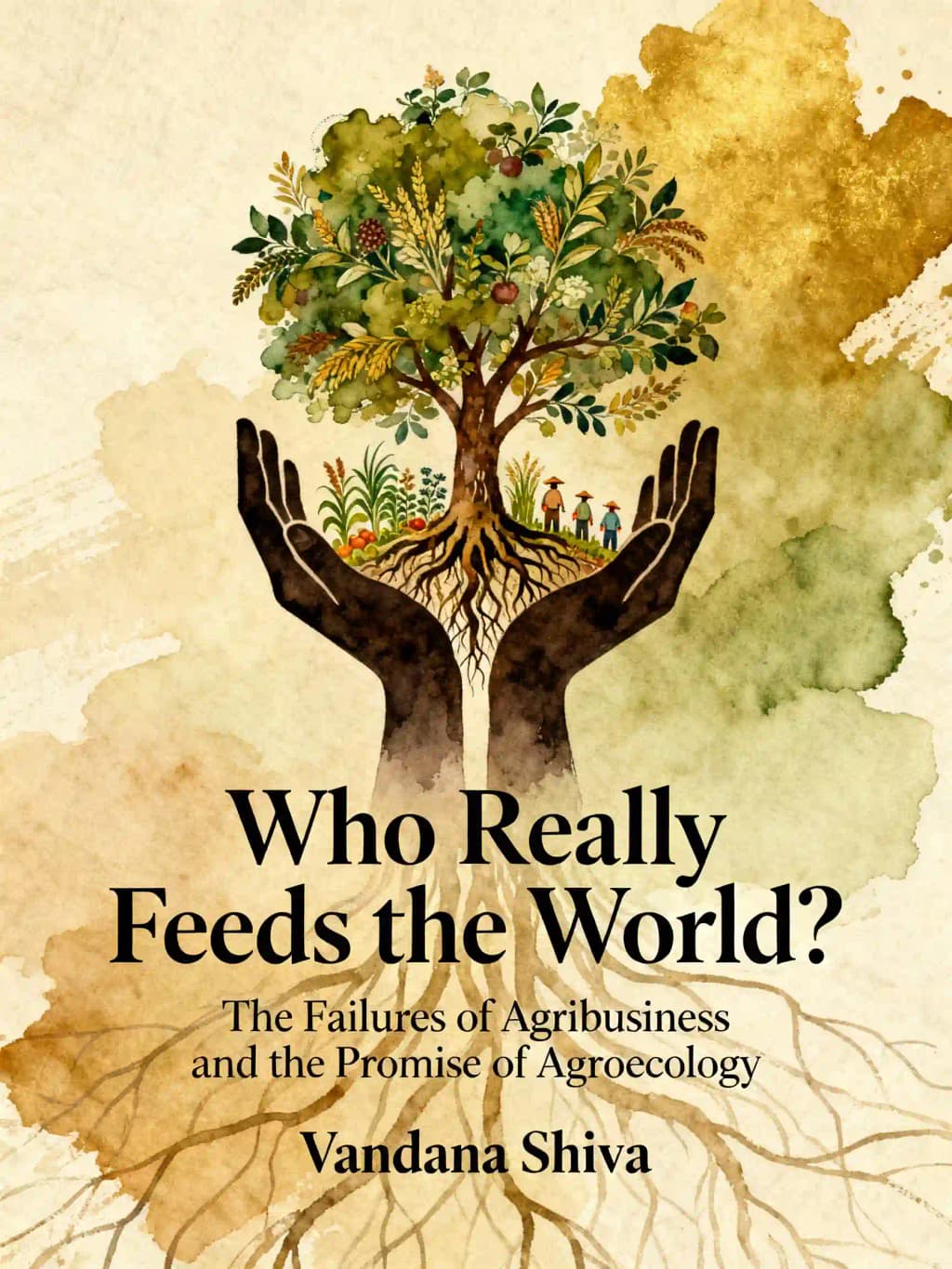
The world faces a critical choice about how we feed ourselves. While industrial agriculture claims to be the solution to global hunger, it's actually creating a perfect storm of ecological devastation, farmer impoverishment, and widespread malnutrition. In "Who Really Feeds the World," renowned physicist and environmental activist Vandana Shiva delivers a passionate indictment of corporate food systems while offering a hopeful vision for sustainable alternatives. Drawing on decades of research and activism, Shiva's work has influenced global food policy debates and inspired grassroots movements worldwide. Her message resonates with growing public concern about food safety, environmental degradation, and corporate control of agriculture. As climate change intensifies and food-related diseases reach epidemic proportions, Shiva's analysis provides a timely framework for understanding how our food choices connect to larger systems of power, ecology, and human health. Her work challenges us to see beyond supermarket shelves to the complex web of relationships that bring food to our tables-and the profound consequences of allowing that web to be controlled by corporate interests.
Глава 2
The War Against Nature: How Industrial Agriculture Threatens Our Future
For ten thousand years, humans practiced ecological farming in harmony with nature's cycles. Colonial experts like Dr. John Augustus Voelcker and Sir Albert Howard found traditional Indian farming systems "perfect" and "permanent." Yet in just fifty years, we've witnessed a devastating shift to chemical-intensive agriculture based on a militarized worldview that treats soil as a lifeless container and plants as machines.
This destructive paradigm emerged from post-war conversion of military technology to agricultural use. After World War I, explosives manufacturers repurposed their nitrogen fixation facilities to produce synthetic fertilizers, essentially continuing warfare-this time against Earth itself. The Green Revolution, introduced to India in 1965 under the guise of preventing starvation, was actually a scheme to create markets for these war chemicals by making plants dependent on synthetic inputs.
The results have been catastrophic. Punjab, once India's breadbasket with dozens of diverse crop varieties, now grows monocultures requiring ever-increasing pesticide doses. The consequences include desertified soils, depleted aquifers, and a "cancer train" that regularly transports pesticide-poisoned farmers to treatment centers.
This reductionist economic paradigm erases ecological goods and services while mysteriously attributing creative power to capital and corporations. Traditional knowledge developed over centuries has been dismissed as primitive, replaced by systems that produce more commodities but less nutrition while trapping farmers in debt through costly seeds and chemicals.
True sustainability involves three interconnected economies: nature's economy (biodiversity and soil fertility), people's economy (communities producing what they need), and the market economy (exchanges between real humans). These should operate under the Law of Return-giving back to seeds, soil, and society. But corporate agriculture has inverted this natural pyramid, placing profit-driven markets on top and creating an ecologically and socially unstable system.
Who really feeds the world? Despite industrial agriculture's claims, small-scale farmers using agroecological methods provide 70% of the planet's food while using only 30% of resources. The true foundations of our food system are living soil, pollinators, biodiversity, seed freedom, local food systems, and women's knowledge-not chemical corporations.
Глава 3
The Living Soil: Foundation of All Food Production
Soil isn't just dirt-it's a complex living system containing billions of organisms that create an intricate web maintaining fertility. Sir Albert Howard, often called the father of organic farming, learned from Indian peasants that "Health in soil, plant, animal, and man is one great subject."
The millions of organisms in healthy soil are the true source of fertility. Earthworms alone increase air volume by up to 30% and water-holding capacity by 20%, making soil more resilient to both drought and floods. A single square meter of organic soil can contain 30-300 earthworms, along with thousands of other organisms including mites, spiders, beetles, and centipedes.
In ecological agriculture, nitrogen-fixing crops like pulses and legumes provide free nitrogen through symbiotic relationships with rhizobia bacteria. Green manure plants like sesbania and glyricidia can yield 6-8 metric tons of biomass per hectare yearly, producing abundant organic matter to replace synthetic fertilizers.
By contrast, synthetic fertilizers destroy soil life by blocking soil capillaries, reducing water infiltration, and killing beneficial organisms like mycorrhizae and earthworms. Two-thirds of applied nitrogen fertilizer isn't even taken up by plants but instead contaminates groundwater and creates dead zones in water bodies. Manufacturing these fertilizers is highly energy-intensive, requiring the equivalent of 191 billion liters of diesel in 2000, projected to rise to 277 billion by 2030.
The consequences of this chemical warfare against soil are devastating. Today, 24 billion metric tons of fertile soil are lost annually worldwide-with India losing 6.6 billion, China 5.5 billion, and the US 3 billion metric tons. Soil is being lost 10-40 times faster than it can be naturally replenished. This degradation threatens to reduce global food production by 30% over the next 20-50 years.
Howard demonstrated that while plant breeding alone contributed to a 10% yield increase, improving soil fertility through organic methods increased yields by 200-300%. At Navdanya farm, Shiva's organization has restored barren land through organic practices, reducing water use by 70% while creating thriving, resilient soil. No technology that destroys soil life can truly feed the world. Degraded soils without organic matter, soil organisms, or water-holding capacity create famines, not food security.
Глава 4
The Pollinators' Plight: Protecting Nature's Essential Workers
Bees, butterflies, insects, and birds are essential pollinators that enable plant reproduction by moving pollen between flowers. Without these pollinators, most plants couldn't reproduce, threatening our food supply. Their contribution to global food security is enormous-honeybees alone pollinate 71 of the 100 most common crops that provide 90% of the world's food supply, worth approximately $200 billion globally.
Yet these vital creatures are disappearing at alarming rates. From 1985 to 1997, US honeybee colonies dropped by 57% due largely to pesticide exposure, which weakens their immune systems and disrupts reproduction. One in every four mouthfuls of food depends on pollinators, making their decline an urgent threat to global food security.
The pesticide industry has dark origins in chemical warfare. After World War II, companies that specialized in genocide repurposed their chemicals for agriculture. Today, up to 1,400 pesticides are used globally, with only 1% actually reaching target organisms while the rest contaminate ecosystems. These nerve poisons, mostly organophosphates, cause devastating health effects from cancer to birth defects.
The health consequences have been staggering. Cancer rates have skyrocketed-from 1 in 20 Americans having cancer in 1960 to 1 in 8 by 1995. In Punjab, India's "Green Revolution" region, cancer rates are disproportionately high, with a daily "cancer train" carrying victims for treatment. Glyphosate has been linked to kidney disease that's killed 20,000 Sri Lankan farmers, while autism rates in the US have increased 35% in just two years, correlating with increased pesticide use.
Genetic engineering, marketed as an alternative to chemical pesticides, follows the same militaristic paradigm of war against nature. Rather than controlling pests, GMO crops have created superpests and superweeds. In the US, approximately 15 million acres are now overtaken by herbicide-resistant superweeds, with pesticide use increasing by 183 million kg between 1996-2011. By 2008, GM crops required 26% more pesticides per acre than conventional varieties.
The war against pests is neither necessary nor effective. Ecological balance through biodiversity is our best pest control mechanism. Countries worldwide are adopting biodiversity-based pest management-Indonesia through FAO-supported farmers' field schools, and India's Andhra Pradesh state promoting pesticide-free farming with increased production and reduced costs. Natural botanical pest control agents like neem provide safe alternatives when needed.
People globally are fighting back against pesticides, with the EU attempting to ban neonicotinoids to protect bees, and countries like Russia and China restricting GMO products. This isn't just about saving insects-it's about saving our food system and ourselves.
Глава 5
The Biodiversity Advantage: Beyond Monoculture Thinking
More than seven thousand species have fed humanity throughout history, yet today just thirty crops provide 90% of human calories, with rice, wheat, and maize accounting for over half our intake. We've lost staggering biodiversity-96% of American apple varieties, 95% of cabbage, 91% of field maize, and 94% of pea varieties disappeared during the twentieth century. In Mexico, only 20% of corn varieties from 1930 remain.
This devastating loss stems from what Shiva calls "Monocultures of the Mind"-imposing one reductionist, mechanistic way of knowing on a world with diverse knowledge systems. This paradigm creates blindness to the evolutionary potential and intelligence of organisms and ecosystems, ignoring the ecological functions arising from relationships between diverse living components.
Three forces drive biodiversity disappearance, all connected to corporate seed control: First, big business entering the seed market has displaced farmers' diverse local varieties with uniform commercial hybrids and GMOs. Second, globalization-driven long-distance trade requires hard, uniform varieties that can travel rather than soft, fresh, seasonal produce. Third, industrial processing by companies like McDonald's and PepsiCo replaces nutritious local dishes with junk-food commodities, influencing what crops are grown.
Biodiverse systems of mixed cropping create symbiotic relationships between soil, water, farm animals, and plants, strengthening their interdependence. Unlike industrial agriculture which breaks these ecological linkages with external chemical inputs, ecological farming integrates these elements sustainably. The myth that diversity leads to low productivity has driven the replacement of farmers' diverse native varieties with misleadingly named "high yielding varieties" (HYVs). These aren't intrinsically high yielding but merely respond well to chemicals-they should properly be called "high response varieties."
When measuring total system productivity including fodder for livestock, indigenous varieties often outperform HYVs. Studies show polyculture systems can produce 100 units of food from just 5 units of inputs, while industrial systems waste 300 units of inputs for the same output-resources that could have produced 5,900 additional food units. Industrial agriculture uses 10 kilocalories of input energy to produce just 1 kilocalorie of food, along with ten times more water and land than ecological agriculture.
When we measure food production by nutrition per acre rather than yield per acre, biodiverse organic farming clearly outperforms chemical monocultures. Navdanya's "Health Per Acre" research shows that organic baranaaja (twelve-crop system) produced 73.5% more protein, 3,200% more vitamins, 67% more minerals, and 186% more iron than conventional monoculture cropping.
Living examples of biodiversity's power exist worldwide-from Tamil Nadu's nine-crop systems to Garhwal Himalayas' baranaaja culture, where twelve food grains are intercropped with finger millet. This system provides maximum food variety and balanced nutrition from minimal land area, thriving even in less fertile areas where water-intensive crops would fail. Similar systems exist worldwide-from Mesoamerica's milpa to Native American "three sisters" cultivation. These biodiverse systems don't just produce food; they sustain communities, cultures, and ways of life centered around traditional knowledge and practices.
Глава 6
Small Farms, Big Impact: The Power of Local Agriculture
Despite our cultural obsession with gigantism, the reality is that "small is big"-ecologically, culturally, and economically. Local farming communities still produce 70% of the world's food through diverse agricultural systems developed over centuries. The assumption that small farms have low productivity is false; they're actually more ecologically efficient than large industrial monocultures.
Industrial agriculture promotes the "myth of more"-that large-scale mechanized farming produces more food at lower costs. But this ignores that only 15% of food prices go to farmers in developed countries, with the rest going to processing and marketing. This system creates "negative economies" for farmers, leading to debt and despair.
Small farms actually produce more total food because small-scale farmers give more care to soil, plants, and animals while intensifying biodiversity rather than chemical inputs. Despite this, globalization has destroyed millions of peasants' livelihoods, with 284,000 Indian farmers committing suicide in fifteen years due to unsustainable chemical-intensive farming.
Today, 70% of the world's food comes from small farms that occupy less than 30% of arable land, while agribusiness uses 70% of land to produce only 30% of food. Small farmers are more efficient, cultivating incredible biodiversity-from Papua New Guinea's 5,000 sweet potato varieties to Indonesian home gardens providing 40% of domestic food supplies.
Small-scale farmers are facing an existential crisis under corporate globalization. Since 1991, India has lost nearly fifteen million farmers-about 2,000 per day. Farmland is increasingly concentrated in fewer hands, with the top 1% of European farms controlling 20% of EU farmland while 80% of farms control just 14.5%. In the US, 40% of farmland is now rented by farmers from banks and investors.
We must reject the false assumption that "big feeds the world" and embrace Gandhi's wisdom about the power of small-scale action. As Navdanya demonstrates, connecting small seeds and small-scale farmers creates food security, livelihood security, and ecological security. The solution isn't to "fertilize land with money" as some officials suggest, but to nurture it with organic matter, living organisms, and the love and intelligence of small-scale farmers.
Глава 7
Seed Sovereignty: Reclaiming Life's First Link
Seed is the foundation of life and the first link in the food chain. For millennia, farmers-especially women-have freely evolved and bred seeds in partnership with nature, creating incredible diversity. But in the last half-century, a reductionist paradigm has privatized seeds through legal and economic frameworks, destroying diversity and creating seed monopolies.
Seeds embody millennia of nature's evolution and centuries of farmers' breeding intelligence, cultivated for diversity, resilience, taste, nutrition and adaptation to local ecosystems. Industrial breeding, however, treats these contributions as nothing-a form of bio nullius (life as empty of intelligence) paralleling terra nullius that justified colonization.
Corporations systematically discredit farmers' native seed varieties by labeling them "primitive cultivars" in contrast to their own "elite cultivars." Yet these traditional varieties contain superior taste, nutrition and quality, which is why people prefer heirloom varieties when available. Indigenous farmers' varieties can be saved and replanted year after year-currently 1.4 billion people depend on farm-saved seed.
To generate profits, agribusinesses must break this self-sustaining system by introducing three alternatives: high yielding varieties (which are actually high-response varieties requiring chemicals), hybrid seeds (which can't be effectively saved), and GMOs (which contain foreign genes, plant cancer genes, antibiotic-resistance markers, and viral promoters).
Corporations maintain contradictory positions about GMOs, claiming they're "substantially equivalent" to avoid safety testing while simultaneously claiming they're novel "inventions" deserving patent protection-an ontological schizophrenia serving only to establish ownership and control.
This legal framework allows corporations to declare themselves "creators" of seeds, claiming patents that criminalize farmers' traditional seed-saving practices. GMOs opened the door to patents on life, with corporations claiming they "invented" plants by adding a single gene. The 1994 TRIPS Agreement, which Monsanto helped draft, institutionalized this globally, defining the "disease" as farmers saving seeds and the "cure" as criminalizing this fundamental freedom.
Court cases like those against Bowman and Schmeiser established dangerous precedents-corporations can own all future seed generations and even claim ownership of crops their GMOs contaminate. Beyond patents, new seed laws enforcing uniformity through UPOV or mandatory registration are criminalizing farmers' diverse varieties worldwide.
These corporate seed controls represent violence against farmers in three ways: biopiracy (patenting farmers' innovations as corporate "inventions"), extortion through royalty collection (as in Brazil's lawsuit against Monsanto), and perverting the "polluter pays" principle into "polluter gets paid" when GMO contamination occurs.
This seed imperialism has created life lords who have pushed thousands of farmers to suicide. Since 1995, 284,000 Indian farmers have killed themselves due to rising input costs, volatile output prices, and crushing debt from predatory seed and chemical companies.
The Navdanya movement has established over 100 community seed banks to reclaim seed as commons, while the global Seed Freedom Movement unites activists worldwide to challenge unjust seed laws and corporate control. The battle for seed sovereignty is ultimately a battle for life itself.
Глава 8
Global vs. Local: The Hidden Costs of Food Miles
Food systems have naturally evolved to be local, following two principles: everyone must eat, and every inhabited place produces food. Local food systems nourish both biological and cultural diversity while allowing farmers to practice the Law of Return. Despite claims that globalization is natural and inevitable, it's actually a corporate-driven phenomenon.
The first wave of globalization began with European control of the spice trade, but until the WTO's 1995 establishment, food remained under local and national sovereignty. Today's global food trade rules were written by corporations to expand their control, creating monopolies rather than competition. Just five corporations dominate each sector: seeds, grain supply, food processing, and retail.
Globalization was promoted with false claims of increased production and cheaper food, but it actually produces commodities rather than food (90% of corn and soy is used for biofuel or animal feed), and relies on $400 billion in subsidies to sustain artificially cheap prices. Without these subsidies, the entire system would collapse.
Globalization has created unprecedented displacement, unemployment, hunger, and food insecurity. Despite being marketed as "free trade," corporate globalization implements unfair trade through policies forcing poor countries to remove import barriers while rich nations maintain subsidies. This enables "dumping" that destroys local food systems.
The price gap between producers and consumers is staggering-in Spain, consumers pay up to 600% more than what farmers receive. Contract farming forces farmers to grow cash crops instead of food, creating a situation where even price increases for their crops leave families poorer as they must buy expensive food.
Kenya exemplifies how trade liberalization destroys food security. Forced to accept structural adjustment in 1980 in exchange for loans, Kenya reduced farmer support, cut import tariffs, and deregulated markets. After joining the WTO in the early 1990s, cheap subsidized imports flooded in, devastating local industries. Kenya's dairy sector collapsed due to cheap powdered milk imports, while its sugar industry was replaced by cheaper imports. Paradoxically, Kenya now exports 350 metric tons of cut flowers and vegetables nightly to the UK while 5.3 million Kenyans go hungry.
NAFTA's 20-year legacy in Mexico demonstrates similar devastating impacts. By removing tariffs on US imports, NAFTA allowed heavily subsidized US corn to flood Mexican markets, causing local corn prices to drop 20% in the first year alone. This devastated Mexico's three million maize farmers, many of whom had cultivated over 209 varieties for thousands of years. Unable to compete, farmers fell into debt, with many forced to grow illicit drugs for cartels.
The environmental costs of global food transportation are enormous. Danish research shows 1kg of food moving globally generates 10kg of carbon dioxide. Toronto food travels an average of 3,333 miles, UK food miles increased 50% between 1978-1999, and a Swedish study found a typical breakfast's ingredients travel a distance equivalent to Earth's circumference. Often, globalization simply creates wasteful "food swaps"-like Britain simultaneously exporting 47 million kilograms of butter while importing 49 million kilograms.
Globalization generates waste at multiple levels, with the FAO estimating 30% of global food supply wasted annually, totaling $1 trillion. The FAO's Food Wastage Footprint project shows that beyond retail costs, another $700 billion in natural resources is wasted, including $172 billion in water, $42 billion in cleared forests, and $429 billion in greenhouse gas costs.
The concept of "freedom" has become contested-while people seek freedom to access vital resources like seed, food, water and land, corporations use "free trade" to commodify these same resources. We need freedoms for people, not corporations, and governments that regulate harmful corporate practices rather than criminalizing citizens through undemocratic seed and food laws.
Глава 9
Women's Wisdom: The Forgotten Foundation of Food Systems
Women are the primary growers and providers of food worldwide, having evolved agriculture through sharing, caring, conservation and well-being. They produce more than half the world's food and provide over 80 percent of food needs in food-insecure regions. Women's food systems are diverse and sustaining, ensuring everyone receives their fair share.
As biodiversity experts, nutritional experts, and ecological economists, women know how to produce more using less. Yet corporate globalization driven by capitalist patriarchy has transformed food from nourishment into commodity, shifting control from women's hands to corporations.
Industrial agriculture is rooted in a patriarchal scientific paradigm privileging violence, fragmentation and mechanistic thought. Beginning with the "fathers of modern science" like Bacon, Newton and Descartes, this paradigm promotes monocultures while denying women's knowledge of agroecology and diversity. Bacon's vision promised to create "heroes and supermen" who would "conquer and subdue" nature, with explicitly gendered language treating nature as female. The Royal Society, founded in 1660, explicitly framed science as a "masculine philosophy" aimed at achieving "Empire of Man Over Nature."
Women utilize vastly more plant diversity than agricultural scientists recognize. In Nigerian home gardens, women plant 18-57 species in a single garden. Sub-Saharan African women cultivate up to 120 different plants alongside men's cash crops. Guatemalan home gardens of less than 0.1 hectare grow more than ten tree and crop species. A single African home garden may contain over 60 food-producing tree species.
Patriarchal economics constructs an artificial "production boundary" that denies production occurring in nature's economy and sustenance economies. This system falsely assumes that consuming what you produce means you don't produce. Women's work remains invisible despite their essential contributions to farming because patriarchal economics fails to count production that isn't wage-based.
A scientific and economic model based on violence toward Earth directly correlates with violence against women. During the Green Revolution in Punjab, advertisements for sex-selective abortion began appearing, as women were displaced from productive agricultural work by chemicals and machines. Economist Amartya Sen estimates more than one hundred million women are "missing" worldwide due to declining sex ratios.
Seeds represent the first link in the food chain, traditionally governed by feminine principles of conservation, genetic diversity, and self-renewability. For five millennia, peasants produced their own seeds through selection, storage, and replanting. The Green Revolution disrupted this sustainable practice by introducing "miracle" seeds that commercialized agriculture and transferred control from peasant women to male technocrats and multinational corporations. In Nepal, studies show women alone decide what seeds to use 60.4% of the time, and when families use their own seeds, women make these decisions 81.2% of the time.
After the failure of Bt and HT crops, corporations have pushed biofortification through genetic engineering as their next market opportunity. Golden rice, promoted to address vitamin A deficiency, produces only 35 micrograms per gram-vastly inferior to natural alternatives like amaranth leaves (14,190 g/100g), drumstick leaves (19,690 g/100g), spinach (5,580 g/100g) and carrots (6,460 g/100g). The real solution to malnutrition lies in growing biodiversity, not in patriarchal science that renders women's superior nutritional knowledge invisible.
Agricultural systems shaped by women feature small-scale farming, conservation of natural resources, minimal dependence on fossil fuels and chemicals, and on-farm production of inputs like compost and green manures. These systems maximize nutrition and health per acre through diversity and integration, with most food consumed locally. The partnership between women and biodiversity has sustained humanity throughout history and must be preserved to ensure future food security.
Глава 10
Cultivating Paradise: The Path Forward
We stand at a critical juncture for the interconnected future of food, people, and planet. Continuing down the industrial agriculture path offers only illusions-apparent abundance through monoculture commodification and false prosperity through money flows that primarily benefit corporations while farmers lose control of seeds, land, and water.
The first transition needed is from fiction to reality-moving from the fiction of corporate personhood to the reality of actual people who grow, process, cook and eat real food. Real people with real bodies are creating food systems that protect Earth and serve humanity. Against all odds, people are designing new agricultural approaches with farming and gardening becoming revolutionary acts.
The second transition is from mechanistic, reductionist science to an agroecological science based on relationships and interconnectedness. We must recognize that soil, seed, water, farmers, and our bodies are intelligent beings, not dead matter or machines. War-based expertise is irrelevant for evolving this intelligence or feeding people.
The third transition is from seed as the "intellectual property" of corporations to seed as living, diverse, and evolving-the commons and source of food and life. Community seed banks and seed libraries are part of the movements for seed freedom resisting unscientific and unjust seed laws based on uniformity.
The fourth transition is from chemical intensification to biodiversity intensification and ecological intensification. Evidence shows ecological systems produce more food and nutrition. We must move from the fiction of "high yield" to the reality of diverse systems outputs-quantity, quality, taste, health, and nutrition.
The fifth transition is from pseudoproductivity to real productivity. The reduction of living nature and creative people to mere inputs into industrial systems creates pseudoproductivity based on exploitation. Real productivity maximizes creative work as an output, recognizes farmers' rights, and internalizes all social, health and ecological costs.
The sixth transition is from fake food to real food, from food that destroys our health to food that nourishes our bodies and minds. We must transition from food as profit-driven commodity to food as our most important source of health and well-being.
The seventh transition is from the obsession with "big" to a nurturing of "small," from the global to the local. Large-scale, long-distance food chains must become small-scale, short-distance food webs based on the understanding that no place is too small to produce food.
The eighth transition is from false, manipulated, and fictitious prices based on the Law of Exploitation to real and just prices based on the Law of Return. Both "cheap" food in rich countries and rising food costs in poor countries stem from a profit-centered system manipulated by corporations and financial institutions.
The ninth transition is from the false idea of competition to the reality of cooperation. Industrial production, free trade, and globalization are built on competition as a supposed virtue, pitting plants against insects, farmers against consumers, and countries against each other. The reality of life is cooperation-from microorganisms to mammals.
These transitions aren't utopian-they're happening worldwide through movements like Navdanya. For thirty years, Navdanya has embodied the change it seeks through diversity, self-organization, cooperation, and the Law of Return. The Navdanya farm in Ramgarh village transformed barren land left by water-depleting eucalyptus plantations into fertile soil with earthworm castings everywhere. Water-holding capacity increased so much that irrigation reduced by 75%. Instead of one non-food species, they now grow over 2,000 crop varieties and 150 tree species, with six times more pollinators than in forests.
Navdanya creates living food economies based on diversity and the Law of Return, ensuring farmers give back to soil and society gives back to farmers. Through fair trade and producer groups that set their own prices, farmers escape exploitation and unfair competition. By connecting rural producers with urban "co-producers" through organic fair trade outlets in Delhi and Mumbai, Navdanya builds cooperation between countryside and city.
Bija Vidyapeeth-the Earth University-serves as Navdanya's learning center for knowledge systems based on learning from nature. Drawing from indigenous knowledge from women, grandmothers, and teachers worldwide, Navdanya has trained 750,000 farmers to practice Earth-protecting agriculture that rebuilds soil, enhances food production, and increases rural incomes.
Industrial agriculture has created a triple crisis: a dying planet, diseased citizens, and debt-ridden farmers. Food democracy-the right of farmers to save seeds and practice agroecology, and citizens' rights to healthy food-offers the alternative. By working with Mother Earth instead of declaring war against her, we can bring abundant, good food to everyone. When we come together in harmony, we can cultivate paradise on Earth.