Глава 1
The Art of Waiting: How Timing Changes Everything
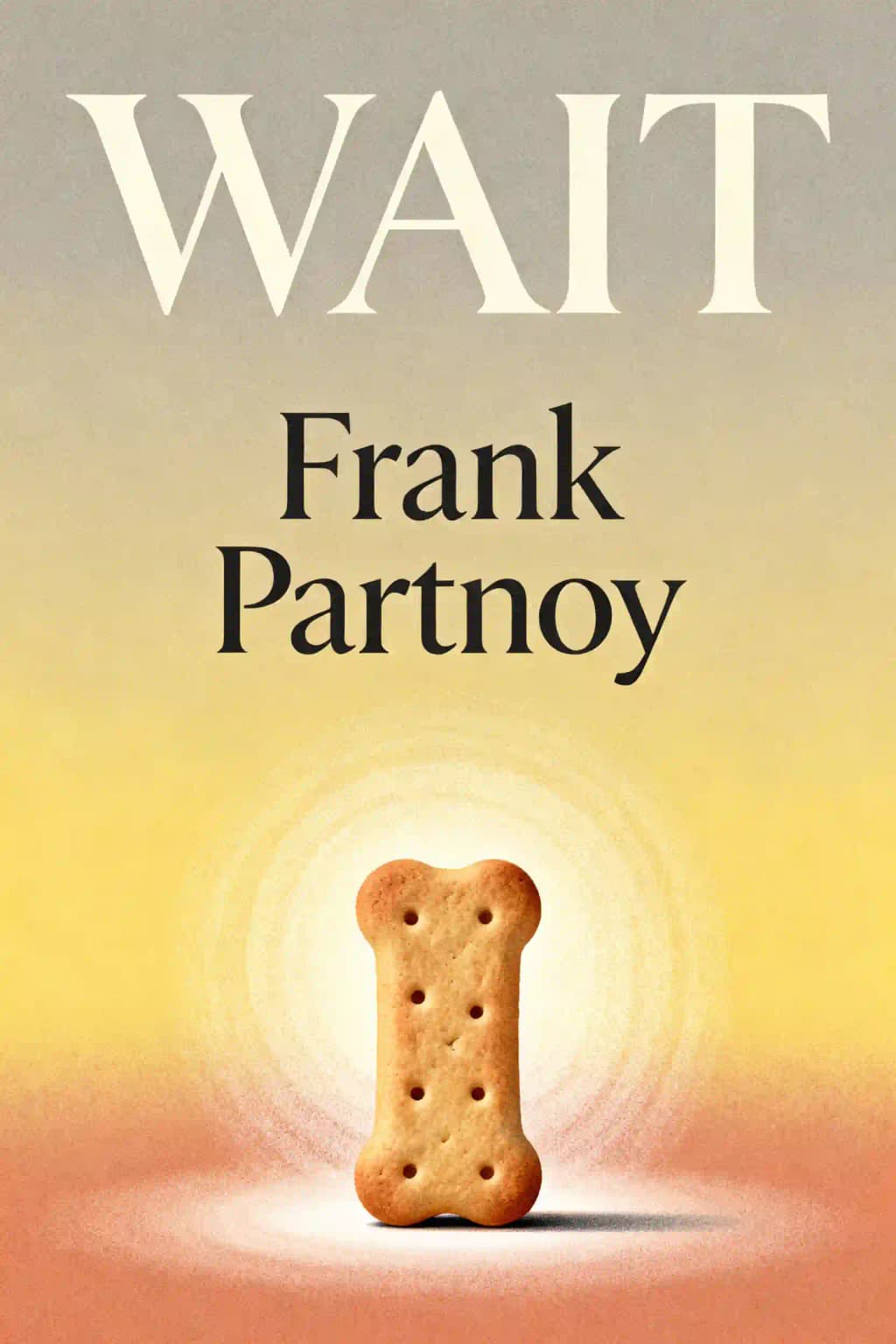
In a world obsessed with speed, Frank Partnoy's "Wait" delivers a counterintuitive message that has resonated with everyone from Wall Street executives to Silicon Valley entrepreneurs. This New York Times bestseller has become required reading at companies like Google and Amazon, where split-second decisions can mean billions in profit or loss. Even celebrities like Oprah Winfrey and Bill Gates have praised its insights, with Gates noting it "completely changed how I make important decisions." What makes this book so compelling? It challenges our fundamental assumption that faster is always better, drawing on neuroscience, psychology, and real-world examples to show that the most successful decision-makers-from tennis champions to financial wizards-know exactly when to hold back and when to act.
Глава 2
The Science of Delay: Our Heart's Hidden Wisdom
The key to understanding decision-making begins with the vagal nerve-a neural pathway connecting our brains with vital organs, particularly the heart. Neuroscientist Stephen Porges discovered that heart rate variability-our heart's ability to flexibly accelerate and brake-predicts psychological health better than any other measure.
In his landmark study, Porges tracked children from nine months to three years of age. While parents' reports of infant behavior showed no correlation with later development, heart rate patterns proved remarkably predictive. Infants with more flexible heart rates-who could quickly accelerate and brake their reactions during developmental tests-had significantly fewer behavioral problems at age three, particularly regarding social withdrawal, depression, and aggression.
This variability represents our emotional regulation system's efficiency. Children with wider ranges of heart response (say, 90-110 beats rather than 95-105) navigate emotional situations more confidently-like a car with responsive acceleration and brakes.
Porges later developed his polyvagal theory after being challenged by a neonatologist about dangerous heart rate drops in infants. He discovered the vagal nerve contains two intertwined systems: an ancient reptilian strand that can freeze and shut down the body, and a newer mammalian strand enabling flexible responses. Both operate within milliseconds but with opposite effects.
This theory explains why some people respond appropriately to stress while others shut down or overreact. When our mammalian vagal system functions properly, we can quickly assess situations and respond flexibly. When the reptilian system dominates, we may freeze inappropriately or experience conditions ranging from asthma to autism-all potentially linked to imbalances between these neural systems.
The implications are profound: our ability to delay reactions-to pause between stimulus and response-may be physically encoded in our nervous systems. Those with greater heart rate variability literally have more flexible response options built into their physiology, allowing them to wait for optimal moments to act rather than reacting immediately to every stimulus.
Глава 3
Split-Second Mastery: The Paradox of Superfast Sports
Tennis champions Jimmy Connors and Chris Evert shared not just a famous romance but an extraordinary ability to return serves-a skill requiring reactions within just 400-500 milliseconds. This presents a fascinating paradox: serve returns must happen too quickly for conscious thought, yet demand sophisticated responses to ball placement, trajectory, and the server's position.
The serve return divides into two phases: visual reaction time (about 200 milliseconds for everyone) and physical reaction time (the remaining 300 milliseconds). While most people can "see" the ball in time, few can physically adjust and swing accurately within the remaining window. Professional servers like Andy Roddick could consistently ace opponents with 140+ mph serves precisely because this window is so narrow.
What set Connors apart was his revolutionary approach-training to be "quick and violent" with intense focus on the precise point where the ball left the server's strings. His eyes were "huge, like Charles Manson's," giving him murderous intensity when returning serves. Coach Angel Lopez emphasizes "ball identification"-the crucial preparation phase requiring not just quick hands and feet, but fast eyes that can focus and translate that focus into attack.
The best players don't have faster visual reaction times than average people. Instead, their superior physical speed gives them extra time for ball identification-absorbing data about the ball's trajectory after it leaves the racquet. They effectively sandwich preparation between seeing and hitting: See (200ms), Prepare (200ms), Hit (100ms). This creates a Zen-like state where the ball appears huge and time seems suspended.
This pattern extends beyond tennis. In baseball, cricket, fencing and other superfast sports, elite athletes excel not because they see faster, but because they process information better during preparation. Oxford neuroscientist Peter McLeod found professional cricket batsmen are only about 50 milliseconds quicker than amateurs-a tiny difference that creates an insurmountable advantage.
Most fascinating is that these superfast sports tap into primal, survivalist nervous system responses. Unlike merely fast sports like football where quarterbacks have seconds to decide, superfast sports demand reactions in milliseconds, relying exclusively on hardwiring. Benjamin Libet, who discovered the half-second delay between unconscious reaction and conscious awareness, noted that professional athletes excel by delaying their responses as long as possible within available time-a principle that applies to all decision-making.
Глава 4
The Speed Paradox: When Faster Isn't Better
In the high-frequency trading world, where milliseconds can mean millions, a counterintuitive truth emerges: sometimes being slower means being better. The story of UNX, Inc. illustrates this perfectly. After building a cutting-edge trading system in California that catapulted them to the top of industry rankings, they moved their computers to New York to reduce transaction times from 65 to 30 milliseconds. Surprisingly, their trading costs increased and execution quality deteriorated. Only by artificially slowing their system back to 65 milliseconds did they regain their competitive edge.
This reveals something profound about decision-making: optimal delay often outperforms maximum speed. High-frequency trading, which now accounts for 70% of U.S. stock trades, represents the evolution from human specialists shouting on trading floors to computer algorithms executing trades in milliseconds. While many firms race to minimize latency-even spending hundreds of millions on direct fiber-optic routes between Chicago and New York to save three milliseconds-the UNX case demonstrates that optimizing delay, not just minimizing it, can be more profitable.
The dangers of excessive speed became dramatically clear during the 2010 "Flash Crash," when the Dow Jones plummeted nearly 1,000 points in minutes before recovering. The crash began when Waddell & Reed's algorithm started selling futures contracts, triggering high-frequency traders to buy, then quickly sell as prices dropped. This created a death spiral where trading volume exploded and prices collapsed-Accenture plummeted from $40 to one cent in seven seconds; Procter & Gamble fell from $60 to $40. Then, just as suddenly, the market recovered, with the entire episode lasting just thirty-six minutes.
Studies show high-frequency traders typically improve liquidity and reduce volatility under normal conditions. However, during uncertainty, they can amplify volatility and price swings. For individual investors, the lesson is simple: we're weekend warriors competing against professionals-we'll lose. Most should buy and hold stocks rather than actively trade.
The most profitable high-frequency trading firms don't just speed up-they strategically manage time, optimizing delay rather than minimizing it. They program algorithms to test reactions with small initial trades before committing, like a fencer's feint. Top trading firms now emphasize strategic thinking over raw speed, teaching decision sciences and poker strategy to help traders understand why algorithms react as they do. Like professional athletes, the best traders understand when to wait-sometimes the second mouse gets the cheese.
Глава 5
Hidden Influences: How Subliminal Messages Shape Our Choices
The movie Fight Club contains single frames of male frontal nudity spliced throughout the film. At 24 frames per second (42 milliseconds per frame), viewers can't consciously perceive these images, yet they raise an intriguing question: can preconscious visual information affect our decisions without our awareness?
This connects to the controversial history of subliminal messaging, beginning with James Vicary's dubious 1957 experiment claiming that flashing "Hungry? Eat Popcorn" and "Drink Coca-Cola" significantly increased sales. His announcement sparked public outrage and regulatory bans, though Vicary later admitted to fabricating the results. Subsequent studies found subliminal advertising ineffective at changing consumer behavior.
Public paranoia about subliminal messaging emerged amid Cold War fears and cultural touchstones like Orwell's 1984 and Packard's The Hidden Persuaders. Despite Vicary eventually admitting to fabricating his results, controversies continued to erupt periodically-from Pressman Toy Corporation's "Get It" flash during a 1973 Husker Du commercial to Disney recalling The Rescuers home video in 1999 over frames containing a topless woman. Our attitudes remain divided between viewing subliminal messaging as threatening manipulation or absurd gimmickry.
While earlier scientific consensus suggested minimal impact, recent research indicates subliminal images can create lasting effects, especially when tapping into existing experiences-from Apple logos boosting creativity to elderly-associated words slowing walking speed.
Sanford DeVoe of the University of Toronto discovered that subliminal exposure to fast-food logos significantly affects behavior beyond mere food choices. In experiments with Chen-Bo Zhong, they found students subliminally exposed to fast-food logos for just twelve milliseconds read 20% faster than control groups. With America's fast-food restaurants expanding from 200 to 31,000 since 1960 while reading time has plummeted, DeVoe wondered if these environmental cues were fundamentally changing our relationship with time.
Further experiments revealed that students exposed to fast-food logos not only became more impatient but actually enjoyed pleasurable experiences less-reporting diminished happiness when viewing National Geographic photos or listening to classical music. The fast-food stimuli warped their sense of time, making music seem longer and interfering with their ability to enjoy aesthetic experiences.
While government regulation of subliminal messaging faces free speech concerns and technological challenges, we can take personal measures to protect ourselves. Being aware of our vulnerability (we're more susceptible when hungry or thirsty) helps, as does consciously slowing down after potential exposure. Research from University College London suggests the most effective defense is keeping our brains actively engaged-when our cognitive resources are occupied with tasks, subliminal messages lose their power to influence us.
Глава 6
When Expertise Fails: The Dangers of Snap Judgments
As we move from milliseconds to seconds, we enter the realm where both unconscious (system 1) and conscious (system 2) thinking operate. With seconds available, we can engage in deliberative thought to either reinforce or override our automatic reactions. The challenge becomes knowing when to trust snap judgments as an expert versus when to delay decisions as a novice-especially difficult when experts face novel situations that effectively turn them into novices.
In November 1978, Bob Gibson, the New York Giants' offensive coordinator, faced a critical decision with seconds remaining in a must-win game against the Philadelphia Eagles. Leading by five points with 31 seconds left, the Giants had possession and needed only to run out the clock. On second down, Gibson called the standard play-have quarterback Joe Pisarcik fall on the ball. But Eagles linebacker Frank LeMaster unexpectedly charged through the line, nearly injuring Pisarcik. With just seconds to decide the third-down call, Gibson had to choose between the safe option of having Pisarcik fall on the ball again or finding an alternative to protect his quarterback.
Unlike millisecond reactions, seconds-long timeframes allow our biological stress responses to activate. When Coach Gibson faced his crucial decision, his adrenal medulla pumped fight-or-flight hormones through his body, raising blood pressure while cortisol increased blood sugar. His executive brain functions diminished as his amygdalae took control, flooding him with noradrenaline that made prioritizing difficult. His decision-making narrowed to focus on safety as his conscious system 2 broke down under stress, defaulting to unconscious system 1 reactions.
Experts like professional athletes Michael Jordan and Jack Nicklaus often perform best under pressure by not overthinking, instead relying on years of training for automatic responses. Research psychologist Gary Klein has studied how experts make time-pressured decisions since 1985, beginning with a significant project for the US Army. Military researchers had spent millions developing decision aids for officers that ultimately went unused, highlighting the gap between theoretical decision-making models and real-world expert behavior.
Klein's groundbreaking study of fireground commanders revealed they didn't consciously weigh options-they simply recognized patterns and acted. These commanders couldn't relate to traditional decision-making models, with one stating, "I don't make decisions." Instead, they relied on experience to identify prototypes and solutions.
When we lack expertise and time to rationally evaluate options, often the best choice is inaction. Even world-class experts become novices in unfamiliar scenarios and should recognize when to pause. Studies show soccer goalkeepers would be better off staying centered during penalty kicks rather than jumping. Similarly, doctors sometimes advise: "Don't just do something. Stand there."
Despite Bob Gibson's decades of coaching experience, he became a novice in the unprecedented scenario against the Eagles. When linebacker Frank LeMaster attacked Giants quarterback Joe Pisarcik, Gibson called "Pro 65 Up" instead of having Pisarcik fall on the ball. The botched handoff resulted in a fumble that Herman Edwards returned for a touchdown, giving the Eagles a shocking 19-17 victory in what became known as the "Miracle at the Meadowlands." Gibson was fired the next day and never worked in football again.
Глава 7
The Double-Edged Sword of First Impressions
Medical professionals swear to treat patients equally, yet over one hundred studies reveal unconscious racial bias affects their clinical decisions. While doctors score low for explicit bigotry, they consistently provide less treatment to black patients than white patients with identical conditions. This contradiction between conscious equality and unconscious discrimination extends beyond medicine into many institutions.
In a revealing study, researchers presented resident physicians with identical case scenarios of a fifty-year-old man with chest pain, varying only the race of the patient in photographs. Despite claiming no racial bias, doctors were significantly more likely to prescribe thrombolysis for white patients than black ones. The Implicit Association Test (IAT) revealed these physicians harbored unconscious preferences for whites, and the stronger this bias, the less likely they were to recommend treatment for black patients.
Dana Carney and Greg Willard further demonstrated that racial prejudice is contagious-students who merely watched videos of someone displaying subtle racial bias subsequently formed more negative impressions of black people themselves. This explains how institutions without explicitly racist missions can perpetuate "institutional racism"-unconscious bias spreads rapidly through social contact.
The concept of "thin slicing" requires more nuanced timing than the popular two-second rule suggests. While we assess race, gender, and age in milliseconds, more complex judgments demand longer observation. For personality traits like sociability, we need at least a minute, preferably five. Thin slicing isn't an instant snap judgment but more like a car climbing a hill-an acceleration of information gathering with a learning curve that varies by task difficulty.
While our automatic processing of faces is powerful, it's also dangerous. We're hardwired to make instantaneous judgments from facial expressions-detecting basic emotions like anger and joy across cultures. This "magical ability" extends to surprising areas: we can distinguish Democrats from Republicans by face alone and even predict which law firms will be profitable by looking at decades-old yearbook photos of partners.
But this same ability leads us astray. We judge attractive people as more trustworthy, intelligent and kind, giving them better jobs, higher pay and faster promotions. For female leaders, however, the opposite occurs-women with masculine features are viewed as more competent leaders while attractive women face discrimination in hiring, particularly when screened by female employees inside companies.
Dana Carney's research demonstrates how our bodies physically respond during thin slicing. When I visited her lab, she showed me how high-power and low-power poses significantly alter our hormonal balance. Simply adopting an "I've got it made" pose (leaning back with hands behind head and feet up) increases testosterone and decreases cortisol. These hormonal changes persist for at least seventeen minutes, allowing us to "pose" privately before important situations to gain confidence.
Глава 8
The Power of Pauses: Mastering Communication Under Pressure
Douglas Adams's famous phrase "DON'T PANIC" represents perhaps the best advice ever given to humanity, as Arthur C. Clarke noted. Panic interferes with decision-making by shutting down our conscious system 2 thinking and forcing us to rely on primal system 1 responses. This can turn experts into amateurs, ending careers and causing tragic mistakes.
Our perception of time varies dramatically based on environment and emotional state. City dwellers perceive pauses as twice as long as rural residents do. Under panic conditions, time becomes elastic-neuroscientists David Eagleman, Chess Stetson, and Matthew Fiesta found that people dropped from 150 feet in a safety harness perceived the three-second fall as lasting four seconds. This time warping occurs because adrenaline surges alter our perception during stress, and intense experiences create deeper memory impressions that seem longer in retrospect.
Professional athletes like race car driver Jackie Stewart harness this phenomenon, experiencing high-speed turns "almost in slow motion" to make precise adjustments. While experts use time warping advantageously, novices find their perception of time distorted uncontrollably, affecting their communication timing and ability to respond appropriately-especially their sense of humor.
As Carol Burnett and Woody Allen both appreciate, "Comedy is tragedy plus time." Timing fundamentally shapes humor, with comedians like Jack Benny and Victor Borge mastering the "extended beat" or "pregnant pause"-where the delay itself becomes funnier than the punchline. These pauses create suspense and give listeners time to process information. When master comedians like Jon Stewart use extended beats, they warp our perception of time, squeezing maximum tension from silence before delivering a punchline.
Walker Clark, an actor and coach who overcame panic in his hockey and pole vaulting careers, developed a theory that the best actors are those who don't panic. When performers panic, they think too much and speak too quickly. Clark teaches his students through "the clap game"-an exercise revealing how self-consciousness and thinking interfere with natural performance. The key to truthful acting is bypassing conscious thought, accessing instincts without overthinking.
Effective communicators understand the strategic value of silence. Whether it's Jon Stewart pausing before a punchline or a professor creating space after a dramatic point, mastering the pause enhances persuasiveness. In modern life, our automatic response is to fill silence with speech, especially under stress. Yet by consciously managing our timing-saying words a little bit later-we can become better communicators without changing content. As Paul Simon notes about songwriting, leaving space after difficult lines gives listeners a chance to "catch up" before the next thought arrives.
Глава 9
The Art of Timing: From First Dates to Fighter Pilots
When we first meet someone, we experience both superfast and deliberate reactions. Our initial attraction happens instantly, but over minutes or longer, we learn more and might change our minds. This tension between snap judgments and thoughtful consideration shapes our relationships.
Irene LaCota, president of It's Just Lunch dating service, has built her business on two counterintuitive principles. First, they never show photos, deliberately preventing clients from making snap judgments based on appearance. "You can't tell anything worthwhile from a photo," she explains, noting that chemistry and compatibility require in-person interaction. Second, they limit first dates to lunch-never dinner. "That's about the right amount of time for a first date," LaCota advises, emphasizing that even if a lunch date goes wonderfully, it shouldn't be extended. This deliberate delay builds anticipation and trust, the essence of relationship building.
Daniel Gilbert's groundbreaking happiness research began with "The Sentence": "The human being is the only animal that thinks about the future." I'd amend this to "thinks very far into the future," as recent research shows many animals can think ahead for minutes but not days. During milliseconds and seconds, humans aren't much different from animals-even worms can "think" unconsciously about immediate futures. But as humans mature, we can contemplate events years ahead, spending roughly 12 percent of our day thinking about the future.
The concept of love at first sight highlights the tension between animal instincts and human deliberation. While humans possess brain circuitry for instant attraction-identifying facial attractiveness in split-seconds or favoring specific body proportions-science remains divided on whether animals experience romantic love. The key to successful dating is being more human than animal, using lunch dates to gain perspective and imagine potential futures. As Dr. Iannis in Captain Corelli's Mandolin wisely observes, love begins as "temporary madness" that "erupts like an earthquake, and then it subsides. And when it subsides, you have to make a decision."
John Boyd, America's greatest fighter pilot, developed the OODA framework (observe-orient-decide-act) as a time-based theory of conflict. Rather than acting first, Boyd advocated waiting for opponents to act, then exploiting their vulnerabilities. The framework applies beyond military contexts to everyday decisions-the faster we complete routine tasks, the more time we have for observation and orientation.
Dating expert LaCota applies an OODA-like approach to first dates. She observes couples for signals that might indicate future problems, just as psychologist John Gottman assesses married couples. Her key advice: don't decide until after lunch, then ask one simple question-"Should we meet again?" This approach harnesses both automatic system 1 and deliberative system 2 responses, allowing time to gather and process information while ultimately trusting gut feelings.
Глава 10
The Strategic Delay: When Procrastination Becomes Wisdom
When does strategic delay cross the line into harmful procrastination? Our society despises procrastination, from the Earl of Chesterfield's "never put off till tomorrow what you can do today" to modern productivity gurus like Peter Drucker and Stephen Covey. Yet procrastination rates have increased sixfold since 1978, with students spending over a third of their time procrastinating and nearly one in five adults qualifying as "chronic" procrastinators.
Nobel Prize-winning economist George Akerlof's experience with procrastination began when his friend Joseph Stiglitz asked him to ship a box of souvenirs from India back to the United States. For eight months, Akerlof woke up each morning and decided "the next morning would be the day" to send the box. This confession shocked his economist colleagues, as it contradicted classical economic theory that assumes rational decision-making.
The challenge with procrastination is that sometimes delaying costly activities is rational. When choosing between paying $100 today or $100 in a year, waiting makes economic sense. The key is the discount rate-how much we value future versus present costs and benefits. Classical economists assumed people use consistent discount rates regardless of timeframe. But research by Daniel Kahneman, Amos Tversky, and Richard Thaler shattered this assumption, showing people have extremely high discount rates for short-term decisions (345% for one month) that decline dramatically for longer timeframes (19% for ten years).
The breakthrough in understanding procrastination came from James Mazur's experiments with pigeons in the 1980s. By offering pigeons choices between smaller immediate food rewards and larger delayed rewards, Mazur discovered their discount rates followed a hyperbolic curve-extremely high for short delays but rapidly declining over time. Harvard economist David Laibson adapted these findings into "quasi-hyperbolic" mathematical models that better describe human behavior than classical economic theories.
People with high discount rates suffer numerous negative consequences. Studies consistently show they're generally less happy, fatter, carry more debt, save less, drink more alcohol, smoke more, exercise less, have lower-paying jobs with shorter tenure, and experience higher divorce rates. Conversely, people with lower discount rates think more deliberately about their actions, maintain moderate habits, carry less credit card debt, and savor healthy foods.
To combat procrastination, we must reduce our short-term discount rates to reasonable levels that better align with our long-term rates. Awareness is the first step-taking discounting questionnaires helps us understand our time inconsistencies. Tools like RescueTime.com can track how we use time, while simple rules help, such as requiring a unique reason before postponing a task and immediately scheduling it for a specific future date.
Paul Graham argues that impressive people are often terrible procrastinators, suggesting procrastination isn't always bad. Since we're always not working on something, the challenge isn't stopping procrastination but procrastinating well-working on important things while postponing less important ones. John Perry calls this approach "structured procrastination"-the art of making procrastination work for you by doing important tasks as a way of avoiding even more important ones.
Reconsidering George Akerlof's procrastination over sending Stiglitz's box from India reveals his behavior wasn't so irrational after all. The immediate cost was significant-navigating India's bureaucracy would have consumed an entire day. Meanwhile, the benefit to Stiglitz was minimal, as the box contained impractical items like a Nepali wedding costume that weren't urgently needed. While the box remained at the top of his to-do list for eight months, Akerlof was simultaneously beginning research that would lead to numerous influential publications and a Nobel Prize.
Глава 11
Breaking Free from the Clock: Rethinking Time and Value
Much human behavior follows "clock time," which divides our days into arbitrary units measured by objective clocks. While days align with natural cycles, hours are entirely arbitrary-a Babylonian legacy of dividing days into twenty-four parts. Clock time dictates when tasks begin and end, but it's not the only way to organize behavior. "Event time" offers an alternative approach where we continue activities until completion or until specific events occur, regardless of elapsed minutes or hours.
The difference between clock time and event time is like choosing between a calendar and a to-do list. Calendars work best when efficiency is the priority-completing tasks quickly at optimal times. To-do lists excel when effectiveness matters more-ensuring tasks are completed regardless of timing. Our conscious system can help determine which approach to use by asking whether efficiency or effectiveness matters more for a particular task.
Stanford psychologist Philip Zimbardo describes humans as "living anachronisms"-hardwired for the slow time of hunter-gatherers but living in a megahertz world. Our central struggle is getting ancient physiology to keep pace with accelerating technology. Zimbardo and colleague John Boyd argue that the industrial revolution fundamentally changed our relationship with time through standardized timekeeping, transforming us from an event-based economy to a time-based one where we're paid by the hour or salary rather than by products completed.
Frederick Winslow Taylor's 1909 book "The Principles of Scientific Management" advocated using time as a tool for workplace efficiency. Taylor instructed managers to break jobs into parts, time workers with stopwatches, and determine the "One Best Way" to complete each task. Though strict Taylorism proved too rigid for modern workplaces, its fundamental tension between employers wanting efficiency and employees selling their most precious commodity-time-persists in today's economy.
While most people feel increasingly time-pressured, the median number of hours actually worked has remained relatively constant over five decades and has recently declined. Technology creates the illusion of longer workdays through multitasking, which ironically makes us less efficient while stretching our perception of time. Work has merged with personal life, and commuting extends the workday-studies show people spend an extra 35 minutes at work for every hour they commute.
Hourly billing creates perverse incentives by focusing workers on time spent rather than work completed. Despite predictions of its decline, hourly pay has steadily increased since the 1970s, with over 58 percent of American wage earners now paid hourly. Even "free agent" independent workers suffer from clock-time thinking-ethnographic research shows they calculate the precise cost of leisure time, work longer hours, volunteer less, and experience higher stress during downtime. The hourly mindset transforms time into money, making every non-working moment feel wasted.
Counterintuitively, time pressure worsens as income rises, even when hours worked remain constant. We perceive that as our time becomes more valuable, it must also be scarcer. In experiments by Sanford DeVoe, people assigned higher billing rates ($90/hour vs. $9/hour) felt significantly more time pressure despite doing identical work. Even calculating one's hourly wage impaired subjects' ability to enjoy leisure activities. The solution may be flat-fee billing, which economists say is more efficient and can reduce stress by getting workers "off the clock."