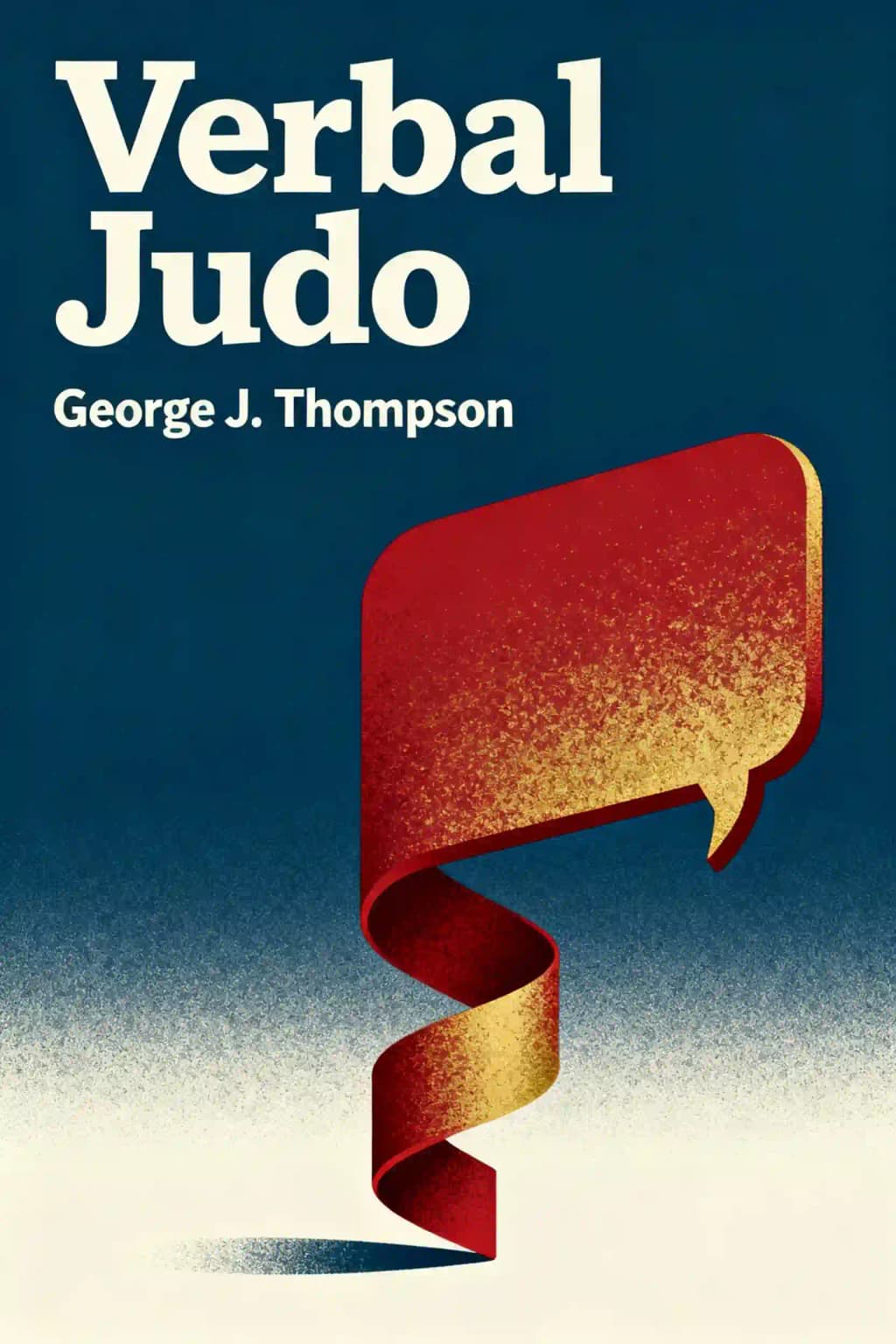
Verbal Judo transforms conflict into cooperation through tactical communication. Required training for police nationwide and adopted by Fortune 500 giants like IBM, this masterclass in persuasion was crafted by a unique English professor-turned-cop with black belts in multiple martial arts. What confrontation could you defuse today?
George J. "Rhino" Thompson (1941–2011), author of Verbal Judo: The Gentle Art of Persuasion, was a pioneering communication strategist and conflict resolution expert whose work reshaped modern law enforcement training.
A former police officer, English professor, and martial artist, Thompson blended linguistic precision with tactical empathy to create his signature "Verbal Judo" framework for de-escalating high-stakes situations. His methods, honed through training over 175,000 officers worldwide via his Verbal Judo Institute, emphasize redirecting aggression through strategic dialogue rather than physical force.
Thompson expanded his insights in The Verbal Judo Way of Leadership and Hammett’s Moral Vision, applying communication principles to leadership and literary analysis. His techniques became mandatory curriculum in police academies and security organizations, with Verbal Judo selling over 500,000 copies and translated into 12 languages. Known for his mantra "speak to be understood, listen to understand," Thompson’s legacy endures through verbaljudo.com, which continues certifying instructors in his evidence-based approach to conflict communication.
Verbal Judo teaches conflict resolution through tactical communication, blending empathy and strategic redirection to de-escalate tensions. Inspired by martial arts, it emphasizes staying calm under pressure, understanding others’ perspectives, and guiding conversations toward cooperative outcomes. The book’s core principles include avoiding personalization, using structured dialogue (like the five-step method), and prioritizing respect to achieve win-win solutions.
This book is ideal for professionals in high-stress roles (law enforcement, customer service, healthcare), managers, and anyone seeking to improve communication skills. It’s particularly valuable for navigating confrontations, diffusing hostility, and fostering collaboration in personal or workplace interactions.
Yes, for its actionable techniques in de-escalation and empathy-driven communication. While some critiques note repetitions and dated police anecdotes, its practical frameworks for conflict resolution remain widely applicable. Readers praise its real-world relevance but advise adapting strategies to non-law-enforcement contexts.
Thompson categorizes individuals as:
Understanding these types helps tailor communication to prevent escalation.
The Five-Step Hard Style method:
This structure redirects aggression into productive dialogue.
Strip Phrases are neutral responses like “I understand” or “Let’s focus on solutions” to deflect insults without escalating conflict. They maintain professionalism and keep conversations goal-oriented, preventing emotional reactions from derailing interactions.
Empathy involves seeing situations from others’ viewpoints without necessarily agreeing. This disarms hostility, builds trust, and makes persuasion easier by addressing underlying concerns. Thompson argues empathy is the cornerstone of effective communication.
Critics highlight repetitive advice, over-reliance on law enforcement examples, and manipulative undertones in “tactical” phrasing. However, proponents argue its principles—when applied ethically—remain effective for conflict resolution.
Unlike “Verbal Karate,” which escalates through counterattacks, Verbal Judo redirects emotional energy toward mutual goals. It prioritizes listening, paraphrasing, and collaborative problem-solving over adversarial confrontation.
Yes. Thompson advises adapting techniques to cultural norms, such as adjusting tone, respecting hierarchies, and avoiding assumptions. The core focus on dignity and active listening transcends cultural barriers.
It recommends depersonalizing disputes, explaining organizational rules transparently, and offering choices to empower compliance. For example, managers might say, “I appreciate your concern—let’s explore solutions that work for both of us,” blending authority with collaboration.
Почувствуйте книгу через голос автора
Превратите знания в увлекательные, богатые примерами идеи
Захватите ключевые идеи мгновенно для быстрого обучения
Наслаждайтесь книгой в весёлой и увлекательной форме
People do not care how much you know until they know how much you care.
If someone upsets you, they "own" you.
Your tongue can be your most dangerous weapon.
Being criticized means you're making an impact.
To subdue the enemy without fighting is the highest skill.
Разбейте ключевые идеи Verbal judo на понятные тезисы, чтобы понять, как инновационные команды создают, сотрудничают и растут.
Выделите из Verbal judo быстрые подсказки для запоминания, подчёркивающие ключевые принципы открытости, командной работы и творческой устойчивости.

Погрузитесь в Verbal judo через яркие истории, превращающие уроки инноваций в запоминающиеся и применимые моменты.
Задавайте любые вопросы, выбирайте голос и совместно создавайте идеи, которые действительно находят у вас отклик.

Создано выпускниками Колумбийского университета в Сан-Франциско
"Instead of endless scrolling, I just hit play on BeFreed. It saves me so much time."
"I never knew where to start with nonfiction—BeFreed’s book lists turned into podcasts gave me a clear path."
"Perfect balance between learning and entertainment. Finished ‘Thinking, Fast and Slow’ on my commute this week."
"Crazy how much I learned while walking the dog. BeFreed = small habits → big gains."
"Reading used to feel like a chore. Now it’s just part of my lifestyle."
"Feels effortless compared to reading. I’ve finished 6 books this month already."
"BeFreed turned my guilty doomscrolling into something that feels productive and inspiring."
"BeFreed turned my commute into learning time. 20-min podcasts are perfect for finishing books I never had time for."
"BeFreed replaced my podcast queue. Imagine Spotify for books — that’s it. 🙌"
"It is great for me to learn something from the book without reading it."
"The themed book list podcasts help me connect ideas across authors—like a guided audio journey."
"Makes me feel smarter every time before going to work"
Создано выпускниками Колумбийского университета в Сан-Франциско

Получите резюме книги «Verbal judo» в формате PDF или EPUB бесплатно. Распечатайте или читайте офлайн в любое время.
Picture this: A suicidal man sits in a bathtub, threatening to electrocute himself. Instead of pleading or forcing him out, police officer George Thompson does something unexpected - he vividly describes the agonizing death that awaits, then casually offers to share "a hundred and four easier ways to die." The man immediately jumps out. This counterintuitive approach exemplifies Verbal Judo - a communication methodology that has saved countless lives since its development. What makes this approach so powerful is Thompson's unique background as both an English professor with a PhD and a street cop who joined the force at age 35, combining academic understanding with real-world application in ways few communication experts can match. The birth of Verbal Judo came from observing masters at work. During a violent domestic dispute, Thompson's partner Bruce Fair walked in, completely ignored the screaming couple, and began casually reading their newspaper. He then looked up and asked if he could use their phone about a car advertisement. The bewildered couple instantly shifted from fighting to hosting - their conflict completely dissolved by this unexpected approach. This incident revealed how communication principles could redirect hostile energy without force - just like martial arts. The core goals became clear: ensuring personal safety through mind-mouth harmony, enhancing professionalism by reducing complaints, and increasing efficiency by "saying it right" the first time.