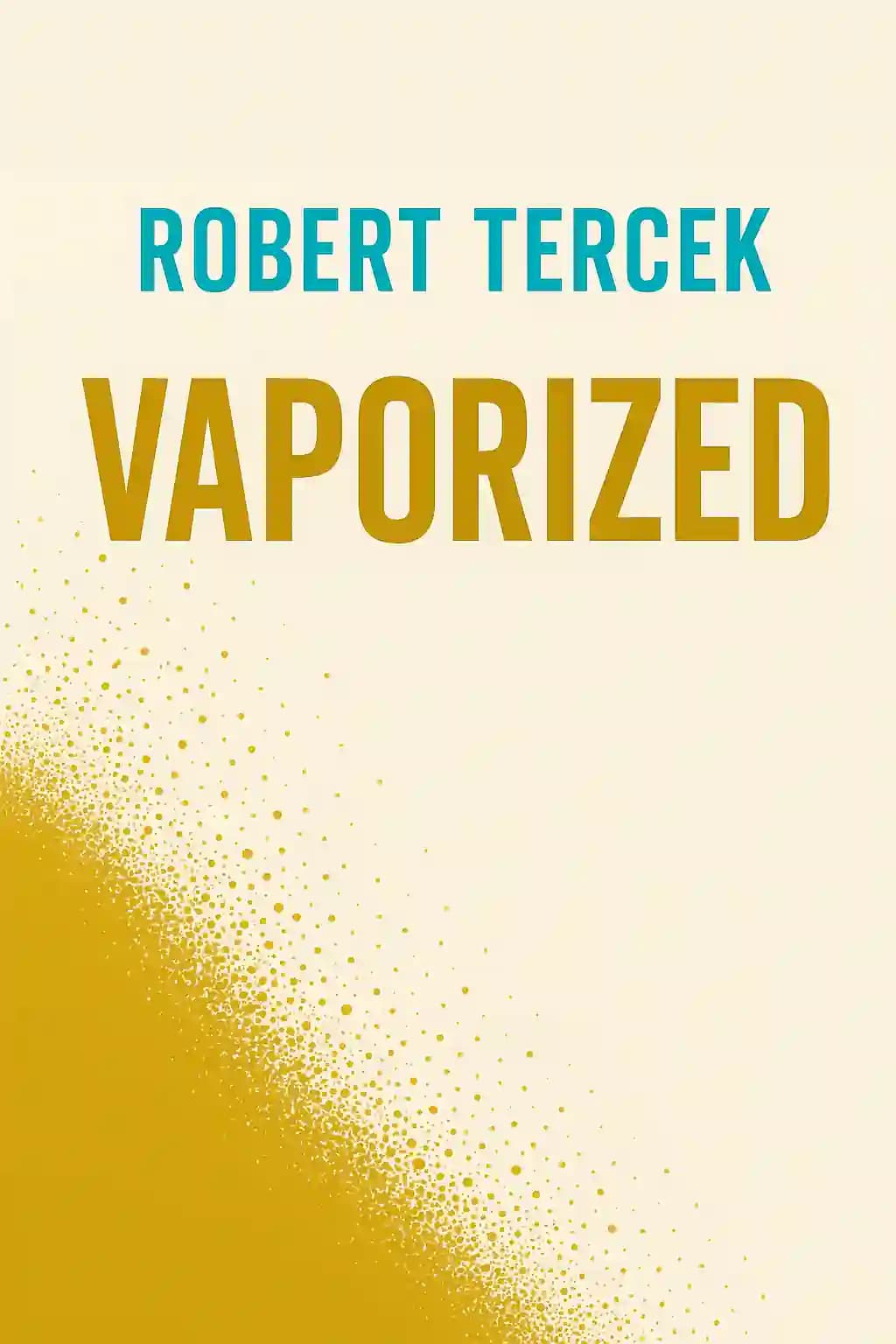
In "Vaporized," Robert Tercek reveals how digital dematerialization is transforming industries. Winner of the 2016 getAbstract International Book Award, this guide offers crucial strategies for thriving when everything physical becomes digital. What happens when your entire business model simply... evaporates?
Robert Tercek, award-winning author of Vaporized: Solid Strategies for Success in a Dematerialized World, is a globally recognized authority on digital innovation and the dematerialized economy. A seasoned media futurist, Tercek draws on three decades of executive leadership at MTV, Sony Pictures, and the Oprah Winfrey Network, where he pioneered groundbreaking digital services like the first mobile video streaming platforms and multiplayer web games.
His book—a 2016 Frankfurt Book Fair International Book of the Year—explores how physical products transform into digital services, leveraging insights from his advisory work with Fortune 500 companies including Google, Microsoft, and IBM.
Tercek hosts The Futurists podcast and serves as a strategic advisor to the Johnny Carson Center for Emerging Media Arts. Recognized as 2021 Humanitarian of the Year for his COVID SMART™ worker safety initiative, he regularly delivers keynotes at events like TEDx and the Sheffield Documentary Film Festival. Vaporized remains a seminal text in business strategy, cited by industry leaders navigating digital disruption.
Vaporized explores how digital technology is dismantling physical industries, transforming goods and services into intangible data. Robert Tercek analyzes the "vaporization" of media, retail, and entertainment, offering strategies to adapt to this software-driven economy. Key themes include dematerialization, platform dominance, and the rise of oligopolies like Apple and Amazon.
Business leaders, entrepreneurs, and professionals navigating digital disruption will find actionable insights. The book suits those in media, tech, or marketing seeking to understand platform economies, data monetization, and survival tactics in industries prone to vaporization.
Yes. Tercek’s analysis of digital transformation remains relevant amid AI advancements and decentralized work models. The book’s framework for identifying "vaporizable" industries helps readers anticipate tech-driven shifts in sectors like healthcare, education, and Web3 ecosystems.
Tercek describes economies where physical products (e.g., CDs, books) are replaced by digital equivalents (streaming, e-books). This dematerialization enables global scalability but erodes traditional revenue models, favoring agile startups over entrenched corporations.
The book highlights media (TV, publishing), retail (brick-and-mortar stores), and finance (cashless payments). Tercek also foresaw cloud computing’s impact on software distribution and the rise of gig economy platforms.
Tercek argues legacy industries fail by prioritizing physical scarcity over digital abundance. He cites Blockbuster’s collapse against Netflix and newspapers’ decline due to free online content as examples of resistance to vaporization.
These emphasize the inevitability of dematerialization and data-centric competition.
Unlike The Second Machine Age, Tercek focuses on business strategy over technical details. It complements Technosocialism by addressing digital economics but prioritizes corporate adaptation over societal policy.
Some argue Tercek underestimates regulatory pushback against tech monopolies. Critics also note the book’s 2015 examples (e.g., Netflix) now feel dated, though its core principles remain applicable.
Tercek’s framework explains AI’s data-hungry models and decentralized tech’s disruption of intermediaries. The book’s lessons help readers assess risks in tokenized assets, metaverse economies, and AI-driven automation.
Почувствуйте книгу через голос автора
Превратите знания в увлекательные, богатые примерами идеи
Захватите ключевые идеи мгновенно для быстрого обучения
Наслаждайтесь книгой в весёлой и увлекательной форме
Everyone is now in 'the information business' whether they realize it or not.
Vapor businesses are inherently unstable—information empires built on air require constant reinvention.
Money flows are the oxygen of digital ecosystems.
Cloud storage has emerged as a sticky subscription model.
Разбейте ключевые идеи Vaporized на понятные тезисы, чтобы понять, как инновационные команды создают, сотрудничают и растут.
Погрузитесь в Vaporized через яркие истории, превращающие уроки инноваций в запоминающиеся и применимые моменты.
Задавайте любые вопросы, выбирайте свой стиль обучения и создавайте идеи, которые действительно вам подходят.

Создано выпускниками Колумбийского университета в Сан-Франциско
"Instead of endless scrolling, I just hit play on BeFreed. It saves me so much time."
"I never knew where to start with nonfiction—BeFreed’s book lists turned into podcasts gave me a clear path."
"Perfect balance between learning and entertainment. Finished ‘Thinking, Fast and Slow’ on my commute this week."
"Crazy how much I learned while walking the dog. BeFreed = small habits → big gains."
"Reading used to feel like a chore. Now it’s just part of my lifestyle."
"Feels effortless compared to reading. I’ve finished 6 books this month already."
"BeFreed turned my guilty doomscrolling into something that feels productive and inspiring."
"BeFreed turned my commute into learning time. 20-min podcasts are perfect for finishing books I never had time for."
"BeFreed replaced my podcast queue. Imagine Spotify for books — that’s it. 🙌"
"It is great for me to learn something from the book without reading it."
"The themed book list podcasts help me connect ideas across authors—like a guided audio journey."
"Makes me feel smarter every time before going to work"
Создано выпускниками Колумбийского университета в Сан-Франциско

Получите резюме книги «Vaporized» в формате PDF или EPUB бесплатно. Распечатайте или читайте офлайн в любое время.
What do Tower Records, Flip cameras, Nokia phones, and taxi medallions have in common? They all seemed invincible-until they vanished. In 2006, Tower Records' flagship store on Sunset Boulevard didn't just close; it disappeared, taking with it an entire cultural ritual of browsing music alongside strangers. This wasn't a simple business failure. It was something more profound: vaporization. The shift from physical to digital doesn't just change how we buy music-it fundamentally rewrites the rules of value, ownership, and survival. Seth Godin warns that everyone is now "in the information business" whether they know it or not. The question isn't whether your industry will be vaporized, but when-and whether you'll see it coming.
Information evolves like water through three states. Solid information lives trapped in physical objects-books where container and content are inseparable, stable but heavy and quickly outdated. Liquid information flows through networks, freed from physical form but tethered to fixed connections. Vapor information moves like atmosphere itself-fast, free, wireless, available everywhere simultaneously. This evolution accelerated dramatically. In 1995, just 14% of Americans were online. By 2013, that reached 74%, with smartphones becoming humanity's primary digital portal. Today, 3.4 billion people carry mobile devices that have absorbed entire product categories-cameras, GPS units, MP3 players, video recorders-transforming dedicated hardware into disposable apps. The Flip camera's fate captures this: Cisco bought it for $590 million in 2009, then shut it down two years later, rendered obsolete by smartphone cameras. Apple pioneered the winning formula: device plus software plus content plus commerce, seamlessly integrated. By embedding iTunes in every device, they created an ecosystem absorbing $23 billion in software sales by 2013. Yet even Apple faces vapor's instability-iTunes downloads fell 13% as audiences migrated to streaming, proving that empires built on air require constant reinvention.
Successful digital businesses function as both switchboard and marketplace-Google connects searchers with information, Amazon links buyers with sellers. The switchboard operator harvests data from every transaction, seeing patterns individual players cannot. At critical scale, these marketplaces become platforms-value control points extracting tolls from every transaction. Nokia's collapse illustrates this brutally. Despite 50% smartphone market share, they missed Apple's ecosystem shift. As Nokia's CEO wrote: "The battle of devices has now become a war of ecosystems." Platform giants control creation tools, discovery systems, monetization, and consumption devices. Apple's 2008 App Store seemed liberating-10 million downloads the first weekend. But we'd traded one dictator for another. Apple's closed ecosystem requires developer approval, enforces arbitrary rules, and takes 30% of revenue. Studies show 50-60% of app businesses are unsustainable, with only 1.6% earning substantial revenue. For most developers, it's profitless sharecropping-all earnings recycled into marketing against 9 million registered developers. With 86% of smartphone time inside apps rather than the open web, slight ecosystem changes determine your fate. To survive, study platforms obsessively.
In the vaporized economy, data becomes renewable oil that appreciates through sharing. Venture capitalist Brad Burnham prioritizes businesses generating fresh data as byproduct of normal use - more users means more valuable data, creating compounding advantages traditional businesses can't match. Facebook's Zuckerberg borrowed "graph theory" to describe the "social graph" - three-dimensional matrices capturing relationships between users, interests, and behaviors. Every major platform now generates unique graphs: Foursquare creates location graphs, Kickstarter yields crowdfunding graphs, Twitter pioneered the interest graph. Data makes other data findable, solving navigation problems through algorithms responding instantly to user activity. Humanity hit a milestone in 2010, collectively generating one zettabyte of data, doubling every eighteen months. By 2020, we'll generate 44 zettabytes - 1.7 megabytes per person per second. Cheap sensors, powerful microprocessors, and always-on connectivity enable measurement of millions of previously unrecorded micro-actions. As Moore's law drives sensors smaller and Metcalfe's law multiplies their networked value, everything that can be measured will be. The question is: who owns that measurement, and what will they do with it?
The lightbulb has seen more innovation in three years than in the previous 125 years. LEDs aren't just efficient bulbs - they're programmable computers converting light into digital content. This exemplifies how the Internet of Things transforms every product, dissolving the separation between online and offline. Brick-and-mortar retailers now deploy sophisticated systems turning stores into 3D websites: matching mobile devices to credit cards with 99% accuracy, tracking emotions through facial expressions, and using beacons to wake smartphone apps. By 2025, nearly all urban activity will likely be recorded through converging technologies - smartphones, GPS, miniature cameras, facial recognition, and social media. The real battle isn't about devices but control of the data layer connecting them to the cloud. Physical products depend on this layer - disconnected, they cease functioning. Apple and Google are aggressively entering IoT with software suites in healthcare, home automation, automotive, and retail payments. Their strategy: position smartphones as the central control point, harvest user data, and commoditize hardware manufacturers.
Oxford researchers found 47% of US jobs face automation. Unlike past cycles, recent "jobless recoveries" show machines permanently replacing humans in routine, middle-wage roles. Economist W. Brian Arthur projects the digital "second economy" will match the entire 1995 physical economy by 2025. The economics are compelling-systems like Amazon's Kiva pay for themselves within a year while eliminating payroll costs. AI is "vaporized human intelligence" distilled into computers. After sixty years of slow progress, AI is advancing rapidly through new algorithms, improved hardware, and vast data. Since 2009, $17 billion has flowed into AI, with investment growing 60% annually. Smart robots are sensor collections interpreting the world. Google's self-driving cars map reality with unprecedented precision as networked nodes dependent on cloud services. By controlling the invisible data layer generated by robots, cars, drones, and satellites, Google creates a value control point extracting tolls from every interaction. Despite automation, humans will retain jobs requiring manual dexterity, snap judgments in unpredictable circumstances, and novel inventions. Your greatest future skill may be collaborating with robots.
Ray Kurzweil, Google's engineering director, envisions digital immortality - transferring human consciousness to computers by 2045, when computing power will match the human brain. We're already migrating existence digitally, spending 7-12 hours daily on screens. DARPA has demonstrated mind-controlled prosthetics and flight simulators, investing $7 million in neural interfaces for soldiers to control robots with brain waves. Dr. Phillip Alvelda's cortical modem project aims to link directly to the visual cortex, bypassing eyes entirely - creating augmented reality without hardware. Biology has transformed from a "read only" science into "read/write" - where we actively reprogram life itself. If substrate-independent mind technology succeeds, human consciousness could explore space without biological bodies - the pilot becoming the spacecraft itself. As researcher Randal Koene notes, "Much of what we think of as progress has been achieved through ever-greater communication." Whole brain emulation could free humanity from skull-bound isolation. This vaporization will likely transform education, labor, corporations, government institutions, and possibly our biological bodies. Rather than denying this rapid change, cultivate a "what if?" mindset. Our reality is constructed from ideas that anyone with a better concept can reconfigure. Pick any thing, institution, or tradition, and ask: how might I replace that with software? Because someone else already is.