Глава 1
The Media Monster Behind the Curtain
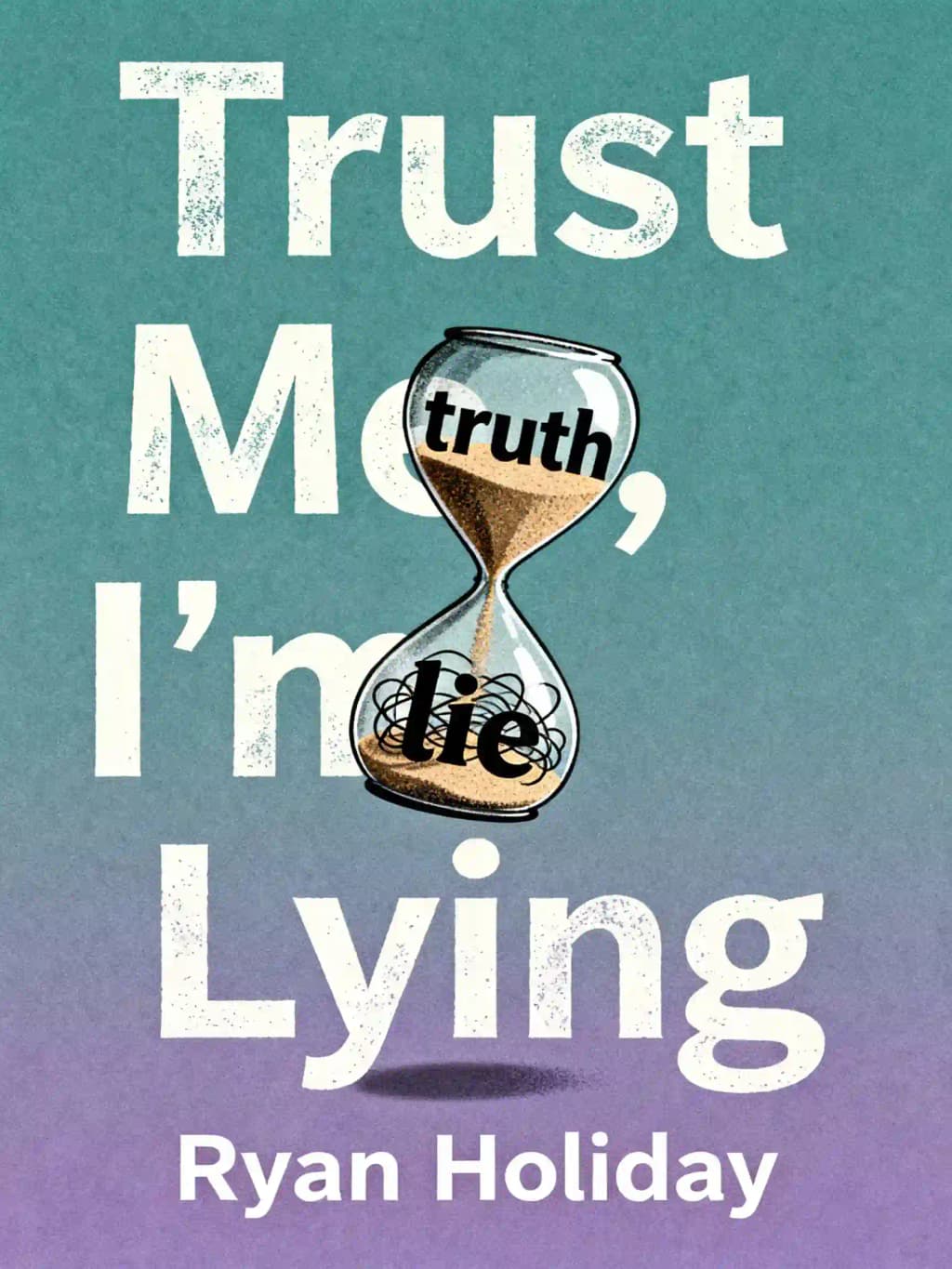
Trust Me, I'm Lying has become a modern classic in media studies since its 2012 publication, revealing the dark underbelly of online news. Ryan Holiday's confessional expose sent shockwaves through journalism circles, with The New York Times calling it "eye-opening" and Forbes declaring it "required reading for anyone in PR or journalism." The book's influence extends beyond media professionals-Tim Ferriss credits it with completely changing how he consumes news, while Seth Godin praised it as "an astonishing, disturbing book." Holiday's insider account of manipulating blogs from American Apparel's marketing department to bestseller campaigns has become required reading in university journalism programs nationwide, offering a rare glimpse into how the digital media sausage is made-and why it's making us all sick.
Глава 2
The Confession: How I Became a Media Manipulator
I am a media manipulator. My job is to deceive. I trick journalists into writing what I want, trading fabricated stories up the media chain until fiction becomes accepted fact. For years, I've orchestrated fake controversies, planted stories, and manipulated public perception for bestselling authors and billion-dollar brands.
Take my campaign for Tucker Max's movie "I Hope They Serve Beer in Hell." In under two weeks, I manufactured nationwide protests, billboard defacements, and media outrage-all completely fabricated. I designed offensive advertisements, called in anonymous complaints about them, alerted activist groups to screenings, created fake social media protests, and planted false stories. This manufactured controversy landed Tucker on the New York Times bestseller list.
As marketing director for American Apparel and consultant for wealthy clients, I perfected this hustle: someone pays me, I manufacture a story, blogs publish it for traffic, and we "trade it up the chain"-from tiny blogs to Gawker to local news to HuffPost to major newspapers and cable networks-until fiction becomes accepted fact.
I studied the economics of online media deeply, learning how the system could be manipulated. Publishers confided in me because I controlled advertising budgets. But eventually, I realized I was feeding a monster I couldn't control. My manufactured stories had real consequences for real people. The system I exploited began to consume everything, including truth itself.
Winston Churchill wrote that appeasers "hope that if they feed the crocodile enough, the crocodile will eat them last." I was even more deluded-I thought I could skip being devoured entirely. I was wrong. Now I'm haunted by a box of news clippings showing the hallmarks of the very scams I've run, yet they involve major news stories of the decade.
This book isn't structured like typical business books but in two parts of overlapping vignettes. First, I explain why blogs matter, how they drive news, and how they can be manipulated. Second, I show the consequences and dangers of this system. I'll reveal nine tactics used to manipulate bloggers and reporters at the highest levels, exposing critical vulnerabilities in our media. What you do with this information is up to you.
Глава 3
How Blogs Hijacked the News Cycle
Consider a New York Times article about Tim Pawlenty, an obscure Minnesota governor, written nearly two years before the 2012 presidential election. Though not yet a candidate, with no campaign director or donors, Pawlenty had a Politico reporter following his every move with camera and laptop.
Strangely, the Times didn't cover Pawlenty directly-they covered Politico covering him. It was a Ponzi scheme: Pawlenty became a candidate, generated millions of online impressions, appeared in print and television, then flamed out. Yet his manufactured candidacy significantly impacted the election.
This illustrates a fundamental shift: blogs have become our newswires. By "blog," I mean all online publishing-from Twitter accounts to newspaper websites. What begins online ends offline. Though millions of blogs exist, a handful of influential ones like Gawker, Business Insider, and Huffington Post wield immense power because they're read by media elites. A blog with small readership becomes powerful when that audience includes TV producers and newspaper writers.
Radio hosts and news anchors who once cited newspaper headlines now repeat what they read on blogs. These stories filter into conversations and rumors. This hidden cycle creates our cultural references, celebrities, and news itself. When I realized this early in my PR career, I thought: If I master the rules governing blogs, I can master all they determine-essentially gaining power over culture itself.
Why would Politico assign a reporter to Pawlenty's phantom candidacy when even the New York Times couldn't justify the expense? Because blogs need endless content. The site covering the most content wins. Political blogs know their traffic-and thus advertising revenue-increases during elections. Their solution? Change reality through coverage.
With Pawlenty, Politico wasn't just manufacturing a candidate; they were manufacturing an entire election cycle phase purely for profit. When a blog like Politico "leaps forward," their arbitrary coverage choice becomes an actual candidate. The manufactured candidate gains real supporters who donate real time and money. Mass media then legitimizes whatever is being discussed online.
The cycle repeats across all blog topics: blogs need traffic, reality doesn't align with their needs, so they create artificial content that becomes real and impacts actual events. The economics of the Internet create twisted incentives making traffic more profitable than truth.
Глава 4
Trading Up the Chain: Manufacturing News From Nothing
In the introduction, I explained my "trading up the chain" strategy-manipulating media through recursion. I can turn nothing into something by placing a story with a small, low-standards blog, which becomes the source for a larger blog, which feeds larger media outlets. This creates what scholars call a "self-reinforcing news wave." People like me do this daily.
Let me illustrate with a positive example: A friend running a charity used my advice to raise money through Kickstarter. Following my instructions, he created a YouTube video highlighting his charity's most shareable work, then wrote an article for a small Brooklyn blog chosen specifically because Huffington Post often picks up their stories.
As expected, Huffington Post featured the story in both New York and Los Angeles sections. My friend then emailed these links from a fake address to a CBS Los Angeles reporter, who produced a TV segment using clips from his edited video. Having built connections on Reddit beforehand, he posted the CBS piece there, where it reached the front page immediately. This Reddit success put the story on the radar of major "cool stuff" blogs like BoingBoing and Laughing Squid.
With no budget, publicist, or experience, his video received nearly half a million views and funded his project for two years. He had single-handedly created and manipulated media attention.
The blog ecosystem works in layers. At the bottom are thousands of bloggers scouring the web for content, required to write several times daily. Above them are hundreds of mid-level journalists at websites, magazines and newspapers who use these lower bloggers as sources and filters. At the top are major national websites, publications, and TV stations who browse lower levels for material to transform into national conversations.
It's bloggers informing bloggers informing bloggers all the way down. This isn't anecdotal-it's fact. A Cision and George Washington University study found 89 percent of journalists use blogs for story research, with roughly half reporting using Twitter and two-thirds using other social networks. The more immediate their publishing medium, the more they rely on sketchy online sources.
I manipulated this ecosystem by targeting specific levels to promote Tucker Max's movie. Starting with small blogs like Curbed LA and FishbowlLA, I sent fake tips about vandalized billboards under pseudonyms. These local sites eagerly published my stories verbatim. For college protests, I'd email small sites claiming "This misogynist is coming to our school" with offensive quotes, triggering coverage that attracted news crews.
The key to reaching major outlets was the soft sell. I targeted sites like Gawker that columnists at places like Washington Post read. I'd send multiple fake tips from different email addresses saying "How have you not done a story about this yet?" with links showing "everyone was talking about it." This manufactured controversy worked brilliantly. Most remarkably, my fake vandalism inspired real action-sixteen feminists later vandalized posters across Manhattan, generating even more coverage.
Глава 5
The Blog Con: How Publishers Make Money Online
The economics of online news is shocking when stripped bare. Traffic equals money-it's that simple. Sites like AOL, Huffington Post, and even the New York Times make their money by selling advertisements paid for by impressions. The equation is straightforward: Advertisement x Traffic = Revenue.
Blogs generate revenue primarily through advertisements sold by impression rates. Publishers earn money through direct ad sales, commission-based sales reps, and ad networks that handle remaining inventory. What matters is that every impression is monetized, even if just for pennies.
Since publishers and advertisers can't distinguish between engaged readers and accidental visitors, all pageviews are equally valuable. This creates a single-minded focus: increasing traffic by whatever means possible.
TMZ revolutionized online media by turning scoop-gathering into a science. Founded by AOL in 2005, it quickly generated nearly $20 million in annual revenue through major exclusives like Mel Gibson's anti-Semitic outburst and Michael Jackson's death announcement. Despite occasional missteps, TMZ's success sent a clear message: exclusives build blogs and scoops equal traffic.
Since genuine exclusives are rare and require effort, blogs have perfected the "pseudo-exclusive"-pretending to have scoops by taking ownership of stories broken elsewhere. One of Gawker's biggest early hits-Tom Cruise Scientology videos that generated 3.2 million views-was actually unearthed by journalist Mark Ebner, who received no credit when Gawker posted the videos before he could publish.
Blogs boost traffic by recruiting star bloggers with established followings. Andrew Sullivan's blog "The Dish" became one of the most sought-after properties, moving from Time.com to TheAtlantic.com (where it drew over a million monthly visitors) before landing at The Daily Beast. Each move brought traffic and prestige to the acquiring site.
The real business model for blogs isn't sustainable revenue but acquisition. They're built to be sold to larger companies for multiples of their traffic and earnings. This explains why blogs chase traffic growth over solid financials and brand recognition over trust-they're positioning for buyouts. Examples abound: AOL bought Weblogs Inc. ($25 million), Huffington Post ($315 million), and TechCrunch ($30 million); Discovery acquired TreeHugger ($10 million); Conde Nast purchased Ars Technica ($20+ million).
The blog world is rife with conflicts of interest. Michael Arrington, TechCrunch's founder, famously invested in startups his site covered. Nick Denton of Gawker invests in companies founded by former employees and has stakes in local blog networks his sites cover. These conflicts serve the ultimate goal: building influence that can be sold to larger media companies or leveraged for profitable investments.
Глава 6
Nine Tactics That Control What You Read
In this environment where bloggers build personal brands and publishers prepare sites for acquisition, media manipulators thrive. The system's ethical laxity creates vulnerabilities that can be exploited to control media narratives.
Tactic #1: Bloggers Are Poor; Help Pay Their Bills
Bribing bloggers rarely involves direct cash payments. Instead, manipulators leverage the metrics that determine bloggers' compensation, creating indirect bribes through the system's own incentive structures. Bloggers are hired for speed rather than skill or integrity, with payment structures reflecting this priority. Whether paid per post (often just $4-12 per article) or by pageviews (where writers must generate millions of views to justify their salaries), bloggers are trapped in a "digital sweatshop" desperately chasing traffic. This creates perfect conditions for manipulation through free products, access to celebrities, or help building a blogger's personal brand.
Tactic #2: Tell Them What They Want to Hear
Journalists are entirely dependent on "self-interested sources" for their facts, creating a massive gray area between what actually happened and what sources claim happened. Online, this problem is magnified as verification standards collapse. I exploit this by creating fake "leaks"-sending anonymous tips or fabricated internal memos that blogs eagerly publish as EXCLUSIVE! content. Even more effective are press releases, which blogs love because they do the entire job for them. Studies show official press releases often appear word-for-word in news accounts.
Tactic #3: Give Them What Spreads, Not What's Good
MIT professor Henry Jenkins gives publishers blunt advice: "If it doesn't spread, it's dead." For media manipulators like me, the inverse is golden-if content spreads, I win, regardless of quality or accuracy. Research confirms this harsh truth: "The most powerful predictor of virality is how much anger an article evokes." Anger has such profound viral power that one standard deviation increase in an article's anger rating equals three additional hours as the lead story on NYTimes.com. Positive emotions work too, but less effectively. Sadness, however, is entirely unviral-it depresses sharing impulses.
Tactic #4: Help Them Trick Their Readers
Bloggers love loaded-question headlines because they drive traffic while avoiding accountability. As Gawker's Nick Denton instructed his writers: "When examining a dubious claim, don't dismiss it with a skeptical headline... You set up a mystery-and explain it after the link." The question mark is their shield-remove it, and the headline becomes an outright lie. But since it's posed as a question ("Did Glenn Beck Rape and Murder a Young Girl in 1990?"), the blogger can't be called wrong; they were "just asking."
Tactic #5: Sell Them Something They Can Sell
To understand how to manipulate blogs, I studied media history and discovered three distinct phases of newspapers that reveal striking parallels to today's media landscape. The Party Press began as political outlets serving party members through subscriptions. Everything changed when Benjamin Day launched the New York Sun in 1833 with a revolutionary distribution method: selling papers individually on street corners. This "cash and carry" approach created what I call the "One-Off Problem"-papers had to fight for sales daily with sensational headlines and content.
Tactic #6: Make It All About the Headline
In a media world driven by clicks, headlines are everything. They must capture attention instantly, whether shouted by newsboys or displayed on search engines. For blogs living by the One-Off Problem, creating compelling headlines is paramount-even when reality isn't interesting. That's where media manipulators come in, crafting news that blogs can package with irresistible headlines. According to former Gawker editor Gabriel Snyder, blog headlines are "naked little creatures that have to go out into the world to stand and fight on their own."
Tactic #7: Kill 'Em with Pageview Kindness
The business breakthrough for blogging was the ability to track readership metrics in real time. From Gawker to The Guardian, sites openly rely on pageview statistics for editorial decisions. The Wall Street Journal uses traffic data to determine which articles appear on its homepage and for how long. The Christian Science Monitor scours Google Trends for story ideas to "ride the Google wave." For bloggers publishing constantly to hit pageview quotas, anything that gets them closer to their goal serves their interests-creating perfect opportunities for manipulation.
Tactic #8: Use the Technology Against Itself
Understanding the structural constraints of blogging as a medium explains almost everything blogs do and can be turned to advantage. The reverse chronological stacking format creates pressure to be short and immediate. Even in 1996, protoblogger Justin Hall felt pressure to post frequently with "no layers to content." This evolved into modern blogging minimums where "Rule #1" is "Always Be Blogging" with sites updated "daily, if not hourly."
Tactic #9: Just Make Stuff Up (Everyone Else Is Doing It)
The system of blog manipulation doesn't just move horizontally but vertically, with fictive claims moving up to increasingly reputable sites until they become "facts." When CBS-branded blogger Jim Edwards repeatedly misinterpreted American Apparel's finances, his claims gained credibility despite being wrong. This created a self-reinforcing cycle where fashion sites needed Edwards' "reporting" to snark on, while Edwards needed their "controversy" to justify his analysis.
Глава 7
The Monster Attacks: Real-World Consequences
The second half of the book shifts from explaining how to manipulate blogs to examining the consequences of such manipulation. My perspective changed when I realized the dangerous implications of the tactics I had been using to sell products, seeing how others used the same methods for more ominous purposes like selling presidential candidates or creating public distractions.
Consider the case of Shirley Sherrod, who lost her job at the Department of Agriculture after Andrew Breitbart posted a deceptively edited video making her appear racist, when her speech was actually about overcoming prejudice. The manipulated clip spread rapidly from blogs to mainstream media, causing a national controversy that even President Obama addressed, lamenting: "We now live in this media culture where something goes up on YouTube or a blog and everybody scrambles."
Breitbart wasn't an ideologue but a master media manipulator who understood the economics of the web perfectly. Having helped build both Drudge Report and Huffington Post, Breitbart knew how to create content that would spread. By splitting the Sherrod clip into easily consumable segments, he made it simple for bloggers to republish without verifying the full context. For media outlets, such controversies are actually profitable, generating three stories instead of one: the accusation, the reversal, and the discussion about the controversy itself.
Despite early hopes that blogs would enhance democracy through engagement and citizen activism, they've established their own tyranny of distraction. Americans spend eight hours daily online (excluding texting and television), fifty billion minutes daily on Facebook, with nearly a quarter of internet browsing on social media and blogs. The web's supposed empowerment is illusory-content is engineered to "bait, distract, and capture" users' attention to sell to advertisers.
Глава 8
The Broken Link Economy and the Culture of Fear
The link economy fails through a fundamental flaw: combining traditional journalism's "delegation of trust" (where outlets could safely repeat facts from other reputable sources) with the web's "link economy" (where sites trade traffic by linking to each other's content). While delegation of trust worked when all outlets followed similar standards, the link economy encourages blogs to borrow content without verification, creating a recursive system vulnerable to manipulation.
This problem manifests in examples like a false report about American Apparel stores closing that persisted despite being untrue, and an Irish student who planted a fake Maurice Jarre quote on Wikipedia that spread to legitimate obituaries worldwide. Though Wikipedia editors quickly removed the fabrication, the quote had already contaminated numerous publications including The Guardian, demonstrating how the link economy is designed to confirm rather than question or correct information.
Blogs create a culture of fear where companies must pay to fill holes dug by social media. Being right matters more to the subject than the writer, forcing businesses to spend thousands on reputation management services to counteract undeserved negative press. This dynamic has become a critical part of brand management as companies face constant threats of false controversies or being crucified for misconstrued remarks.
Various forms of online extortion exist, from the explicit-like Brazilian video producer Fernando Motolese offering Danone a choice between releasing a "fun" or "disgusting" spoof of their digestive health yogurt for a fee-to the implicit, such as TechCrunch's Michael Arrington threatening a startup founder with publishing negative personal information after she announced her own news before his site could break it.
Глава 9
The Myth of Corrections and the Rise of Unreality
"Iterative journalism"-the practice where bloggers publish first and verify later-is a dangerous pseudo-philosophy masking naked greed. This approach doesn't improve news but creates unnecessary fires that publicists like me must constantly extinguish. Rather than saying "this is what we don't know," iterative journalists claim knowledge-lessness while reporting whatever they've heard as news.
Getting bloggers to issue corrections requires either obsequious flattery (suggesting the mistake wasn't their fault) or aggressive confrontation (escalating to their bosses). Even when corrections are made, they typically appear long after most traffic has occurred, buried at the bottom of posts where few readers see them.
Beyond factual errors, corrections rarely address the deeper problem: when key facts are wrong, the entire premise of stories needs reexamination, not just updates. Business Insider's Henry Blodget exemplifies this problem-publishing unfounded rumors about journalist salaries, then getting additional traffic by reporting denials of those rumors while immediately launching new speculations.
Blogs further this self-deception by covering their own conferences as news, liveblogging speeches from people they paid to appear and generating dozens of posts that drive pageviews while creating the impression of importance. TechCrunch, AllThingsDigital, PSFK, Mashable, and GigaOm all host events they then cover extensively, creating a conflict of interest that makes readers think they're missing something important when it's just a manufactured pseudo-event.
Глава 10
The Dark Side of Snark and Digital Lynch Mobs
Snark, defined as remarks that leave victims unable to respond without making things worse, is the perfect tool for bloggers who need to produce content quickly. It's "click-friendly, cheap, and fast," hiding in cutting adjectives and mock superlatives that reduce people to caricatures. When victims try to defend themselves, they only make the situation worse-their energy "will be used against you to make the embarrassment worse."
Blogs function as modern "degradation ceremonies," anthropological rituals where communities single out and denounce members. From my unique position, I admit to both protecting clients from digital mobs and directing them toward enemies-power I use but don't relish.
Julian Assange's rapid transformation from "intriguing web hero to ominous pariah" following sexual misconduct allegations demonstrates this process. Gawker's headlines shifted from playful to cutthroat in just two weeks, launching a site soliciting embarrassing information about Assange. What's telling is how quickly Assange's previously celebrated qualities were reframed as character flaws-his need for secrecy became "paranoid," his mission for transparency now about his "enormous ego." Assange hadn't changed; the narrative about him had.
Глава 11
Navigating a Post-Truth Media Landscape
I can't point to a courageous new media critic who understands the problem of fake news-not in the Fox News sense, but the fake news permeating most media outlets. Ironically, Nick Denton of Gawker complains about fake news, an irony almost too much to bear since Denton helped create the very system he criticizes.
The internet has replaced television as our dominant cultural medium, but instead of worshipping entertainment, it worships traffic and clicks. This creates a "loop of incentives that cannot be escaped" where blogs reduce the world to "conflict, controversy, and crap" for pageviews. The result is a web of misinformation where few can distinguish fact from fiction, creating opportunities for manipulators like me.
When reading blogs, understand their coded language. "According to a tipster" often means someone like me tricking them. "We're hearing reports" could mean random Twitter mentions. "Leaked documents" usually means someone emailed a blogger fabricated information. "BREAKING" stories reach readers too soon, without fact-checking. "EXCLUSIVE" typically indicates favorable coverage arrangements with sources.
Blogs use "substance words"-terms like "developing," "sources," and "exclusive"-as "abandoned shells" that retain their journalistic connotations while being emptied of their traditional meaning and standards. This creates a dangerous situation where readers have been taught to believe what they read, but the old rules no longer apply.
We live in an "age of no-authority" where our knowledge itself has become an empty shell: "Our facts aren't fact, they are opinions dressed up like facts. Our opinions aren't opinions; they are emotions that feel like opinions. Our information isn't information; it's just hastily assembled symbols."
I could confess thousands more media violations but have shown enough to expose the sickening secrets of how blogs operate. The cumulative effect is unreality-we're surrounded by illusions that make us lash out at others while confusing advertising with art. There are no easy solutions, but my job was to prove something is "massively wrong" and confess my role in it.
News cannot be instant, free, or reduced to 140 characters without losing its value. Hopefully, exposing these problems will begin to dismantle the system: "What is known can't jerk us around unwittingly." The choice of what to do with this knowledge is now yours.