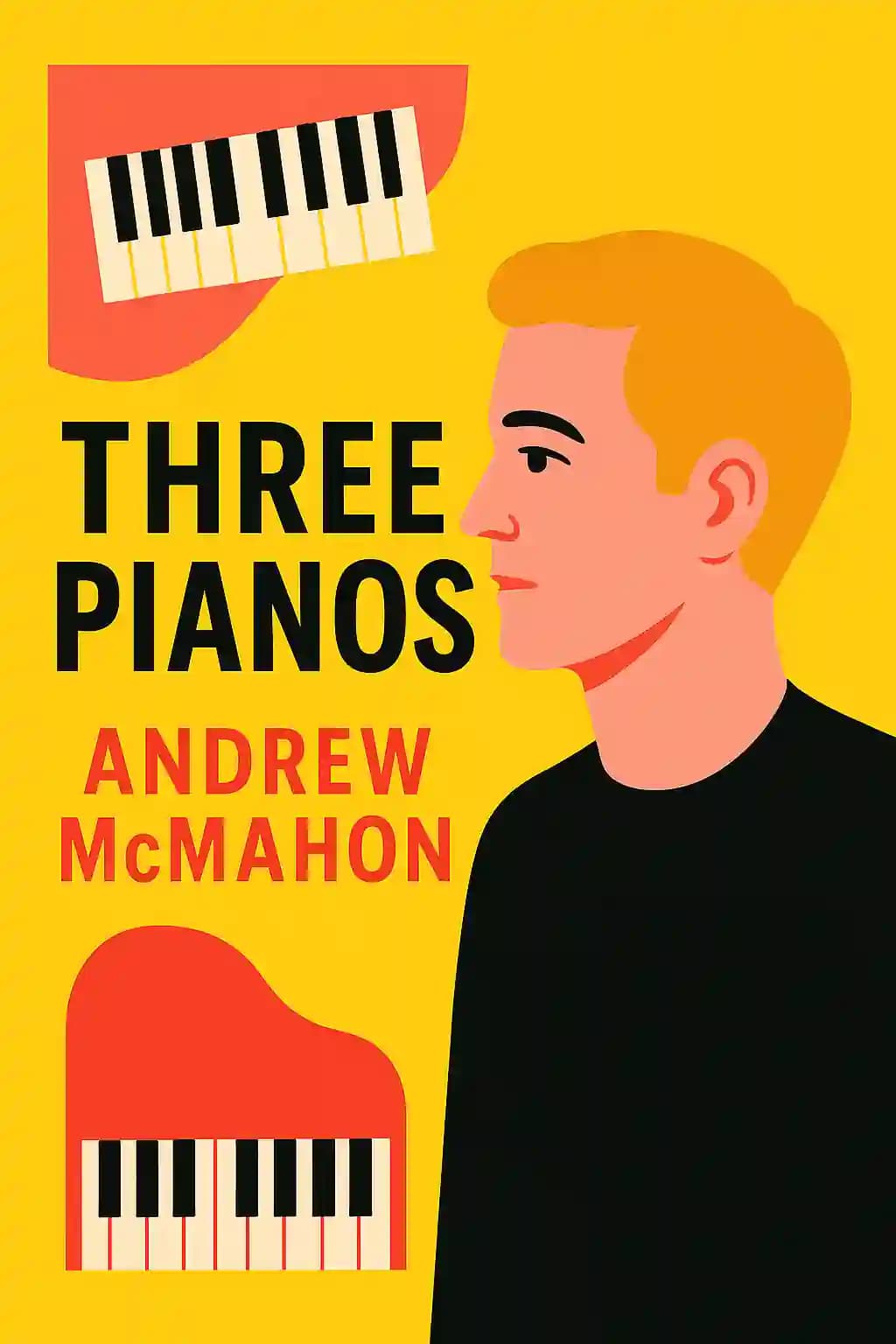
In "Three Pianos," musician Andrew McMahon transforms his leukemia battle, addiction struggles, and music journey into a raw memoir where three instruments become powerful symbols of resilience. His poetic storytelling has fans discovering new meanings in songs they thought they already knew.
Andrew McMahon, renowned musician and memoirist, is the author of Three Pianos: A Memoir, a poignant exploration of resilience, creativity, and the healing power of music. Best known as the indie-rock frontman of bands Something Corporate and Jack’s Mannequin, McMahon weaves his experiences as a child piano prodigy, leukemia survivor, and Grammy-nominated artist into this raw, introspective work.
The memoir delves into themes of family trauma, addiction, and artistic identity, reflecting his nearly three-decade career in music and his role as founder of the cancer-research nonprofit Dear Jack Foundation.
McMahon’s storytelling extends beyond the page through his solo project Andrew McMahon in the Wilderness and the acclaimed documentary Dear Jack, which chronicles his cancer battle. His TEDxTalk on creativity and survival further amplifies his authority on overcoming adversity.
A Billboard-charting artist, McMahon’s music and writing resonate with fans globally, blending vulnerability with anthemic hope. Three Pianos has been celebrated for its lyrical prose and unflinching honesty, cementing McMahon’s legacy as a multifaceted voice in contemporary memoir.
Three Pianos is a memoir by musician Andrew McMahon that chronicles his life through three pivotal pianos, each symbolizing different eras: his childhood as a prodigy, his rise with bands Something Corporate and Jack’s Mannequin, and his battle with leukemia. It explores themes of addiction, resilience, and healing through music, framed by raw reflections on family struggles and personal growth.
This book resonates with fans of McMahon’s music, memoir enthusiasts, and anyone navigating themes of addiction, illness, or creative perseverance. It’s ideal for readers seeking candid narratives about overcoming adversity and the transformative power of art.
Yes—its blend of lyrical prose, heartfelt honesty, and unique structure (addressing pianos as characters) offers a fresh take on the memoir genre. McMahon’s storytelling balances grit with hope, making it compelling for both music lovers and general readers.
Each piano represents a life stage:
These instruments act as metaphors for emotional anchors and creative evolution.
McMahon’s family dynamics drive the narrative, particularly his father’s opioid addiction and his sister’s mental health struggles. Their challenges shape his resilience, while his wife Kelly’s unwavering support becomes a cornerstone of his recovery.
The memoir vividly recounts McMahon’s 2005 leukemia diagnosis, treatment, and recovery, highlighting his physical and emotional battles. His journey underscores the fragility of life and the determination to rebuild after trauma.
Dear Jack chronicles McMahon’s public cancer battle, which he references to contextualize his vulnerability during treatment. The documentary’s raw portrayal complements the memoir’s introspective tone.
McMahon intersperses lyrical letters to his pianos with linear storytelling, creating an intimate, reflective narrative. This structure immerses readers in his emotional landscape and creative process.
Some reviewers note the memoir’s self-critical tone and repetitive themes of self-destruction post-recovery. However, these elements reinforce its authenticity, portraying McMahon’s unvarnished struggles with fame and identity.
Music is framed as McMahon’s lifeline—through composing, he processes trauma, confronts mortality, and rebuilds his life. The pianos symbolize salvation, offering solace during isolation and despair.
The memoir reveals the pressures of fame, creative burnout, and the industry’s emotional toll. McMahon’s candid account demystifies the glamour of touring and highlights the importance of artistic authenticity.
Unlike typical rags-to-riches tales, McMahon’s focus on vulnerability, familial bonds, and near-fatal illness offers a darker, more introspective perspective. Its structural creativity (e.g., piano-centric chapters) sets it apart from linear career retrospectives.
Почувствуйте книгу через голос автора
Превратите знания в увлекательные, богатые примерами идеи
Захватите ключевые идеи мгновенно для быстрого обучения
Наслаждайтесь книгой в весёлой и увлекательной форме
Confronting the past wasn't the family's strength.
Music became his salvation.
On the very best days, a song was born.
Music became his social currency.
Andrew felt whiplash between hope and dread.
Разбейте ключевые идеи Three Pianos на понятные тезисы, чтобы понять, как инновационные команды создают, сотрудничают и растут.
Выделите из Three Pianos быстрые подсказки для запоминания, подчёркивающие ключевые принципы открытости, командной работы и творческой устойчивости.

Погрузитесь в Three Pianos через яркие истории, превращающие уроки инноваций в запоминающиеся и применимые моменты.
Задавайте любые вопросы, выбирайте голос и совместно создавайте идеи, которые действительно находят у вас отклик.

Создано выпускниками Колумбийского университета в Сан-Франциско
"Instead of endless scrolling, I just hit play on BeFreed. It saves me so much time."
"I never knew where to start with nonfiction—BeFreed’s book lists turned into podcasts gave me a clear path."
"Perfect balance between learning and entertainment. Finished ‘Thinking, Fast and Slow’ on my commute this week."
"Crazy how much I learned while walking the dog. BeFreed = small habits → big gains."
"Reading used to feel like a chore. Now it’s just part of my lifestyle."
"Feels effortless compared to reading. I’ve finished 6 books this month already."
"BeFreed turned my guilty doomscrolling into something that feels productive and inspiring."
"BeFreed turned my commute into learning time. 20-min podcasts are perfect for finishing books I never had time for."
"BeFreed replaced my podcast queue. Imagine Spotify for books — that’s it. 🙌"
"It is great for me to learn something from the book without reading it."
"The themed book list podcasts help me connect ideas across authors—like a guided audio journey."
"Makes me feel smarter every time before going to work"
Создано выпускниками Колумбийского университета в Сан-Франциско

Получите резюме книги «Three Pianos» в формате PDF или EPUB бесплатно. Распечатайте или читайте офлайн в любое время.
A piano contains over ten thousand moving parts, each calibrated to perfection, waiting for human touch to bring them to life. When Andrew McMahon's mother unwrapped her birthday gift-a gleaming black piano with keys like a checkerboard matching his incomplete childhood smile-neither could have predicted this instrument would become his lifeline through addiction, cancer, and ultimately, redemption. The piano arrived in their Chicago North Shore home as a symbol of suburban success, but it would evolve into something far more profound: a witness to tragedy, a vessel for grief, and eventually, a bridge back to life itself. While his mother's clicking fake nails danced across classical compositions, young Andrew hid in hallway corners, mesmerized by her musical magic, unknowingly preparing for the day when necessity would bind him to those keys forever. Summer 1991 brought two seismic shifts: a move from Illinois to a shadowy Tudor home in California, and Andrew's first encounter with mortality. His uncle Stuart-the family's buoyant raft-died at thirty-eight from cancer. For a boy about to turn nine, death's machinery was utterly foreign. He slipped a poem into Stuart's coffin lining, believing his uncle might read it in whatever came next. The family moved into their strange new house the very night Stuart was buried, a castle-like structure sitting fifty feet below street level where coyotes howled through Andrew's basement bedroom window. For a month, he cried himself to sleep praying for Stuart's return. Then September arrived with unexpected grace. Sitting before the piano with dangling legs, Andrew formed his first chord-three simple notes a friend had shown him could create six possible combinations. As he stumbled through this progression, something miraculous happened: his voice joined in, completing their circuit. Sunlight poured gold across the trees outside as time both stopped and raced forward. The piano became his sanctuary, music his salvation-a spiritual fire they would tend together on the very best days when songs were born.