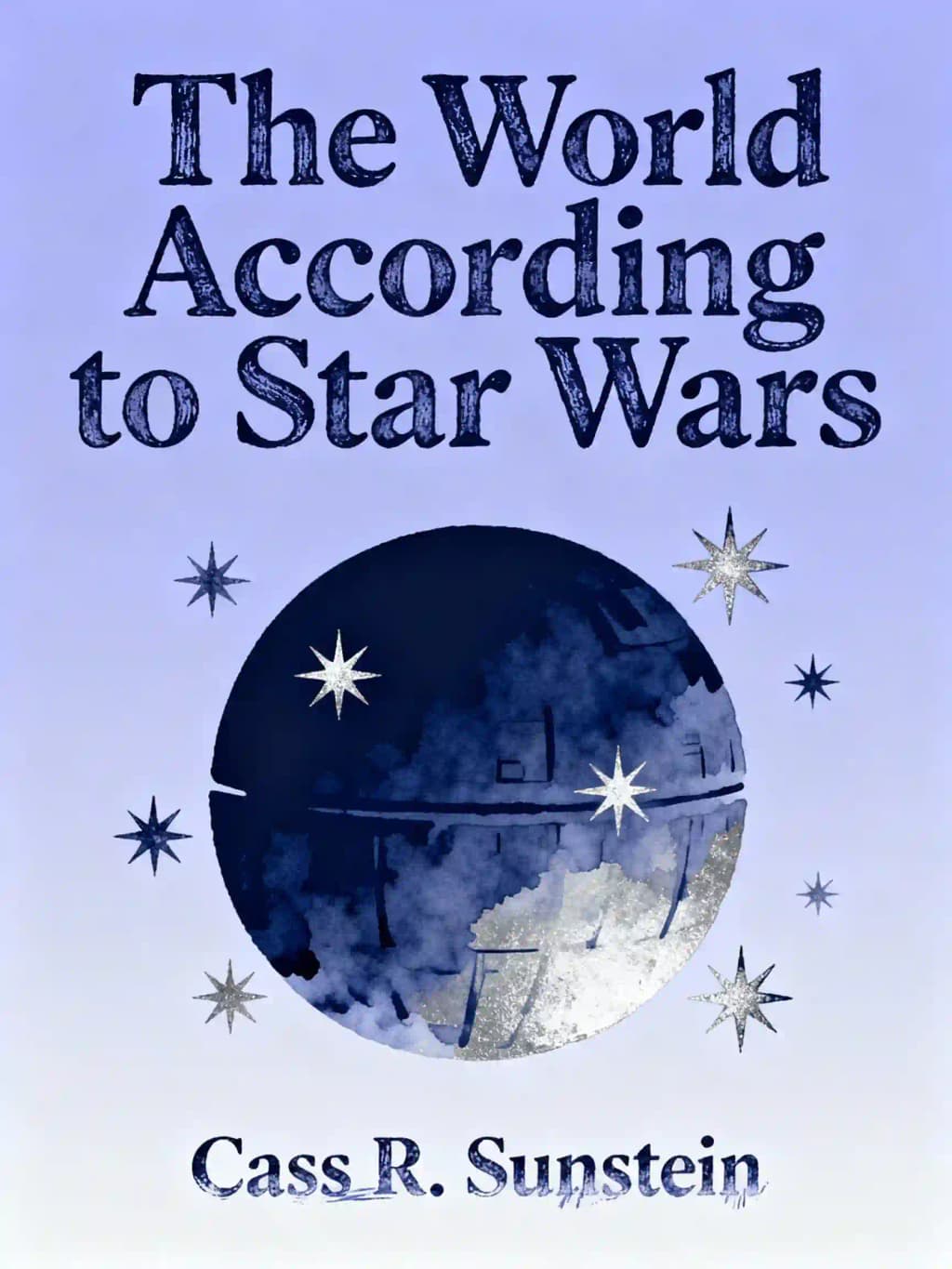
Discover how Star Wars explains constitutional law, politics, and human choice in this New York Times bestseller. Sunstein reveals the saga wasn't meticulously planned - Darth Vader wasn't originally Luke's father! Why did the UN Correspondents Association spotlight this cultural phenomenon?
Cass R. Sunstein, bestselling author of The World According to Star Wars and renowned legal scholar, explores the intersection of pop culture, mythology, and behavioral economics in this non-fiction analysis of the Star Wars phenomenon.
A Robert Walmsley University Professor at Harvard Law School and former Obama administration official (2009–2012), Sunstein brings expertise from constitutional law and nudge theory—a framework he pioneered in his co-authored book Nudge, which revolutionized policy design worldwide. His works like Impeachment: A Citizen’s Guide and #Republic demonstrate his ability to make complex legal concepts accessible to general audiences.
Sunstein’s insights have earned global recognition, including Norway’s Holberg Prize (2018), often described as the Nobel equivalent for law and humanities. A New York Times contributor and frequent media commentator, he combines academic rigor with cultural analysis—a hallmark visible in The World According to Star Wars. This New York Times bestseller has been translated into 28 languages, cementing Sunstein’s status as a leading voice in explaining societal phenomena through unexpected lenses.
The World According to Star Wars explores the cultural phenomenon of the Star Wars saga through legal, behavioral economic, and sociological lenses. Cass R. Sunstein analyzes the franchise’s unexpected success, its themes of free will and rebellion, and ties its narratives to real-world concepts like constitutional law and parenting. The book also delves into George Lucas’s creative process and the societal factors that shaped the films.
This book is ideal for Star Wars fans seeking deeper analysis of the saga’s societal impact, as well as readers interested in pop culture’s intersection with law and economics. Scholars of behavioral science or media studies will appreciate Sunstein’s connections between the films and concepts like social dynamics and choice architecture.
Yes, for its unique blend of entertainment analysis and academic insight. While some critics note uneven pacing in later chapters, the book offers thought-provoking parallels between the Star Wars universe and real-world themes like family bonds, political resistance, and the psychology of fandom.
Sunstein frames the Rebel Alliance’s struggle as a metaphor for constitutional governance, comparing the Empire’s authoritarianism to flawed legal systems. He argues that the saga’s emphasis on collective action and ethical leadership mirrors principles in democratic law.
The book posits that Star Wars champions free choice over destiny, using characters like Anakin Skywalker to illustrate how decisions shape identity. Sunstein ties this to behavioral economics, suggesting societal “nudges” (like the Force) influence choices without removing autonomy.
Sunstein attributes its popularity to universal themes (good vs. evil, family reconciliation), timing in post-Vietnam America, and George Lucas’s innovative storytelling. He also highlights audience-driven social dynamics, where collective enthusiasm sustained its cultural relevance.
Some readers find later chapters overly speculative, with strained comparisons between Star Wars and niche academic topics. Others note the concise format leads to dense sections, particularly in behavioral economics explanations.
He frames Luke and Vader’s relationship as a study in parental legacy and reconciliation, reflecting broader human struggles with inherited trauma. Sunstein connects this to psychological themes of forgiveness and self-determination.
Sunstein references his famed behavioral economics concept, arguing the Star Wars galaxy’s political conflicts mirror how societies are “nudged” toward rebellion or compliance through social norms and institutional design.
While Nudge focuses on policy design, this book applies similar behavioral principles to pop culture, making academic ideas accessible through a beloved narrative. Both emphasize how small influences shape human decisions.
Its analysis of media’s role in shaping societal values remains timely amid debates about storytelling in the AI era. The book’s insights into fandom and collective narratives also resonate with modern discourse on viral content.
Sunstein suggests Star Wars teaches:
He also highlights how art reflects and influences societal debates—a lens applicable to modern media.
Почувствуйте книгу через голос автора
Превратите знания в увлекательные, богатые примерами идеи
Захватите ключевые идеи мгновенно для быстрого обучения
Наслаждайтесь книгой в весёлой и увлекательной форме
The trick is to pretend you've planned the whole thing out in advance.
I don't like that and I don't believe that.
Nobody thought that it was going to be a big hit.
It moves like a son of a bitch, and you don't question too much.
People craved optimism and exhilaration.
Разбейте ключевые идеи The World According to Star Wars на понятные тезисы, чтобы понять, как инновационные команды создают, сотрудничают и растут.
Выделите из The World According to Star Wars быстрые подсказки для запоминания, подчёркивающие ключевые принципы открытости, командной работы и творческой устойчивости.

Погрузитесь в The World According to Star Wars через яркие истории, превращающие уроки инноваций в запоминающиеся и применимые моменты.
Задавайте любые вопросы, выбирайте голос и совместно создавайте идеи, которые действительно находят у вас отклик.

Создано выпускниками Колумбийского университета в Сан-Франциско
"Instead of endless scrolling, I just hit play on BeFreed. It saves me so much time."
"I never knew where to start with nonfiction—BeFreed’s book lists turned into podcasts gave me a clear path."
"Perfect balance between learning and entertainment. Finished ‘Thinking, Fast and Slow’ on my commute this week."
"Crazy how much I learned while walking the dog. BeFreed = small habits → big gains."
"Reading used to feel like a chore. Now it’s just part of my lifestyle."
"Feels effortless compared to reading. I’ve finished 6 books this month already."
"BeFreed turned my guilty doomscrolling into something that feels productive and inspiring."
"BeFreed turned my commute into learning time. 20-min podcasts are perfect for finishing books I never had time for."
"BeFreed replaced my podcast queue. Imagine Spotify for books — that’s it. 🙌"
"It is great for me to learn something from the book without reading it."
"The themed book list podcasts help me connect ideas across authors—like a guided audio journey."
"Makes me feel smarter every time before going to work"
Создано выпускниками Колумбийского университета в Сан-Франциско

Получите резюме книги «The World According to Star Wars» в формате PDF или EPUB бесплатно. Распечатайте или читайте офлайн в любое время.
What makes a story transcend entertainment to become cultural DNA? Star Wars has achieved something remarkable: it's generated over $30 billion in revenue while simultaneously becoming a shared language that connects strangers across continents. Politicians invoke it in debates, diplomats reference it in negotiations, and even people who've never watched the films recognize Darth Vader's breathing. This isn't just commercial success-it's cultural penetration at a depth usually reserved for ancient myths or world religions. The saga offers something increasingly rare: a common reference point in our fragmented world, a story that feels both deeply personal and universally understood.