Глава 1
The Art of Second-Order Decisions: How We Shape Our Lives Through Meta-Choices
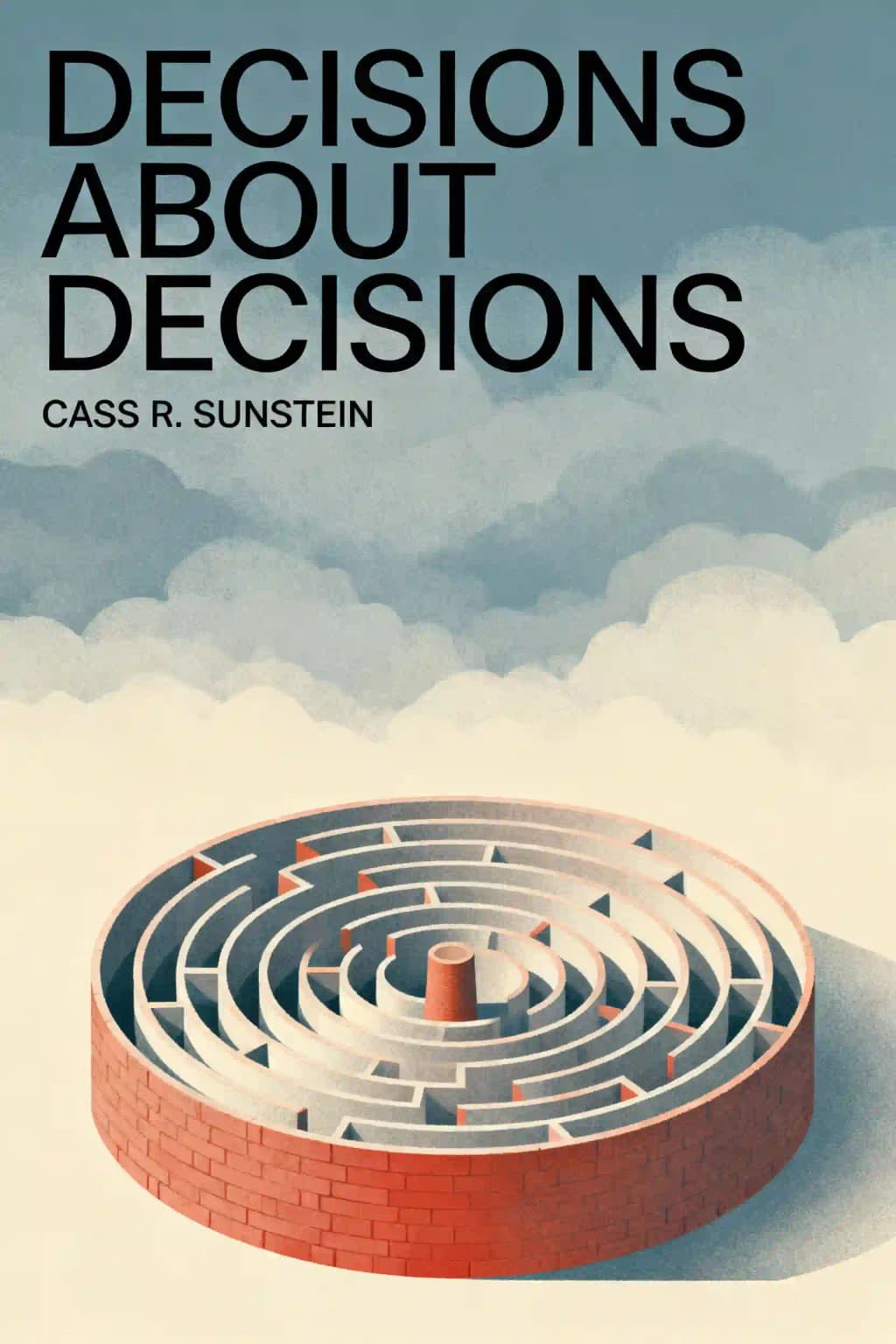
How do we decide how we decide? This fundamental question shapes every aspect of our lives, from mundane daily choices to life-altering decisions. In his groundbreaking book "Decisions About Decisions," Harvard law professor Cass Sunstein explores the fascinating world of second-order decisions-the strategies we use to guide our decision-making processes themselves.
The book has garnered significant attention since its release, with figures ranging from Barack Obama to Daniel Kahneman praising its insights. It's frequently cited in behavioral economics courses at top universities and has influenced policy discussions worldwide. What makes Sunstein's work particularly valuable is how it bridges academic research with practical wisdom, offering a framework that helps us understand why some decision strategies lead to fulfillment while others create misery.
As Frank Ramsey wisely noted, "it is pleasanter to be thrilled than to be depressed, and not merely pleasanter but better for all one's activities." This insight applies not just to what we do, but to how we choose to decide-a distinction that makes all the difference in creating a life well-lived.
Глава 2
The Strategic Arsenal: Eight Ways We Simplify Decision-Making
When facing life's countless choices, we rarely make each decision from scratch. Instead, we develop strategies that simplify our decision-making processes. These second-order decisions help us overcome cognitive limitations and emotional burdens.
The most rigid strategy is establishing rules-complete specifications that eliminate future decisions entirely. "I never eat dessert during weekdays" or "I always save 15% of my income" are personal examples. Organizations similarly use rules: "No exceptions to the speed limit" or "Three strikes and you're out" in criminal justice. Rules provide decisional simplicity but sometimes create absurd outcomes when rigidly applied.
More flexible are presumptions-rebuttable guidelines that provide defaults while allowing exceptions. You might presume against working weekends unless facing a genuine emergency, or presume in favor of accepting social invitations unless you have compelling reasons to decline. Environmental agencies might presume against allowing pollution above certain thresholds unless companies demonstrate that further reductions would be impossible.
Standards offer even more flexibility, providing evaluative principles rather than specific instructions. While a rule specifies "55 mph maximum," a standard simply prohibits "excessive speed." In personal life, we might commit to not eating "too much" or not spending "too much" time on social media-leaving room for contextual judgment.
Routines-self-conscious, voluntary habits-simplify recurring decisions. Unlike mindless habits, routines represent deliberate strategies: taking the same route to work, exercising at the same time daily, or following specific morning rituals. These patterns eliminate constant reconsideration while preserving the option to deviate when circumstances warrant.
When facing complex decisions with uncertain outcomes, small steps allow incremental progress while maintaining reversibility. Living together before marriage, taking night classes before changing careers, or starting a side business before quitting your job exemplifies this approach. Anglo-American common law similarly favors incremental development, with judges typically making narrow decisions that resolve little beyond individual cases.
Sometimes decision difficulty leads to picking-random or arbitrary selection without deliberation. Flipping coins, choosing the first option seen, or using irrelevant factors ("It's sunny, so I'll take the Florida job") exemplifies this strategy. Unlike reasoned "choosing," picking deliberately avoids deliberation when it seems futile or when options appear equally attractive.
Delegation transfers decisions to others-spouses, experts, friends, or institutions-offering relief from decisional burdens. These arrangements vary from casual advice-seeking to binding institutional authority. Delegation works particularly well when others possess greater expertise or when assuming personal responsibility creates special problems.
Finally, heuristics-mental shortcuts-bypass detailed analysis. Voting based on party affiliation simplifies overwhelming local elections; categorizing new acquaintances guides initial social interactions. While some heuristics produce "irrational" results, many generate good outcomes while reducing cognitive overload.
Глава 3
The Cost-Benefit Calculus of Decision Strategies
Every decision strategy balances two fundamental costs: decision costs (the burdens of making choices) and error costs (the consequences of making wrong choices). If decision-making were costless, we'd always make individualized calculations for optimal outcomes. But decisions impose real burdens-emotional, cognitive, and institutional-which is why we often prefer strategies that reduce options or information.
These costs vary qualitatively as well as quantitatively. Decision costs include time, money, stress, anxiety, and anticipated regret. Error costs differ in number, magnitude, and type. Additionally, people sometimes value assuming or avoiding responsibility regardless of outcomes, and institutions often need predictable frameworks for planning purposes.
Different strategies distribute decision burdens differently across time. Rules and presumptions require substantial thought upfront but little on-the-spot (High-Low). Picking and small steps minimize thinking both before and during decisions (Low-Low). Delegation defers burdens to others (Low-High). The worst approach-requiring intensive deliberation both before and during decisions (High-High)-is typically counterproductive except for life's most important choices.
Consider how this plays out with rules. Creating good rules requires significant initial investment-you must anticipate various situations and determine appropriate responses. Once established, however, rules make subsequent decisions mechanical. This High-Low approach works well for planning and organizations with high turnover, where consistency matters more than perfect outcomes in each case.
The optimal strategy depends on context. When facing numerous similar decisions requiring advance planning rather than improvisation, High-Low strategies like rules make sense. When stakes are low or decisions are emotionally difficult, Low-Low approaches like picking work better. When others have greater expertise or trustworthiness, delegation (Low-High) becomes attractive.
Глава 4
The Delegation Dilemma: When and How to Transfer Decisions
Delegation-transferring decision authority to others-deserves special attention because it fundamentally changes who bears the burden of choice. People delegate when they dislike making certain decisions, doubt their capacity to decide wisely, or seek to avoid responsibility.
In daily life, we constantly engage in informal delegation-spouses deciding dinner choices, friends selecting restaurants, colleagues determining meeting times. These arrangements work best when decision burdens are high for the delegator but low for the delegate, who may have specialized knowledge or actually enjoy the responsibility.
In business and government, delegation often stems from similar motivations. Government itself represents delegated authority from citizens, with further subdelegations occurring when legislatures lack information, consensus, time, or immunity from interest-group pressures. The Federal Reserve's independence exemplifies how delegation can insulate necessary but unpopular decisions from political influence.
Delegation merits consideration whenever trustworthy delegates are available and self-decision seems undesirable. Yet delegation can become an abdication of responsibility, create unfairness, or generate more errors than alternatives. It works best when the delegator cannot handle decision burdens or create workable rules, while the delegate would perform adequately or better.
Three complications affect delegation. First, delegates themselves often resort to second-order decisions-creating rules, proceeding incrementally, or even subdelegating further. Second, controlling delegates presents principal-agent problems, solvable through various mechanisms from treating delegates as mere consultants to retaining power to revoke delegation. Third, delegation's initial burdens may not be low after all, as choosing whether and to whom to delegate can itself become complex.
Can we delegate decisions to our future selves? While not precisely analogous to interpersonal delegation, procrastination on major life decisions effectively delegates choice to one's future self. This intrapersonal delegation occurs either because timing seems wrong for deciding now or because you believe your future self will have better information or judgment. Like delegation to others, this approach creates principal-agent problems between your current and future selves.
Глава 5
The Transformative Power of Life-Changing Choices
Some decisions are fundamentally transformative, creating potential upheaval that may be simultaneously exhilarating and searing, putting our deepest values and preferences at risk. These pivotal moments - like choosing a career path, deciding to have children, or relocating to a new country - force us to consider what we're truly trying to maximize in life: happiness (immediate pleasure and satisfaction), eudaimonia (flourishing and meaning), or psychological richness (diverse, perspective-altering experiences that challenge our worldview).
Transformative choices create a fascinating psychological phenomenon where people often become equally satisfied with either path they choose, adapting to and finding meaning in their decisions. Had Margaret remained childless, she might have developed strong preferences for a child-free life, cherishing her freedom, career advancement, and spontaneous travel. Had Susan stayed a lawyer instead of becoming a writer, she might have found the idea of writing "a reckless dream," taking pride in her legal achievements and courtroom victories. This adaptability demonstrates our remarkable capacity to construct meaning around our choices.
Research consistently suggests people report greater satisfaction after making major life changes than when maintaining the status quo, even when those changes initially seemed daunting. When facing transformative decisions, we confront not just our current self but a "counterfactual person" - a different version of ourselves who would exist had we chosen differently. This creates a unique decision-making challenge, as philosopher Edna Ullmann-Margalit suggests, where for our most fundamental choices, we eventually "run out of reasons" and must choose without complete justification or certainty.
An alternative framework is to evaluate decisions based on their holistic effects on our welfare - considering the interplay between pleasure, purpose, and psychological richness. Different individuals reasonably weight these elements differently based on their values and temperament. Some prioritize stability and contentment, while others seek growth through challenge and novel experiences. While moral considerations and impacts on others remain crucial factors, when focusing on personal welfare, people must attempt to predict their subjective experience under different possible futures, acknowledging the inherent uncertainty in such predictions.
As Theodore Roosevelt compellingly suggested, a life of challenge, growth, and richness might ultimately outweigh mere contentment or comfort. For truly transformative choices, we must deeply consider what makes life good for us individually, while recognizing that our values, preferences, and even our fundamental identity may shift dramatically after we make our choice. This understanding can both liberate us from paralysis and remind us to approach such decisions with appropriate gravity and self-reflection.
Глава 6
The Information Paradox: When Knowledge Hurts
Information isn't always beneficial. Sometimes we don't want to know (lacking motivation to learn) and sometimes we want not to know (actively avoiding information). People might avoid learning about health risks in foods they enjoy, genetic predispositions to disease, colleagues' opinions, or their likely death date.
People typically want information for two main reasons: instrumental value (enabling better decisions) or affective value (producing positive feelings). Information has power-it can help us improve performance, make money, reduce health risks, or make better purchases. Some knowledge is valued not for utility or pleasure, but because it contributes to a fuller, richer life-understanding Shakespeare, Earth's origins, or human history may have intrinsic value regardless of practical application.
However, much information lacks practical value-knowing the height of everyone born in Paris in 1920 won't change how we live. Some information induces negative feelings: learning about a loved one's death date, bad medical test results, or unethical labor practices behind products we enjoy. Information can even have negative instrumental value when knowing hurts performance-lawyers might better defend clients without knowing their guilt, and patients might fight illness more effectively without knowing poor odds.
Research reveals significant heterogeneity in information-seeking behavior. People's willingness-to-pay varies dramatically by information type: modest amounts for practical information like calorie counts ($15 median), but substantial sums for existential knowledge like whether heaven exists ($200 median). For consumer information, despite its apparent usefulness, many remain uninterested-only 62% want to know credit card late payment fees, 60% want GMO information, and 67% want tire safety ratings.
When people decide whether to seek information, their choice typically depends on whether the information offers utility, pleasure, or both. The human condition often presents difficult cases where information is useful but unpleasant to receive. People's decisions resemble high-stakes poker: optimists might seek potentially devastating information, while those averse to short-term losses might avoid information that could save their lives-a troubling paradox for human decision-making.
Глава 7
Belief Formation: The Climate Change Case Study
Obtaining information differs fundamentally from adopting beliefs. While beliefs typically depend on information, people may ignore, discredit, or dismiss information-sometimes justifiably, sometimes not. The relationship between volition and belief is complex; we often don't consciously "decide" to believe basic facts, yet our beliefs ultimately rest on decisions about what constitutes credible evidence.
Climate change presents a perfect case study in belief formation amid uncertainty. With projections ranging from modest (0.5F warming by 2100) to catastrophic (8.6F), and constantly evolving scientific estimates, people must decide what to believe with incomplete information.
Research reveals three distinct patterns in how people update their climate beliefs: Strong believers in climate change update their views significantly more when receiving unexpectedly bad news than good news. Climate skeptics show the opposite asymmetry, updating beliefs only when receiving unexpectedly good news while ignoring bad news entirely. Those with moderate initial beliefs update equally regardless of whether news is good or bad.
Two explanations account for this asymmetrical updating. The first involves motivated reasoning: people with low climate change belief find good news doubly pleasing (confirming both their temperature predictions and their stance on climate change), while completely dismissing bad news as alarmist. High believers may find bad news affirming of their concerns, while good news creates cognitive dissonance by suggesting their alarm was unwarranted.
The second explanation is purely cognitive: people may be rationally updating based on their priors, finding information consistent with their existing beliefs more credible than contradictory information. Either way, these patterns help explain why new information often increases rather than decreases polarization on divisive issues.
These findings have broad implications beyond climate science. When people receive variable information about any contentious topic, polarization increases rather than decreases. Those most concerned revise estimates upward upon receiving bad news, while those least concerned revise downward with good news. This asymmetry fuels polarization across domains including personal health, finance, terrorism, immigration, and policy effects.
Глава 8
The Multidimensional Value of Beliefs
Belief change operates as a value-based decision where every belief carries utility. People change beliefs when a new belief's expected utility exceeds that of their old belief. This utility derives from multiple dimensions categorized into external and internal outcomes, each with accuracy-dependent and accuracy-independent components.
External outcomes include accuracy-independent consequences (like monetary rewards or social acceptance that occur regardless of whether the belief is accurate) and accuracy-dependent consequences (external benefits from holding accurate beliefs and costs from holding inaccurate ones). If someone believes the stock market will rise and invests accordingly, they gain money if correct but lose if wrong.
Internal outcomes similarly divide into accuracy-independent effects (cognitive and affective outcomes derived directly from a belief itself, regardless of external consequences or accuracy) and accuracy-dependent effects (where believing something inaccurate leads to greater disappointment later). Believing one will earn a good grade creates immediate positive feelings but leads to greater disappointment if a failing grade arrives.
The brain implicitly combines expectations about various outcomes to determine each belief's overall utility. Belief formation becomes a multi-attribute value-based decision problem aimed at holding beliefs with the highest value rather than the most accurate beliefs. These calculations often occur unconsciously, similar to many other brain processes that drive decisions.
This framework explains why factual corrections sometimes fail to counter misinformation-people resist changing beliefs that threaten their identity or affiliations. "Surprising validators" who are credible but unexpected can overcome this resistance. In education, addressing accuracy-independent aspects of self-efficacy beliefs (like peer pressure) may help close gender gaps in STEM confidence.
People ultimately hold beliefs that maximize utility, which comes from weighing all potential outcomes-both accuracy-dependent and accuracy-independent. Religious beliefs might reduce stress and provide social acceptance regardless of accuracy. Health risk beliefs might cause fear and sadness people prefer to avoid. This explains why belief change isn't simply about improving accuracy but adopting higher-utility beliefs.
Глава 9
The Social Dimension of Consumption
Critics often characterize market relationships as atomistic and alienating, but consumption patterns frequently reflect social and communal impulses. Consumers relate not only to products but to other customers, seeking solidarity and belonging through their choices.
Goods can be categorized based on their relationship to others' choices. "Solitary goods" like morning coffee have value independent of others' consumption. "Social goods" derive value from others' consumption patterns and divide into two types: "solidarity goods" increase in value when widely enjoyed (like popular media), while "exclusivity goods" decrease in value with widespread use (like limited-edition art).
Many goods become more valuable when widely enjoyed-movies, presidential debates, national monuments, or millennium celebrations. Their worth stems partly from benefits derived from shared consumption. The value can be intrinsic (enjoying something others enjoy) or instrumental (leading to valuable social interactions).
Conversely, exclusivity goods are valued precisely because few others enjoy them. These status-related or positional goods become less valuable as more people consume them. In extreme cases, an exclusivity good has value only because one person alone enjoys it.
Demi-solidarity goods occupy a middle ground where value decreases if either too many or too few people participate. You might avoid restaurants that are either overcrowded or empty, or attend political rallies only if moderately sized. Similarly, many follow fashion without wanting to blend completely or stand out excessively.
A society with few solidarity goods faces numerous problems. Shared experiences-even traumatic ones-create a sense of common endeavor among diverse people, promoting social cohesion and stability. When solidarity goods are numerous, people more readily see each other as fellow citizens with shared interests. Beyond "social capital" (relationships promoting reciprocity), societies need "solidarity capital"-shared experiences fostering trust, altruism, and norms that solve collective action problems.
Глава 10
The Paradox of Social Media: Paying to Be Less Happy
Social media consumption presents a fascinating paradox. Research shows that while Facebook makes people slightly less happy on average (more depressed, anxious, and less satisfied), those who experience increased well-being after ceasing use still demand significant compensation to give it up permanently.
A study with Facebook users revealed a striking disparity between willingness to pay (WTP) and willingness to accept (WTA) for the platform's use. When asked how much they would pay monthly for Facebook, users gave a median answer of just $1 (average $7.38), with nearly half (46%) saying they would pay nothing. However, when asked how much compensation they would require to stop using Facebook, the median jumped to $59 monthly (average $74.99).
Even more striking, research by Hunt Allcott and colleagues found that deactivating Facebook accounts for four weeks actually increased users' well-being, creating a puzzling situation where people demand payment to give up something that apparently makes them less happy. Those who deactivated experienced decreased depression and anxiety while improving happiness and life satisfaction. Users gained about sixty minutes daily, which they spent with friends, family, or watching television alone.
Yet paradoxically, after experiencing these benefits, users still demanded a median of $87 to continue their Facebook abstinence for another month. Multiplied across Facebook's 240 million American users, this suggests hundreds of billions in annual consumer surplus.
Two possibilities might resolve this paradox. First, people might be making a mistake when valuing Facebook access at $87 monthly. This valuation could reflect mere habit, social norms, or even addiction rather than genuine welfare enhancement. When breaking the habit, they discover they're better off, yet still demand payment to continue abstaining.
The second possibility is that survey measures of well-being fail to capture everything people truly value. Facebook users might follow politics not to be happy but because they believe good citizens should stay informed. They might value knowing about friends' lives as inherently worthwhile, even when this knowledge doesn't increase happiness.
Глава 11
The Promise and Peril of Algorithmic Decision-Making
Algorithmic decision-making has become an increasingly common second-order strategy across domains from medical diagnosis to hiring decisions. The fundamental claim is that algorithms can overcome harmful cognitive biases that affect even trained, experienced professionals.
Research by Kleinberg and colleagues compared algorithmic versus human judicial decisions about pretrial release of criminal defendants. Using the same data available to judges at bail hearings, their algorithm dramatically outperformed human judges on every relevant dimension. The algorithm could either maintain current detention rates while reducing crime by 24.7 percent, or maintain current crime rates while reducing jail populations by 41.9 percent.
A key factor in judges' underperformance is "Current Offense Bias"-they underestimate risk when the current charge is minor (despite other risk factors) and overestimate risk when the current charge is serious (despite other mitigating factors). The algorithm avoids this bias by properly weighting the current charge within the context of other relevant factors.
Beyond bias, human judgment suffers from noise-unwanted variability in decisions. While bias creates systematic errors, noise creates a decision lottery-which doctor you see determines your treatment. A major advantage of algorithms is their consistency. Unlike humans, they produce the same answer every time given the same inputs.
Despite algorithms' superior performance, many people resist algorithmic decision-making. This resistance stems partly from valuing personal agency-people often prefer to make their own decisions even knowing they'll get worse outcomes. Agency has intrinsic value, and people demand a premium to surrender it.
People are less forgiving of algorithms than humans. They readily forgive human mistakes but lose faith in algorithms after seeing them err, even when algorithms outperform humans overall. This leads to the irrational preference for making our own decisions despite knowing algorithms would yield better results.
While algorithms can eliminate cognitive biases, addressing discrimination is more complex. They can prevent disparate treatment by not considering protected characteristics, but disparate impact remains challenging. The greatest virtue of algorithms is transparency-they make tradeoffs between competing values like racial balance and crime reduction explicitly clear, allowing us to see precisely what we gain and lose with different approaches.