Глава 1
A Journey Through Shadows and Starlight
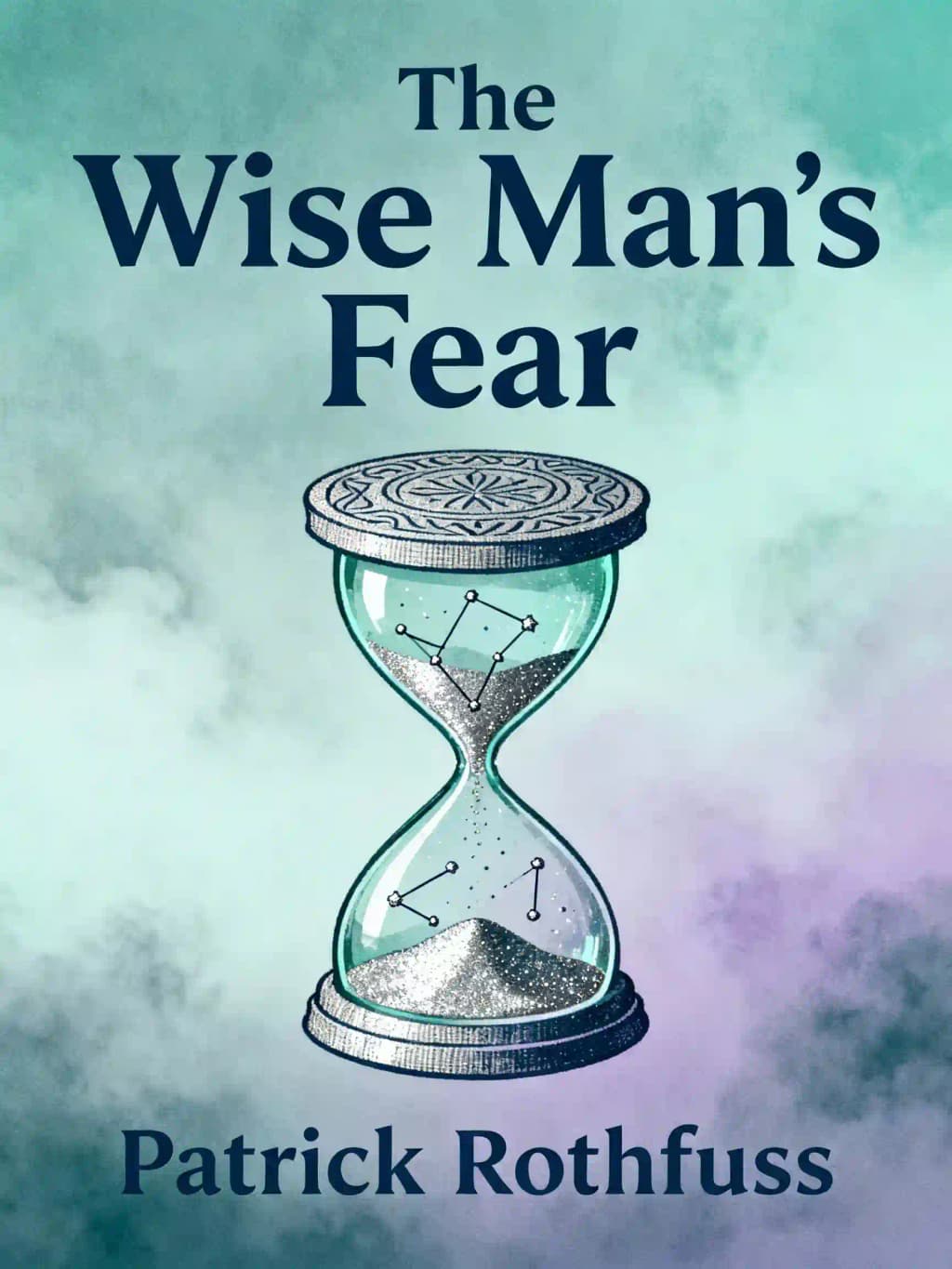
The Wise Man's Fear by Patrick Rothfuss stands as a masterpiece of modern fantasy, continuing the tale of Kvothe the Bloodless. Published in 2011 as the second installment in The Kingkiller Chronicle, it quickly became a New York Times bestseller and cemented Rothfuss's reputation as one of fantasy's most lyrical voices. The book has garnered a cult following, with fans including Lin-Manuel Miranda (who's involved in adapting it for screen) and fantasy author Brandon Sanderson, who praised its "beautiful language and deep characterization." Its cultural impact extends beyond literature-the fictional "tak" game described in the book has been developed into a real board game, and phrases like "the patient, cut-flower sound of a man waiting to die" have become iconic in fantasy literature circles.
Глава 2
The Silence of Storytelling
The story continues at the Waystone Inn where Kvothe-now living as the innkeeper Kote-resumes telling his life story to Chronicler with Bast in attendance. The framing narrative reveals a world falling into chaos, with strange creatures appearing and social order breaking down. Reports of demon-road attacks increase, while travelers speak of entire towns going dark. Meanwhile, Kvothe seems a shadow of his legendary self, unable to perform even simple sympathy bindings or play the music that once earned him fame across the Four Corners of Civilization.
There's a haunting quality to these interludes, punctuated by the recurring motif of silence. "It was night again. The Waystone Inn lay in silence, and it was a silence of three parts," Rothfuss writes, establishing the atmospheric tension that permeates the story. This silence represents not just the absence of sound but the absence of Kvothe's true self-his music, his magic, his very identity. The first silence is the hollow echo of empty roads outside; the second, the quiet of the inn itself; and the third, the greatest silence, emanates from Kvothe himself, "wrapped in a blanket of faded memories and waiting to die."
What makes these sections so compelling is how they contrast with the vibrant, active protagonist of the inner narrative. The frame story Kvothe moves with "the precision of an innkeeper," while in his tale, he moves with "the grace of a dancer." His hands, once capable of creating the most beautiful music ever heard at the University, now mechanically polish glasses and serve drinks. This juxtaposition creates an underlying tension that drives reader engagement-what could possibly transform the brilliant, capable young man of the story into the resigned innkeeper of the frame? The careful way he maintains his disguise as Kote suggests both practice and purpose, hinting at deeper reasons for his self-imposed exile.
When Chronicler and Bast learn that Kvothe spoke with the Cthaeh-a malevolent oracle whose every interaction leads to disaster-the stakes of the narrative suddenly escalate. Bast's horror reveals that Kvothe's story isn't just a personal tragedy but potentially a world-shaping catastrophe in progress. The Cthaeh, bound to a great tree in the Fae realm, sees all possible futures and speaks only to cause the most harm possible. Every hero who has ever spoken to it has brought ruin, from Lanre who destroyed six cities to Jax who stole the moon. This revelation casts a dark shadow over everything Kvothe has done since that encounter, suggesting his actions, however well-intentioned, may be part of some greater tragedy still unfolding.
Глава 3
University Trials and Tribulations
Returning to the University, Kvothe faces familiar challenges with new complications. His rivalry with Ambrose Jakis intensifies when Ambrose steals Denna's ring and later attempts to poison Kvothe with a "plum bob"-a drug that strips away inhibitions while leaving rational thought intact. This leads to one of the novel's most vulnerable moments, as Kvothe breaks down in Auri's arms, mourning his lost parents.
What distinguishes these University sections is how they balance magical education with universal coming-of-age experiences. Kvothe's financial struggles, his complicated friendship with Denna, and his navigation of academic politics feel authentic despite the fantasy setting. When he's forced to pawn his precious lute, the anguish is palpable-it's not just an instrument but his connection to his lost family and true self.
The University sections also expand the novel's magical systems. Through Master Elodin's eccentric teaching methods, we learn more about Naming-a primal form of magic requiring one to understand the true nature of things. "Small facts lead to great knowing," Elodin tells his students, "just as small names lead to large names." This philosophy extends beyond magic to become a central theme of the book: true understanding requires looking beneath surfaces.
Perhaps most poignant is Kvothe's relationship with Auri, the fragile girl who lives in the "Underthing" beneath the University. Their interactions highlight Kvothe's capacity for gentleness and understanding. When he plays music for her on the rooftops, we see a different side of him-not the clever trickster or determined scholar, but someone capable of profound connection.
Глава 4
The Maer's Service and Court Intrigue
When financial pressures force Kvothe to leave the University temporarily, he travels to Severen to serve Maer Alveron-one of the most powerful nobles in the Commonwealth. This section plunges Kvothe into a world of courtly intrigue where words carry double meanings and power dynamics shift beneath polite conversation.
The Maer's court introduces fascinating new characters, particularly Bredon, who teaches Kvothe the game of tak. Their matches become metaphors for court politics, with Bredon emphasizing that winning isn't the goal-"the point is to play a beautiful game." This philosophy contrasts sharply with Kvothe's usual approach of seeking the quickest path to victory, challenging his worldview.
Kvothe's discovery that the Maer is being slowly poisoned by his arcanist Caudicus showcases his cleverness, but also his naivety in court matters. His direct approach nearly gets him killed before he learns to navigate the subtle currents of noble politics. This section brilliantly illustrates how different types of intelligence are valued in different contexts-Kvothe's academic brilliance doesn't automatically translate to social acumen.
The courtship plot between the Maer and Meluan Lackless adds another layer of complexity, especially when Kvothe realizes that Meluan's hatred of the Edema Ruh (traveling performers like Kvothe's family) stems from her sister running away with a trouper-possibly Kvothe's own father. This connection, which Kvothe himself doesn't fully recognize, adds dramatic irony that enriches the narrative.
Perhaps most intriguing is the Lackless box-an ancient heirloom with no visible opening that contains something that shifts inside. This mysterious object connects to folklore Kvothe has known since childhood and hints at deeper secrets tied to the world's history and the Chandrian, the mysterious beings who killed Kvothe's family.
Глава 5
Bandits in the Forest
Sent by the Maer to deal with bandits attacking tax collectors, Kvothe leads a small band of mercenaries into the Eld forest. This expedition marks his first real leadership role and tests his ability to command respect from hardened professionals who doubt his youth and inexperience.
The forest journey showcases Rothfuss's talent for character development through group dynamics. Dedan's bluster, Hespe's practicality, Marten's woodcraft, and Tempi's alien stoicism create a complex social ecosystem that Kvothe must navigate. Particularly compelling is the unspoken attraction between Dedan and Hespe, which Kvothe observes with a mixture of amusement and frustration at their mutual blindness.
This section also introduces the Adem culture through Tempi, a mercenary whose reserved manner and strange customs fascinate Kvothe. Their philosophical discussions about the Lethani-a concept encompassing right action and moral behavior-provide some of the novel's most thought-provoking moments. When Tempi explains that the Lethani is not rules imposed from outside but knowledge that lives within, he articulates a sophisticated ethical framework that contrasts with the Commonwealth's more rigid structures.
The bandit confrontation culminates in one of the book's most dramatic displays of magic, as Kvothe calls down lightning to defeat the bandits. This moment of power comes with a price-Kvothe nearly dies from the effort, and the leader of the bandits (whom readers recognize as Cinder, one of the Chandrian) escapes. The scene demonstrates both Kvothe's growing abilities and the limitations of his power when facing truly ancient evils.
Глава 6
The Fae Realm and Felurian
Following the bandit encounter, Kvothe has his most fantastical adventure when he pursues the legendary Felurian into the Fae realm. This seductive being from folklore is known for luring men to their deaths through exhaustion or madness, yet Kvothe not only survives but negotiates his release-after months of being her lover and student.
The Felurian sequence represents a dramatic shift in tone and setting. Time flows differently in the Fae, and normal physics don't apply. The perpetual twilight, strange creatures, and altered rules create a dreamlike quality that contrasts sharply with the grounded realism of earlier sections. This otherworldliness is captured in Rothfuss's lyrical prose: "The air itself was different. It felt thicker, somehow. The colors were richer, the shadows deeper."
Kvothe's confrontation with Felurian showcases his growing magical ability. When she attempts to enslave his mind, he enters a state of perfect awareness where his "sleeping mind" awakens, allowing him to see her true nature and sing a song that captures her essence. This demonstration of naming magic impresses even Felurian, who agrees to let him return to the mortal world eventually.
Beyond the adventure aspects, this section explores themes of sexuality, power, and storytelling. Felurian teaches Kvothe not just about physical intimacy but about the power of reputation. When he threatens to write a mediocre song about her, she's more terrified than when he nearly killed her with magic-understanding that in stories, immortality of a different kind is at stake.
The Felurian episode also provides crucial worldbuilding information. Through her, Kvothe learns that the Amyr (a group he's researching) were not originally human, and that the Chandrian are feared even in the Fae realm. Most significantly, Kvothe encounters the Cthaeh-a malevolent oracle trapped in a tree whose perfect knowledge of future possibilities allows it to cause maximum harm with just a few carefully chosen words.
Глава 7
The Ways of the Adem
Following his time with Felurian, Kvothe travels to Ademre with Tempi, who faces punishment for teaching an outsider their martial arts. This section presents the novel's most fully realized foreign culture, with its own language, customs, and philosophical framework centered around the Lethani.
The Adem challenge Western fantasy conventions by inverting familiar gender dynamics-women hold most positions of authority, and their society views emotional expressiveness (rather than physical modesty) as shameful. Their belief that men have nothing to do with human reproduction initially strikes Kvothe as absurd, but Rothfuss uses this cultural difference to explore how deeply held beliefs shape perception.
Kvothe's training under Vashet, "the Hammer," provides some of the book's most profound character development. Unlike University education, which comes naturally to Kvothe, the Ketan (the Adem martial art) requires him to unlearn habits and embrace unfamiliar concepts. His struggles humanize him and demonstrate growth beyond his natural talents.
The Adem's approach to violence offers a fascinating philosophical counterpoint to conventional fantasy heroics. They view fighting not as glorious but as a regrettable necessity, taking no pleasure in combat itself but only in following the Lethani. When Vashet explodes with anger after Kvothe suggests he's learning sword techniques merely to win fights, she articulates this philosophy: "You think I am teaching you to win fights? What a laughable little mind you have."
The culmination of this section-Kvothe's test at the sword tree-combines physical challenge with philosophical depth. Rather than fighting his way through whirling leaves that could slice his skin, he uses his naming ability to still the wind, then walks out empty-handed. This choice demonstrates his understanding that the test wasn't about obtaining a prize but about revealing character through action.
Глава 8
Revenge and Reckoning
After leaving Ademre with his newly earned sword Caesura, Kvothe encounters a group of bandits who have committed an unforgivable transgression - impersonating the Edema Ruh while kidnapping and abusing two young girls. This section contains some of the novel's darkest material, as Kvothe methodically plans and executes his revenge. He first gains their trust by playing the part of a fellow traveler, sharing their fire and food, while secretly lacing their drinks with a powerful sleeping draught. What follows is a systematic elimination of the entire false troupe, carried out with a cold precision that startles even Kvothe himself.
The vengeful massacre marks a crucial turning point in Kvothe's moral journey, revealing depths of darkness within him that even he didn't know existed. While he justifies his actions as necessary protection of the Ruh name and the rescue of innocent victims, the calculated nature of the killings reveals a disturbing capacity for premeditated violence. Particularly chilling is his treatment of their leader, Alleg, whom he leaves to die slowly from a gut wound - a death chosen specifically for its prolonged suffering. "I did the most terrible thing I have ever done," Kvothe later confesses in his narrative. "It was the worst thing I have ever done. I have never done anything so terrible since." The weight of these words becomes heavier when considering Kvothe's numerous other violent encounters throughout the series.
The aftermath in Levinshir, where Kvothe returns the girls to their families, serves as a bitter lesson in the persistence of prejudice. Despite his heroic rescue, the townspeople's reaction is mixed with undercurrents of suspicion and distrust. Some openly question his motives, while others whisper about "Ruh tricks" behind his back. Even the grateful parents of the rescued girls show subtle signs of unease when learning of his heritage. This section powerfully illustrates how deeply ingrained prejudices can persist even in the face of direct evidence contradicting them. The town's reaction mirrors larger societal patterns where individual actions, no matter how noble, often fail to overcome collective biases.
Upon returning to Severen, Kvothe's forced revelation of his Edema Ruh heritage to Meluan Lackless - known for her particular hatred of the Ruh - proves catastrophic to his carefully built position at court. Though the Maer Alveron acknowledges Kvothe's service with a writ of performance and continued funding for his education, the loss of his patronage represents a significant setback. This outcome demonstrates how societal prejudices can abruptly close doors of opportunity, regardless of an individual's merit, achievements, or proven loyalty. The incident serves as a harsh reminder that in this world, birth and blood often matter more than deeds and character.
The entire sequence, from the brutal revenge to its aftermath, represents a crucial turning point in Kvothe's story, where his actions, though arguably justified, lead to consequences that ripple throughout the remainder of the narrative. It raises complex questions about justice, vengeance, and the price of upholding honor in a world bound by rigid social prejudices.
Глава 9
The Weight of Knowledge
Throughout the novel, Kvothe's search for information about the Chandrian and the Amyr drives much of his motivation. This quest for knowledge takes on moral complexity as he discovers that information itself can be dangerous or manipulated.
The University Archives become a metaphorical labyrinth where Kvothe searches for truth among contradictory accounts. His discovery that someone has been systematically removing information about the Amyr suggests a conspiracy spanning centuries. "It's not what's missing," he realizes, "it's the pattern of what's missing."
His conversation with the Cthaeh represents the novel's most disturbing exploration of knowledge. This being, which sees all possible futures, uses its perfect knowledge to cause maximum harm. It reveals that Denna's mysterious patron beats her and that Cinder-one of his parents' killers-was the bandit leader who escaped him. These painful truths, delivered with malicious intent, raise the question of whether some knowledge is better left undiscovered.
The Lackless box represents knowledge physically contained-something ancient and powerful locked away for good reason. When the Maer suggests simply breaking it open, both Kvothe and Meluan are horrified by the suggestion. Some secrets, the novel suggests, deserve patient understanding rather than forced revelation.
Perhaps most poignantly, Kvothe gains knowledge about himself through others' perspectives. When Vashet sees something "dark and troubling" in his nature that even the Lethani cannot fix, it forces him to confront aspects of himself he's avoided acknowledging. Similarly, his conversations with Denna about her mysterious patron reveal his own hypocrisy-he judges her choices while making similar compromises in his own life.
Глава 10
The Unfinished Symphony
As the novel concludes, Kvothe returns to the University with new wealth, skills, and reputation. Yet despite these outward successes, fundamental questions remain unanswered, and new complications arise. His relationship with Denna grows more strained after their argument about her song portraying Lanre (whom Kvothe believes is Haliax, leader of the Chandrian) as a hero rather than villain.
The frame story reminds us that this younger, successful Kvothe will somehow transform into Kote the innkeeper-a man who has lost or surrendered his magic, who cannot open his mysterious thrice-locked chest, and who seems to be waiting to die. The contrast between the rising action of the inner narrative and the apparent defeat of the frame creates a powerful narrative tension.
In perhaps the novel's most meta moment, Bast and Chronicler discuss the implications of Kvothe having spoken with the Cthaeh. If this malevolent being truly sees all futures and chooses the most destructive path, then Kvothe himself has become "like a plague ship sailing for a harbor," spreading catastrophe wherever he goes. This revelation recontextualizes the entire narrative-suggesting that Kvothe's seemingly heroic journey might be part of a greater tragedy.
The novel's title-The Wise Man's Fear-comes from a saying Kvothe learns: "There are three things all wise men fear: the sea in storm, a night with no moon, and the anger of a gentle man." By the end, we've seen Kvothe encounter all three, particularly the last as his own gentle nature gives way to moments of terrible anger and violence.
Like all middle volumes in trilogies, The Wise Man's Fear leaves us suspended between what was and what will be. But unlike many middle books, it doesn't merely bridge the beginning and end-it deepens and complicates the story in ways that transform our understanding of everything that came before. The young man's journey continues, but the shadow of the broken innkeeper looms over every triumph, reminding us that this tale, for all its beauty and adventure, is ultimately a tragedy in the making-or perhaps, if we dare hope, a tragedy that might yet be undone.
Глава 11
The Art of Storytelling
At its heart, The Wise Man's Fear is a book about stories-how they shape us, how they can be weapons or shields, and how the truth behind legends often differs from the tales themselves. Kvothe consciously crafts his own legend throughout the novel, sometimes through genuine accomplishments and sometimes through clever manipulation of perception.
The layered narratives create a rich tapestry of storytelling traditions. We hear Hespe's folk tale about Jax stealing the moon, Sceop's story about the Edema Ruh's hospitality, and countless other stories-within-stories. Each offers different perspectives on truth and morality while enriching the world's cultural texture.
Perhaps most significantly, the novel itself is structured as a story being told, with all the unreliability that implies. Kvothe admits to Chronicler that he sometimes embellishes for dramatic effect, leaving readers to wonder which parts might be exaggerated or misremembered. This uncertainty doesn't diminish the story but enhances it, inviting us to engage critically with the narrative just as Kvothe engages with the stories he encounters.
In a world where names hold power and words can work magic, storytelling becomes more than entertainment-it becomes a form of magic itself. As Kvothe shapes his legend and Rothfuss shapes our understanding of his world, The Wise Man's Fear demonstrates that the greatest power may lie not in the ability to call the wind or fight with perfect grace, but in the ability to tell a story that changes how we see the world.
Глава 12
The Music of What Happens
Music runs through The Wise Man's Fear like a heartbeat, connecting Kvothe to his past and revealing his soul. His lute represents not just his livelihood but his identity-when it's stolen, he feels as though his heart has been taken. When Denna gifts him a beautiful case for it, he weeps with gratitude.
Beyond its personal significance, music serves as a metaphor for the novel's approach to storytelling. Like a complex composition, the narrative weaves together multiple themes, tempos, and movements. There are virtuosic displays of technique in the University sections, haunting minor-key passages in the Fae realm, and the steady rhythm of travel during the road sequences.
When Kvothe plays "The Lay of Sir Savien Traliard" at the Eolian, the performance represents more than musical skill-it demonstrates how art can transcend technical perfection to touch something deeper. Similarly, when he plays for Felurian or Auri, music becomes a language beyond words, expressing what cannot otherwise be said.
In the frame story, Kvothe's silence-his refusal or inability to play music-becomes the most powerful indication of how far he has fallen. The absence of music in his present life contrasts sharply with its abundance in his past, creating a sense of loss more profound than any explicit description could convey.
Through music, Rothfuss reminds us that some truths can only be approached indirectly-through art, through metaphor, through the spaces between notes. In a story concerned with naming and knowing, music represents a different kind of knowledge-not analytical but intuitive, not spoken but felt. It is, perhaps, the language of the sleeping mind that Elodin tries to awaken in his students, and the language that Rothfuss himself employs to awaken something similar in his readers.