Глава 1
Mind in Motion: The Wandering Brain's Hidden Power
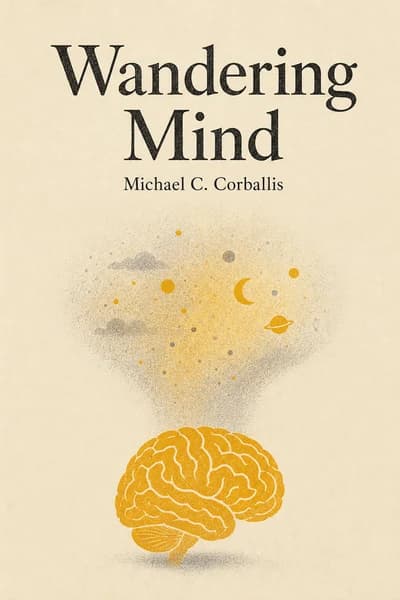
Ever caught yourself staring out the window during an important meeting? You're not alone. For centuries, mind-wandering has been dismissed as laziness or inattention-something to be overcome rather than celebrated. Michael Corballis's groundbreaking exploration challenges this notion entirely, revealing how our mental perambulations are not just normal but essential to what makes us human. The book has garnered praise from neuroscientists and psychologists alike, with Steven Pinker calling it "a refreshing counterpoint to our productivity-obsessed culture." While mindfulness meditation apps encourage us to stay present, Corballis makes a compelling case that our tendency to mentally time-travel is the foundation of creativity, empathy, and innovation. From Einstein's thought experiments to J.K. Rowling conceiving Harry Potter during a delayed train journey, history's greatest breakthroughs often emerged not from focused attention but from minds allowed to wander freely. As we'll discover, that daydream you feel guilty about might actually be your brain's most sophisticated evolutionary adaptation.
Глава 2
The Default State: Our Minds Are Built to Wander
Mind-wandering afflicts us all-during lectures, meetings, or while reading even the most captivating literature. Studies reveal we "zone out" multiple times while reading great works like Tolstoy, and our minds wander approximately 46.7% of our waking hours. This means that nearly half of our conscious life is spent in some form of mental drift, whether planning weekend activities during work meetings or contemplating life's mysteries while washing dishes. Even experienced meditators report significant mind-wandering during their practice, showing how deeply ingrained this tendency is in human cognition.
Hans Berger's pioneering electroencephalography (EEG) work in the 1920s first demonstrated that the brain produces distinct wave patterns even during rest. His discovery of alpha waves-rhythmic patterns occurring when people closed their eyes-revolutionized our understanding of brain activity. Later research using PET scans and fMRI revealed what neuroscientist Marcus Raichle termed the "default-mode network"-a set of brain regions that activate when we're not focused on external tasks. This network includes the medial prefrontal cortex, posterior cingulate cortex, and angular gyrus, areas crucial for self-reflection, autobiographical memory, and social cognition. This network uses only 5-10% less energy than the task-engaged brain, suggesting mind-wandering is far from a passive state.
The classic example of the daydreamer comes from James Thurber's "The Secret Life of Walter Mitty," where the protagonist's fantasy of commanding a Navy hydroplane is interrupted by his wife's complaint about his driving. This tension between rich internal life and external demands resonates with most of us. Modern examples abound: the office worker imagining tropical beaches during budget meetings, or the student crafting elaborate scenarios while staring at textbooks.
Is mind-wandering bad for us? Some research suggests it might be. A smartphone study of 5,000 people found participants reported less happiness during mind-wandering than when fully engaged in activities-even when their wandering thoughts were pleasant. Laboratory studies have shown that mind-wandering can impair reading comprehension by up to 30% and reduce memory retention significantly. Perhaps this is because imagining pleasant activities rarely matches the joy of actually experiencing them. Some studies even suggest excessive mind-wandering correlates with shorter telomeres in immune cells, potentially accelerating aging. Chronic worriers, who spend considerable time in negative mind-wandering, show elevated stress hormones and decreased immune function.
Yet despite these potential downsides, mind-wandering serves crucial functions. It allows us to escape the present to consider possible futures, reflect on past mistakes, and understand others' minds. Research shows that controlled mind-wandering can enhance problem-solving abilities, with studies finding that participants who took breaks to let their minds wander performed better on creative tasks than those who maintained focused attention. Most importantly, it's the wellspring of creativity and innovation-many breakthrough discoveries, from Einstein's theory of relativity to Paul McCartney's composition of "Yesterday," emerged during periods of mental wandering. Rather than feeling guilty about our wandering minds, perhaps we should recognize these mental journeys as essential to what makes us human, helping us navigate both our inner and outer worlds with greater wisdom and creativity.
Глава 3
Memory: The Landscape of Mental Wandering
Memory provides the essential foundation for mind-wandering, giving our thoughts places to wander to. Without it, we couldn't visit the past or construct possible futures. Memory operates in three distinct layers, each contributing differently to our mental journeys.
The first layer consists of skills-walking, talking, writing, playing instruments-that we learn and generally retain. Some skills stay with us permanently ("you never forget how to ride a bike"), while others fade with disuse. In our mind-wandering, we can still perform these skills with our former proficiency, even when physically we no longer can.
The fragility of episodic memory-our personal experiences-becomes dramatically apparent in cases of amnesia. Henry Molaison, perhaps the most famous amnesia case, could still learn new skills like mirror-tracing despite having no recollection of practicing. He even accurately drew the floor plan of his post-operation house despite having no episodic memory of learning it. Clive Wearing, a distinguished BBC musician struck by herpesviral encephalitis, lives in a mere seconds-long window of consciousness. Though he retained musical abilities, he's constantly surprised by his surroundings, even cards he just laid out. These amnesiacs share one limitation: denied access to their past, they've lost the luxury of nostalgia.
While we often lament poor memory, remembering everything would be equally problematic. Savant syndrome demonstrates this through cases like Kim Peek, who memorized 9,000 books but scored below average on intelligence tests. Daniel Tammet, who recited pi to 22,514 decimal places using synesthetic visualization of numbers as "multidimensional, colored shapes," shows how extraordinary memory can coexist with poetic sensibility. Solomon Shereshevskii's limitless memory actually impeded normal functioning-his synesthesia was so intense that a vendor's tone of voice conjured "black cinders" that prevented him from buying ice cream.
Perhaps most troubling is memory's unreliability. The recovered memory movement of the 1980s-90s led to innocent people being accused of crimes that never occurred, as therapists unwittingly implanted false memories. Memory isn't a faithful record but a "fickle witness" that supplies information-some true, some false, always incomplete-that we use to construct stories. "Memory is a poet, not an historian," as Marie Howe said. Even public figures like Hillary Clinton and Ronald Reagan have recalled heroic acts that never happened. According to evolutionary psychologists, self-deception evolved because it reduces the chance of being caught in a lie-if you believe your own false information, you tell it with the equanimity of truth.
Глава 4
Mental Time Travel: Journeying Beyond the Present
Remembering is mind-wandering into the past, but we can also wander into the future, imagining what might happen tomorrow or years from now. Evidence shows people actually spend more time thinking about the future than the past, with a natural continuity between them as time flows relentlessly onward.
While our lives are bounded by birth and death, we can mentally journey beyond both through history, literature, and futuristic scenarios. We use our remembered past to construct our futures-the same brain regions activate when remembering past events and imagining future ones. People with amnesia like Henry Molaison couldn't imagine future events any more than they could remember past ones, living in what their biographers called a "permanent present tense" or "forever today." Patient N.N. described trying to think about tomorrow as "a big blankness" like "swimming in the middle of a lake."
Memory's flexibility serves future planning better than accuracy. By age four, most children develop the mental capacity to construct possible future events. We create "possible selves"-future images that motivate our life choices. Our imagined futures can even extend beyond death, reinforcing religious beliefs and concepts like heaven, hell, and reincarnation.
Is mental time travel uniquely human? While Wolfgang Kohler concluded that chimpanzees were stuck in the present like amnesiac Clive Wearing, evidence challenges human uniqueness in this ability. Santino, a male chimpanzee in Sweden, collects and hides stones to throw at zoo visitors, suggesting he plans future events. Even birds demonstrate remarkable temporal abilities-Clark's nutcrackers retrieve cached food from thousands of locations, while scrub jays remember what food they cached, where, and when, choosing breakfast foods based on anticipated future needs rather than present hunger.
However, these behaviors might be explained by instinct rather than true mental time travel. Lloyd Morgan's canon warns against attributing higher mental faculties to animals when simpler explanations suffice-a principle reinforced by the famous case of Clever Hans, the horse whose apparent mathematical abilities were actually responses to subtle trainer cues. The difficulty in determining whether animals mentally time-travel stems largely from their lack of language to report their experiences, unlike humans who readily describe memories and plans.
Глава 5
The Hippocampus: Navigation Center for Mental Journeys
The hippocampus, a seahorse-shaped structure nestled deep in the temporal lobes, serves as the brain's central station for mental time travel. This structure is absolutely essential for our ability to mentally navigate backward and forward in time. Amnesic patients like Henry Molaison, K.C., and Clive Wearing all suffered major hippocampal damage, leaving them stranded in the present with "seahorse-shaped scars where memory used to be."
Functioning as Grand Central Station of the brain's default-mode network, the hippocampus activates when we recall past events or imagine future scenarios. Interestingly, the same brain regions activate whether remembering or imagining, with the hippocampus connecting cortical and emotional areas. It specifically handles "temporal consciousness"-knowing where you are in the ribbon of time-particularly for personal experiences rather than general knowledge.
The structure appears directionally organized, with its anterior (front) end more concerned with future events and its posterior (rear) end with past events. This dual function might explain false memories like Hillary Clinton's mistaken recollection of escaping gunfire in Bosnia-perhaps an imagined scenario later remembered as real.
Beyond time travel, the hippocampus also maps physical space. John O'Keefe and Lynn Nadel's classic work revealed "place cells" in rat hippocampi that activate based on the animal's location. Human hippocampi contain similar cells, as shown when epilepsy patients navigated virtual towns while researchers recorded neural activity. These hippocampal maps are dynamic, adjusting to new environments and operating at different scales like the zoom function on digital maps. London taxi drivers, who must master "The Knowledge" of the city's complex geography, develop enlarged hippocampi compared to bus drivers who follow set routes.
Recent evidence suggests mental time travel isn't unique to humans-even rats may imagine past and future events. Recordings from rat hippocampi show "sharp-wave ripples"-sequences of place cell activations that occur when rats are asleep or immobile, suggesting they're mentally tracing paths through previously experienced mazes. Sometimes ripples trace reverse routes or shortcuts never physically taken, suggesting rats consolidate spatial memories by creating more extensive cognitive maps.
These findings suggest that mental time travel evolved from simple spatial navigation mechanisms conserved across species. The common ancestor of rats and humans lived 66 million years ago, but in a spatial world, knowing where you are, where you've been, and where you're going next remains fundamental. While rats may lack the executive processing of even a four-year-old child, we should be wary of creating "impregnable mental fortresses" that no animal could invade. As Darwin noted, the difference between human and animal minds is "one of degree and not of kind."
Глава 6
The Social Mind: Wandering into Others' Thoughts
We routinely venture into the minds of others-whether fictional characters or real people we interact with daily. This ability to imagine others' thoughts and feelings is fundamental to humanity, allowing us to engage with fiction, judge personalities, and make social decisions.
Our sense of knowing others' thoughts has often led people to believe in telepathy or extrasensory perception (ESP). Some proponents invoke quantum entanglement, suggesting that once-interacted particles might remain connected regardless of distance. However, despite thousands of experiments, evidence for paranormal abilities remains unconvincing, especially considering negative results often go unpublished. Fraudsters like Uri Geller have been thoroughly debunked by magicians like James Randi.
Yet humans seem naturally inclined toward belief in mind powers that transcend physics. Paul Bloom suggests we're born as philosophical dualists, predisposed to believe mind and body are separate-a facet of mind-wandering itself.
We're remarkably good at knowing what others think-not through ESP but through subtle sensory cues, cultural sharing, and simple observation. The Sally-Anne test demonstrates this: children over four understand that Sally will look for her marble where she believes it is (the basket), not where it actually is (the box) after being moved without her knowledge. Surprisingly, even seven-month-old babies seem to understand others' beliefs. When shown videos where cartoon characters hold false beliefs about objects' locations, babies look longer when the character's expectations aren't met-suggesting they anticipate the character's surprise.
This "social sense" activates our default-mode network, linking mind-wandering to understanding others' minds. Theory of mind has recursive properties-I may believe that you believe that I believe something-potentially driven by deception. As Walter Scott wrote: "O what a tangled web we weave, when first we practise to deceive!"
Animals show varying degrees of mind-reading abilities. Chimpanzees understand what others can see and know, demonstrating tactical deception by retrieving food when dominant chimps aren't watching. Dogs surpass chimps in reading human intentions, easily understanding pointing gestures that indicate hidden food. This ability stems from domestication, which began when wolves scavenged human refuse and evolved to be comfortable around humans-"survival of the friendliest." While there's likely continuity between human and animal mind-reading abilities, humans take this capacity to greater recursive depths, perhaps driven by increasing loops of deception.
Глава 7
Storytelling: Sharing Our Mental Wanderings
Humans may not be unique in mental time travel or mind-reading, but we are distinctive in our ability to share these mind-wanderings through storytelling. Literary scholar John Niles suggested renaming our species Homo narrans-the storytellers. Stories likely evolved from play, an activity seen across many species that often involves pretending. While play happens in the present, stories add the "once upon a time" element, complex narrative structure, and social sharing beyond direct participants.
Children develop storytelling abilities between ages two and six, often relishing stories with elements of danger. Stories probably originated with hunter-gatherers sharing foraging experiences, as seen in present-day Ache people who report detailed accounts of hunting encounters. This communication helped groups become familiar with terrain and hunting techniques, while elders passing stories to children might explain why humans evolved to live beyond child-bearing years.
Language likely evolved from pantomime to conventionalized gestures and finally to spoken words. Early storytelling may have been acted out physically, but pantomime proved inefficient and ambiguous. Communities developed standard gestures with agreed meanings, eventually replacing manual gestures with vocal ones. Grammar emerged as rules for conveying sequences and relationships between story elements. The shift from manual to vocal communication occurred gradually, with speech offering advantages: it freed hands for tools and childcare, required less energy, worked in darkness, and functioned without visual contact.
During the Pleistocene, our ancestors developed distinctly human characteristics-tripling brain size, adopting upright stance, and establishing the "cognitive niche" through knowledge sharing and storytelling. Stories bind cultures together through common narratives of heroism and discovery. Indigenous Australian stories may date back 50,000 years, telling of the Dreamtime when ancestral spirits created the world. Similarly, Maori legends from 750 years ago describe the demigod Maui using his magic fishhook to pull up New Zealand's North Island.
Fiction extends beyond creation myths to depict everyday life with imaginative overlays that enhance understanding and emotional involvement. Crime stories serve as modern morality tales where perpetrators are always caught and punished. Research shows fiction increases empathy and improves mind-reading abilities by activating brain areas involved in theory of mind. Stories ultimately define our species uniquely, expanding our mental horizons beyond physical limitations and enabling vast technological achievements.
Глава 8
Dreams: The Nightly Wanderings
Dreams represent the most ubiquitous wanderings of the mind, activating the default-mode network while we sleep. Unlike daydreams, night dreams unfold as stories we experience as real, though occasionally we have "lucid dreams" where we're aware we're dreaming. Our sleep alternates between REM and NREM periods, with dreams being most vivid during REM sleep that occurs about every 90 minutes.
Freud viewed dreams as "the royal road to the unconscious," revealing suppressed thoughts disguised in symbols that needed interpretation. While his symbolic interpretations have fallen from favor, Freud's recognition of the unconscious mind remains valuable, as insights often emerge when consciousness is focused elsewhere.
Finnish psychologist Antti Revonsuo proposes that dreams evolved as simulations of threatening events, allowing us to develop coping strategies for real dangers. Studies across cultures show 65-75% of dreams contain threats-far higher than in waking life-with aggression being most common (40%), followed by failures and misfortunes. These simulations may have been adaptive during the Pleistocene when life was "nasty, brutish, and short," helping our ancestors prepare for predators and dangers.
The threat theory of dreams may extend beyond humans to other animals, as dreams are driven by brainstem processes that flow through emotional centers before influencing higher memory areas. While REM dreams focus on emotional fears, NREM dreams represent recent experiences rather than fears. Similar to the hippocampal "ripples" in rats that correspond to familiar terrain trajectories, human NREM dreams often reference recent waking experiences, though rarely as exact replays.
Dreams serve to both regulate emotions during REM sleep and consolidate/expand memories during NREM sleep, with different brain chemistry distinguishing these states. Though dream theory often focuses on threats and traumas, many dreams are positive and enjoyable. Despite being largely forgotten, dreams may activate the unconscious and create internal landscapes for later mental wanderings, occasionally providing creative inspiration.
Глава 9
Beyond Reality: Hallucinations as Extreme Mind-Wandering
Hallucinations, originally meaning simply "a wandering mind," are perceptions of things that aren't there-most commonly visions or voices, but occasionally involving other senses. Unlike normal mind-wandering, hallucinations are projected into external space with the vividness of reality, sometimes superimposing unreal elements onto normal perception.
Julian Jaynes proposed that until around 1000 BC, humans were effectively controlled by hallucinations interpreted as gods issuing commands. He found evidence in the Iliad, where characters lack first-person narrative and consciousness is replaced by gods' instructions. According to Jaynes, catastrophic events in the second millennium BC caused this system to break down, with the Odyssey showing a striking shift where characters make their own decisions and speak in first person.
Neurosurgeon Wilder Penfield discovered that applying weak electrical stimulation to exposed brain tissue could induce hallucinatory or dream-like experiences. While stimulating the temporal lobe, patients experienced what seemed like memory replays. However, these "experiential responses" were likely more like dreams than actual memories, suggesting we probably never remember things precisely as they happened.
Hallucinations frequently occur when normal sensory input is reduced or removed, as though the brain invents an imaginary world when the real one is shut off. Blind people often experience Charles Bonnet syndrome-vivid visual hallucinations as eyesight deteriorates. Similarly, deaf people may hallucinate music with remarkable detail and accuracy. Sensory deprivation experiments showed that people in soundproofed cubicles or floating in sensory deprivation tanks quickly developed increasingly complex hallucinations.
Hallucinogenic drugs offer "transcendence on demand," revealing our evolutionary relationship with nearly 100 psychoactive plants. Oliver Sacks himself experimented extensively with drugs in the 1960s, experiencing vivid hallucinations before eventually escaping addiction. Hallucinations and dreams access brain regions beyond conscious control, suggesting a trade-off: during waking hours, imagination must be kept in check by reality, while during sleep or sensory deprivation, the brain challenges its own limits.
Глава 10
The Creative Advantage of Wandering Thoughts
Creativity emerges from what psychologist Donald T. Campbell called "blind variation and selective retention." The randomness of our mental wanderings supplies the creative spark, while our ability to recognize valuable discoveries provides the "selective retention." This challenges the popular notion that creativity resides exclusively in the right brain-despite internet claims about "right brain creativity," research shows creative cognition activates the default-mode network underlying mind-wandering across both hemispheres.
Randomness permeates the universe itself-from the uncertainty principle in physics to weather patterns and evolutionary processes. Animals physically wander through space, sometimes purposefully and sometimes exploring new territories, which can lead to evolutionary change. Humans are particularly prolific wanderers, having dispersed from Africa to populate the globe.
Through both physical and mental wandering, we invite randomness to intervene, occasionally discovering novelty and striking gold. As Wordsworth found poetic inspiration wandering in England's Lake District, our mental travels-whether through time, into others' minds, or in dreams-contain random elements that sometimes lead to unexpected illumination.
The brain is never inactive, with our minds wandering away from daily tasks for at least half our lives. During waking hours, we exercise some control over these wanderings, but during sleep, dreams take over with unpredictable content. Though mind-wandering has a negative reputation, nature has equipped us to be more than robots locked into routines. Our brains have resources to escape the present and play-an adaptive function that helps us prepare for life in a complex world.
Far from being a defect or distraction, the wandering mind represents one of our most sophisticated evolutionary adaptations. It allows us to transcend the limitations of our immediate surroundings, learn from the past, prepare for the future, understand others, and create the innovations that define humanity. Perhaps instead of fighting our wandering minds, we should embrace these mental journeys as the source of our greatest human potential.