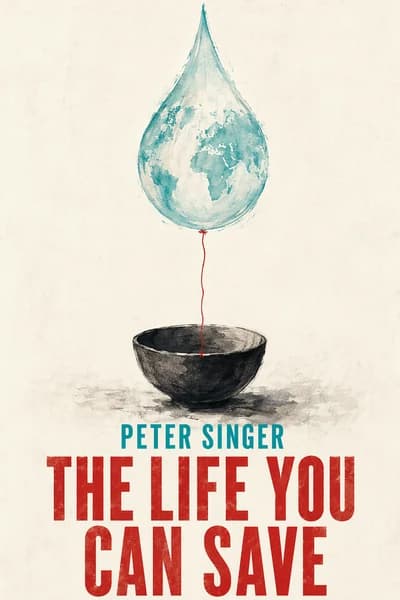
Peter Singer's "The Life You Can Save" challenges our moral compass: could you walk past a drowning child? This revolutionary book inspired 17,000+ pledges and launched a global movement, proving that with just 1% of your income, you can literally save lives.
Почувствуйте книгу через голос автора
Превратите знания в увлекательные, богатые примерами идеи
Захватите ключевые идеи мгновенно для быстрого обучения
Наслаждайтесь книгой в весёлой и увлекательной форме
Imagine walking past a shallow pond and noticing a child drowning. Would you ruin your expensive shoes to save them? Of course you would - without hesitation. Yet every day, we ignore children dying from preventable causes simply because they're far away. This is the moral challenge at the heart of "The Life You Can Save." While extreme poverty has fallen dramatically - from 34% to 10.7% of the global population - 736 million people still live on less than $1.90 daily. This isn't the relative poverty we see in wealthy nations; it's absolute poverty: chronic hunger, no healthcare, and early death. Children die from easily preventable diseases while we spend $1,100 annually on coffee and throw away 400 pounds of food per year. Our comfortable assumption that surplus money is ours to spend freely doesn't hold up under scrutiny. Major religious and philosophical traditions agree: Jesus emphasized charity above all else, Thomas Aquinas taught that surplus wealth is "owed" to the poor, Judaism considers tzedakah essential to justice, and Islam requires annual zakat. We resist these implications, telling ourselves we've earned our money. But this overlooks the "social capital" enabling success in wealthy nations that those in poor countries lack. The world's wealth distribution is starkly unequal: 1% own 45% of global wealth while 64% own just 2%. The contrast is stark: a single fancy dinner out could fund deworming medication for hundreds of children or provide mosquito nets protecting multiple families from malaria. If distance doesn't change our moral obligation to save a drowning child, why should it matter when children are dying from poverty halfway around the world?
Разбейте ключевые идеи The Life You Can Save на понятные тезисы, чтобы понять, как инновационные команды создают, сотрудничают и растут.
Выделите из The Life You Can Save быстрые подсказки для запоминания, подчёркивающие ключевые принципы открытости, командной работы и творческой устойчивости.

Погрузитесь в The Life You Can Save через яркие истории, превращающие уроки инноваций в запоминающиеся и применимые моменты.
Задавайте любые вопросы, выбирайте голос и совместно создавайте идеи, которые действительно находят у вас отклик.

Создано выпускниками Колумбийского университета в Сан-Франциско
"Instead of endless scrolling, I just hit play on BeFreed. It saves me so much time."
"I never knew where to start with nonfiction—BeFreed’s book lists turned into podcasts gave me a clear path."
"Perfect balance between learning and entertainment. Finished ‘Thinking, Fast and Slow’ on my commute this week."
"Crazy how much I learned while walking the dog. BeFreed = small habits → big gains."
"Reading used to feel like a chore. Now it’s just part of my lifestyle."
"Feels effortless compared to reading. I’ve finished 6 books this month already."
"BeFreed turned my guilty doomscrolling into something that feels productive and inspiring."
"BeFreed turned my commute into learning time. 20-min podcasts are perfect for finishing books I never had time for."
"BeFreed replaced my podcast queue. Imagine Spotify for books — that’s it. 🙌"
"It is great for me to learn something from the book without reading it."
"The themed book list podcasts help me connect ideas across authors—like a guided audio journey."
"Makes me feel smarter every time before going to work"
Создано выпускниками Колумбийского университета в Сан-Франциско

Получите резюме книги «The Life You Can Save» в формате PDF или EPUB бесплатно. Распечатайте или читайте офлайн в любое время.