Глава 1
When Fear of Failure Trumps Fear of Missing Out
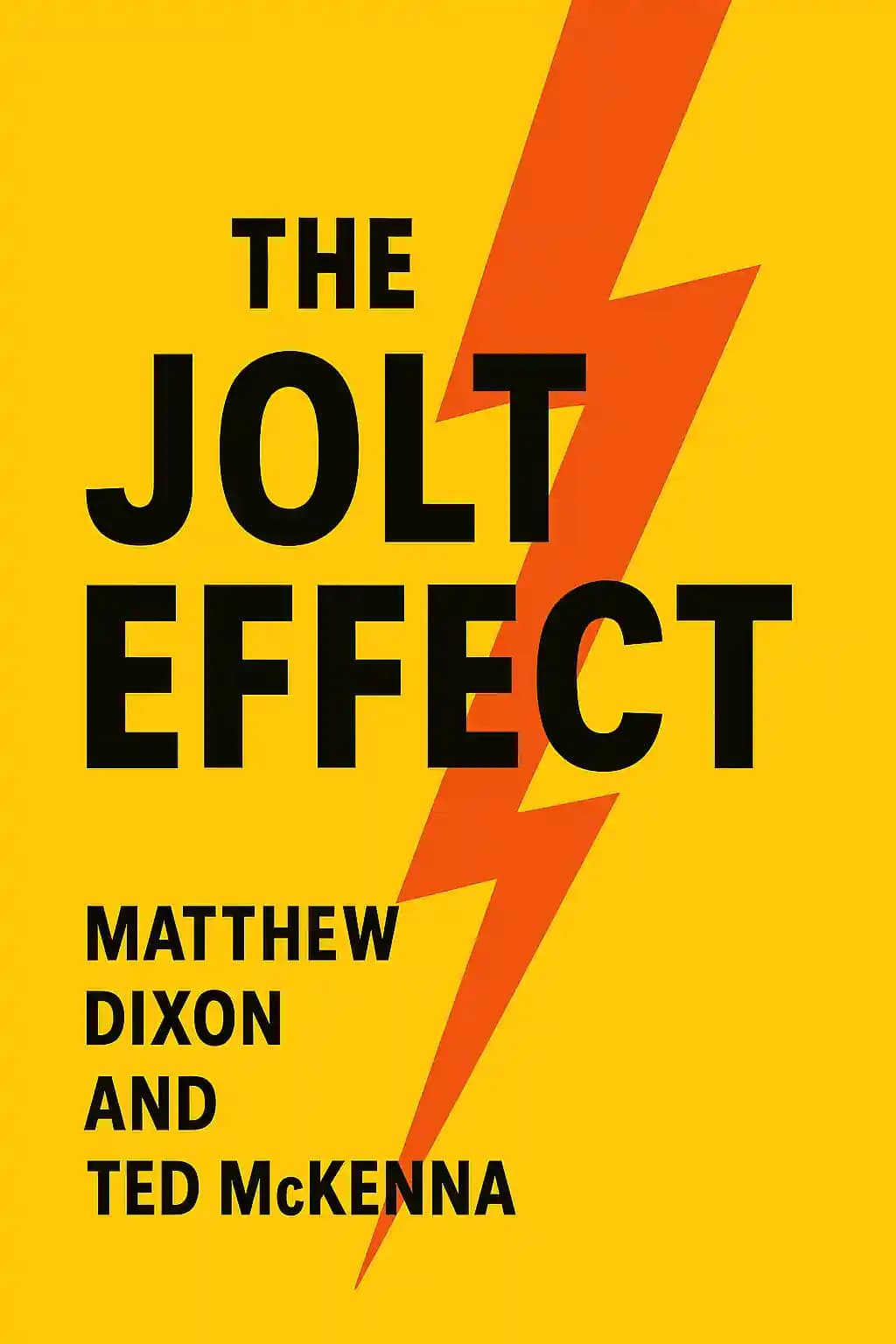
In the high-stakes world of sales, a groundbreaking discovery has quietly revolutionized our understanding of why deals stall. Matthew Dixon and Ted McKenna's "The Jolt Effect" emerged from an unprecedented research opportunity created by the pandemic's shift to virtual selling. Analyzing millions of sales conversations through AI, they uncovered something that challenges decades of sales wisdom: the greatest obstacle isn't customer resistance to change, but customer fear of making the wrong decision. This revelation has transformed how industry leaders approach closing deals. The book has become required reading at companies like Salesforce, Microsoft, and Oracle, with CEOs citing it as the missing piece in understanding modern buyer psychology. Even Warren Buffett, known for his investment acumen, reportedly remarked that understanding "omission bias" explained decades of customer behavior he'd observed but couldn't name.
Глава 2
The Hidden Enemy: Why Customers Choose Inaction
For decades, sales professionals have operated under a fundamental assumption: the customer's status quo is their biggest competitor. Sales organizations invest heavily in training reps to overcome this resistance to change, making it the focus of nearly every sales conversation. But our research reveals a surprising truth: when deals stall out, it's not always because salespeople failed to convince customers to change. Of all deals lost to "no decision," only 44 percent stem from customers preferring their status quo. The majority-56 percent-involve customers who actually want to abandon their status quo but are simply unwilling or unable to make a decision.
This distinction between status quo bias and indecision represents fundamentally different challenges. Status quo bias manifests when customers express preference for their current solution, don't see enough difference in alternatives, or fear the change process itself. However, even when customers intend to change, over half of opportunities still end in inaction.
Why? Because customers fear errors of commission (making a wrong decision) more than errors of omission (failing to act). Nobel Prize-winning psychologists Daniel Kahneman and Amos Tversky demonstrated through prospect theory that people value minimizing losses two to three times more than maximizing gains. The emotional impact of losing $100 feels significantly stronger than the pleasure of finding $100, despite the identical monetary value.
More importantly, customers place greater weight on losses resulting from actions they take than losses from inaction. When considering a major purchase, a customer would rather miss out on $10 million in potential benefits than actively make a decision that costs the company $10 million. Customers fear messing up more than missing out.
Глава 3
Why Making Mistakes Feels Worse Than Missing Opportunities
Errors of commission feel more consequential for several reasons. First, they're tangible and directly observable, while errors of omission remain abstract and hypothetical. When a company invests in the wrong technology platform, the negative consequences are immediately visible in wasted resources and disrupted operations. In contrast, the cost of not pursuing a promising opportunity often remains hidden. Second, making a specific choice closes off other possibilities, while errors of omission can be indefinitely postponed. For example, choosing one vendor creates switching costs and lock-in effects that make it harder to change course later. Third, commission errors carry personal accountability-someone signs the agreement and commits resources-whereas responsibility for omission errors can be distributed among many decision-makers. This explains why executives often prefer to delay decisions rather than risk being personally associated with a failed initiative.
Our research identified three specific fears driving customer indecision. First, "valuation problems" occur when customers struggle to compare different options with incompatible metrics or features. We heard customers say things like "I know your system is cheaper to operate but your competitor's is much faster" or "This solution has better security but worse usability." These trade-offs create cognitive strain as buyers attempt to weigh incommensurable factors. Second, "lack of information" manifests as customers requesting endless research despite already investing significant time. One customer asked for "one more demo to just confirm that we are leaving no stone unturned," while another spent months gathering additional case studies even after completing extensive vendor evaluations. This reflects a deeper fear that some crucial detail might be overlooked. Finally, "outcome uncertainty" reflects the gap between promised benefits and customer confidence they'll materialize. This is especially pronounced for transformative solutions where results depend heavily on successful implementation and adoption.
These drivers of indecision will only intensify in the future as technology and markets evolve. The explosion of vendor options makes choosing increasingly difficult - what was once a choice between a handful of providers may now involve dozens of possibilities across multiple categories. The overwhelming volume of available information feeds customers' fear they haven't done enough homework, with endless online reviews, analyst reports, and peer recommendations to consider. And as solutions become more complex and "sticky," customers increasingly worry whether their investments will ever pay off. The rise of integrated platforms and ecosystem solutions raises the stakes further, as choosing wrong can impact multiple business processes and partner relationships. This creates a paralyzing dynamic where the cost of mistakes seems to grow even as the pressure to transform increases.
Глава 4
The Silent Killer of Sales Opportunities
Indecision is particularly dangerous because it's difficult for salespeople to detect. Unlike status quo bias, which customers openly discuss, indecision stems from personal fears customers may not recognize or admit. Using natural language processing across more than 2.5 million sales conversations, we found indecision markers in a staggering 87% of all sales interactions. These markers include phrases like "let me think it over," "I need to sleep on it," and "I'm not sure if the timing is right." Even when customers express clear buying intent, conversion rates average only 26% because uncertainty inevitably creeps in during the decision process.
The correlation between indecision emotions and deal outcomes is striking. Our analysis shows that win rates plummet from 45-55% in conversations with low indecision markers to below 5% when high indecision is present. The seemingly innocuous phrase "I need to think about it some more" proved more highly correlated with lost deals than any other customer utterance-even more than direct objections about price or competition. This phrase has become known as the true kiss of death in sales, serving as an early warning signal that the deal is likely to stall.
Remarkably, salespeople typically respond to customer indecision by making the problem worse. When customers show hesitation, reps instinctively try to defeat the status quo again-either by emphasizing how bad the current state is ("You're losing $100,000 every month you delay") or by reselling the benefits of the future state ("Think about all the efficiency gains you'll achieve"). This approach backfires dramatically because indecisive customers who've already agreed to move forward now fear something different: the potential failure resulting from their actions. They're no longer comparing your solution to the status quo-they're imagining worst-case scenarios of implementation failure.
While overcoming status quo focuses on the cost of inaction, indecisive customers aren't worried about abstract concerns like missing discount windows or delaying implementation. Their primary fear centers on personal risk and career implications. The internal narrative becomes "What if I champion this solution and it fails?" You don't get fired for losing a discount or maintaining the status quo, but you do get fired for spending significant budget on a solution that fails to deliver. This fear of failure creates a powerful psychological barrier that traditional sales techniques often fail to address. Successful salespeople recognize that addressing implementation concerns and providing concrete risk mitigation plans is more effective than simply restating benefits or creating urgency.
Глава 5
The JOLT Method: A New Playbook for Indecisive Customers
After establishing that indecision is a pervasive problem that robs sales organizations of productivity, our research revealed that salespeople need two distinct playbooks, not just one. Where average performers only focus on beating the status quo by appealing to the "pain of same," top sellers recognize a second crucial phase that requires a completely different approach. If the first playbook dials up fear of not purchasing, this second playbook must dial down the fear of purchasing - a nuanced distinction that makes all the difference in closing deals.
The JOLT method consists of four key behaviors high performers use to overcome customer indecision:
Judge the indecision by qualifying opportunities based not just on external criteria but on the customer's ability to decide. This involves carefully assessing behavioral signals like repeated information requests, delayed responses, and inability to commit to next steps. Top performers actively look for these warning signs early in the sales process and adjust their approach accordingly.
Offer your recommendation by providing clear guidance rather than asking more questions. When faced with indecision, many salespeople mistakenly respond with more discovery questions. Instead, high performers recognize when it's time to shift from asking to telling, providing confident, prescriptive guidance that helps customers move forward.
Limit the exploration by controlling information flow when customers request excessive information. This means strategically managing the amount and timing of information shared, preventing analysis paralysis. Successful sellers recognize when additional information will help versus when it will only fuel further indecision.
Take risk off the table by addressing concerns about potential purchase failure. This involves proactively identifying and neutralizing specific risks that could derail the purchase decision, whether they're implementation concerns, ROI uncertainties, or organizational resistance. Top performers create detailed risk mitigation plans and often incorporate guarantees or pilot programs.
The payoff for implementing the JOLT method is substantial and backed by extensive data. While only 7 percent of calls studied showed high JOLT skill demonstration, the results are dramatic when properly applied. Unlike relitigating the status quo (which has a negative impact 84 percent of the time), using JOLT techniques gives sellers a 70 percent probability of a good outcome.
The win rate differences are particularly striking across different customer segments: with low-indecision customers, average sellers convert at 39 percent while JOLT sellers achieve nearly 70 percent. Most importantly, with moderately indecisive customers (who make up the majority of opportunities), JOLT sellers maintain a 57 percent conversion rate compared to average performers' 26 percent-a 120 percent improvement. These improvements hold true across industries, deal sizes, and sales cycles, making JOLT a versatile framework for addressing the universal challenge of customer indecision.
The method's success lies in its systematic approach to addressing both rational and emotional barriers to decision-making, while maintaining forward momentum in the sales process. By implementing JOLT, organizations can significantly reduce sales cycle times and improve forecast accuracy, as deals are less likely to stall in the final stages.
Глава 6
Judge the Indecision: Qualifying Beyond Budget and Authority
Customer indecision appears equally in both won and lost deals, making it something salespeople must navigate rather than eliminate. Interestingly, high performers have fewer highly indecisive customers in their pipelines, suggesting they qualify opportunities differently. As one successful medical device salesperson explained, she evaluates both a customer's ability to buy AND their ability to decide.
To identify the source of customer indecision, salespeople should look for specific indicators associated with each type. For valuation problems, customers may express wanting everything, repeatedly ask about differences between options, or get distracted by newly discovered features. With information deficits, customers typically request excessive information, delay decisions to gather more data, or mention being "in the dark." For outcome uncertainty, customers often press for ROI projections, reference past negative experiences, or request guarantees.
High performers use a four-step process to gauge customer indecisiveness: examining how customers search for information, how they evaluate alternatives, whether they demand perfection or accept "good enough," and interpreting delay signals.
When customers engage in excessive information gathering that indicates discomfort with ambiguity, or when they "backtrack" after encountering new information, it signals potential indecision. One rep described a customer who, after three months of successful engagement including a completed pilot and contract negotiations, suddenly wanted to evaluate newly discovered competitors "to leave no stone unturned." The rep immediately recognized this as terminal indecision, politely paused negotiations, and six months later, the customer still hadn't made a decision.
High performers also distinguish between procrastination and decision avoidance. While procrastinators delay but intend to decide eventually, decision avoiders have no intention to act. To differentiate between these delay types, top salespeople make "powerful requests" that require customer commitment, like arranging meetings with key stakeholders. Procrastinators will typically comply, while avoiders will resist involving others-revealing their true intentions.
Глава 7
Offer Your Recommendation: The Paradox of Choice
Barry Schwartz's groundbreaking work on "The Paradox of Choice" reveals a counterintuitive truth: the abundance of options in modern life often paralyzes rather than empowers customers. Whether shopping for jeans or enterprise software, too many choices lead to decision paralysis and regret.
Excessive choice undermines customer decision-making in three critical ways. First, more options increase the statistical likelihood of making a poor choice, triggering anticipated regret. Second, even when customers make objectively good decisions, they experience less satisfaction because they constantly wonder if another option might have been better. Third, as options multiply, customers' expectations escalate unreasonably, transforming "satisficers" (willing to accept good-enough solutions) into "maximizers" (seeking perfection across all attributes).
While minimizing choices seems like an obvious solution, research shows customers are initially attracted to more options. In the famous "jelly experiment," a table with 24 flavors attracted 60% of shoppers but only 3% purchased, while a table with just 6 flavors attracted fewer shoppers (40%) but converted 30% of them into buyers.
High performers employ two critical skills when making recommendations. First is "proactive guidance"-shifting from asking about needs to confidently stating what the customer needs. This approach alone increases win rates from 18% to 44%, a 144% improvement.
Even more powerful is "advocacy"-offering a personal recommendation that signals the rep is on the customer's side. Phrases like "Here's what I would do if I were you" demonstrate the rep feels personally responsible for the customer making a good choice. This technique by itself lifts win rates by 74%.
When used together, these techniques create a powerful combination. Sales calls using neither technique convert at just 13%, using one technique raises conversion to 29%, and using both techniques achieves an impressive 48% win rate.
Глава 8
Limit the Exploration: When More Information Hurts
It's perfectly normal for customers to want to do their homework before making significant purchase decisions. But determining how much information is "enough" remains a critical question, with the "P = 40 to 70 rule" offering a useful guideline. This concept, coined by General Colin Powell, suggests that once information is in the 40-70% range, you should go with your gut. Waiting for 100% certainty breeds "analysis paralysis" and actually increases risk rather than reducing it.
High-performing salespeople establish themselves as subject matter experts and trusted guides on the customer's learning journey. Rather than preventing customers from doing their own research, they position themselves as having already done the research for the customer. Top sellers rely less on bringing in subject matter experts, and when they do, they carefully control how much these experts speak.
While 69% of sales calls contain customer objections, only 52% of these objections receive rebuttals-a gap that kills conversion rates. When no rebuttal is offered, win rates drop by nearly half to 17%, but with just one rebuttal, rates increase to 31%. High performers excel at detecting "implicit non-acceptance" through subtle cues like tone changes or hesitations, and they proactively address these concerns with "pre-buttals" that achieve 40% win rates.
The third behavior enabling salespeople to limit customer exploration is practicing radical candor, which balances "challenging directly" with "caring personally." Kim Scott's framework identifies four engagement styles, with radical candor being the sweet spot where reps focus on customer best interests while being unafraid to redirect them. Top performers probe to understand what's driving information requests, asking the "question behind the question" to uncover underlying concerns, then recommending better ways to address those concerns.
High-performing sales calls sound distinctly different from average ones. Top sellers are more assertive in demonstrating expertise and actually do more talking than the customer-speaking 58% of the time in won deals versus 52% in lost deals. Contrary to conventional sales training about listening more than talking, successful reps don't shy away from sharing valuable expertise.
Глава 9
Take Risk Off the Table: Addressing the Fear of Failure
When customers face outcome uncertainty-the fear they won't capture expected benefits from their purchase-they often hit pause and "think about it." This third source of indecision is the most intractable for sellers to overcome. Even when customers understand the value proposition and have chosen an option, they hesitate before signing, recalling past experiences of vendors who overpromised and underdelivered.
While average sellers respond to outcome uncertainty with FUD tactics (fear, uncertainty, and doubt), high performers take a fundamentally different approach. They recognize customers aren't hesitating because they might miss an opportunity to win, but because they fear making a decision that causes them to lose. Top sellers understand they're asking customers to take a leap of faith, while customers hear that inner voice whispering "better safe than sorry."
The first technique high performers use to de-risk purchases is setting realistic expectations. While average sellers push impressive but unattainable ROI projections, top performers focus on "believable impact" rather than "maximum impact." They deliberately underpromise, establishing conservative expectations they're confident customers will achieve or exceed. Data shows this technique dramatically impacts win rates-when reps set expectations, win rates jump to 51% (compared to just 20% when they don't).
High performers also understand that offering customers a safety net is far more effective than using fear tactics. In transactional sales, this often means highlighting cancellation windows, plan changes, or money-back guarantees. In complex B2B sales where formal guarantees aren't possible, top performers create detailed pre-closing project plans, recommend professional services support, or use creative contracting to protect specific areas of concern. When reps offer options that minimize perceived downside risk, win rates more than double from 22% to 46%.
Top performers often proactively suggest customers start smaller than they initially want. When customers request comprehensive packages but experience sticker shock at the price, average reps struggle to scale back without making customers feel they're settling for less. Elite reps preemptively recommend starting with core services before customers see prices, positioning it as being a good steward of the customer's money.
Глава 10
Becoming a Buyer's Agent: Building Trust in the Sales Process
JOLT sellers function similarly to modern travel advisors-they stop selling to customers and start buying for them once purchase intent is established. They understand that customers reach out to salespeople because they're struggling to buy and need help with what, how, and when to purchase. These star reps assume the role of delegates-trusted partners who help customers work through indecision.
The principal-agent problem occurs when one person (the agent) makes decisions for another (the principal), but incentive misalignments create distrust. This happens when information asymmetry exists-the agent knows more than the principal. In sales, the power imbalance is particularly stark: sellers possess insider knowledge about products and services while being incentivized to maximize deal values. Fearing they're missing crucial information, customers delay decisions while seeking more research, perpetuating indecision.
High performers overcome the agency dilemma through several trust-building techniques. First, they suggest customers avoid "overbuying" when appropriate, recommending less expensive options that better match needs. Second, they offer positive feedback on competitors' products or even recommend them when they're genuinely better fits. Third, they honestly admit when their products can't meet certain requirements rather than overselling capabilities. Finally, they build credibility by acknowledging when they don't know answers to specific questions.
When sales representatives execute the JOLT playbook effectively, they earn the right to confidently ask for the business and position saying "yes" as the customer's default option. Drawing on behavioral science, top sellers leverage the power of defaults to move decisions from the reflective to the automatic system of thinking. By confidently asking for the business, they make saying "yes" the path of least resistance.
Глава 11
Beyond Win Rates: Creating Long-Term Customer Loyalty
JOLT isn't just about improving win rates-it's about building sustainable customer loyalty that drives profitable growth. By setting realistic expectations and building trust during the sales process, JOLT sellers create better customer experiences that benefit everyone in the organization.
Customer loyalty operates along two dimensions: product/brand stickiness (from low to high) and effort of experience (from low to high). The ideal position is high stickiness with low effort-like Apple products or Amazon Prime, where customers willingly pay premiums for differentiated products with seamless experiences.
Indecision can linger long after a contract is signed, creating what psychologists call "post-decision dysfunction." Even when salespeople close deals without using JOLT behaviors, customers who felt uncertain during the process often experience three types of dysfunction: worrying about whether they made the right choice, checking their decision by researching alternatives after signing, and decision instability where they may change their mind entirely.
Research shows a direct correlation between customer effort and sales win rates-when buyers perceive high effort, win rates plummet to as low as 9%, while low-effort experiences can achieve 40-90% win rates. The common approach of relitigating the status quo when customers show indecision actually increases effort by heightening fears. In contrast, JOLT behaviors dramatically reduce customer effort by addressing buyers' personal fears about taking action.
By effectively using JOLT to help customers overcome indecision, salespeople not only win more business but also reduce customer effort, enhance the overall experience, and significantly improve the odds of building loyal, long-term relationships. In today's increasingly complex buying environment, the ability to guide customers through their decision-making fears may be the most valuable skill a salesperson can develop.