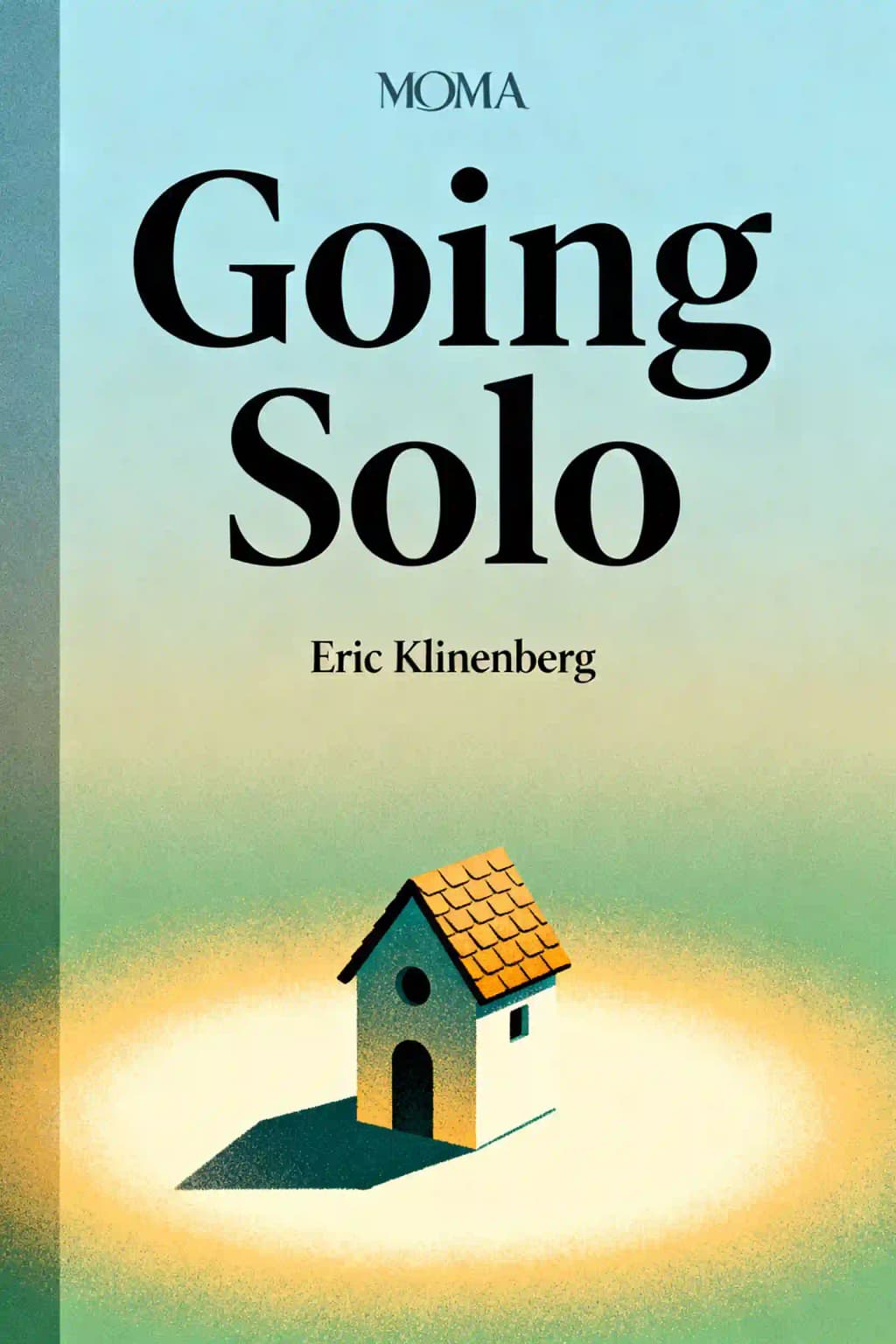
Going Solo
The Extraordinary Rise and Surprising Appeal of Living Alone
Обзор книги Going Solo
In "Going Solo," Eric Klinenberg reveals why 28% of Americans now live alone - a staggering rise from 10% in the 1950s. This isn't isolation; it's liberation. What cultural shift transformed solitude from stigma to status symbol?

Ключевые темы в Going Solo
- solo living
- urban singlehood
- social isolation
- individual autonomy
- modern domesticity
Цитаты из Going Solo
Living alone allows people to do what they want, when they want, and on the schedule they want.
Living alone has become not just common but often deeply fulfilling.
Living alone is expensive.
Living alone as a form of self-protection.
They're all I have.
Персонажи в Going Solo
- Eric KlinenbergAuthor and sociologist studying solo living
- PhilJournalist who uses his apartment as an oasis
- NickSRO resident practicing extreme self-protection
Об авторе
Об авторе книги Going Solo
Eric Klinenberg, author of Going Solo: The Extraordinary Rise and Surprising Appeal of Living Alone, is a distinguished sociologist and Helen Gould Shepard Professor of Social Science at New York University. His expertise lies in urban studies, social infrastructure, and cultural shifts, with Going Solo delving into the global phenomenon of solo living and its implications for modern society.
A bestselling author and public intellectual, Klinenberg’s research on community resilience and disaster response, including his Robert Park Book Award-winning Heat Wave: A Social Autopsy of Disaster in Chicago, has influenced urban policy and climate adaptation strategies. He co-authored the #1 New York Times bestseller Modern Romance with Aziz Ansari and directs NYU’s Institute for Public Knowledge.
Klinenberg’s work has been featured in The New Yorker, The New York Times Magazine, and Time, which named Going Solo “the number one idea changing our lives.” As research director of Rebuild by Design, he helped redevelop communities post-Hurricane Sandy. His books, translated into over a dozen languages, blend rigorous scholarship with accessible storytelling, cementing his reputation as a vital voice on social connectivity in the 21st century.
Скачать резюме книги «Going Solo»
Получите резюме книги «Going Solo» в формате PDF или EPUB бесплатно. Распечатайте или читайте офлайн в любое время.
Часто задаваемые вопросы об этой книге
Going Solo examines the surge in single-person households, exploring why over 31 million Americans live alone and how this trend reshapes culture, politics, and urban infrastructure. Eric Klinenberg challenges stereotypes, arguing solo living fosters civic engagement, environmental sustainability, and personal fulfillment rather than isolation. The book combines demographic data, interviews, and historical analysis to reveal how modern connectivity enables this lifestyle.
This book is ideal for sociologists, urban planners, policymakers, and readers curious about shifting social norms. It appeals to singles seeking validation, professionals studying housing trends, and anyone interested in how individualism impacts community structures. Klinenberg’s accessible style also makes it suitable for general audiences.
Yes, for its groundbreaking insights into one of the 21st century’s defining social shifts. Klinenberg’s blend of rigorous research and human stories dismantles myths about loneliness while offering a fresh perspective on urban development and societal well-being.
Key arguments include:
- Solo living enhances personal freedom and self-discovery.
- Urban infrastructure (e.g., cafes, coworking spaces) supports singleton lifestyles.
- Singles contribute more to civic life than married counterparts.
- Environmental benefits arise from smaller living spaces.
Klinenberg contends that single-person households are now the most common U.S. domestic unit, surpassing nuclear families. He argues this reflects economic prosperity, gender equality, and digital connectivity—not societal decay.
Some critics argue the book underestimates the emotional risks of prolonged solitude or overstates the universality of singleton benefits across class lines. Others note it focuses heavily on urban contexts, neglecting rural experiences.
Singletons often occupy apartments in walkable cities, reducing reliance on cars and suburban sprawl. Their smaller homes also tend to consume less energy per capita compared to family households.
Klinenberg highlights libraries, parks, and cafes as critical spaces fostering community among solo dwellers—a concept expanded in his later work Palaces for the People. These spaces mitigate isolation while encouraging social interaction.
The book cites cases where unmarried employees face biased assumptions (e.g., smaller pay raises). One subject, Sherri, was denied a raise because her boss wrongly presumed her singleton lifestyle required less income.
- “Living alone is not anti-social; it’s the ultimate social act.”
- “The smartphone… allows us to be together even when we’re alone.”
These lines underscore the book’s themes of redefined connectivity and individualism.
While Going Solo focuses on individual lifestyles, Palaces examines communal spaces that bind diverse populations. Together, they explore how modern societies balance autonomy and collective life.
As remote work and urban density rise, solo living remains a practical choice for professionals valuing flexibility. The book’s insights into social infrastructure inform debates about housing crises and mental health in post-pandemic cities.
Cities can prioritize mixed-use developments, affordable micro-apartments, and public spaces that encourage casual interaction—strategies aligned with Klinenberg’s vision of “singleton-friendly” urban design.