Глава 1
Why Giants Fall: The Innovation Paradox
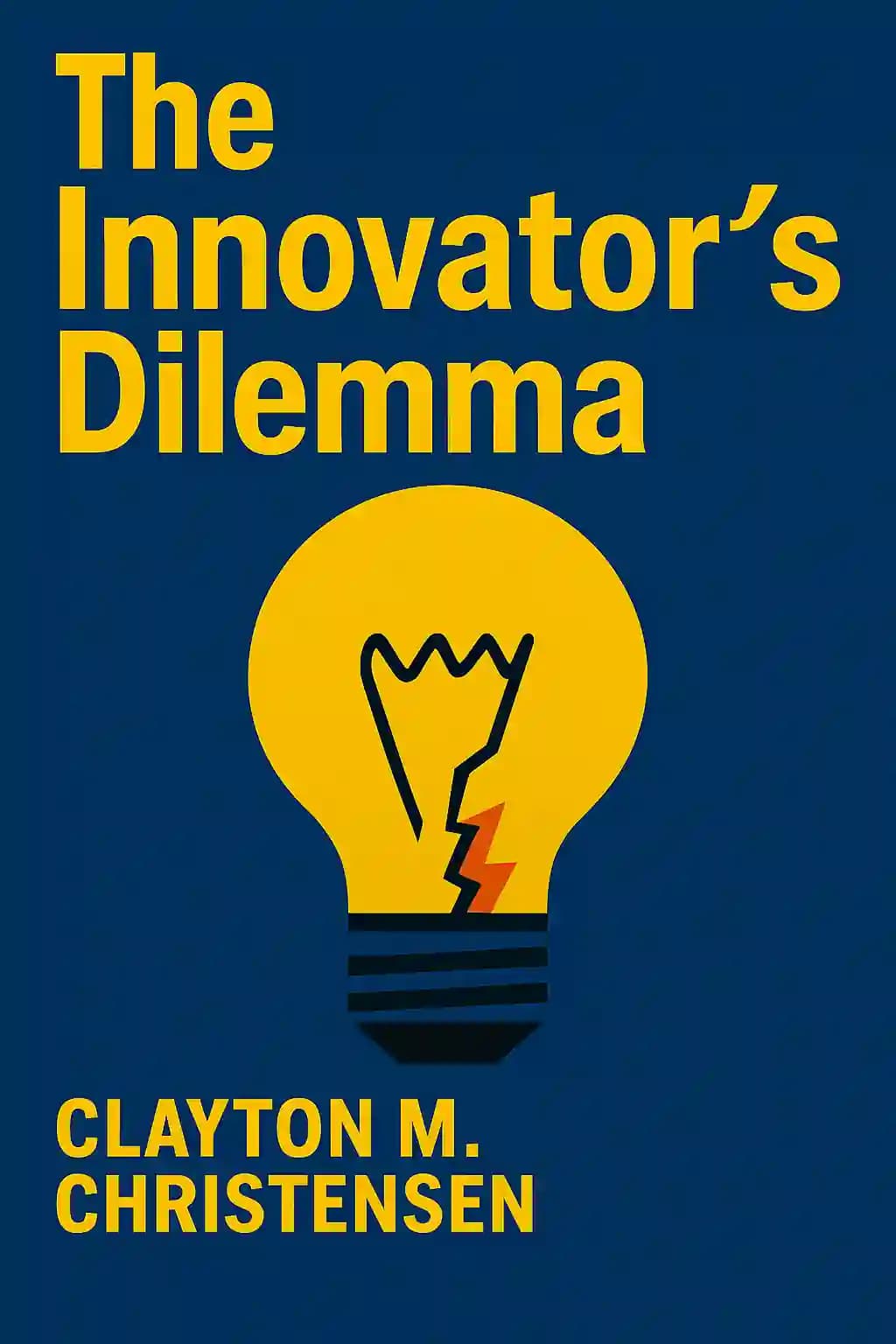
Ever wondered why the mightiest companies - Kodak, Blockbuster, Nokia - collapsed at the peak of their success? Clayton Christensen's groundbreaking work reveals the stunning truth: they failed not because they did something wrong, but because they did everything right. Named by The Economist as one of the six most important business books ever written, "The Innovator's Dilemma" introduces the revolutionary concept of disruptive innovation that has transformed business thinking worldwide.
Christensen, the Harvard professor whose theories influenced Steve Jobs and countless Silicon Valley leaders, challenges the sacred rules of good management. Through meticulous research across industries from disk drives to excavators, he demonstrates how listening to customers and pursuing higher profits can be the very things that destroy great companies.
This isn't just theory - it's the business equivalent of evolutionary biology. Whether you're a startup founder or corporate executive, this book offers a radical new lens to spot industry earthquakes before they hit. The insights within don't just explain the past; they provide the tools to shape your future in our increasingly disruption-prone world.
Глава 2
The Disruptive Innovation Framework
At the heart of Christensen's theory lies a critical distinction between two types of technological change. Sustaining technologies are those that improve product performance along dimensions historically valued by mainstream customers-like increased hard drive storage capacity or faster computer processors. Established companies typically excel at these innovations because they align perfectly with their existing customer needs.
Disruptive technologies, however, initially underperform along these traditional metrics but offer other benefits-they're typically cheaper, simpler, smaller, or more convenient. The classic example Christensen explores extensively is the evolution of disk drive technology. When smaller disk drives (like the shift from 8-inch to 5.25-inch drives) first appeared, they offered less storage capacity than their larger counterparts. Established disk drive manufacturers, listening carefully to their mainstream customers who demanded more storage, dismissed these smaller drives as irrelevant.
What these companies missed was that these "inferior" products were finding footholds in emerging markets with different needs. Personal computer manufacturers, for instance, valued the smaller size and lower cost of 5.25-inch drives over raw storage capacity. As these disruptive technologies improved along traditional performance metrics (storage capacity), they eventually satisfied mainstream market demands while retaining their disruptive advantages (smaller size, lower cost), ultimately displacing established technologies and the companies that championed them.
This pattern repeated with remarkable consistency across multiple generations of disk drive technology, with established leaders falling to new entrants with each architectural shift. The same companies that were responsive, customer-focused, and well-managed found themselves vulnerable precisely because they followed the principles that had made them successful in the first place.
Глава 3
The Innovator's Dilemma Unpacked
The true dilemma lies in the rational, well-intentioned decisions that lead successful companies astray. Three key insights explain this paradox:
First, resource allocation processes in successful companies are designed to support sustaining innovations and reject disruptive ones. Companies depend on customers and investors for resources, and these stakeholders don't initially value disruptive innovations. When managers propose projects targeting small, uncertain markets with lower profit margins, they typically lose the internal competition for resources to projects promising immediate returns in existing markets.
Second, small markets don't solve the growth needs of large companies. A disruptive technology that might generate $50 million in new revenue looks attractive to a small startup but barely moves the needle for a multi-billion-dollar corporation. The mathematics of growth increasingly bias large companies toward pursuing larger opportunities, making them structurally unsuited to nurturing disruptive innovations in their early stages.
Third, markets that don't exist can't be analyzed. Traditional market research and planning processes work well for sustaining innovations where the market is known. But disruptive innovations often create entirely new markets whose size and characteristics can't be known in advance. Companies that demand market size validation before investing are effectively choosing not to enter markets that can't yet be measured-a seemingly rational decision that becomes a fatal flaw when facing disruption.
The book illustrates these principles through detailed historical analysis of the disk drive industry, which Christensen calls "the fruit fly of the business world" due to its rapid generational changes that make patterns of innovation more visible. But the framework extends far beyond this single industry.
Глава 4
Disruption Beyond Disk Drives
Christensen meticulously demonstrates how the same patterns played out in industries ranging from mechanical excavators to steel production, retail, and more.
In mechanical excavators, for example, hydraulic technology initially produced machines with less power and reach than traditional cable-actuated excavators. Established manufacturers like Bucyrus Erie saw little reason to embrace hydraulics when their mainstream customers (mining companies and large construction firms) demanded ever-increasing power and capacity. But hydraulic excavators found a foothold in residential construction, where their smaller size and greater precision were valuable. As hydraulic technology improved, these machines eventually satisfied the requirements of mainstream markets while retaining advantages in cost and reliability, ultimately displacing cable excavators almost entirely.
The integrated steel industry provides another striking example. Minimills initially produced lower-quality steel at lower costs, suitable only for concrete reinforcing bars (rebar)-the lowest-value segment of the market. Established integrated steel mills were actually happy to abandon this low-margin business to focus on more profitable products. But as minimills improved their technology, they moved upmarket to structural beams, then to sheet steel, progressively displacing integrated mills from each segment they entered.
In each case, the established leaders didn't fail because they were blind to the new technology-many actually pioneered the disruptive technologies themselves. They failed because their processes and values were optimized for serving existing customers with sustaining innovations, making them structurally unable to pursue disruptive opportunities effectively.
Глава 5
The Northeasterly Pull: Why Companies Move Upmarket
A fascinating aspect of Christensen's analysis is his explanation of why companies consistently migrate "upmarket" toward higher-margin, higher-performance products and rarely move "downmarket" toward simpler, lower-margin offerings-even when that's where disruptive threats emerge.
This "northeasterly pull" results from the natural incentives within successful organizations. Higher-tier markets offer better margins and the opportunity to differentiate through performance improvements. Lower-tier markets, in contrast, often feature commoditized products with thin margins. When faced with competitive pressure, the rational choice for a company is to move upmarket rather than fight harder for the same or lower margins.
Seagate Technology exemplifies this pattern. Initially focused on 5.25-inch drives for desktop computers, Seagate progressively shifted its attention to higher-capacity drives for file servers and engineering workstations as competition intensified in the desktop market. This upward migration was financially rational but left Seagate vulnerable to disruption from below as new entrants introduced smaller 3.5-inch drives.
The steel industry showed the same pattern. As minimills took over the rebar market, integrated mills moved upmarket to more profitable products like structural steel and sheet steel. Each time minimills improved enough to attack the next tier, integrated mills retreated upmarket again, eventually finding themselves cornered in the highest-tier markets with nowhere left to climb.
This upward migration creates vacuums at the low end of markets, providing perfect entry points for disruptive technologies. The established players, focused on their most profitable customers, often don't even notice the threat until it's too late.
Глава 6
Managing Disruptive Innovation
The second half of Christensen's book moves from diagnosis to prescription, offering principles for how managers can harness disruptive technologies successfully. These insights are particularly valuable because they don't require superhuman foresight or abandoning the management practices that make companies successful with sustaining innovations.
The first key principle is to give responsibility for disruptive technologies to organizations whose customers need them. Since a company's existing customers typically don't value disruptive innovations initially, trying to develop them within the mainstream organization faces nearly insurmountable obstacles. Successful approaches include creating autonomous organizations focused on the disruptive opportunity or acquiring a smaller company already positioned in the emerging market.
Quantum Corporation exemplifies this approach. When 3.5-inch drives emerged as a potential disruption to their 5.25-inch drive business, Quantum created an independent subsidiary called Plus Development specifically to develop and market the smaller drives. This separation allowed Plus to focus on the unique needs of the emerging portable computer market without being constrained by Quantum's existing customer relationships and value network.
Similarly, IBM succeeded with personal computers by establishing an independent business unit in Florida, far from its mainframe operations in New York. This separation allowed the PC division to develop different processes and values appropriate to the personal computer market's needs for lower costs and faster development cycles.
Глава 7
Matching Organization Size to Market Size
A fundamental principle in business strategy is ensuring alignment between organizational scale and market opportunity size. This alignment is critical because it directly impacts a company's ability to grow effectively and maintain investor confidence. Large companies typically require substantial revenue growth - often $100 million or more annually - to maintain their stock prices and organizational momentum. What constitutes an attractive opportunity varies dramatically based on company size: a $50 million opportunity might represent an exciting 50% growth prospect for a $100 million company but would barely register as a 0.5% bump for a $10 billion enterprise.
This size-opportunity mismatch explains why large companies often struggle with emerging markets and disruptive innovations. The initial markets for disruptive technologies are typically small and uncertain, making them unattractive to large corporations despite their future potential. This phenomenon is well-illustrated by several historical examples:
Apple's Newton PDA experience in the 1990s serves as a classic cautionary tale. Despite selling more units than the original Apple II computer had in its early days (about 200,000 units annually) and being technologically innovative, the Newton was labeled a failure. The reason wasn't technical shortcomings or lack of market interest, but rather that its revenue contribution was too small to move the needle for Apple, which by then had grown into a multi-billion dollar company. This same company would later succeed spectacularly with the iPhone, but only after the smartphone market had grown large enough to support Apple's scale.
To address this challenge, successful companies have employed several effective strategies:
1. Creating autonomous divisions: Establishing small, independent organizations within the larger company that can pursue emerging opportunities without the burden of corporate overhead or revenue expectations. These units often operate with different metrics and timeframes than the parent company.
2. Strategic acquisitions: Buying smaller companies that are already succeeding in emerging markets and - crucially - maintaining their independence and entrepreneurial culture. This approach requires resisting the natural urge to integrate these acquisitions too quickly into the parent company's systems and processes.
3. Incubation structures: Developing special organizational structures that protect and nurture new ventures until they reach sufficient scale to matter to the parent company.
The Allen-Bradley case provides an instructive example of successful implementation. When facing the transition from electromechanical to electronic motor controls, they acquired a small startup specializing in electronic technology. Instead of immediately integrating it into their main operations, they maintained its independence, allowing it to develop and refine its technology in smaller markets. Only when electronic technology was ready to address mainstream markets did they begin integration. This approach protected the innovative unit from corporate pressures while allowing it to build capabilities that eventually transformed the entire company.
This principle has become even more relevant in today's fast-moving technology markets, where large companies must constantly balance maintaining their core business while positioning themselves for future disruptions. Companies like Google (Alphabet) and Amazon have institutionalized this approach through structures like Google X and Lab126, creating spaces where small teams can pursue potentially disruptive innovations without the pressure of immediate revenue contributions.
Глава 8
Discovery-Driven Planning for Uncertain Markets
Perhaps the most counterintuitive principle Christensen offers is embracing the fact that markets for disruptive technologies cannot be known or analyzed in advance. Traditional planning processes that demand detailed market size projections and financial forecasts are inappropriate when the market doesn't yet exist.
Instead, Christensen advocates "discovery-driven planning"-a process that acknowledges uncertainty and focuses on learning and adaptation rather than execution of a predetermined plan. This approach involves making small initial investments, testing key assumptions in the real world, and being prepared to pivot as market feedback arrives.
Honda's entry into the American motorcycle market illustrates this principle perfectly. Honda initially planned to sell large motorcycles to compete with Harley-Davidson but discovered unexpectedly that their small Supercub bikes-which they had brought to America just for their own transportation-generated enormous interest from retailers like Sears. This discovery of an entirely new market segment (recreational motorcycling) that valued different attributes (simplicity, affordability) than the traditional motorcycle market led to Honda's eventual dominance.
Similarly, Intel didn't have a grand strategy to dominate the microprocessor market when it developed its first CPU. The company was primarily focused on memory chips and created the microprocessor almost as a side project. Only as the personal computer market emerged did Intel recognize the enormous potential of this business and shift its focus accordingly.
Глава 9
Capabilities and Disabilities
A particularly insightful aspect of Christensen's framework is his analysis of organizational capabilities as consisting of three elements: resources, processes, and values.
Resources-including people, technology, and capital-are the most visible components of capability and the easiest to change. Processes are the patterns of interaction, coordination, and decision-making that transform resources into products and services. Values are the standards by which employees make prioritization decisions.
As organizations mature, their capabilities increasingly reside in their processes and values rather than in their resources. This shift creates a paradox: the very processes and values that make a company effective at its current business can become disabilities when facing disruptive change.
Digital Equipment Corporation (DEC) exemplifies this dynamic. Despite having excellent engineers and technology (resources), DEC's processes were optimized for designing and building minicomputers with complex, proprietary architectures. These processes were fundamentally misaligned with the personal computer market's need for simpler designs using standardized components. Similarly, DEC's values prioritized high performance and engineering elegance over the cost minimization that drove the PC market.
This framework explains why simply acquiring new resources-hiring different people or buying new technologies-often fails to build new capabilities for addressing disruptive innovations. The existing processes and values typically overpower these new resources, bending them to serve the organization's established priorities.
Глава 10
The Technology S-Curve and Performance Oversupply
A final key insight in Christensen's framework involves the relationship between technological progress and market demands. Technologies typically improve along S-curves, with slow initial progress, then rapid advancement, and finally diminishing returns as physical limits are approached.
Markets, however, have their own trajectories of performance requirements that often grow more slowly than technological capability. This creates "performance oversupply"-a condition where products exceed what customers can actually use or value.
Performance oversupply changes the basis of competition in markets. When products don't yet satisfy customer requirements, the competitive focus is on performance improvement. But once products exceed customer needs, competition shifts to other attributes like reliability, convenience, and ultimately price.
This dynamic creates perfect conditions for disruptive technologies to gain footholds. When mainstream products overshoot customer needs on traditional performance metrics, customers become willing to accept trade-offs on those metrics in exchange for improvements in other dimensions like simplicity or convenience.
Intuit's QuickBooks exemplifies this principle in accounting software. Established accounting packages had become increasingly complex and feature-rich, overshooting the needs of most small businesses. QuickBooks offered significantly fewer features but was much easier to use-a trade-off that small business owners without accounting backgrounds were happy to make. Despite initial dismissal from accounting professionals who valued the complex features of traditional software, QuickBooks captured 70% of the small business accounting software market.
Глава 11
Applying the Framework: Electric Vehicles as a Case Study
In the book's final chapter, Christensen applies his framework to electric vehicles (EVs), which at the time of writing (mid-1990s) were still in their very early stages. This analysis provides a fascinating test case for his principles.
Christensen correctly identified that established automakers were approaching EVs as a sustaining technology-trying to make electric cars that could compete directly with gasoline vehicles on range, speed, and carrying capacity. This approach was doomed to failure because battery technology couldn't yet match the performance of internal combustion engines on these dimensions.
Instead, Christensen suggested that successful electric vehicles would need to find markets that valued the unique attributes of electric propulsion (quiet operation, zero emissions, low maintenance) and didn't require the performance characteristics where EVs couldn't yet compete. He speculated about potential markets like urban delivery vehicles, campus transportation, or even vehicles for teenage drivers where limited range might be seen as a feature (keeping teens close to home) rather than a bug.
This analysis proved remarkably prescient. Tesla, which emerged years after Christensen's book, initially targeted a high-end sports car market where electric motors' instant torque was an advantage and wealthy early adopters were willing to pay a premium for new technology. Only after establishing this beachhead did Tesla move gradually toward more mainstream markets.
Глава 12
The Enduring Relevance of the Innovator's Dilemma
What makes Christensen's work so powerful is that it doesn't rely on criticizing managers for shortsightedness or incompetence. Instead, it shows how good managers making rational decisions according to sound business principles can still lead their companies toward failure when facing disruptive innovation.
The dilemma is that the very management practices that help companies succeed with sustaining technologies-listening to customers, pursuing higher margins, demanding market validation before investing-can become fatal flaws when confronting disruption. This isn't a problem that can be solved by simply being more aware or trying harder within the same frameworks.
Instead, successfully managing disruptive innovation requires creating separate organizational spaces where different processes and values can thrive-spaces where small markets can be exciting, where learning and discovery are prioritized over execution, and where the metrics of success are aligned with the unique characteristics of disruptive technologies.
The principles Christensen outlines have only grown more relevant in the decades since publication. Industries from media to transportation, healthcare to finance have experienced waves of disruption that follow the patterns he identified. Companies that have thrived amid these changes-like Amazon, which has repeatedly disrupted itself-have often explicitly applied Christensen's insights.
Perhaps most importantly, the book offers hope along with its warnings. By understanding the structural forces that drive the innovator's dilemma, managers can design approaches that harness these forces rather than fighting against them. The path isn't easy-it requires the courage to create organizational space for initiatives that might initially seem marginal or even threatening to the core business. But for companies willing to embrace these principles, disruption becomes an opportunity rather than a death sentence.
Глава 13
Beyond Technology: The Human Element of Disruption
While Christensen's framework focuses primarily on technological and market dynamics, there's a profound human element to the innovator's dilemma that deserves reflection. The managers who miss disruptive innovations aren't incompetent-they're often the best in their fields, making decisions that would be praised in business school case studies.
The tragedy lies in how organizational systems can turn individual brilliance into collective blindness. Career incentives reward managers who deliver predictable results in existing markets rather than those who champion risky ventures in uncertain territories. Resource allocation processes naturally favor initiatives with clear ROI projections over those requiring leap-of-faith assumptions. And the very human desire to serve existing customers well can blind organizations to emerging opportunities with different customers.
This human dimension suggests that addressing the innovator's dilemma requires not just structural changes but cultural ones as well. Organizations need to create spaces where failure in service of learning is accepted, where small wins in emerging markets are celebrated even if they don't immediately impact the bottom line, and where managers are rewarded for thoughtful exploration of uncertain territories.
Perhaps the most profound insight from Christensen's work is that innovation isn't primarily about technology-it's about understanding human needs and organizational dynamics. The companies that master this understanding gain not just competitive advantage but the ability to repeatedly reinvent themselves as markets evolve, creating lasting value rather than temporary success.
In a world where disruption has become the norm rather than the exception, this capacity for continuous reinvention may be the only sustainable competitive advantage. And that makes the lessons of "The Innovator's Dilemma" not just interesting business theory but essential wisdom for survival in the modern economy.