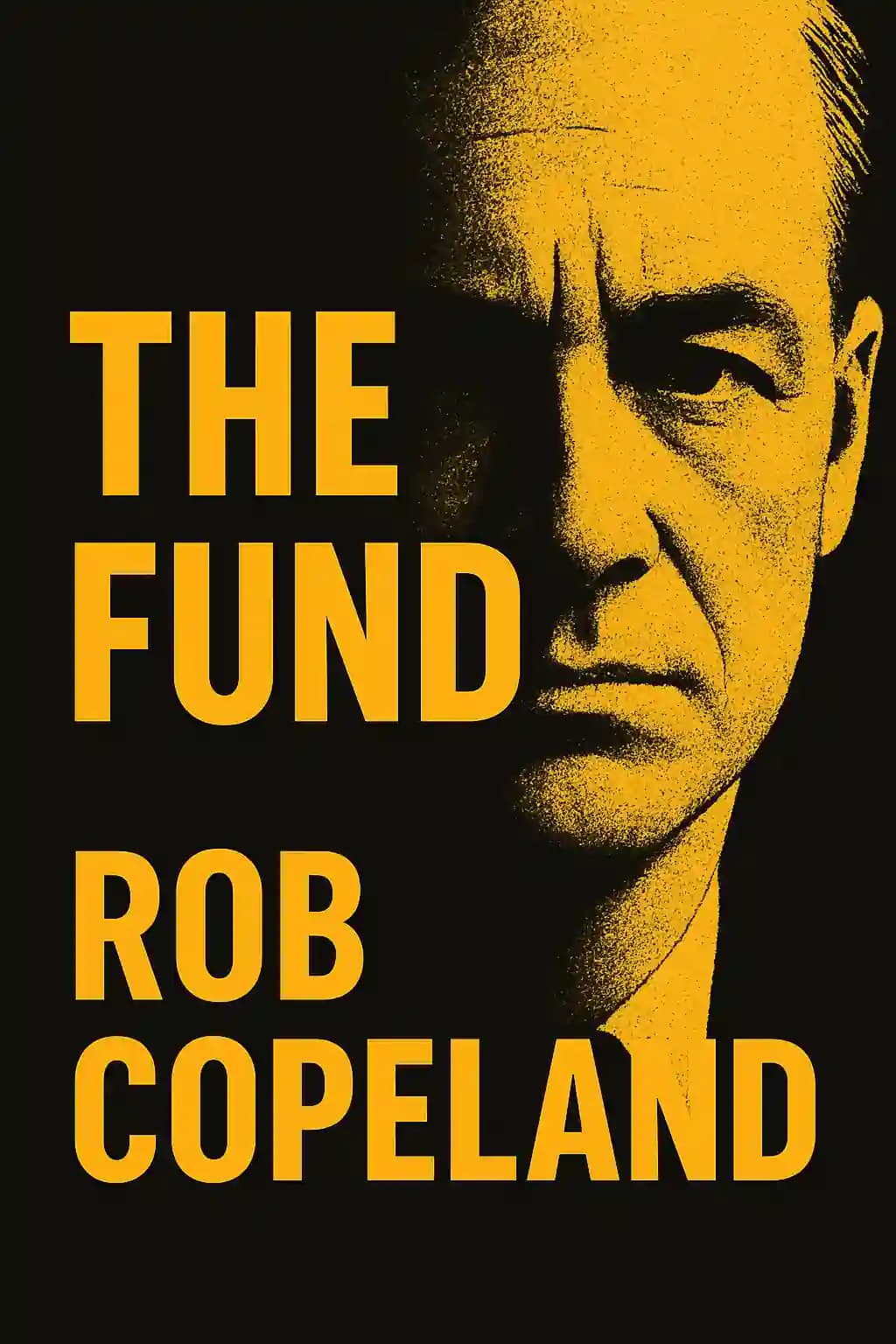
Peek inside Ray Dalio's $150 billion Bridgewater Associates, where surveillance and "Principles" reduced employees to tears. Even as an NYT bestseller, this expose prompted Dalio himself to dismiss it as "tabloid gossip" - while revealing his secretive trading strategies impact billions.
Rob Copeland, author of The Fund: Ray Dalio, Bridgewater Associates, and the Unraveling of a Wall Street Legend, is a seasoned finance reporter for The New York Times and former hedge-fund specialist at The Wall Street Journal. His investigative work on Bridgewater Associates, the world’s largest hedge fund, earned him a New York Press Club Award and established his authority on Wall Street’s inner workings.
The book, a gripping exposé of Ray Dalio’s empire, blends corporate history with themes of leadership, transparency, and the complexities of high-stakes finance, informed by Copeland’s decade-long coverage of the industry.
Copeland’s reporting has been featured on ABC’s Good Morning America, NPR, and prominent finance podcasts, cementing his reputation as a trusted voice in business journalism. His front-page investigations into Silicon Valley and elite financial circles further underscore his expertise. The Fund, published by Macmillan Audio in 2023, is available as a 13-hour audiobook and has sparked widespread discussion for its unflinching portrayal of Bridgewater’s radical corporate culture and Dalio’s legacy.
The Fund is an investigative expose by Rob Copeland that dismantles Ray Dalio’s carefully crafted image as a benevolent financial guru. It reveals Bridgewater Associates’ toxic workplace culture, detailing how Dalio’s “radical transparency” principles fostered paranoia, psychological manipulation, and ethical compromises among employees. The book draws on firsthand accounts of high-profile figures like former FBI director Jim Comey and Pennsylvania Senate candidate David McCormick.
This book is ideal for readers interested in corporate ethics, hedge fund operations, or critiques of Silicon Valley-style leadership cults. Finance professionals, HR leaders, and fans of investigative journalism will gain insights into the dark side of Wall Street’s “principles-driven” success stories. It also appeals to those fascinated by billionaire culture and workplace psychology.
Yes, for its unflinching look at Bridgewater’s contradictions: Dalio’s public persona as a management sage versus accounts of employee surveillance, ideological coercion, and legal intimidation. Copeland’s meticulous reporting—including interviews with insiders—makes it a gripping case study in corporate hubris and the human cost of unchecked power.
The book depicts a pressure-cooker environment where employees undergo:
While Dalio’s Principles promotes idealized management theories, The Fund serves as a counter-narrative—exposing how those same principles reportedly caused emotional harm, stifled dissent, and prioritized Dalio’s ego over employee well-being.
Despite managing $150B+, Copeland suggests Bridgewater’s success relied less on Dalio’s much-hyped algorithms and more on:
Dalio and Bridgewater aggressively disputed Copeland’s reporting, attempting to discredit the author and suppress critical narratives. The firm reportedly pressured media outlets and used legal threats to shape coverage.
As a Pulitzer Prize-contending New York Times finance reporter, Copeland leveraged years of investigative work—including interviews with 100+ Bridgewater insiders—to challenge Dalio’s mythos. His expertise in financial systems adds credibility to the exposé.
Absolutely. It’s a cautionary tale about leadership cults in an era obsessed with “disruptive” management theories. The book resonates amid debates about workplace mental health, CEO accountability, and ethical finance practices in 2025.
Почувствуйте книгу через голос автора
Захватите ключевые идеи мгновенно для быстрого обучения
It's a tale of unchecked power, psychological manipulation, and the dangers of conflating wealth with wisdom.
It was like being in an abusive relationship. You start to doubt your own perceptions of reality.
What he built instead was a gilded cage of conformity and fear.
The tragedy is that he never seemed to realize the monster he had created.
Разбейте ключевые идеи Fund на понятные тезисы, чтобы понять, как инновационные команды создают, сотрудничают и растут.
Задавайте любые вопросы, выбирайте свой стиль обучения и создавайте идеи, которые действительно вам подходят.

Создано выпускниками Колумбийского университета в Сан-Франциско
"Instead of endless scrolling, I just hit play on BeFreed. It saves me so much time."
"I never knew where to start with nonfiction—BeFreed’s book lists turned into podcasts gave me a clear path."
"Perfect balance between learning and entertainment. Finished ‘Thinking, Fast and Slow’ on my commute this week."
"Crazy how much I learned while walking the dog. BeFreed = small habits → big gains."
"Reading used to feel like a chore. Now it’s just part of my lifestyle."
"Feels effortless compared to reading. I’ve finished 6 books this month already."
"BeFreed turned my guilty doomscrolling into something that feels productive and inspiring."
"BeFreed turned my commute into learning time. 20-min podcasts are perfect for finishing books I never had time for."
"BeFreed replaced my podcast queue. Imagine Spotify for books — that’s it. 🙌"
"It is great for me to learn something from the book without reading it."
"The themed book list podcasts help me connect ideas across authors—like a guided audio journey."
"Makes me feel smarter every time before going to work"
Создано выпускниками Колумбийского университета в Сан-Франциско

Получите резюме книги «Fund» в формате PDF или EPUB бесплатно. Распечатайте или читайте офлайн в любое время.
Ray Dalio's origin story is the stuff of Wall Street legend. A middle-class kid from Long Island, he bought his first stock at age 12 and was trading by high school. After graduating from Harvard Business School, he founded Bridgewater out of his two-bedroom apartment in 1975. From these humble beginnings, Dalio built Bridgewater into a behemoth, amassing a fortune of over $19 billion. By the 2000s, Bridgewater was the world's largest hedge fund, managing $150 billion and boasting eye-popping returns. But it wasn't just Bridgewater's financial success that set it apart. Dalio had developed a unique management philosophy centered on radical transparency and what he called an "idea meritocracy." Employees were encouraged to challenge each other openly, regardless of rank. Every meeting was recorded. Performance was constantly evaluated through a system of public ratings and rankings. Dalio codified these practices in a 123-page manifesto called "Principles," which became required reading for all Bridgewater employees. He claimed this system allowed the best ideas to rise to the top, creating a workplace nirvana of truth-seeking and personal growth. The reality, as I discovered, was far different.
As I spoke to more and more Bridgewater alumni, a disturbing pattern emerged. Far from the utopia Dalio described, employees painted a picture of a cult-like environment where conformity was prized above all else. New hires were immediately thrust into Bridgewater's insular world. They attended multi-day indoctrination sessions where they were taught to speak in Dalio's unique vernacular of "principles." Terms like "getting to the other side" (overcoming a challenge) and "getting in sync" (aligning with others) became part of daily conversation. Employees were subjected to constant surveillance and evaluation. Meetings were videotaped and dissected. "Coaches" shadowed workers, grading their every interaction. A proprietary iPad app called "Dots" allowed anyone to rate their colleagues in real-time on dozens of attributes. The pressure to conform was immense. Those who questioned Dalio's principles or failed to embrace the culture were quickly ostracized or fired. As one former executive told me, "It was like being in an abusive relationship. You start to doubt your own perceptions of reality." The human toll was severe. I spoke to numerous ex-employees who described anxiety, depression, and even suicidal thoughts stemming from their time at Bridgewater. One young analyst told me how he would vomit from stress before important meetings. A former manager recounted breaking down in tears in her office, overwhelmed by the constant criticism and mind games. Yet many stayed, seduced by the prestige and eye-popping salaries Bridgewater offered. As one ex-employee put it, "It's like being in an abusive relationship where your abuser also pays you millions of dollars."
At the center of this maelstrom was Ray Dalio himself. In public, he cultivated an image as a benevolent guru, dispensing wisdom on everything from economics to life philosophy. He gave TED talks, wrote bestselling books, and hobnobbed with world leaders. But behind closed doors, a very different Dalio emerged. Former employees described a mercurial, often cruel leader who seemed to revel in humiliating subordinates. In one infamous incident, Dalio berated a young employee in front of hundreds of colleagues, reducing the man to tears. Dalio's word was law at Bridgewater. Those who challenged him, even senior executives, were swiftly shown the door. The firm churned through a parade of co-CEOs and other top leaders, unable to establish a stable management structure beyond Dalio's iron grip. Yet Dalio seemed blind to the toxic culture he had created. He genuinely believed his system was producing "meaningful work and meaningful relationships," as he often said. When confronted with criticism, he dismissed it as coming from those who simply couldn't handle the truth.
As I dug deeper into Bridgewater's vaunted investment process, another surprising discovery emerged. For all the talk of algorithmic trading and data-driven decisions, much of the firm's success seemed to hinge on Dalio's personal intuition. Only a tiny handful of employees - perhaps 10 out of over 1,500 - actually knew how Bridgewater's trading systems worked. The vast majority were engaged in what one ex-employee called "a glorified book club," endlessly debating abstract principles rather than making investment decisions. This centralization of knowledge meant that, contrary to Dalio's claims of building a "perpetual motion machine," Bridgewater remained heavily dependent on its founder. As Dalio aged and took a less active role, the firm's performance began to suffer. Its flagship Pure Alpha fund lagged the S&P 500 for much of the past decade. Yet the mystique around Bridgewater persisted. Investors, dazzled by past returns and Dalio's celebrity, continued to pour in billions. It was as if no one wanted to be the first to point out that the emperor had no clothes.
By 2022, cracks in the Bridgewater edifice were becoming impossible to ignore. Dalio's attempts to hand over control to successors repeatedly faltered. Key executives and investors headed for the exits. The firm's performance continued to lag. In late 2022, Dalio announced he was finally stepping down from his remaining roles at Bridgewater. But the firm he left behind seemed adrift, struggling to define itself without its domineering founder. As I reflect on the strange saga of Bridgewater, I'm struck by how it embodies some of the worst excesses of modern capitalism. It's a cautionary tale about the dangers of unchecked power, the allure of guru worship, and our society's tendency to equate wealth with wisdom. Ray Dalio set out to create a system of radical truth-seeking. What he built instead was a gilded cage of conformity and fear. The tragedy is that he never seemed to realize the monster he had created. In the end, the story of Bridgewater is a reminder that no amount of principles or algorithms can substitute for basic human decency and empathy. It's a lesson Wall Street - and society at large - would do well to heed.