Глава 1
When Friction Becomes Your Friend: The Organizational Paradox
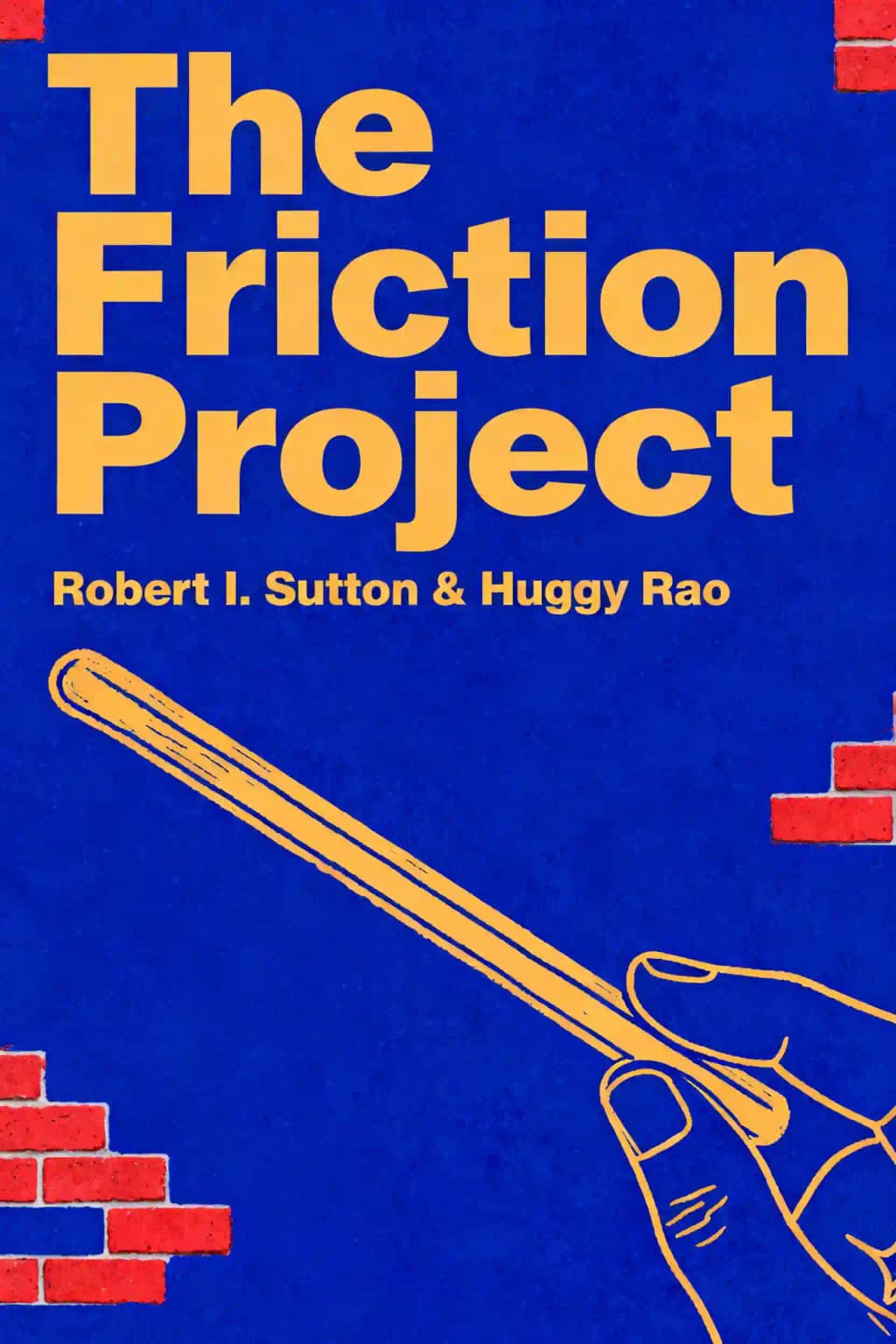
Ever found yourself drowning in pointless meetings, wading through endless email threads, or navigating labyrinthine approval processes? You're experiencing what Stanford professors Robert Sutton and Huggy Rao call "bad friction" - the organizational gunk that makes work harder, slower, and more frustrating than necessary. After seven years studying this phenomenon across countless organizations, they've distilled their insights into "The Friction Project," a book that's become required reading in Silicon Valley boardrooms and beyond. Even Bill Gates called it "a practical guide to making organizations work better" - high praise from someone who built one of the most successful companies in history. What makes this book particularly compelling is its counterintuitive thesis: while bad friction should be eliminated, good friction - the kind that slows us down at the right moments - is essential for quality, creativity, and human connection. As we navigate an era obsessed with frictionless experiences, this nuanced perspective offers a refreshing alternative to the "faster is always better" mindset that dominates modern work culture.
Глава 2
The Friction Paradox: When Easy Is Wrong and Hard Is Right
Not all friction is created equal. The authors distinguish between destructive friction that grinds people down and constructive friction that enables better outcomes. Consider Dutch supermarket Jumbo's "slow checkout lane" - deliberately designed for elderly customers who value human connection over efficiency. This counterintuitive approach recognizes that sometimes making things harder creates more meaningful experiences.
This paradox extends beyond customer experiences into how we value our own work. The "IKEA effect" demonstrates that we cherish things more when we've invested effort in creating them. Military boot camps leverage this principle by making membership deliberately difficult, creating stronger bonds among those who persevere. As the authors note, "Labor leads to love" - we become attached to things we've suffered to achieve, regardless of their objective value.
The friction paradox challenges us to think more carefully about what should be easy versus hard. When Hawaii Pacific Health discovered doctors were spending 43% of their time updating electronic health records versus only 13% with patients, Dr. Melinda Ashton launched the aptly named "Getting Rid of Stupid Stuff" program. Her team collected 188 nominations of pointless requirements and implemented 87 improvements. Just eliminating one click during hourly rounds saved 1,700 nursing hours monthly across four hospitals - a perfect example of making the right things easier.
But sometimes adding friction is exactly what's needed. At Rohm and Haas, a company known as a "stealth CEO factory," leaders are taught to slow down and consider five stakeholder perspectives before making major decisions. This deliberate friction produces better outcomes and trains future executives in thoughtful decision-making.
The key insight? Effective leaders must become "friction fixers" who thoughtfully determine what should be easy versus difficult in their organizations, making the right things frictionless while deliberately preserving or adding friction where it serves a valuable purpose.
Глава 3
The Trustee Mindset: Protecting Others' Time and Energy
Friction fixers see themselves as trustees of others' time and energy - a mindset exemplified by Winston Churchill's famous 1940 "Brevity" memo imploring colleagues to write shorter reports. Like Churchill, effective leaders identify and remove obstacles that waste people's resources while recognizing when to deliberately slow things down.
This trustee mindset operates within what the authors call the "cone of friction" - a leader's zone of potential impact where they can make things easier or harder for others. Dropbox CEO Drew Houston demonstrated this when he cleared employees' calendars of meetings for two weeks in an event dubbed "Armeetingeddon," establishing new guidelines like "schedule meetings if (and only if) other forms of communication won't cut it."
Five commitments guide effective trustees:
First, friction fixing requires constant vigilance - "it's like mowing the lawn." Despite dramatic interventions like Churchill's memo or Dropbox's meeting purge, the battle against organizational friction never ends. Churchill had to re-send his brevity memo years later when he returned as prime minister, and Dropbox's meeting culture eventually deteriorated again.
Second, organizations should be treated as "malleable prototypes" rather than permanent fixtures. When IDEO CEO David Kelley restructured his company, he reminded employees that "enlightened trial and error outperforms the planning of flawless intellects" and even shaved his trademark mustache to symbolize that changes are "temporary and reversible experiments."
Third, trustees celebrate doers, not posers. During the 100,000 Homes Campaign, Becky Margiotta's team learned to identify and ignore "hollow Easter bunnies" - people who talked impressively but never followed through. Instead, they created awards to celebrate genuine contributors.
Fourth, effective trustees focus on fixing problems rather than assigning blame. MIT researchers found that in dysfunctional organizations, employees who identify systemic problems are often punished. Boeing's broken culture exemplified this - employees hid design flaws in the 737 MAX because they feared speaking up, ultimately contributing to two crashes that killed 346 people.
Finally, trustees honor prevention over firefighting. While organizations often celebrate heroic "war heroes" who develop work-arounds for broken systems, the best designs are those "you notice that you don't notice" because they work so smoothly.
What powers this trustee mindset? Psychologist Jessica Tracy calls it "authentic pride" - self-esteem gained from conscientious care and accomplishment that earns others' respect. This contrasts with "hubristic pride," where people feel superior due to inherent qualities. Authentic pride drives long-term prestige through hard work, fueling the persistent effort required to fix organizational friction.
Глава 4
Friction Forensics: A Systematic Approach to Deciding What Should Be Easy vs. Hard
When conducting "friction forensics," leaders must first ask two fundamental questions: "Is it the right thing for us to do?" and "Do we have the will and skill to do it well?" When something is safe and proven effective, it should typically be quick and easy - like the TSA PreCheck program that saves trusted travelers time. Conversely, things that are dangerous or harmful should be made difficult or impossible.
The emergency department ultrasound study illustrates this perfectly. Adding "process friction" at General Hospital (requiring doctors to justify ultrasound orders) reduced unnecessary tests by 11.1% compared to Flagship Hospital's frictionless ordering system. This friction saved patients 30 minutes in waiting time, reduced costs by $200,000 over two years, and had no negative health impacts. The broader lesson is that sometimes inconvenience forces necessary reflection - asking "Should we do this?" rather than just "Can we do this?"
However, friction's value depends on perspective. While patients and insurers benefited from General Hospital's approach, doctors faced additional work and the hospital lost potential revenue. These trade-offs highlight why friction decisions are complex and context-dependent.
Unfortunately, friction is often weaponized for selfish purposes through "dark patterns" that trick users with manipulative interfaces. The "roach motel" problem is particularly common - making it easy to enter but difficult to escape a service. Greg Bensinger criticized Amazon's labyrinthine Prime cancellation process, while Netflix offers a contrasting approach - making cancellation easy with just a couple clicks. This customer-friendly approach challenged Netflix to "make the product so good that customers don't want to cancel" rather than trapping dissatisfied users.
The most successful organizations master "friction shifting" - knowing precisely when to accelerate and when to apply necessary friction. Navy SEALs exemplify this balance - their extraordinary efficiency in operations like the bin Laden raid stems from their grueling six-month training process that selects for individuals who can instantly shift between lightning-fast action and careful assessment.
Глава 5
The Help Pyramid: Five Levels of Friction Fixing
Friction fixers help others in two ways: through prevention and cure (implementing changes to make the right things easy and wrong things hard) and by dealing with symptoms (keeping others sane and motivated to survive broken systems). The authors introduce the "Help Pyramid" framework with five levels of intervention:
At the bottom level, "reframing" involves shaping how people feel about obstacles that are difficult to remove. Friction fixers use methods similar to cognitive behavioral therapy to help people view challenges as less upsetting. Real estate agent Rumana Jabeen exemplifies this approach by calming anxious clients through assurances and temporal distancing ("this too shall pass"), helping them see that current stresses will seem minor in retrospect.
The second level, "navigating," involves serving as a trail guide, steering people to find the best path through a system without altering it. Friction fixers help colleagues avoid "gunk people" (workplace vigilantes who enforce rules obsessively) and connect them with "grease people" (who help others avoid red tape). In extremely broken systems like San Francisco's permit process, professional navigators ("permit expeditors") become necessary, though this breeds inequality as only those who can afford such help succeed.
The third level, "shielding," involves absorbing and deflecting friction so others don't have to face it. In hostile environments, good managers act as "shit umbrellas," deflecting the chaos raining down from above. This protection can be heroic, as when Pixar cofounders Ed Catmull and Alvy Ray Smith refused to provide layoff names, instead offering their own - ultimately saving the company.
The fourth level, "neighborhood design and repair," involves making small-scale improvements to organizational systems. At Microsoft's learning and development team, meetings were shortened by five or ten minutes to combat virtual fatigue, creating breaks between back-to-back meetings. Sometimes adding constructive friction is beneficial, as in Stanford's LaunchPad class where instructors Perry Klebahn and Jeremy Utley impose deliberate obstacles on students launching real businesses.
The highest level, "system design and repair," aims to transform entire organizations. This requires more influence, especially in large, complex organizations with many fiefdoms. Some systemic changes come as top-down commands from executives, like Drew Houston's "Armeetingeddon" at Dropbox or Steve Jobs firing all Apple's general managers upon his return in 1997. Others blend top-down and bottom-up approaches, like Hawaii Pacific Health's "Getting Rid of Stupid Stuff" campaign or AstraZeneca's "Million Hours Campaign" which combined corporate-wide interventions with local "simplification champions."
Глава 6
The Five Friction Traps: Where Organizations Get Stuck
The authors identify five common "friction traps" that plague organizations, providing specific tactics to address each one. These traps create organizational friction that impedes progress, wastes resources, and diminishes employee engagement.
The first trap, "oblivious leaders," occurs when those in power become disconnected from everyday experiences. General Motors executives exemplify this problem - they avoid the frustrating car-buying process through their Product Evaluation Program, receiving new cars every six months for just $250 monthly with free gas and maintenance. This "power poisoning" has three symptoms: privilege that shields leaders from everyday hassles, the fallacy that leaders automatically know everything important about their organizations, and increased selfishness. Similar examples can be found in tech companies where executives use internal beta versions of products, never experiencing the bugs and frustrations that plague regular customers.
When leaders become oblivious, six major consequences emerge. "Executive magnification" occurs when employees pursue leaders' instructions more forcefully than intended - like when one executive's offhand comment about no blueberry muffins led to years of staff ensuring blueberry muffins appeared at every event he attended. Another example involved a CEO casually mentioning purple as her favorite color, leading to office renovations featuring purple walls and furniture. "Multiplication madness" happens when leaders remain blind to how small burdens compound when imposed on many people over time - like sending a 1,266-word email with a 7,266-word attachment to over 2,000 professors, collectively wasting thousands of hours of reading time. "Decision amnesia" occurs when leaders repeatedly revisit decisions that teams believed were final, wasting time and undermining implementation. This often manifests in projects being repeatedly revised or initiatives being restarted multiple times.
To counter power poisoning, leaders should "be an elephant, not a hippo" - referring to hippopotamuses' giant mouths and tiny ears (symbolizing powerful people who talk too much and listen too little) versus elephants' small mouths and giant ears (representing better leadership). Successful CEOs like Microsoft's Satya Nadella and IBM's Arvind Krishna regularly practice "listening tours" where they spend time with frontline employees and customers. Leaders gain deeper insights through "ride-alongs" or "shadowing" - watching, following, and questioning employees as they work. For instance, Starbucks requires all corporate employees to work in stores annually, while Amazon executives regularly spend time in fulfillment centers. Research also shows that high-performing global leaders practice "downward deference" - reducing social distance and deferring to subordinates' technical and cultural expertise. This might involve senior executives seeking input from junior employees on digital initiatives or consulting local teams about regional market conditions.
Organizations can combat oblivious leadership through structured programs like reverse mentoring, where junior employees mentor senior executives on topics like new technologies or emerging market trends. Regular employee feedback surveys, anonymous suggestion systems, and skip-level meetings (where leaders meet with employees two levels below them) also help maintain connection with ground-level realities.
Глава 7
Addition Sickness: Why Organizations Keep Piling On
The second friction trap, "addition sickness," refers to organizations' chronic tendency to add rather than subtract - new staff, rules, meetings, and processes that accumulate like plaque. As George Carlin joked, "My shit is stuff. Your stuff is shit" - we see our additions as essential while viewing others' as unnecessary friction.
This "addition bias" is hardwired: across twenty studies, researchers found people consistently default to adding solutions rather than removing elements. Organizations make this worse by rewarding those who create new initiatives while ignoring or even punishing subtraction. Universities exemplify this problem - administrative staff has ballooned from a 1:1 ratio with faculty in 1987 to 2:1 by 2008, with each administrator generating new rules, forms, and processes that strangle capability.
To combat addition sickness, friction fixers conduct "good riddance reviews" or "sludge audits" to identify what to remove. They implement simple subtraction rules like eliminating in-person interviews when unnecessary, removing ink signature requirements, and limiting core organizational values to four or fewer with vivid imagery. They also create "subtraction rituals" to mark the removal of outdated practices - like when Zipcar employees smashed old desktop computers with sledgehammers to symbolize their shift to a mobile-first strategy.
Organizations can also designate "subtraction specialists" with authority to identify and remove friction. At Hootsuite, CEO Ryan Holmes appointed Noel Pullen as "czar of bad systems" after Noel challenged a costly T-shirt approval process. Noel created a Bad Systems group to track bottlenecks, using a points system to prioritize fixes based on impact versus effort.
With collaborative work ballooning by 50% over two decades and worsening during the pandemic, organizations are fighting back against meeting overload. Asana's "Meeting Doomsday" program had employees audit their calendars, remove all standing meetings under five people for 48 hours, then only restore valuable ones. Participants saved an average of 11 hours monthly by eliminating meetings, reducing frequency, and shortening durations.
Глава 8
Broken Connections: When Smart People Can't Work Together
The third friction trap, "broken connections," involves failures of communication, collaboration, and integration that create friction despite having skilled staff. A three-year study of a state-of-the-art cancer hospital revealed how these problems manifest despite the center's mission of "patient-centered care." Cancer patients were forced to coordinate their own complex treatments across dozens of specialists with little support - what patient activists called "the cancer tax."
Even smart, hardworking leaders create coordination problems due to cognitive biases. Stanford researchers identified "coordination neglect" - where people fixate on parts of organizations while ignoring how they should work together. One mode is "component focus," where specialists concentrate solely on their work while ignoring connections to others, like the Ford engineer who only saw chassis when looking at cars or the oncologist who viewed a patient's tumor as the only relevant aspect of health.
To diagnose destructive competition, friction fixers ask: "Do people get ahead by doing great work AND helping others succeed? Or by doing great work while undermining colleagues?" When Satya Nadella took over Microsoft in 2014, he abolished Ballmer's toxic "stack ranking" system that forced managers to rate 10% of employees as poor performers regardless of actual performance. Nadella encouraged people to be "learn-it-alls not know-it-alls" and implemented his "One Microsoft" philosophy against "a confederation of fiefdoms." These changes transformed Microsoft's culture, with the company's market cap growing from $300 billion to over $2.5 trillion by 2023.
Friction fixers energize coordination by creating emotionally "hot causes" that generate shared anger and pride, which fuel "cool solutions" - concrete, coordinated actions. At the Cancer Center, patient activists shared their ordeals with hospital staff, which motivated employees to develop solutions. Initially resistant physicians, after hearing patients' stories and reading research on care coordination, changed their perspective.
Глава 9
Jargon Monoxide and the Speed Trap: Communication and Pace Problems
The fourth friction trap, "jargon monoxide," refers to convoluted, soulless language that creates friction in organizations. Whether it's executives talking about "leveraging core competencies to create synergies" or consultants promoting "fit-for-purpose accountable cells," this pretentious language leaves people bewildered about what to do and how to do it.
The authors identify four types of problematic language: "Convoluted Crap" (unnecessarily complex language that wastes time), "Meaningless Bullshit" (empty communication that serves the speaker's purpose but is essentially meaningless), "In-Group Lingo" (specialized language that helps insiders but excludes others), and "Jargon Mishmash Syndrome" (when organizations use so many different labels that people can't distinguish between signal and noise).
Friction fixers replace hollow jargon with language that inspires action and clarity. Research reveals five characteristics of powerful communication: concrete language rather than vague terms, present tense that conveys confidence, language suggesting personal choice rather than external obligation, sensory metaphors that link concepts to bodily experiences, and framing work as ongoing journeys rather than completed destinations.
The fifth friction trap, "fast and frenzied," examines when excessive speed damages organizations. Too much speed at the wrong time is dangerous - contributing to 29% of traffic fatalities and causing organizational harm. Research shows companies with mission statements emphasizing "locomotion" terms (do it, fast, urgent) faced more EEOC violations than those focused on "assessment" (careful, consider, thorough).
Excessive speed harms individuals through burnout (affecting 67% of employees), selfishness (hurried people ignore others needing help), bullying (overloaded bosses are more likely to abuse subordinates), bad decisions (the "bandwidth tax" prevents thoughtful consideration), and diminished creativity (people were 45% less likely to think creatively on high-pressure days).
When excessive speed pervades an organization, it creates a vicious cycle that's difficult to reverse. Organizations accumulate "technical debt" when necessary work is postponed, and "organizational debt" from compromises made to "just get it done." Uber exemplifies this pattern - their decentralized teams initially helped them scale rapidly but created massive technical and organizational debt that eventually led to coordination failures, software outages, and legal problems.
Глава 10
Becoming a Friction Fixer: Your Personal Journey
Organizations filled with people who make the right things easier and wrong things harder are more humane, productive, and innovative. Friction fixing is an ongoing journey, not a one-time destination. Leaders like Hollywood executive producer Sheri Singer learn to identify early warning signs of problems (like talent delays in hair and makeup) that can derail an entire production day.
Successful friction fixers obsess over the small details that, when combined, lead to significant improvements. Like the Zen archer who masters each tiny element of the process rather than fixating on hitting the target, effective leaders focus on perfecting the component parts of their systems. Steve Jobs exemplified this by spending countless hours with Ron Johnson designing every minute detail of the Apple Store experience, resulting in innovations like eliminating cash registers in favor of mobile checkout devices.
Organizations need both "grease people" (rule-breakers who reduce friction) and "gunk people" (rule-followers who add necessary friction) in the right roles. Grease people - or "Chaos Muppets" like Cookie Monster - are comfortable taking risks, bend rules, and encourage innovation. They're ideal for creative roles like Pixar's story development teams. Gunk people - or "Order Muppets" like Bert - follow rules, focus on potential problems, and maintain stability. They're essential for roles requiring safety and consistency, like operating Disney's Space Mountain.
Great leaders and teams aren't permanently stuck in either mode - they shift between approaches based on what each situation requires. Jeff Bezos's framework of "one-way doors" (irreversible decisions requiring careful deliberation) versus "two-way doors" (reversible decisions that can be made quickly) illustrates this principle.
Friction fixing accelerates when shared civility, caring, and love pervade an organization. At WD-40, CEO Garry Ridge built a culture where leaders both reward great work and provide "radical candor" - honest feedback delivered with respect. The highest level is companionate love, which research has linked to greater job satisfaction, teamwork, and even better patient outcomes in healthcare settings.
Smart friction fixers accept that organizational life will always be messy. As the military acronym SNAFU (Situation Normal: All Fucked Up) suggests, every organization has unavoidable friction. David Kelley advises, "Life is messy sometimes. Sometimes the best you can do is to accept that it is a mess, try to love it as much as you can, and move forward." Taking responsibility for making the right things easier and the wrong things harder is what it takes to be a friction fixer - a journey that never truly ends but consistently improves life for everyone in your organization.