Discover why Rumi, a 13th-century Sufi mystic, became America's bestselling poet through Coleman Barks' transformative translations. What spiritual wisdom made this 4.39-star Goodreads phenomenon resonate with modern seekers and earn recognition among history's greatest literary works?
Jalal ad-Din Muhammad ar-Rumi (1207–1273) was a 13th-century Persian poet, mystic, philosopher, and Sufi saint whose work in The Essential Rumi continues to captivate readers worldwide with its profound exploration of divine love, spiritual transformation, and unity with the divine. Born in present-day Afghanistan and later settling in Konya (modern-day Turkey), Rumi founded the order of the Whirling Dervishes and developed a deeply mystical approach to Islamic spirituality that transcends religious and cultural boundaries.
His poetry, spanning themes of longing, emptiness, friendship, and the soul's journey toward enlightenment, draws on Sufi mysticism and incorporates biblical and Qur'anic figures like Solomon, Moses, and Jesus as powerful spiritual metaphors. Rumi's intense friendship with spiritual mentor Shams-e Tabrizi profoundly shaped his poetic voice and philosophical worldview.
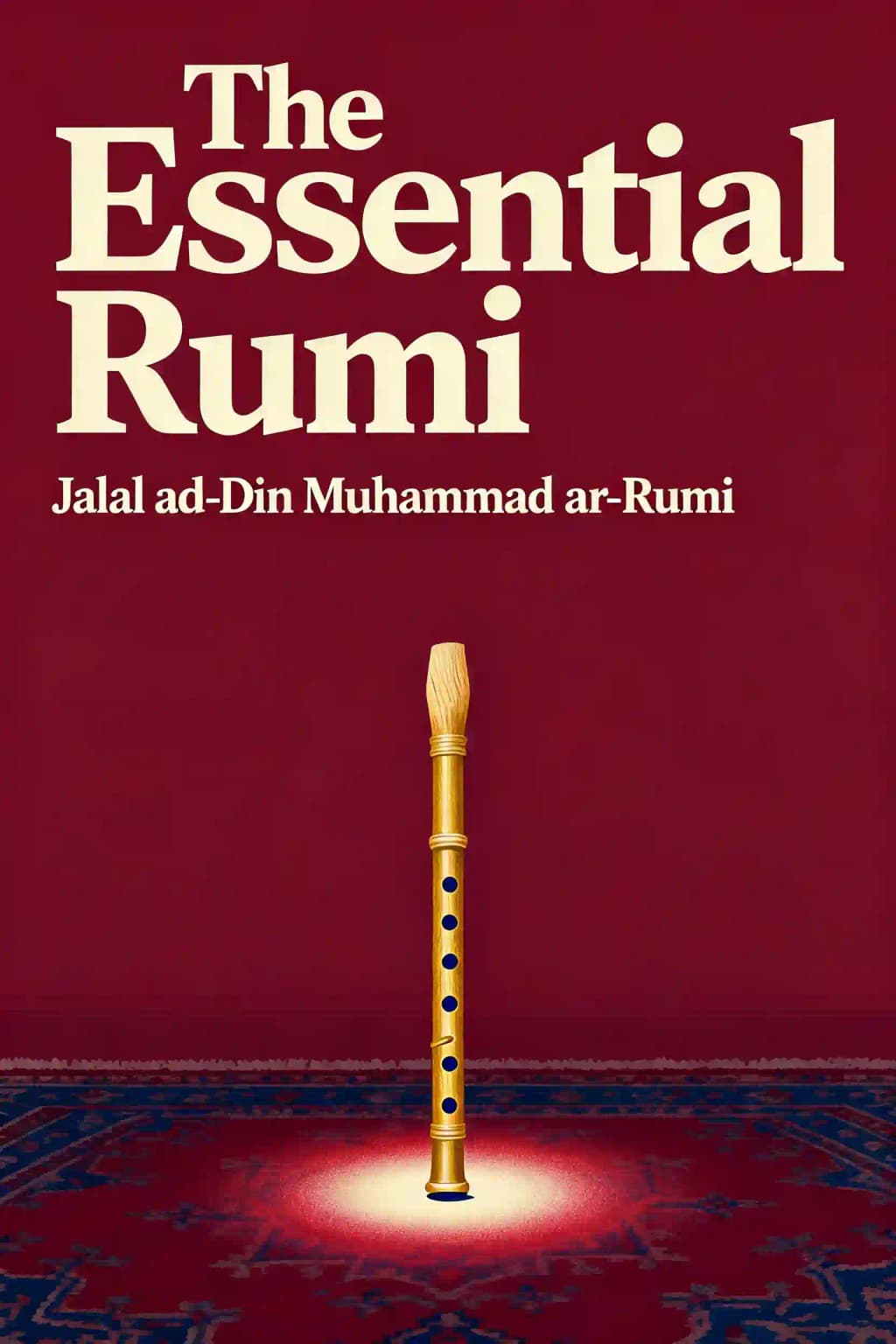
The Essential Rumi, masterfully translated by Coleman Barks into accessible modern English, remains the bestselling collection of Rumi's work and has been translated into numerous languages, establishing Rumi as one of the most widely read poets in the world today.
The Essential Rumi is a collection of mystical poetry by 13th-century Persian poet Jalal ad-Din Rumi, translated by Coleman Barks. The book explores profound themes of divine love, spiritual transformation, and the soul's journey toward unity with the divine through Sufi wisdom. Rumi uses rich metaphors, paradoxes, and imagery drawn from nature to convey timeless insights about the human condition, self-discovery, and the interconnectedness of all beings.
The Essential Rumi is ideal for spiritual seekers, poetry lovers, and anyone exploring mysticism or personal transformation. Readers interested in Sufism, Eastern philosophy, or contemplative practices will find deep value in Rumi's teachings. The book also appeals to those navigating life transitions, seeking meaning beyond material existence, or looking to deepen their understanding of love as a spiritual force that transcends human relationships.
The Essential Rumi is absolutely worth reading for its timeless spiritual wisdom and profound insights into love, transformation, and the divine. Rumi's poetry speaks directly to universal human experiences, making ancient Sufi teachings accessible and relevant to modern readers. The metaphorical language invites multiple readings and personal interpretation, offering new layers of meaning with each encounter. Many readers find themselves reflected in Rumi's verses, discovering that he articulates spiritual thoughts they've long held.
Jalal ad-Din Muhammad Rumi was a 13th-century Persian poet, Islamic scholar, and Sufi mystic whose work has transcended cultural and religious boundaries for over 700 years. Living in Persia during a period of significant intellectual development, Rumi founded the Mevlevi Order of whirling dervishes and created poetry deeply rooted in Sufi mysticism. His writings on divine love, spiritual transformation, and the soul's journey remain among the most celebrated mystical literature worldwide.
The Essential Rumi explores several interconnected themes including divine love as a transformative spiritual force, the soul's journey toward unity with the divine, inner transformation through self-discovery, and embracing emptiness as a space of infinite possibility. Rumi emphasizes the interconnectedness of all beings, the limitations of rational thought in grasping spiritual truths, and the importance of surrendering ego to achieve enlightenment. Separation and reunion, silence and sound, loss and renewal also permeate throughout.
The Essential Rumi contains several iconic quotes that capture Rumi's spiritual philosophy. "The wound is the place where the Light enters you" suggests that suffering opens pathways to enlightenment and growth. "Don't grieve. Anything you lose comes round in another form" teaches acceptance of life's cyclical nature. "Let the beauty we love be what we do" encourages aligning actions with passions. "You are not a drop in the ocean. You are the entire ocean in a drop" reflects the vast divine potential within each individual.
The Essential Rumi presents love as the fundamental force animating all existence and connecting the universe to its divine source. Rumi depicts divine love as transcending physical attraction, serving as the primary path to spiritual enlightenment and union with God. His poetry explores love's transformative power to purify the soul, its role in personal growth, and how it bridges the gap between human and divine realms. Love becomes both the journey and destination in Rumi's spiritual framework.
The Essential Rumi is deeply rooted in Sufi mysticism, the Islamic mystical tradition emphasizing direct personal experience of divine love and truth. Rumi incorporates Sufi practices like meditation, prayer, and the pursuit of inner knowledge through symbolic language and metaphor. The poetry reflects core Sufi concepts including fana (annihilation of ego), spiritual intoxication, the importance of a sheikh (spiritual guide), and the tavern as metaphor for worldly distractions. Rumi's work exemplifies Sufi teaching methods that use paradox to transcend rational understanding.
Rumi employs metaphors extensively in The Essential Rumi to convey complex spiritual truths through accessible imagery. He draws from nature—depicting transformation through water and fire, spring's renewal representing spiritual rebirth—and everyday objects to illustrate profound concepts. The "tavern" represents worldly distractions, while "emptiness" symbolizes divine potential. Animal characters like the mouse and frog illustrate spiritual relationships. These metaphors enhance emotional impact, invite multiple interpretations, and help readers connect abstract spiritual concepts to lived experience.
The Essential Rumi teaches that transformation requires embracing inner change, surrendering ego, and accepting uncertainty as opportunities for spiritual growth. Rumi uses paradoxes like "dying to live" and "losing oneself to find oneself" to illustrate how genuine freedom comes through releasing rigid self-concepts. Self-discovery involves introspection, questioning assumptions, and recognizing personal limitations before the divine's vastness. The journey is ongoing, with the soul continuously evolving toward greater unity and enlightenment through courage and humility.
The Essential Rumi offers practical guidance for contemporary spiritual seekers by encouraging introspection, embracing life's paradoxes, and finding meaning beyond material pursuits. Rumi's teachings on accepting loss, transforming suffering into wisdom, and recognizing interconnectedness provide tools for navigating modern challenges like anxiety, isolation, and existential questioning. His emphasis on love as a spiritual practice and emptiness as creative potential helps readers develop resilience, compassion, and deeper self-awareness applicable to personal relationships, career transitions, and inner peace.
The Essential Rumi emphasizes the paramount importance of a spiritual guide or sheikh in navigating the complex terrain of mystical development. Rumi portrays the mentor as a beacon of light who reveals hidden aspects of the disciple's essence through insight, direction, and sacred practices. The master-disciple relationship is built on deep trust, respect, and the disciple's willingness to surrender personal ambitions. This guidance is presented as essential for authentic transformation, reflecting Rumi's own transformative relationship with his spiritual mentor Shams of Tabriz.
Почувствуйте книгу через голос автора
Превратите знания в увлекательные, богатые примерами идеи
Захватите ключевые идеи мгновенно для быстрого обучения
Наслаждайтесь книгой в весёлой и увлекательной форме
Out beyond ideas of wrongdoing and rightdoing, there is a field. I’ll meet you there.
The wound is the place where the Light enters you.
Don’t grieve. Anything you lose comes round in another form.
Let the beauty we love be what we do. There are hundreds of ways to kneel and kiss the ground.
Your task is not to seek for love, but merely to seek and find all the barriers within yourself that you have built against it.
Разбейте ключевые идеи The essential Rumi на понятные тезисы, чтобы понять, как инновационные команды создают, сотрудничают и растут.
Погрузитесь в The essential Rumi через яркие истории, превращающие уроки инноваций в запоминающиеся и применимые моменты.
Задавайте любые вопросы, выбирайте свой стиль обучения и создавайте идеи, которые действительно вам подходят.

Создано выпускниками Колумбийского университета в Сан-Франциско
"Instead of endless scrolling, I just hit play on BeFreed. It saves me so much time."
"I never knew where to start with nonfiction—BeFreed’s book lists turned into podcasts gave me a clear path."
"Perfect balance between learning and entertainment. Finished ‘Thinking, Fast and Slow’ on my commute this week."
"Crazy how much I learned while walking the dog. BeFreed = small habits → big gains."
"Reading used to feel like a chore. Now it’s just part of my lifestyle."
"Feels effortless compared to reading. I’ve finished 6 books this month already."
"BeFreed turned my guilty doomscrolling into something that feels productive and inspiring."
"BeFreed turned my commute into learning time. 20-min podcasts are perfect for finishing books I never had time for."
"BeFreed replaced my podcast queue. Imagine Spotify for books — that’s it. 🙌"
"It is great for me to learn something from the book without reading it."
"The themed book list podcasts help me connect ideas across authors—like a guided audio journey."
"Makes me feel smarter every time before going to work"
Создано выпускниками Колумбийского университета в Сан-Франциско

Получите резюме книги «The essential Rumi» в формате PDF или EPUB бесплатно. Распечатайте или читайте офлайн в любое время.
Imagine standing beneath a vast desert sky when suddenly you feel it-a presence so profound it makes your heart tremble. This is the experience of reading Rumi, the 13th-century Sufi mystic whose poetry has captivated millions across eight centuries. When Madonna cited Rumi as her favorite poet, or when Deepak Chopra declared his work essential spiritual reading, they joined a tradition of reverence spanning continents and generations. Rumi's poetry has sold over two million copies in North America alone, making him the bestselling poet in the United States. What mysterious power allows ancient Persian verses to resonate so deeply with modern audiences? Perhaps it's because these poems open a place of direct connection with the divine that transcends religious doctrine. In a world hungry for authentic spiritual experience, Rumi offers a feast of divine intoxication that speaks directly to the soul.
In Rumi's universe, love isn't simply an emotion but the essence of existence itself. "Love is the master," he declares, describing himself as "merely a straw before the furious wind of Love." This isn't a sanitized, greeting-card sentiment, but a wild, untamable power transforming everything it touches. When Rumi writes, "In Love's hands, I'm like a cat in a sack, sometimes hoisted high, sometimes flung about," he's describing the exhilarating surrender defining the spiritual path. This surrender isn't passive but dynamic - like "mill wheels turning day and night." How differently might we approach challenges if we saw ourselves as instruments of something greater? The executive facing difficult decisions, the artist confronting a blank canvas, the parent responding to a child - all could find liberation in the wisdom that true agency comes paradoxically through surrender. Through this surrender, transformation becomes possible: "Through Love's power, bitter things become sweet, copper turns to gold, dregs become purest wine, and pain transforms to medicine."
"Stay close, my heart," Rumi counsels, directing our attention to the wisdom within rather than external authorities. This inward journey forms the core of his teaching - a departure from traditions emphasizing rules and rituals. For Rumi, the divine beloved dwells not in temples or texts but in our hearts. This journey requires discernment: "Not every sugarcane holds sweetness, not all abysses have peaks." In today's world of spiritual marketplaces, Rumi advises looking beyond flashy packaging to the substance: "Be selective about where you seek nourishment." The path isn't comfortable - it demands confronting our shadows. When Rumi writes, "if rejected by the Friend, recognize your own resistance," he acknowledges how we often sabotage our growth. What appears as divine rejection typically reflects our unwillingness to change. The journey culminates in discovering that the beloved we seek externally has been within us all along. "From myself I am copper, through You, friend, I am gold." We're not acquiring something new but uncovering what was always present.
"The lover's sustenance comes from loving the bread itself - no actual bread is needed." With these words, Rumi guides us beyond dualistic thinking. He reveals a reality where lover and beloved dissolve into unity, where nourishment comes from the act of loving itself. "Lovers have established themselves in non-existence," he writes, referring not to emptiness but to the spacious awareness beyond the separate self. Modern quantum physics similarly recognizes that separation between observer and observed breaks down at fundamental levels. Rumi's declaration "I am neither Christian, nor Jew, nor Magian, nor Muslim" emerges from this non-dual understanding. When boundaries are seen as artificial, religious divisions lose their divisive power. Rumi offers recognition of the unity underlying diversity. In "Look at Love," he celebrates opposites: "Water and fire, earth and wind - enemies yet friends." Nature demonstrates the harmony of apparent contradictions. Rather than fighting difficulties, we see how opposites complement each other: "Why concern yourself with good and bad? Pay attention instead to how things blend together."
"Should Love rejoice if I don't burn?" Rumi asks, embracing suffering as purification rather than punishment. "From now on, burning becomes my purpose," he declares, "for like a candle, burning makes me brighter." This perspective reveals pain's hidden purpose in spiritual awakening. Instead of asking "Why is this happening to me?" which breeds bitterness, Rumi suggests asking "What is this teaching me?" This transforms suffering from meaningless torment into purposeful transformation. In Rumi's alchemical metaphor, base metals becoming gold represents the soul's refinement through difficulty. "My heart is Love's dwelling place. If Love wishes to burn this house, who could forbid it? Burn this house completely - fire only improves a lover's home." Rumi's greatest poetry emerged from his most devastating loss - Shams of Tabriz's disappearance. Rather than being destroyed by grief, he was transformed, his pain becoming the crucible for spiritual gold. This view extends to death, which Rumi sees as transformation: "You're a deathless soul that can't be confined to a dark grave; you're filled with divine light."
"Show me your face-I crave flowers and gardens." Rumi views human relationships as mirrors reflecting divine beauty, recognizing human love as a gateway to divine love rather than rejecting worldly attachments. This perspective blossomed in Rumi's relationship with Shams of Tabriz. Writing, "The face of Shamsi Din, Tabriz's glory, is the sun whose track I follow," Rumi sees divine love manifesting through human form - not idolizing another person but recognizing them as a window to divine light. Instead of seeking partners who fulfill egoic needs or match cultural ideals, we might look for those who awaken our recognition of the divine. Rather than changing others to meet our expectations, we can approach them with reverence, seeking to understand the divine expressed through their unique being. Rumi acknowledges relationship challenges: "Let us adore one another before we cease to exist." His solution is radical presence - meeting each other fully now rather than postponing reconciliation.
"Who's knocking at my door?" This question begins one of Rumi's most profound dialogues, revealing the paradox of spiritual seeking. The seeker declares love while the beloved demands evidence: "He demanded witnesses for my claim; I offered my tears and yellow face as proof." Rumi shows that spiritual seeking isn't finding something new but recognizing what was always present: "I will accompany you in the grave when you leave behind your worldly possessions and family." The beloved we seek has never been absent; only our perception of separation was illusory. This transforms spiritual practice from desperate striving to grateful reception: "Oh happy day when I shall die in your presence, my ruler! Like sugar I'll melt near your sweet treasure." Death becomes not an ending but a consummation - the dissolution of boundaries between lover and beloved. This timeless relationship permeates ordinary existence: "I am the pure awareness in your heart, present in joy and despair alike." Ultimately, Rumi reveals that seeker and sought are one: "Looking at myself, I no longer see my form, for within that moon, my body has transformed as fine as soul."