Глава 1
The AI Revolution: Transforming Our Economy and Society
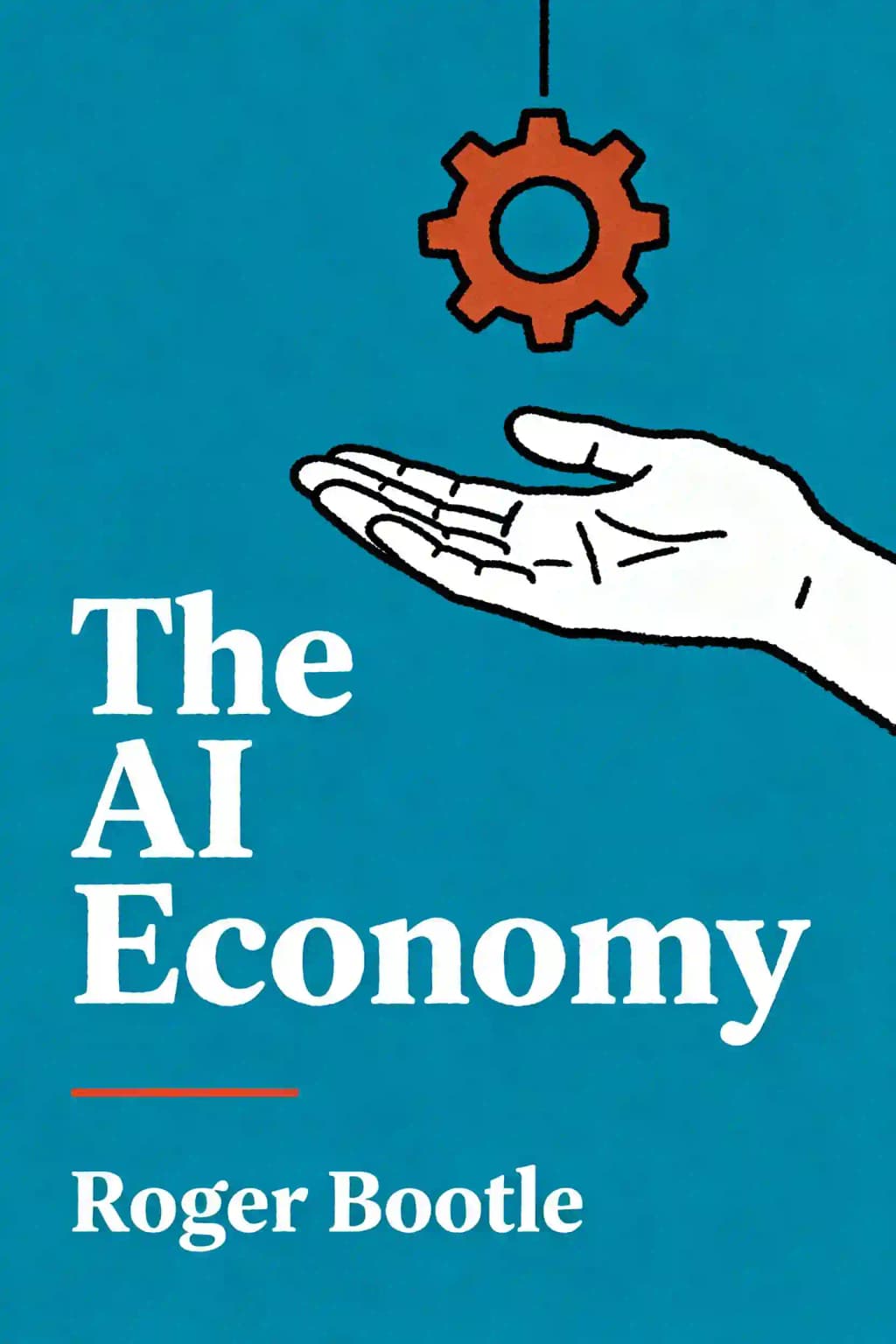
In a world increasingly dominated by technological advancements, Roger Bootle's "The AI Economy" stands as a refreshing counterbalance to both the techno-utopian and apocalyptic narratives surrounding artificial intelligence. The book has garnered significant attention from business leaders like Bill Gates and Elon Musk, who have publicly referenced its balanced perspective on AI's economic implications. Unlike many AI-focused works that either celebrate or fear the coming revolution, Bootle approaches the subject as an economist examining one of our age's greatest socioeconomic challenges. His work has been particularly influential in policy circles, with several governments citing his frameworks when developing their AI strategies. What makes this book particularly valuable is how it cuts through both the technical jargon and the hyperbole to deliver clear insights about what might actually happen when robots and AI transform our economy-a transformation that will touch every single one of us, regardless of our profession or social standing.
Глава 2
From Ancient Progress to Modern Revolution
Human history has witnessed one true economic "singularity"-the Industrial Revolution that began in late 18th century Britain. Before this transformation, economic progress was virtually nonexistent; afterward, it became the norm. World GDP data dramatically illustrates this shift: virtually no change from 2000 BCE to Year 0, a doubling from Year 0 to 1800 (taking 1,800 years), then explosive growth afterward-reaching 3.5 times the 1800 level by 1900, and over 30 times by 2000.
Despite significant technological milestones occurring well before the Industrial Revolution-animal domestication, crop cultivation, the wheel's invention-these advances didn't translate into measurable economic growth. Several factors explain this paradox: early developments unfolded too gradually to show significant year-by-year improvements; structural limitations prevented productivity gains in agriculture from benefiting the broader economy; societies generated minimal surplus for capital accumulation; and population growth consistently absorbed productivity gains, preventing improvements in per capita living standards.
The Industrial Revolution marked the turning point when people steadily became better off, though progress was neither smooth nor universal. During the "Engels pause" in the early nineteenth century, wage growth lagged behind productivity, squeezing living standards. The new market economy introduced fluctuations in aggregate demand, creating periods of substantial unemployment. Technological progress inherently created winners and losers through what Schumpeter called "creative destruction," with workers like the Luddites resisting mechanization that threatened their livelihoods.
Despite these challenges, the economy consistently created new jobs to replace those lost to technological advancement. Agriculture's share of employment plummeted from 40% in 1900 to just 2% today in the US, while manufacturing employment in the UK fell from 40% in 1901 to 8% today, with services rising to 83%. Overall employment has consistently risen, with wages growing proportionately with productivity, though individual workers often suffered during transitions.
The postwar period from 1945 to 1973 saw extraordinary economic expansion, with world GDP growing at 4.8% annually. This "Golden Age" ended with the oil price shocks of the 1970s and subsequent economic challenges. Since the Global Financial Crisis, economic growth has been notably subdued, with some economists arguing this represents "the new normal." Robert Gordon offers a supply-side explanation, suggesting slower technological progress is fundamentally responsible for slowing growth, with recent innovations focused more on entertainment and communication than replacing human labor.
However, four counterarguments challenge Gordon's technological pessimism: productivity growth may be improperly measured; sluggish growth may reflect lingering effects of the financial crisis; digital revolutions need time to manifest their full impact; and we may be on the brink of transformative developments in biotechnology, nanotechnology, 3D printing, and AI that will multiply economic possibilities.
Глава 3
AI: Revolutionary Yet Familiar
Is the AI revolution fundamentally different from previous technological shifts? Two contradictory critiques exist: first, that the AI revolution is merely hype with minimal economic impact; second, that it's so transformative it will eliminate human labor without creating replacement jobs.
History shows we consistently underestimate technological change-from IBM's Thomas Watson predicting "a world market for about five computers" to skeptics dismissing the internet's potential in the 1990s. AI, conceptually developed by Alan Turing in 1950, has recently accelerated due to enormous growth in processing power, data availability, improved recognition technologies, deep learning advances, and algorithm-based decision-making.
The technological progress since the Industrial Revolution has followed a distinct pattern: first machines replaced human brawn, then computers replaced repetitive brainwork. Now AI threatens to replace non-repetitive brainwork as well. This raises profound questions about humanity's place in the future economy. Without work, humans face not only problems of purpose and meaning, but also economic survival.
How serious is the employment threat? Various forecasts paint concerning pictures: The Millennium Project predicts global unemployment of 24% by 2050; McKinsey estimates up to 700 million people could be displaced by 2030 with rapid technological adoption. An OECD study concluded 14% of jobs in rich countries are "highly automatable"-representing 66 million positions.
Despite these alarming headlines, complete job elimination may be overstated. McKinsey notes fewer than 5% of jobs are entirely automatable, though about 60% could have 30% or more of their activities automated. Countries with the highest robot density (Singapore, Japan, Germany) often have the lowest unemployment rates. The aspects of work least susceptible to automation are creativity, sensing emotion, and common sense-suggesting human jobs may transform rather than disappear.
Despite the impressive rhetoric around Moore's Law, technological progress often follows an S-curve-starting slowly, entering an exponential phase, then slowing. AI history is particularly marked by cycles of investment followed by disappointment-so-called "AI winters." Since the 1940s, machines matching human intelligence have consistently been predicted to arrive "about 20 years in the future," with that date perpetually receding.
Despite being around since 1961, robots continue to disappoint early expectations. Half of industrial robots remain confined to automotive manufacturing where defined tasks and rigid environments match their capabilities. Everyday tasks humans find simple-folding towels, tying shoelaces, assembling IKEA furniture-remain extraordinarily difficult for robots. This illustrates Moravec's paradox: tasks humans find complex (like chess) prove relatively easy for AI, while seemingly simple tasks requiring perception, mobility, and common sense remain extraordinarily difficult.
While AI and robotics will bring extraordinary developments, efficiency improvements, and entirely new goods and services-causing many to lose their livelihoods-this revolution will be momentous but not unprecedented. Like the steam engine, jet engine, and computer before it, AI will reinvigorate economic growth while experiencing blind alleys, exaggerations, and disappointments.
Глава 4
The Macroeconomic Landscape
The economic effects of robots and AI are subject to profound uncertainties, making forecasting difficult. Robots and AI should be analyzed as forms of capital investment that are becoming increasingly productive. This increased return on capital should lead to greater investment, upward pressure on real interest rates, increased output per capita, and possibly higher average real wages.
The tech literature often envisions economic Armageddon with mass unemployment and poverty. Two distinct pessimistic visions exist: the technological view that machines will outperform humans in nearly all jobs, and the economic view that robots and AI will deplete purchasing power in the economy.
The economics of aggregate demand is fundamental to understanding AI's impact. When robots produce, their owners gain income to spend. However, in money economies, income isn't always fully spent, leading to economic downturns when production exceeds purchases. The AI economy might tend toward depressed demand if income shifts from wages to profits, as capital owners (including robot owners) capture more national income, or if AI widens income inequality between low-skilled workers and those who can work alongside machines.
While robots and AI may increase income inequality, several offsetting factors exist: aging populations in Western countries will soon mean more retirees who spend rather than save; global trade imbalances have decreased; and banks are recovering their ability to lend. Most importantly, the investment opportunities created by AI, nanotechnology, and biotechnology could generate buoyant investment spending that counteracts any shift from wages to profits.
Contrary to pessimistic views about productivity slowdown, robots and AI could drive productivity growth back to impressive levels through direct replacement of humans by machines across various activities and the use of robots and AI to enhance human productivity in service sectors. The AI revolution could add substantial value to global output-potentially enabling GDP per capita to more than double in a generation if productivity growth returns to rates seen during economic golden ages.
While many AI specialists presume the Robot Age will bring underemployment and depression (implying sustained low interest rates), if public policy addresses income distribution shifts, and if factors like aging populations and AI-related investment offset consumption weakness from inequality, there's no reason for the Robot Age to coincide with ultra-low interest rates. In fact, real interest rates might return to pre-2007 levels or even higher.
Глава 5
The Future of Work and Leisure
Throughout history, humanity's relationship with work has been contradictory-viewed either as the key to purpose and godliness or as an exhausting, dehumanizing burden. As we enter the AI economy, work is variously seen as something to be liberated from or something to be terrified of losing.
In his 1931 essay "Economic Possibilities for Our Grandchildren," Keynes predicted living standards would rise four to eight times within a century, ending economic scarcity. This prediction has largely materialized in developed economies, with standards of living now five to seven times higher. However, his prediction that we would work only 15 hours weekly hasn't come true. Instead, many professionals work longer hours than ever.
The competitive instinct keeps people working hard even when basic needs are met. People strive to show they're equal or superior to peers, maintaining status differences and pursuing positional goods that are inherently limited in supply. Many work long hours driven by the desire to "win" and "beat others," with wealth serving as a way of "keeping score."
Beyond competition, work provides comradeship, interest, and purpose. Unemployment consistently ranks among the greatest causes of unhappiness, beyond mere income loss. Work generates social interaction, pride, identity and meaning.
Despite these attractions, several factors suggest a more balanced future: historical evidence shows working hours have actually halved since 1870 in industrialized countries; people may choose leisure once basic material needs are fully met; for many, work remains tedious (80% reportedly hate their jobs); countries with shorter working hours report higher happiness levels; and "Happiness Economics" indicates minimal happiness gains from income beyond certain thresholds.
For many in advanced economies, there exists a strong latent demand for more leisure time that will likely grow as wealth increases. Several possibilities exist for redistributing leisure throughout working life: shorter working days, shorter working weeks, extended holidays, more part-time work in dual-earner households, longer education, and earlier retirement.
The future likely holds an intermediate position between two extremes: continuing to work as much as before versus taking all productivity gains as leisure. Where people land on this spectrum depends largely on income distribution. In developing regions like Africa, China, and India, where material satiety remains distant, productivity gains will likely translate to higher living standards rather than leisure. Even in Western societies, those at the bottom of the income ladder may prefer more work hours. But for middle and upper-income earners in advanced economies, we'll likely see shorter working days, three-day weekends, and longer holidays become normal.
Глава 6
Jobs in the AI Economy
The future job market remains fundamentally unpredictable. Looking back from 1900, who could have foreseen agriculture employment falling to a twentieth of its former level, or the disappearance of horse-related occupations, or that mental health nurses would outnumber Royal Navy sailors?
Driving jobs represent one of the most discussed categories at risk from AI. The potential impact is enormous: a 2017 trucking industry report predicted that 4.4 million of 6.4 million trucking jobs in America and Europe could disappear by 2030. However, there exists a substantial gap between the hype surrounding self-driving vehicles and the current reality.
Despite decades of promises-from GM's radio-guided car concept in 1939 to Sergey Brin's unfulfilled 2012 prediction of commercial availability by 2018-driverless vehicles face significant challenges. Safety remains the primary concern, with a University of Michigan study finding higher crash rates for driverless cars, primarily because human drivers struggle to interact with them.
The industry uses six levels of autonomy, from level 0 (no automation) to level 5 (no human involvement possible). Current legislation and safety concerns create contradictions-UK law requires "drivers" not to take hands off the wheel for more than a minute, yet the purpose of driverless technology is to free humans from driving.
Despite aircraft being largely flown by computers today, the complete elimination of pilots remains improbable. Even with superior computer performance in normal conditions, human judgment remains essential for handling extreme scenarios and system malfunctions.
Contrary to popular belief, not all manual jobs face immediate threat from automation. Robots still struggle with manual dexterity, making many skilled trades relatively secure. Plumbers, electricians, gardeners, builders, and decorators likely have safe employment prospects for the foreseeable future.
Many vulnerable jobs aren't manual but involve routine mental tasks. Airport check-in assistants are disappearing, while high-end positions like fund managers face AI replacement-BlackRock has already sacked managers and transferred billions to computer-powered systems. Commerzbank is experimenting with AI-generated research notes to replace analysts, property valuers are being outperformed by algorithms, and routine legal work is increasingly automated.
Despite job losses, the World Economic Forum and Boston Consulting Group project 12.4 million new US jobs by 2026. Many will come from the AI industry itself-designing robots, developing software, teaching humans to work with AI, and counseling those struggling with AI relationships. Healthcare shows the greatest potential, with a projected net gain of 2.29 million positions.
Many jobs won't be replaced by robots but enhanced by them. In surgery, da Vinci Xi robots at London's University College Hospital removed 700 prostates and bladders in 2017-but they were controlled by surgeons viewing 3D screens. In diagnostics, AI shows remarkable advantages-while human doctors would need 160 weekly reading hours to keep up with medical research, AI has no such limitations.
As robots and AI create greater wealth, many people will choose to work fewer hours, increasing their leisure time. This spending creates employment opportunities, particularly as consumer preferences shift toward "experiences" rather than material goods. Activities from nights out to holidays and weddings are highly employment-intensive and demand human interaction.
Even if machines offer cheaper service options, many people will pay extra for human interaction. While some prefer machine interactions at checkouts or check-ins, most value authentic human service-whether arrogant, unctuous, or somewhere in between. This preference extends across personal services from caregiving to entertainment.
Глава 7
Winners and Losers in the AI Economy
The impact of robots and AI will not fall equally on all people and parts of the world. Just as with previous technological revolutions, beneath aggregate economic progress lie painful human tragedies. Even when economies create enough new jobs to replace those destroyed, individuals, groups, regions, and countries often struggle to transition to new activities.
Income inequality has grown substantially in recent decades, particularly in the US. Between 1980 and 2014, the bottom quintile saw virtually no growth in real disposable income while the top quintile enjoyed 2.8% annual growth. The top quintile's share of total post-tax income rose from 44% to 53%, with the top 1% increasing from 8.5% to 16%.
Globalization added billions of workers to the world economy, creating competition concentrated at the lower-skilled end of labor markets in developed economies. This depressed wages for less-skilled workers while benefiting higher-income individuals who faced less direct competition and could purchase goods and services more cheaply.
Beyond simply reducing labor demand, the communications revolution has created "winner-takes-all" markets where compensation depends on relative rather than absolute performance. Digital goods enjoy enormous economies of scale, enabling market leaders to dominate-Amazon controls 75% of e-books, Facebook 77% of social media, and Google 90% of search advertising.
While many fear a future where masses scramble for low-paid jobs while capital owners and those with specialized skills prosper, this outcome isn't inevitable. Many AI developments may actually reduce inequality by undermining middle-class incomes and providing services at lower prices. The ability for most people to obtain well-paid jobs will depend on multiple factors: robots' technical capabilities, their costs, human-AI complementarity, consumer preference for human services, reduced costs of professional services, voluntary leisure choices, and how leisure preferences distribute across income levels.
The robot and AI revolution will sweep unevenly across countries, reshaping the global balance of power much like the Industrial Revolution did. While few countries will lead in AI production-likely the USA, China, and perhaps the UK in some fields-many more can benefit from AI consumption.
Countries vary enormously in their robot deployment and AI investment. South Korea leads with 631 industrial robots per 10,000 manufacturing employees, followed by Singapore (488), Germany (309), and Japan (303), while the UK (71) and China (68) lag behind advanced economies. Investment shows similar disparities-between 2012-2016, the USA spent $18.2 billion on AI, China $2.6 billion, and the UK just $850 million, though still ranking third globally.
Cultural attitudes toward robots vary dramatically between East and West. Asian countries-particularly Japan, China, and South Korea-embrace robots as helpful allies, with Japanese children growing up with robot heroes like Astro Boy. Western societies, influenced by narratives like Frankenstein and The Terminator, view robots as threatening.
Глава 8
Policy Responses to the AI Revolution
Should we encourage AI development or try to restrict it? This fundamental question drives policy discussions around robotics and AI. While some fear these technologies will cause mass unemployment and inequality, the AI revolution will actually enhance our productive capabilities and enable lives of increased consumption and leisure.
The idea of a "robot tax" has gained notable supporters, including Bill Gates, who argues that robots performing work previously done by taxed human workers should be taxed similarly. However, viewing robots as capital investments rather than "artificial workers" changes this perspective entirely. Capital investments typically receive favorable tax treatment through allowances and subsidies based on three key assumptions: jobs lost in one sector will be created elsewhere; society benefits from high investment levels that lead to higher living standards; and in a globalized world, taxing capital equipment would drive investment elsewhere.
While a robot tax is inadvisable, governments cannot adopt complete laissez-faire toward AI. Asimov's three laws provide a starting point for an ethical framework: robots must not harm humans, must obey humans except where it conflicts with the first law, and must protect themselves unless it conflicts with the first two laws.
AI requires serious state intervention to prevent cybercrime. Malware incidents increased from 275 million in 2014 to 357 million in 2016, while machine learning introduces new risks. AI could create personalized "phishing" scams that are harder to detect.
Without clear legal frameworks governing robotics and AI, their practical implementation will be severely hindered. Key questions include liability when robots cause harm-should responsibility lie with the user, manufacturer, designer, or none of these?
AI's effectiveness relies on processing massive amounts of personal data, raising serious privacy concerns. This "Big Data" reveals individuals' preferences, behaviors, and connections, potentially improving services but also invading privacy. The Cambridge Analytica scandal exemplifies these risks-the company harvested data from 87 million Facebook users to develop psychological profiling algorithms for political manipulation.
AI-enabled surveillance threatens human liberty and privacy through unprecedented monitoring capabilities. China's 2020 surveillance project aims to create a network that is "omnipresent, fully networked, always working and fully controllable," including the Social Credit System that scores citizens based on behavior monitored through CCTV and social media.
Глава 9
Education for the AI Age
Education must fundamentally change to address the AI revolution, just as it evolved from training church ministers and colonial administrators to today's curriculum. While AI was once an elite graduate subject, it must now enter mainstream education. Many argue the future lies exclusively with STEM subjects (science, technology, engineering, mathematics), suggesting humanities should take a backseat.
Traditional education remains vital in developing critical thinking skills through subjects like history, religion, art, and philosophy. A growing consensus among entrepreneurs and educators recognizes this need. Mark Cuban predicts "free thinkers who excel in liberal arts" will be in demand as automation increases, leading some to suggest replacing STEM with STEAM (adding Arts).
Despite traditional education's value, reform is necessary. Employers most value qualities like leadership and teamwork that aren't emphasized in academic study. Sir Ken Robinson argues that penalizing "wrong answers" stifles creativity: "We don't grow into creativity. We grow out of it, or rather we get educated out of it."
As AI creates more leisure time, education must prepare people to use it meaningfully. Many already struggle with free time, and education can teach fulfillment through literature, music, and other enriching pursuits. Education should also introduce crafts, active sports participation, physical fitness, social skills, and civic responsibilities.
Educational methods need revolutionary change. It's "astonishing and scandalous" that many institutions still use teaching methods from 1600-or even Aristotle's time. While some predict AI will reduce demand for teachers, the opposite may occur. AI could enable smaller class sizes and personalized instruction, moving away from Sir Ken Robinson's observation that students are "educated in batches, according to age, as if the most important thing they have in common is their date of manufacture."
The traditional education model of 10-20 years of early learning followed by 40-50 years of employment with little further education is becoming outdated. In the AI economy, people will need multiple learning periods throughout life, interspersed with employment. As Alvin Toffler predicted, "the illiterate of the twenty-first century will not be those who cannot read and write, but those who cannot learn, unlearn, and relearn."
Глава 10
Ensuring Prosperity for All
This chapter examines how to ensure widespread prosperity in the Robot Age, even if jobs become temporary, insecure, and poorly paid. While the author previously argued that AI won't cause "Death of Work," he acknowledges potential futures resembling either poor countries (with swarms offering dubious services) or pre-modern times (with extensive domestic service).
To address inequality exacerbated by AI, we could make the current redistribution system more efficient. The state could improve public services delivery, particularly education which affects earning capacity and social mobility. Countries with low government spending could increase their tax-to-GDP ratios to European levels, with extra funds directed to the poor.
A universal basic income comes in many variants but essentially provides regular payments to all citizens regardless of circumstances. Implementation questions include whether to include recent immigrants (which could attract migration if generous), whether payments begin at birth or adulthood, whether amounts vary by age or circumstances, and whether it replaces or supplements existing welfare systems.
UBI has garnered surprising support from tech entrepreneurs like Mark Zuckerberg and Elon Musk, who believes "we're not going to have a choice" as automation displaces workers. The concept has historical advocates including Thomas More, Thomas Paine, and Bertrand Russell, who argued that making "idleness economically possible" would motivate making work less disagreeable.
Despite these endorsements, UBI faces serious challenges. Beyond uncertain labor supply effects, opposition to UBI rests on four key arguments. First, it would offend most people's sense of fairness-the prospect of hardworking citizens supporting those who choose idleness. Second, UBI could increase social exclusion, as joblessness already correlates with social problems. Third, the cost would be prohibitive-even at poverty-level amounts, the expense would be enormous. Fourth, rather than simplifying welfare systems, UBI would likely add complexity.
The case that AI will dramatically increase inequality isn't compelling, and any increases may not be significant enough to warrant new anti-inequality measures. An alternative approach is simply accepting inequality. This isn't necessarily callous-there's no uniquely fair income distribution, and in our increasingly wealthy societies, inequality matters less than before. In developed countries, even with rising inequality, absolute poverty as previously known has largely disappeared.
Глава 11
Beyond the AI Economy
If the Singularity occurs, the economic analysis presented throughout this book would become irrelevant as human labor becomes completely redundant. Beyond economic concerns, we might become subjects under AI rule-not necessarily from malevolence but from the superintelligent machines' conclusion that our emotions and irrationality make us untrustworthy.
Some AI thinkers reject the human-versus-machine dichotomy, noting that humans already incorporate artificial components from pacemakers to artificial hips. Ray Kurzweil, Google's Director of Engineering, believes humans will inevitably merge with machines, potentially achieving immortality.
Despite the enthusiasm of Singularity advocates, prominent thinkers like Noam Chomsky and Steven Pinker remain deeply skeptical, dismissing it as "science fiction" with "not the slightest reason to believe" in its arrival. Progress toward general AI has been painfully slow.
Perhaps the human condition, including our physical embodiment, is fundamental to intelligence and consciousness. Our ability to engage with the physical world might be inseparable from our biological nature. If true, creating true intelligence artificially from non-biological matter would be impossible.
Sir Roger Penrose, who established the Penrose Institute to study consciousness through physics, suggests the human brain isn't simply a supercomputer. He believes quantum effects may operate in the brain and that "there are areas where computers will never be better than us, such as creativity."
Rather than human diminishment, a widespread acceptance of consciousness as distinct from physical processes might lead to renewed human self-confidence and even an inching toward belief that mind is at the root of the universe. Ironically, the search for superhuman artificial intelligence might bring us face to face with the Almighty and Eternal.




![[d0d24f21-3901-4518-9c7d-4b8c1c407a66:c0000] The meta problem in robotics is be able to solve a humano… p1-1](/_next/image?url=https%3A%2F%2Fd1y2du6z1jfm9e.cloudfront.net%2Fassets%2Fpodcast%2Fgreen.png&w=1024&q=50)
![[d0d24f21-3901-4518-9c7d-4b8c1c407a66:c0001] The meta problem in robotics is be able to solve a humano… p1-1](/_next/image?url=https%3A%2F%2Fd1y2du6z1jfm9e.cloudfront.net%2Fassets%2Fpodcast%2Fpurple.png&w=1024&q=50)
![[d0d24f21-3901-4518-9c7d-4b8c1c407a66:c0002] The meta problem in robotics is be able to solve a humano… p1-1](/_next/image?url=https%3A%2F%2Fd1y2du6z1jfm9e.cloudfront.net%2Fassets%2Fpodcast%2Fyellow.png&w=1024&q=50)