Глава 1
The Procrastinator's Worst Enemy: How to Turn "Someday" into Today
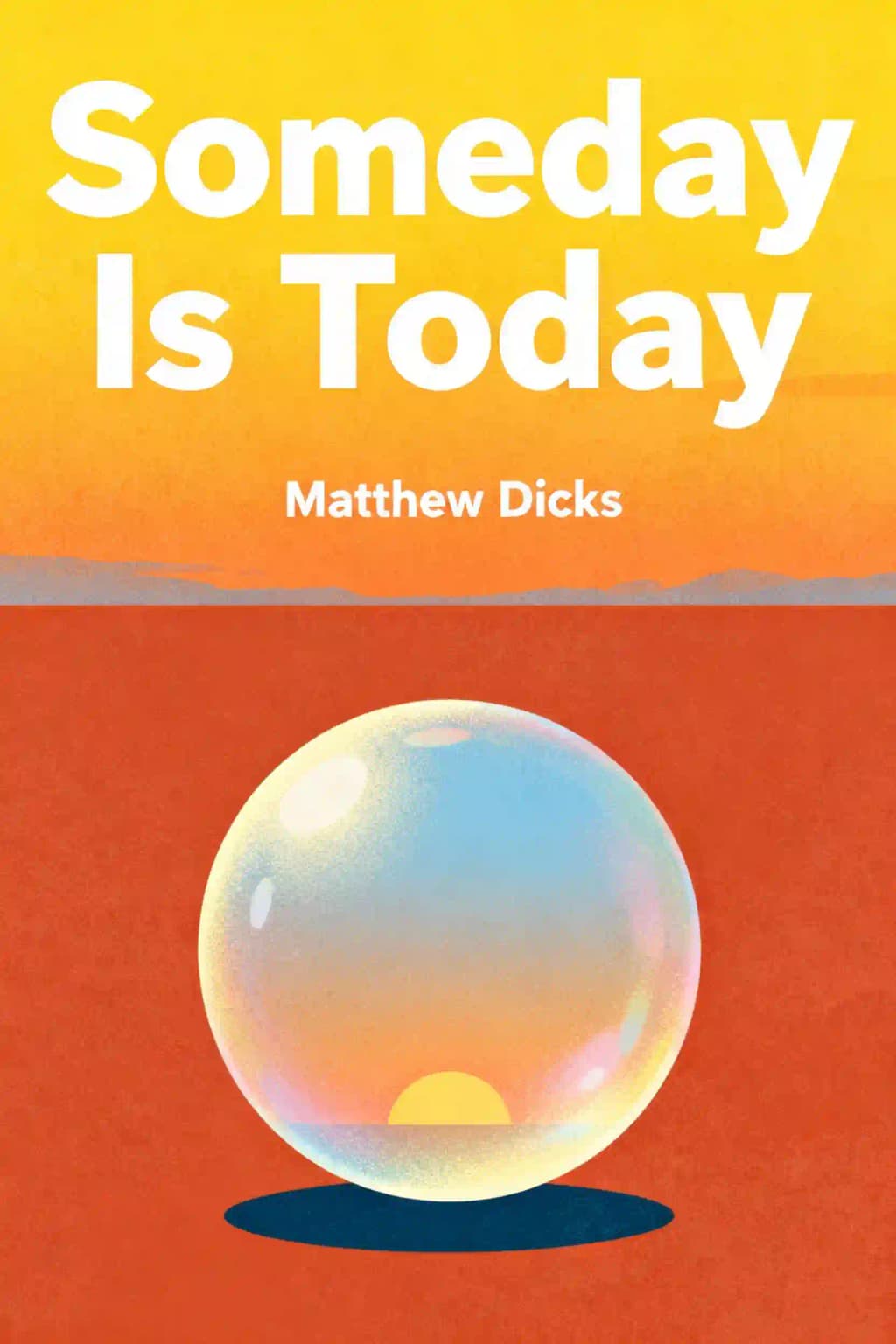
What if the greatest obstacle to your success isn't lack of talent or opportunity, but a simple two-syllable word? In "Someday Is Today," Matthew Dicks exposes "someday" as the most dangerous word in the English language-a horizon that never arrives, leading to unfulfilled dreams and deathbed regrets. This revelation comes from a man who knows something about making the most of life: Dicks has published nine books in twelve years while maintaining his career as an elementary school teacher, performing as a champion storyteller, running a wedding DJ business, consulting for corporations, producing musicals, and raising a family. The book has garnered praise from productivity experts like David Allen and creative professionals who appreciate its practical, no-nonsense approach to getting things done. Unlike many productivity guides that demand complete lifestyle overhauls, Dicks offers actionable strategies that work within the constraints of real life-turning those "little black holes in time" into opportunities for meaningful progress.
Глава 2
The One-Hundred-Year-Old Plan: Consulting Your Wisest Advisor
When faced with difficult decisions about how to spend your time, who better to consult than the version of yourself who has witnessed your entire life unfold? This is the essence of the One-Hundred-Year-Old Plan-a decision-making framework born from Dicks' traumatic life experiences that taught him the true value of time.
Rather than making choices based on immediate desires or temporary discomfort, he mentally consults his future self at the end of life. When his young son asks to play monster freeze tag while he's trying to meet a writing deadline, his one-hundred-year-old self reminds him that children won't ask to play forever. When his daughter asks to be picked up despite his injured shoulder, his future self says these moments are precious and fleeting.
This perspective transforms seemingly small decisions into meaningful ones. When a friend declines attending a Patriots game because it might make the next workday difficult, Dicks sees this as shortsighted. His future self knows that a single difficult workday will be forgotten, but memorable experiences with friends endure.
We claim to value time while simultaneously wasting it on trivial activities. As Steve Jobs noted, remembering his mortality helped him make important life choices. The key is understanding time's preciousness now, not just when facing death. By consulting your "most trustworthy narrator"-your future self-you make decisions that lead to fewer regrets and greater happiness.
This approach doesn't mean always choosing leisure over work. Sometimes the one-hundred-year-old you will advise finishing that chapter, completing that project, or pushing through difficult tasks. The wisdom comes in distinguishing between what will matter in the long run and what won't. Your elderly self knows which experiences you'll treasure and which you'll forget-and that knowledge can guide your present-day choices toward a life with fewer regrets.
Глава 3
Minutes Matter: Harnessing the Power of Small Time Increments
"I don't have time" is perhaps the most common excuse for not pursuing creative projects, but Dicks challenges this notion by revealing how he completed nine books in twelve years while maintaining a full teaching schedule. His secret? Valuing minutes rather than waiting for hours.
Dicks recounts meeting an aspiring novelist at McDonald's who hadn't started writing because she needed specific conditions-two-to-three-hour blocks, a quiet coffee shop, midmorning hours. Meanwhile, when she arrived seven minutes late to their meeting, he had already written nine good sentences. Those sentences brought him closer to completing his novel, which ultimately consists of thousands of such small contributions.
Despite preferring midmorning writing sessions himself, Dicks writes whenever possible around his teaching schedule. He writes during lunch breaks (including sentences in this very book), while waiting for pasta water to boil, during oil changes, and in the minutes before delayed meetings start. He finished his first novel and immediately started his second that same day, rather than taking a planned break.
This approach extends beyond writing to all aspects of life. We each have exactly 1,440 minutes or 86,400 seconds daily. How we use these small increments determines our productivity and accomplishments. Dicks encourages making time a primary factor in all decision-making, whether choosing where to live (he's maintained a 5-10 minute commute throughout his teaching career), selecting a career (teaching offers fewer workdays annually than most professions), or deciding between local and distant options (is A+ pizza worth 100 minutes of driving when A- pizza is available nearby?).
Even ten-minute blocks of time are incredibly valuable. In just ten minutes, you can write several sentences, empty a dishwasher, fold laundry, exercise, pay bills, or engage in stress-reducing activities. By creating a list of productive ten-minute tasks and keeping it visible, you transform what might otherwise be wasted moments into meaningful progress toward your goals.
The message is clear: don't wait for perfect conditions or large blocks of time. Minutes matter, and those who harness them accomplish what others only dream about.
Глава 4
Sleep Smarter: Maximizing Rest While Minimizing Time
People often assume Dicks accomplishes so much because he doesn't sleep much, but this misconception is problematic for several reasons. Sleep is crucial for creativity and health, and suggesting that minimal sleep is the key to productivity creates unrealistic expectations. The truth is that while Dicks may spend fewer hours in bed than most, he treats sleep seriously and efficiently-something few people do.
Most people confuse the amount of sleep they require with the amount of time they spend in bed, which rarely correlate. When Dicks asks clients about their sleep habits, they often claim to need eight hours but are actually counting time spent reading, watching TV, tossing and turning, and lingering after waking up. By eliminating this non-sleep time in bed, you can recapture significant time-saving an hour a night means reclaiming 365 hours or more than fifteen days annually.
To improve sleep efficiency, Dicks recommends several critical practices that must be followed without exception:
First, adopt a consistent sleep schedule every day without exception-weekends, vacations, and holidays included. This consistency trains your body to release melatonin and wake up naturally at the right times. The benefits include falling asleep faster (Dicks is out within a minute of his head hitting the pillow) and awakening naturally without an alarm about 85% of the time.
Second, reserve your bed exclusively for sleep. Stop reading, watching television, or using your phone in bed immediately. These activities train your brain that sleep is just one of several things you do in bed, making it harder to fall asleep quickly. If you enjoy reading before bed, do it in a chair or on the sofa-never in bed.
Additional strategies include playing white noise (which provides an auditory sleep cue and masks disruptive sounds), practicing relaxation techniques (meditation has transformed Dicks' sleep despite not fitting his "brand"), exercising daily, eliminating the snooze button, keeping your bedroom cool (around 65F), and managing evening light exposure with tools like f.lux to adapt screen color temperature.
After implementing these proper sleep strategies, you might experiment with sleeping less. Dicks shares the story of his colleague Erica, who transformed her life by waking up an hour earlier despite having three young children. That extra hour for exercise and self-care created a positive "ripple effect," eventually helping her launch a personal coaching business. As Dicks says: "You can sleep eight hours a night and not write a book, or you can sleep seven hours a night and become an author."
Глава 5
The Eagle and the Mouse: Seeing the Big Picture vs. Every Detail
Years ago, before children and domestic responsibilities, Dicks and his wife Elysha worked at the same school. During their first year of marriage, she complained to their principal about him because he had completed all twenty-one of his report cards in under two hours while simultaneously winning $400 in online poker and listening to an audiobook. In that same time, she had completed just two report cards.
Their principal explained that on the traditional Native American spirit wheel, Dicks was like an eagle-soaring above, seeing the bigger picture and knowing where to direct his efforts-while Elysha was like a mouse-close to the ground, attentive to every detail. Neither position is better; both have advantages. The eagle sees the larger picture and knows where to direct effort, while the mouse sees every tiny but important detail. When Elysha heard this explanation, her response was perfect: "But eagles eat mice!"
Eagles understand that not everything deserves their attention. Dicks practices what he calls "deliberate incuriosity"-strategically ignoring information that won't matter hours later or that he has no control over. When he received a royalty check from his Korean publisher with a sales report, he promptly discarded the report. His father-in-law was shocked he didn't look at how many books he'd sold in Korea, but why bother? The check was what mattered, not sales figures from half a world away in a language he can't speak.
Eagles also limit decision-making to preserve mental bandwidth. This is why Steve Jobs wore the same outfit daily, why Obama limited himself to gray or blue suits, and why Zuckerberg owns twenty identical gray T-shirts. Dicks follows this approach too-wearing simple, consistent clothing because fashion decisions don't advance his goals with fifth-graders.
The eagle perspective asks: If something won't matter in an hour, day, week, or year, why let it matter now? When Dicks' daughter Clara left the freezer door open, destroying hundreds of dollars of stockpiled food, he reminded his wife that in three days, this would just be an amusing anecdote about "the most expensive Popsicle ever."
Eagles also recognize the "spotlight effect"-the false belief that others notice you more than they actually do. This insight saves tremendous time-Dicks goes directly from the gym to grocery store without showering, saving needless trips. He's streamlined his existence by eliminating decisions about umbrellas, watches, jewelry, and owning just one reversible belt. The average American owns "more than five belts," but who has more time to be productive?
When it comes to productivity, less truly is more-fewer decisions and fewer possessions free your mind and time for what truly matters.
Глава 6
Breaking Rules Strategically: Being a Criminal to Protect Your Time
Sometimes protecting your time requires bending or breaking rules-what Dicks calls "being a criminal." When his beloved principal retired and was replaced by a "crocodile" administrator, he found himself trapped in endless, mind-numbing faculty meetings. Rather than waste this time, he decided to "Matt Dicks" these meetings by bringing productive work. He completed his notary application during these sessions over two years and even wrote almost an entire novel during meetings.
It began with lists like "Stupid Things Stupid Administrators Do in Faculty Meetings" that he shared with colleagues to boost morale. Eventually, these lists evolved into a character unlike himself, telling a story that became his book "Twenty-One Truths about Love."
Most rule followers-including many teachers who were once obedient students-overestimate the consequences of minor infractions, failing to distinguish between feedback and actual trouble. Having experienced real trouble himself, including jail time, Dicks understands that small barriers shouldn't hold you back. This perspective allows him to teach Shakespeare despite it not being in the curriculum and to install rock seating outside his classroom without prior approval.
Sometimes being a criminal means ignoring arbitrary rules that waste your time. When Dicks installed rocks as outdoor seating without approval, administrators complained but couldn't undo what was already benefiting students. He regularly tests the "I'm not going to do this-let's see what happens" approach with meaningless administrative tasks, successfully avoiding four years of pointless data entry until a new, detail-obsessed principal caught him.
Even in personal life, he rejects unnecessary norms-like his wife's insistence that dishes must be completely dry before putting them away. He's "invented" parking spots in full lots, pretended to be a hotel guest to use a restroom, and bypassed application processes to secure speaking engagements.
These small acts of rule-breaking aren't about hurting others but about preserving your time and creating opportunities. Don't let arbitrary barriers-like that short rope at the watchtower-prevent you from ascending to greatness. The key is distinguishing between meaningful rules that protect people and arbitrary ones that simply waste time. By breaking the latter strategically, you create space for what truly matters.
Глава 7
Say Yes: Opening Doors to Unexpected Opportunities
In fall 1997, Dicks' best friend Bengi called with an unexpected question: "Do you want to be a wedding DJ?" It was absurd-Dicks had never expressed interest in being a DJ, knew nothing about weddings (having only attended two), and had no desire to run his own business. He was already overwhelmed-attending two colleges full-time, working as a McDonald's manager, tutoring part-time, and navigating a failing marriage. Yet when Bengi called, convinced they could do better than his own wedding DJ, Dicks said yes.
This simple affirmation launched an extraordinary possibility tree of opportunities. Within six months, despite a rocky trial run at a VFW hall, they were working their first wedding. Three months later, they booked three dozen weddings at their first bridal show.
If you don't have people like Bengi pushing you outside your comfort zone, you must challenge yourself. In 2009, Dicks became fascinated with The Moth podcast featuring true stories told live without notes. For two years he wondered if he could do it before finally saying yes to himself. At his first Moth StorySLAM in New York, he desperately hoped his name wouldn't be drawn from the hat. When it was called tenth, he froze until his wife kicked him under the table. He told a story about pole-vaulting in high school and somehow won.
His decade as a wedding DJ had unknowingly prepared him by teaching him to speak confidently without notes, while writing novels had honed his storytelling skills. That first yes to Bengi had trained him for this moment without his realizing it. A "no" always leads to nowhere, but a "yes" opens endless possibilities.
Despite popular advice to "say no more often," Dicks considers this nonsense. A yes can always become a no later if needed, but saying yes initially opens doors to extraordinary opportunities. Just before the pandemic, he challenged himself to try stand-up comedy despite being terrified-a difficult yes is often the best yes.
When you say yes, you acknowledge that being invited to try something new is a gift. Dicks has said yes to things he initially thought ridiculous: golf (which he considered stupid and elitist until friends bought him $10 yard sale clubs), teaching Shakespeare to second-graders (now a hallmark of his teaching career), and countless other opportunities that transformed his life.
His mother died in 2007, never knowing he would become an author, storyteller, comic, columnist, consultant, golfer, and playwright-all roles he embraced by saying yes after her passing. These define who he is today, making it heartbreaking she never witnessed these parts of his life.
Глава 8
Finding Your People: The Essential Support System
No creator truly succeeds alone. In February 2005, trapped in Boca Raton with no internet, cable TV, or rental car, Dicks found himself with nothing to do after finishing his only book. With time on his hands, he abandoned his usual approach of planning novels with Post-it Notes and whiteboards-a method that had repeatedly failed him. Instead, he began writing a story about a burglar who steals things that go unnoticed, an idea sparked by a friend's missing earring.
Writing without a plan for the first time, he completed three chapters that felt genuinely good. Upon returning to Connecticut, he assembled a team of eight readers who provided feedback chapter by chapter. Some offered critical analysis, others copyediting, and one simply showered him with praise-all were essential. They became his audience, his team, his people.
Seven books later, Dicks maintains a database of beta readers, selecting them based on each project's needs. For a book about mothers and daughters, he chose mostly women; for a novel about a teacher-turned-bookstore owner, he included several educators. Even a simple encouraging note from his editor renewed his energy and enthusiasm. Having people invested in your work isn't just helpful-it's everything.
Finding your team adds crucial accountability to your creative process. Without readers for your manuscript, listeners for your song, or an audience for your podcast, it's easy to abandon your work when challenges arise. Most creators lack external accountability since they're their own bosses-the artist decides when to paint, the musician when to compose, the entrepreneur when to write their business plan. Without accountability, procrastination, often fueled by fear and perfectionism, takes over.
We assume we'll make our dreams come true "someday," but then we run out of somedays. Dicks once met an 87-year-old woman who promised to write her story "someday" after hearing him speak. A decade later, she's likely gone without ever sharing her story. But what if she'd joined a writing group that met weekly? What if she'd had deadlines and supportive feedback?
Since 2010, Dicks has posted yearly goals online and shared monthly progress updates as accountability. With 53 goals across six categories in 2021, he's averaged a 54.3% completion rate over the years. These updates have become some of his most-read posts, with readers invested in his journey and sometimes offering assistance. They're his unseen partners who motivate him to do more.
Not every supporter is helpful-some are toxic. Years ago, Dicks joined a writers' group at a local library, only to be met with venomous questions about whether his publishing success came from "knowing the right people." We need the right people: honest, supportive humans invested in our success, who lack envy and genuinely love us.
Глава 9
Creativity Without Preciousness: Making Things Happen Anywhere
Society increasingly turns simple activities into elaborate productions-tableside guacamole preparation, signature wedding drinks, travel soccer leagues. This trend wastes time and energy that creators simply can't afford. As a maker of things, you must reject ornamentation and unnecessary complexity.
A shower is already amazing-more than half the world's population lacks daily access to hot water. You don't need bourbon to make it special. Similarly, signature wedding drinks, tableside guacamole preparation, and latte art are examples of turning simple pleasures into precious rituals. Coffee culture has transformed a simple beverage into a means of self-definition.
Creation requires going into the mines, digging deep, working hard-not staging Instagram-worthy moments. Great creators like John Grisham (writing at 5am before his law job), J.K. Rowling (writing in cafes as a single mom), and Steve Jobs (building in a garage) succeeded through simplicity and dedication, not preciousness. Warren Buffett, one of America's wealthiest people, still lives modestly in his 1958 home.
This principle extends to all aspects of creative work. Bulletin board borders exemplify our tendency to waste time on unnecessary embellishments. Either a well-intentioned teacher or a clever marketing executive convinced educators that bulletin boards need decorative borders beyond their natural edges. In the real world, no one expects bulletin boards to be "fetching or delightful"-it's the information they display that matters.
When Dicks added a functional world map to his classroom bulletin board, colleagues suggested he add decorative borders, but his students agreed they were unnecessary. The lesson is simple: Don't waste time and effort on something just because everyone else does it, especially when it yields no meaningful results. The absence of artistic flourishes doesn't affect students' ability to learn. Why waste time on decoration when you could do something meaningful instead?
Your creation should be precious, but the act of making it should be ordinary. Creation happens anywhere-in stolen moments between responsibilities, in unglamorous settings, with whatever tools are available. The precious, Instagram-worthy creative space is often just another form of procrastination. Real creators make things happen regardless of their circumstances.
Глава 10
Optimism as Strategy: Believing Everything Will Work Out
Most people quit on their dreams, settling for less or nothing at all, only to die with regret. As creative souls facing negative forces, competition, and bad luck, we need optimism to persevere. Even when pessimists are proven right, they gain nothing but smug satisfaction, while optimists are happier and live longer. History shows that creative success often requires years of toil before achieving greatness.
When facing temporary difficulties, Dicks practices "throwing my present to the future"-acknowledging that current problems will soon be irrelevant and adopting the emotional disposition of his future self. This strategy helps alleviate suffering from troublesome but temporary struggles, maintaining optimism even when facing immediate challenges.
Dicks uses this strategy constantly, believing everything will work out before working it out in real life. As his wife Elysha noted about his success: "You believe everything will work out, then you work it out." This isn't blind optimism but strategic positive thinking that creates space for solutions to emerge.
Remember that if you're chasing dreams, you're already doing better than most people who live ordinary lives they never dreamed of. Hold your head high and believe in yourself-you're above average, though perhaps keep that thought to yourself.
The book concludes with a whimsical yet powerful mantra suggested by Dicks' nine-year-old son Charlie: "Super Cow." It's perfect-a secret phrase for when the struggle is mighty and the finish line seems impossibly far away. Let it remind you of all you've accomplished, your skills and strategies. Super Cow: Creator Optimistically Winning. Say it aloud. Shout it. At minimum, it will make you smile on tough days; at best, it reminds you that a nine-year-old believes in you.
Your future is bright-believe it, remind yourself daily how extraordinary you are. Believe everything will work out, then work it out. Remember: someday is today. Now go kill it.