Глава 1
Unleashing the Spark Within: How the Creator Mindset Transforms Business
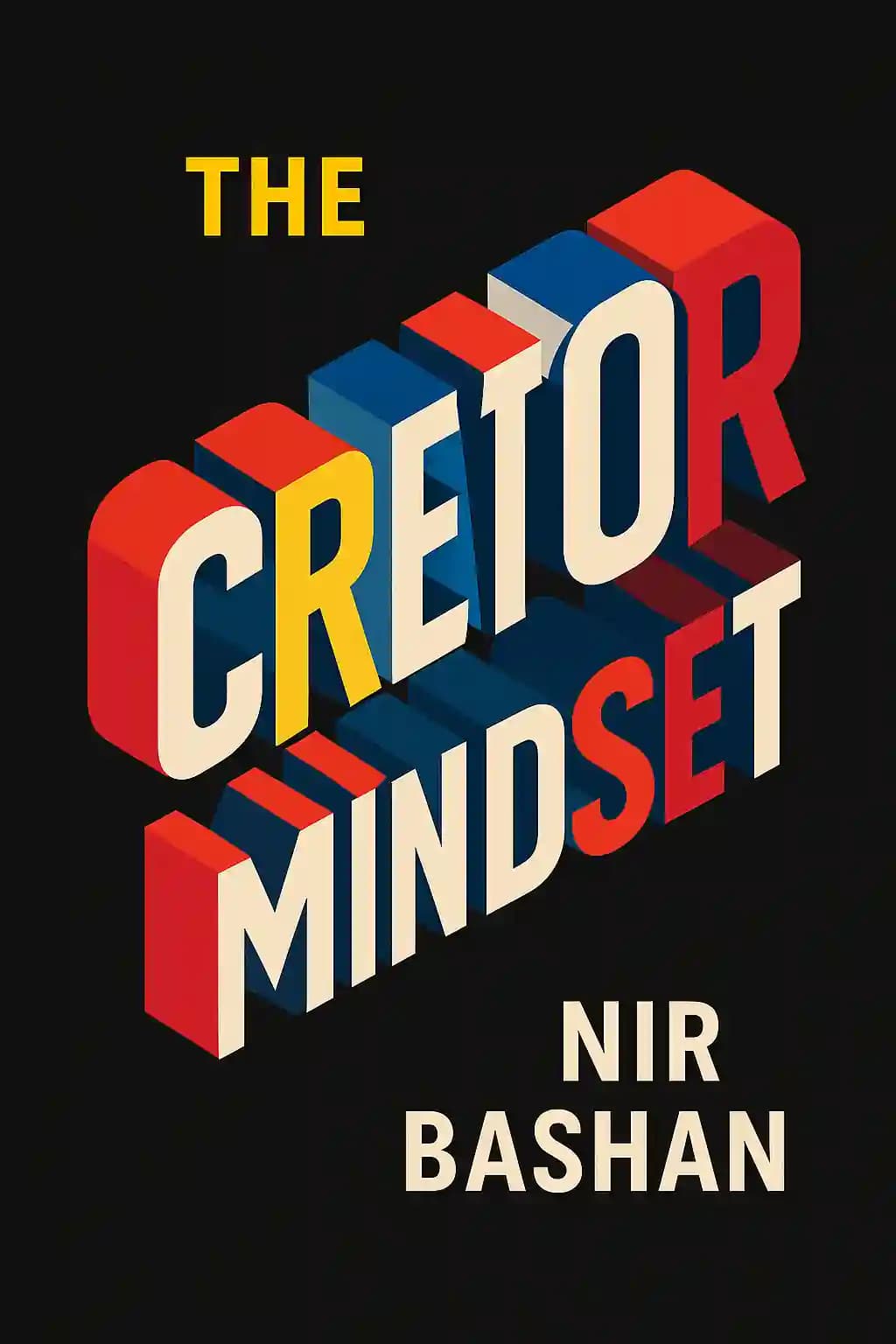
Have you ever wondered why some businesses thrive while others fail within their first five years? The answer might surprise you-it's not about having the best analytical skills or the most detailed spreadsheets. According to Nir Bashan, we're facing a creativity crisis in the business world. Most professionals operate at only half their potential, overdeveloping analytical thinking while neglecting creative thinking. This imbalance explains why Apple nearly collapsed before Steve Jobs returned with his creative vision, and why companies like Kodak failed despite inventing the digital camera. The Creator Mindset has been embraced by leaders across industries, from Fortune 500 executives to military strategists, who recognize that creativity isn't just for artists-it's the essential competitive advantage in today's idea economy. As Bashan's approach gains traction globally, it's reshaping how we think about problem-solving, innovation, and business growth by tapping into a natural ability we all possess but have forgotten how to use.
Глава 2
The Analytical-Creative Imbalance: Business at Half Power
Remember when Steve Jobs was ousted from Apple? Under analytically-focused leadership, the company nearly collapsed as innovation dried up in favor of maximizing margins. The board believed they could run Apple better without Jobs' creative influence, focusing instead on metrics, cost-cutting, and restructuring. Products stagnated as leadership adopted a "if it ain't broke, why fix it" mentality, ignoring a fundamental principle: change is inevitable. During this period, Apple's market share plummeted from 16% to just 4%, while their product line became increasingly confused and unfocused.
As bankruptcy loomed, Apple tried every analytical solution in the playbook-layoffs, restructuring, even suing Microsoft-all of which failed spectacularly. They cut 4,100 employees, eliminated 30% of their product line, and pursued aggressive cost-reduction strategies, yet their stock continued to fall. In desperation, they brought Jobs back, who immediately made the creative yet shocking decision to approach rival Bill Gates for a $150 million bailout, with the condition that Apple drop its lawsuit. This creative solution not only saved Apple but benefited both companies, demonstrating how creativity can triumph where analytical thinking fails. The partnership led to Microsoft Office for Mac, which became a crucial selling point for Apple computers in business environments.
This story illustrates the central problem Bashan identifies: most businesses operate with only half their potential brainpower. By neglecting creative thinking in favor of pure analytics, they're essentially accepting half a paycheck for their work. Traditional business education reinforces this imbalance, teaching students to focus almost exclusively on data, metrics, and formulas while treating creativity as frivolous rather than essential. MBA programs typically dedicate less than 10% of their curriculum to creative problem-solving and innovation, while over 70% focuses on analytical skills.
The consequences are stark-80% of businesses fail within their first five years, not because they lack analytical rigor, but because they can't adapt creatively to changing circumstances. Even established companies become vulnerable when they lose their creative edge, as demonstrated by once-mighty brands like Kodak, who held over 90% of the film market but failed to embrace digital photography, Toys "R" Us, who couldn't adapt to online retail despite strong financial analysis, and Pan Am Airlines, whose rigid adherence to traditional routes and services led to their downfall despite sophisticated market analysis.
The good news? We all possess the creative capacity to solve seemingly unsolvable problems. It's not about artistic talent but about awakening a dormant part of our minds that sees possibilities where others see only obstacles. Research shows that children display genius-level creativity until about age five, after which traditional education begins to suppress it. However, this creativity isn't lost - it's merely dormant, waiting to be reactivated through conscious effort and proper techniques. Companies that successfully balance analytics with creativity, like Netflix, Tesla, and Amazon, consistently outperform their peers by margins of 20% or more in both revenue growth and market capitalization.
Глава 3
Rediscovering Your Innate Creative Abilities
Think back to kindergarten-that moment when you were handed an enormous piece of butcher paper and paints, sparking a feeling of limitless possibility. This wasn't about becoming an artist; it was about seeing what could be rather than what was. Children naturally approach the world with creativity, turning blocks into fortresses and couch cushions into secret passageways, while adults become trapped in practical, analytical thinking.
Why does this happen? Our education system trains us to fear being wrong, to seek only "right" answers rather than creative exploration. We learn to silence our creative impulses in favor of safe, predictable solutions. The result? We forget how to access a fundamental human capacity that evolved even before language or fine motor skills-creativity as a survival mechanism.
To reconnect with this innate ability, Bashan suggests simple exercises like drawing a flower or writing down persistent problems to examine their physical appearance. These activities begin rewiring the brain for creative thinking, helping us listen to that creative voice that occasionally pops up with fresh ideas-the same voice we often shut down with "that won't work" or "we've never done it that way."
This isn't about complicated creative protocols or artistic talent. It's about awakening what's already there-the creative capacity we're all born with. Creativity isn't mysterious, innate, or dependent on fleeting inspiration. It's a reliable skill that can be developed through practice and specific techniques.
One such technique is the Trinity of Creativity-a three-part formula consisting of Concept (highest-level view), Idea (medium-level view), and Execution (detailed view). Like viewing Earth from different distances, each perspective reveals different opportunities. Most people comfortably operate only at the Execution level, but creative success requires visibility across all three interconnected views.
By systematically exploring variations at each level, you can generate creative alternatives that would otherwise remain hidden. Subtle changes at the Execution level offer seedlings of potential new products or services; Idea-level adjustments create significant innovations; and Concept-level changes enable radical transformations that can completely reinvent your business or career.
Глава 4
The Unlikely Personality Traits Behind Creative Success
Three essential personality traits form the foundation of creativity: humor, empathy, and courage. These attributes, built into each person, must be used in combination to generate innovation.
Humor opens us to creativity by acknowledging we aren't always in control. It gives permission to fail, to be human, and to make mistakes-essential ingredients for innovation. When facing business problems like excess inventory, responding with humor rather than anger creates space for creative solutions. A lighthearted comment about a "merch monster" might spark practical ideas like temporary discounted storage. Beyond problem-solving, humor makes us more relatable and likable, fostering connections that often become more memorable than the work itself.
Empathy manifests in two forms: internal and external. Internal empathy involves genuinely listening to staff and coworkers, understanding that business transactions center on customers' needs rather than ourselves. It means building meaningful relationships within the company and taking responsibility for your own destiny rather than blaming external factors. External empathy requires examining outside factors honestly without judgment-especially competitors. Rather than merely criticizing competitors, creative minds study them with curiosity to learn valuable insights that can improve their own standing.
Courage-perhaps the most difficult component-requires looking honestly at ourselves to recognize room for improvement. It takes tremendous guts to acknowledge our flaws and try something new. Like our ancestors who fought with pointed sticks when there was no other choice, modern courage means trusting your creative instinct even when data and analytics suggest otherwise. It's about finding answers in uncomfortable places, believing that creativity can overcome fear, and having the will to try new ideas.
These three traits work together to spark creativity that leads to innovation, wealth, and growth. The good news? They're already built into each of us-we just need to consciously develop them.
Глава 5
The Lost Art of Listening: Hearing Your Way to Creative Solutions
Listening-a skill we've largely abandoned in modern times-is essential to creative success. While our ancestors listened for survival (which berries were poisonous, which mountain passes were safe, which animal sounds signaled danger), today we talk too much and listen too little, often fearing manipulation or missing opportunities. But effective listening yields profound creative wealth, serving as the foundation for innovation, problem-solving, and breakthrough thinking.
To manage time creatively, we must transform how we approach meetings. Research shows most corporate meetings (67%) waste time completely, with the average executive spending 23 hours per week in meetings, yet only achieving meaningful outcomes in less than a third of them. The Creator Mindset approach transforms meetings through three essential principles. First, establishing clear purpose-always asking "Why are we having this meeting?" This question anchors creativity by providing focus and preventing drift into unproductive territory. Second, strictly limit meeting duration since studies show most 60-minute meetings yield only 15-20 minutes of real productivity. Third, establish derivative action items-specific, measurable steps that can be taken TODAY to solve problems NOW, rather than pushing decisions into an endless future.
Microlistening represents a revolutionary approach to gathering insights. Instead of broad, unfocused information gathering, it means selective, limited listening to carefully chosen trusted sources. This approach saves both time and money while yielding profound insights from small but highly relevant sample sizes. One brilliant Fortune 500 CMO, despite having a multi-million dollar budget for extensive testing, relied on just five carefully selected trusted colleagues for feedback on marketing initiatives. Though analytically questionable with its small sample size, this approach proved creatively effective, leading to multiple award-winning campaigns and double-digit market share growth.
Our urge to talk stems from ego seeking validation and the modern compulsion to be seen as knowledgeable and authoritative. However, counterintuitively, speaking less increases your chance of being heard and remembered. Studies show that executives who speak 20% less in meetings are perceived as 40% more influential. The more you thoughtfully consider your words and create space for others to contribute, the more you increase your chances of hearing something profound and valuable. Modern minds have given listening a bad reputation-we fear manipulation through others' words or worry about appearing passive, so we talk nonstop to control situations. But this fear cuts short creative learning opportunities and prevents us from accessing the collective wisdom around us.
The less you talk and the more thoughtfully you choose your words, the more impact you'll have-a counterintuitive but powerful creative principle that transforms both personal effectiveness and group dynamics. Master listeners report gathering three times more actionable insights than their more talkative counterparts, proving that silence truly can be golden in the pursuit of creative solutions.
Глава 6
Embracing Mistakes as Pathways to Innovation
In 1928, during perilous times between world wars, Dr. Alexander Fleming made what would become one of history's most important mistakes: leaving his lab equipment uncleaned before vacation. Upon returning, he found mold in his petri dishes and, thinking creatively, examined it under a microscope-discovering penicillin and eventually leading to antibiotics that saved millions of lives. This serendipitous discovery revolutionized modern medicine and demonstrated how seemingly careless errors can lead to groundbreaking innovations.
This exemplifies "mistake utility"-understanding how errors become worthwhile. The Creator Mindset views mistakes not as failures to be avoided but as opportunities for innovation. Other celebrated "mistakes" include Post-its (from a failed attempt at creating super-strong glue), safety glass (from an accidentally dropped flask), and Toll House cookies (from substituting chopped chocolate when ingredients ran out). The microwave oven was invented when Percy Spencer noticed a chocolate bar melting in his pocket while working with magnetrons, and WD-40 was the 40th attempt at creating a water displacement formula - the previous 39 "mistakes" led to the perfect solution.
The analytical mindset views mistakes as things to be avoided at all costs, but this pessimistic perspective stifles innovation. In reality, mistakes create breeding grounds for creativity and unexpected opportunities. When we remove the fear of making errors, we give ourselves permission to explore, push boundaries, and create freely. Companies like Google and 3M explicitly encourage experimentation and celebrate failures as learning opportunities, allocating specific time for employees to work on side projects that might fail but could lead to breakthrough innovations.
To maximize mistake utility in your career or company, follow three key steps. First, stop your relentless pursuit of goals and take a minute to examine recent errors, looking for valuable clues about what happened. Document these mistakes and their contexts, as patterns might emerge that lead to insights. Second, learn to love imperfection-in our race for constant improvement and productivity, we often miss the creative potential revealed by imperfections. Consider how Japanese kintsugi art transforms broken pottery into more valuable pieces by highlighting the cracks with gold. Third, rethink outcomes by letting go of preconceived notions. The Creator Mindset requires accepting that results might differ from expectations-and that's okay.
By controlling outcomes too rigidly, we miss opportunities for creativity to present unexpected but potentially superior results. The freedom that comes from not having to get everything right all the time sparks innovation that rigid perfectionism never could. Companies like Pixar embrace this philosophy by showing early, imperfect versions of their films to test audiences, allowing the feedback from these "mistakes" to guide improvements. Similarly, Thomas Edison's famous quote about not failing but finding 10,000 ways that won't work exemplifies how embracing mistakes can lead to revolutionary breakthroughs.
Глава 7
The Four Ps: Essential Tools for Creative Growth
Two friends who ran a successful high-end automotive repair shop in Los Angeles employed creative approaches and thrived initially. Despite their success, they eventually hit a growth ceiling when they wanted to expand, diversify, hire more staff, and potentially franchise their business model. Their limitation stemmed from using only one or two elements of The Creator Mindset rather than fully embracing all principles.
To achieve true creative potential, we need four essential tools-the four Ps: People, Process, Product, and Profit-which serve as checks and balances along the path to creative mastery.
People are the most valuable commodity in any business and the strongest connections in your career network. They generate creativity-not machines or tools. For businesses, this means hiring slow and firing fast: find the best people and let them use their natural talents while quickly removing those who don't contribute positively. Rather than focusing solely on resumes, hire for character and potential-like military veterans who bring discipline and leadership regardless of industry experience.
Process enables the achievement of little victories that build toward bigger goals through clear, precise steps. Without proper process, even brilliant creative ideas lead to confusion and chaos rather than meaningful outcomes. Process allows creative initiatives to be communicated clearly across an organization, preventing resistance to change by showing staff how new ideas can be interesting rather than threatening.
Understanding your true product means looking beyond the obvious analytical view to see what you really provide. For example, a manufacturer of military-grade parts isn't just in manufacturing-they're in the trust business. A nurse isn't just taking temperatures and updating charts-they're in the communication business. This creative definition opens up new possibilities for career advancement or business growth by energizing the core meaning of your product with your audience.
Profit is the culmination of getting the other three Ps right. When viewed creatively rather than analytically, profit transforms from a symbol of greed into an altruistic opportunity to contribute meaningfully-whether through charitable donations, personal purchases, or business expansion. Profit enables you to spend money on what you deem important and affects others' ability to create their own meaningful goals.
Глава 8
Breaking Free from Technology's Grip on Creativity
We mistakenly believe comfort is desirable, striving for comfortable homes, food, and surroundings. Yet The Creator Mindset cannot flourish in comfort-it breeds complacency, not innovation. Our human nature seeks comfort and predictability, building anxiety when things don't go as planned. Technology companies exploit this vulnerability, activating our dopamine receptors with likes and new apps, preying on our genetic makeup.
Despite promising connection, our technology dependence creates isolation and an idealized self-image we can never achieve. In this isolated world, creativity becomes more vital than ever, connecting us to our authentic, ancestral selves.
To combat technology's grip on our lives, we need six practical approaches: Schedule a Tech Detox Day weekly to discover renewal away from screens; Do It in Person by prioritizing face-to-face interactions over digital convenience; Accept that Multitasking is BS (proven through a simple exercise showing it takes 4-8 times longer than single-tasking); Switch Gears by focusing completely on one task before moving to another; Do Something Uncomfortable Today to push beyond your comfort zone; and Realize Tech Is Fleeting while Creativity Lasts Forever-understanding that our creative contributions, like musical notes, continue resonating long after we've finished.
There's a disease more deadly than any illness-self-doubt. It lives dormant in all of us, waiting for the right moment to strike. When examined through The Creator Mindset, self-doubt is a disease of inaction-a paralyzing introspection that prevents us from embracing creativity. It affects every profession, pushing us toward analytical thinking that demands absolute answers while rejecting creative input.
Self-doubt thrives in comfort. Modern conveniences have freed us from survival concerns, giving us abundant time for self-reflection that can spiral into crippling doubt. Our educational system reinforces this by training students to fear being wrong, seeking only "right" answers rather than creative exploration.
To combat self-doubt, we can use three powerful tools: the Faucet Tap visualization (letting ideas flow naturally without judgment), the Light of Positivity (reframing doubt with a positive attitude), and the Shotgun method (writing down doubts until they transform into ideas). These practices help us break free from technology's false promises and reconnect with genuine creative thinking.
Глава 9
Championing Creativity in a World of No
In 1973, Steve Sasson joined Kodak and by 1975 had invented the world's first digital camera-an eight-pound device that took grainy black-and-white photos. Despite this groundbreaking innovation, Kodak's leadership rejected it, convinced no one would want digital pictures. This resistance to creative change ultimately led to their bankruptcy in 2012.
To champion creativity effectively, first Think Like a Child-recapture that childlike indifference to failure and willingness to explore without boundaries. This creative grit not only helps solve problems but creates contagious camaraderie by connecting to the primordial creative brain we all possess. Second, Try Saying Yes Sometimes instead of defaulting to the safer "no." Saying yes requires taking risks, but offers greater rewards and champions creativity in ways that transcend the daily grind.
Fear of failure drives bad business decisions, yet it's through failure that creativity shines brightest. Trying to get it right all the time is impossible and more costly long-term than learning from mistakes. Various fears-cash flow problems, lack of profit, decreasing margins, bad bosses, unclear career objectives-can all be transcended through creativity. Each limitation actually forces creative thinking: cash flow issues require examining spending patterns, profit problems demand creative solutions to leverage existing revenue, and decreasing margins call for differentiation through creativity.
Nothing works forever-today's solutions may not work tomorrow. To champion creativity and avoid getting stuck in a particular time period, ask yourself two crucial questions: Will what I'm doing today be relevant tomorrow? And when it's no longer relevant, how can I change it? These questions force an honest assessment of your offering's longevity and push you to prepare for inevitable change.
The rest upon success tool (RUST) is the only tool in this book you should avoid. The Creator Mindset fights our natural urge to say "Why fix what isn't broken?" Companies like Kodak, Toys "R" Us, Pan Am Airlines, and Columbia House all rested on past success, creating cultures that revered history while dismissing future possibilities. In such environments, creativity is systematically shut down, employees feel their ideas won't be taken seriously, and investors grow disengaged.
Глава 10
Creative Reinvention: Writing Your Future Story
The remarkable transformation of Porsche demonstrates the power of creative reinvention. From its dark origins manufacturing vehicles for the Nazi war machine, including tanks and submersibles, Porsche reinvented itself after WWII under Ferry Porsche's leadership. Following his father Ferdinand's death, Ferry made a clean break with the past, directing the company toward creating the world's finest sports cars-a goal far removed from its military origins.
Today, Porsche exists in the realm of dreams, its wartime beginnings largely forgotten. The company eventually acknowledged its past in 1999 by establishing a fund for concentration camp laborers and commissioning a historical study, but its focus remains firmly on its reinvented identity.
This transformation teaches us that past mistakes can become seeds for progress through reinvention, requiring two key steps: breaking away from the past while also recognizing it. If you're dissatisfied with your career or company's history, change its future direction. Porsche transformed from making killing machines to vehicles of sporting pleasure-a complete reinvention requiring only the will to change paths.
When you break from the past, your future actions stand on their own merit, based not on historical context but on what you now deem important. The most effective way to change your past is by creating a different future. While breaking from the past is essential, at some point in your reinvention journey you must acknowledge your origins. Sometimes recognition needs to happen upfront for reinvention to take hold. Regardless of when, acknowledging your past helps anchor how far you've come, completing your transition to reinvention.
To truly start anew with The Creator Mindset, you must question everything-even widely held beliefs. While most media portrays a world in decline, creativity reveals a different reality. Looking through The Creator Mindset lens uncovers positive truths that challenge pessimistic narratives. Despite common perception, global life expectancy shows an unmistakable upward trajectory. Charitable giving is flourishing globally, with Americans giving 3-15 times more than residents of other countries. Since 1990, access to clean drinking water has risen dramatically worldwide, even as population has exploded.
These are remarkable insights revealed when we fight natural pessimism and embrace creative thinking. The Creator Mindset isn't just a business strategy-it's a way of seeing the world as it can be rather than as it is, transforming obstacles into opportunities and limitations into launching points for innovation.