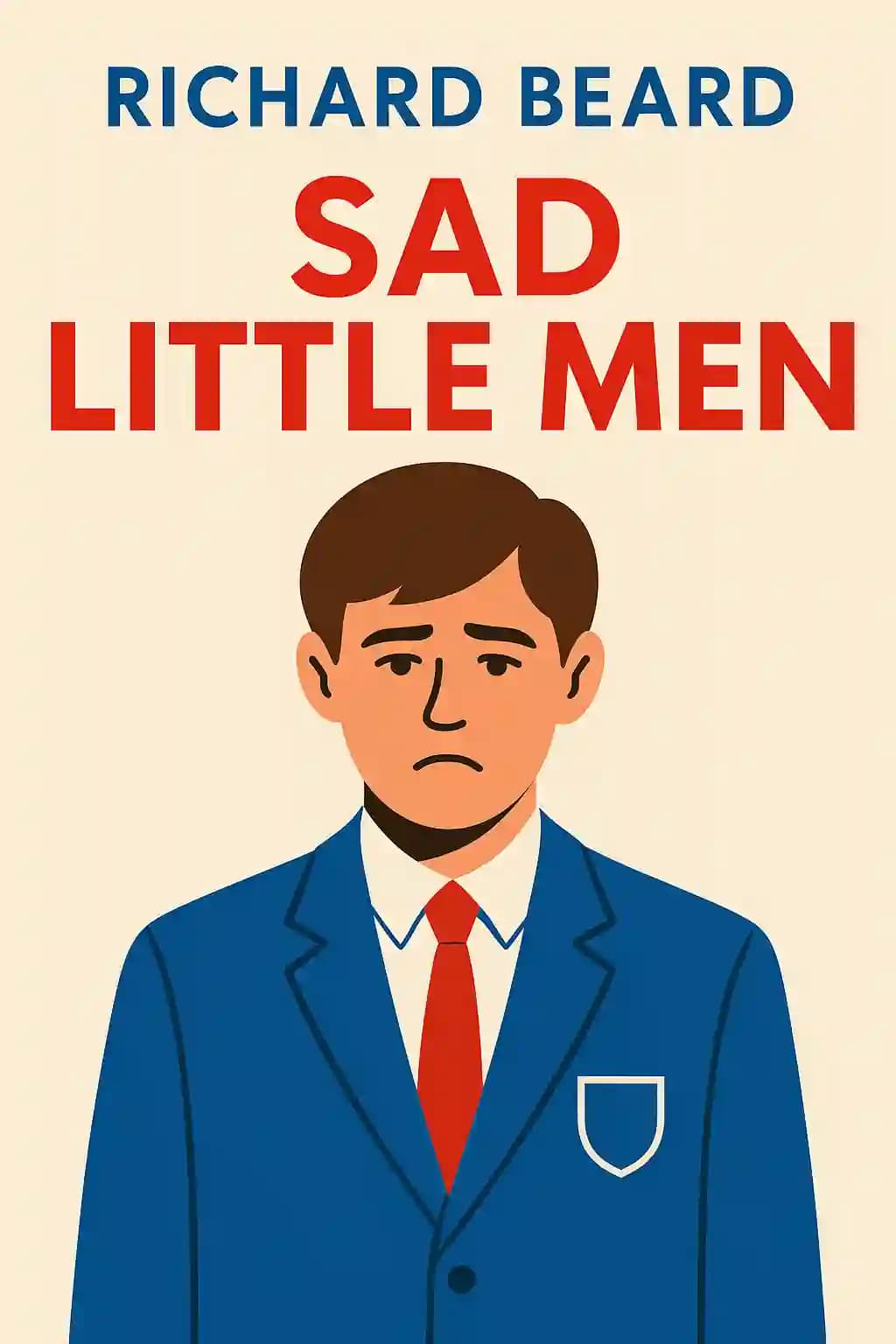
Inside Britain's elite boarding schools lurk the origins of political dysfunction. Richard Beard's searing memoir-expose - praised by Tom Holland as "insanely readable" - reveals how emotional deprivation creates leaders like Boris Johnson, leaving readers questioning if privilege actually ruins empathy.
Richard James Beard, award-winning English author of Sad Little Men, combines incisive social commentary with deeply personal memoir to critique Britain’s private education system.
A graduate of Cambridge University and the University of East Anglia’s prestigious Creative Writing program, Beard draws on his own boarding school experiences to explore themes of privilege, trauma, and institutional power. His acclaimed memoir The Day That Went Missing (2017), winner of the PEN/Ackerley Prize and a National Book Critics Circle finalist, established his reputation for blending family history with cultural analysis.
Beard’s fiction, including Goldsmiths Prize-shortlisted Acts of the Assassins and Lazarus Is Dead, reimagines historical and biblical narratives through modern literary experimentation.
Former Director of London’s National Academy of Writing and a Visiting Professor at the University of Tokyo, Beard’s work has been featured in The New York Times and on BBC programs. Sad Little Men was named a 2025 Book of the Year by the Times Literary Supplement and The Observer, cementing his status as a provocative voice in contemporary British nonfiction.
Sad Little Men examines the emotional and societal impact of Britain’s private boarding school system through Richard Beard’s personal experiences. The memoir critiques how these institutions prioritize stoicism over emotional well-being, fostering a culture of repression that shapes future leaders. Beard argues this "re-education" perpetuates elitism and dysfunction in British society, blending autobiography with broader social analysis.
This book appeals to readers interested in British class dynamics, education reform, or memoirs about trauma and resilience. Educators, policymakers, and critics of elitist systems will find Beard’s critique of boarding schools’ psychological toll compelling. Fans of Beard’s earlier works, like The Day That Went Missing, will appreciate his introspective prose.
Yes—Beard’s blend of personal narrative and societal critique offers a provocative look at how private schools mold England’s power structures. Its emotional depth and sharp analysis make it essential for understanding systemic elitism. However, critics note its narrow focus on Beard’s generation and limited diverse perspectives.
Beard compares boarding schools to “cult-like, imperialist indoctrination camps” that prioritize conformity over critical thinking. He highlights emotional detachment, glorification of suffering, and the reinforcement of class hierarchies through disciplines like Classics. These schools, he argues, produce leaders ill-equipped for modern, empathetic governance.
Beard’s childhood letters to his parents reveal hidden desperation beneath superficial updates about cricket and sweets. They symbolize boarding school boys’ forced self-reliance and the systemic gaslighting that teaches children to mask vulnerability—a survival tactic with lifelong emotional consequences.
Beard draws from his traumatic childhood at Pinewood School and Radley College, where he endured isolation and repression. His brother’s drowning, later explored in The Day That Went Missing, underscores his focus on suppressed grief. As a former boarding school insider, he offers firsthand authority on systemic flaws.
Some reviewers note Beard’s limited engagement with diverse perspectives, particularly racial or modern experiences. His focus on mid-20th-century practices risks neglecting contemporary reforms. Critics also question his generalization of boarding schools as uniformly toxic.
Beard dismisses Classics as a tool to maintain ties to “ruling caste” ideologies, arguing it prioritizes elitist tradition over critical inquiry. This curriculum, he claims, reinforces imperialist mindsets rather than fostering intellectual growth.
The title reflects the emotional stunting Beard observes in boarding school alumni—men trained to lead but unequipped to connect authentically. It critiques how early trauma shapes adulthood, perpetuating cycles of power and emotional detachment.
Unlike The Day That Went Missing (focused on personal grief), Sad Little Men expands into societal critique. Both memoirs use Beard’s life to explore broader themes, but this book explicitly ties private education to England’s political and cultural failures.
While primarily diagnostic, Beard implies systemic dismantling of elitist education is necessary. He advocates for nurturing emotional intelligence over stoicism and diversifying leadership pipelines beyond private school networks.
As debates about privilege and inequality intensify, Beard’s analysis sheds light on how elite education perpetuates systemic inequities. Its insights resonate amid calls for inclusive leadership and mental health awareness in institutional reforms.
Почувствуйте книгу через голос автора
Захватите ключевые идеи мгновенно для быстрого обучения
A mother’s love was ‘a trick’ that lasted only until the beginning of each term.
We were wary of feeling full stop.
The mass gaslighting of children by their caregivers is a phenomenon that demands more attention.
It is time to question whether this is really who we want in charge.
Разбейте ключевые идеи Sad Little Men на понятные тезисы, чтобы понять, как инновационные команды создают, сотрудничают и растут.
Выделите из Sad Little Men быстрые подсказки для запоминания, подчёркивающие ключевые принципы открытости, командной работы и творческой устойчивости.

Задавайте любые вопросы, выбирайте голос и совместно создавайте идеи, которые действительно находят у вас отклик.

Создано выпускниками Колумбийского университета в Сан-Франциско
"Instead of endless scrolling, I just hit play on BeFreed. It saves me so much time."
"I never knew where to start with nonfiction—BeFreed’s book lists turned into podcasts gave me a clear path."
"Perfect balance between learning and entertainment. Finished ‘Thinking, Fast and Slow’ on my commute this week."
"Crazy how much I learned while walking the dog. BeFreed = small habits → big gains."
"Reading used to feel like a chore. Now it’s just part of my lifestyle."
"Feels effortless compared to reading. I’ve finished 6 books this month already."
"BeFreed turned my guilty doomscrolling into something that feels productive and inspiring."
"BeFreed turned my commute into learning time. 20-min podcasts are perfect for finishing books I never had time for."
"BeFreed replaced my podcast queue. Imagine Spotify for books — that’s it. 🙌"
"It is great for me to learn something from the book without reading it."
"The themed book list podcasts help me connect ideas across authors—like a guided audio journey."
"Makes me feel smarter every time before going to work"
Создано выпускниками Колумбийского университета в Сан-Франциско

Получите резюме книги «Sad Little Men» в формате PDF или EPUB бесплатно. Распечатайте или читайте офлайн в любое время.
I was just eight years old when my parents sent me away to boarding school. It was 1975, and I was not alone; Boris Johnson and David Cameron, men who would later shape the destiny of England, were also starting their journeys in similar institutions. My first school was Pinewood, a prep school on the edge of the Cotswolds, while Johnson went to Ashdown House and Cameron to Heatherdown. Those early days were marked by a profound sense of loneliness and fear. I quickly learned that the most important lesson for survival was to hide these feelings, even from myself. The letters I wrote home were designed to reassure my parents that I was okay, that they hadn’t been cruel by sending me away. But behind the surface banalities about weather, cricket, and sweeties, there was a scared, lonely little boy begging for the love he craved deeply. This emotional austerity started from the moment my parents drove away. A mother’s love was ‘a trick’ that lasted only until the beginning of each term. As I grew older, this sadness turned to anger, with a seething unspoken promise that someday, somehow, someone would have to pay.