Глава 1
The Corporate Takeover of Democracy
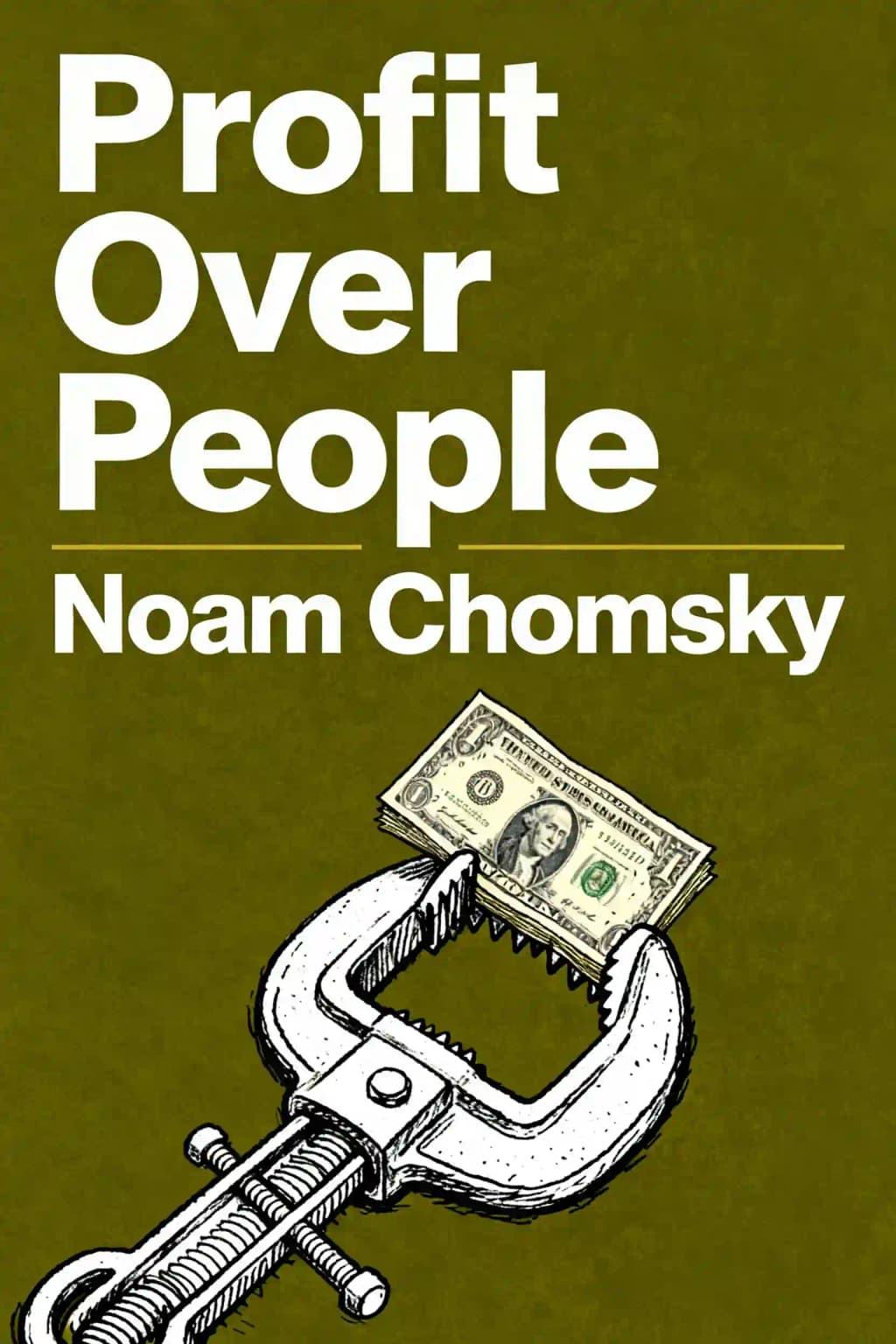
In a world where corporate profits soar while wages stagnate, where financial markets dictate government policies, and where economic decisions affecting millions are made behind closed doors, Noam Chomsky's "Profit Over People" stands as a prophetic critique of our time. Since its publication, the book has become required reading in political science departments worldwide and has influenced generations of activists, including figures like Bernie Sanders and Alexandria Ocasio-Cortez. Its unflinching examination of neoliberalism has only grown more relevant as income inequality reaches historic levels. What if the economic system we're told represents freedom and prosperity is actually designed to benefit a small elite at the expense of democratic principles and human welfare? This question lies at the heart of Chomsky's analysis-one that challenges us to look beyond the rhetoric of "free markets" to the reality of power relations shaping our world.
Глава 2
The Neoliberal Revolution: Doctrine vs. Reality
Neoliberalism presents itself as the champion of freedom through unfettered markets, but its actual implementation reveals a striking disconnect between rhetoric and practice. This economic doctrine emerged in the 1970s and 1980s, championed by Reagan and Thatcher, and quickly spread globally through institutions like the IMF and World Bank. Its basic tenets include liberalizing trade and finance, letting markets set prices, privatizing public assets, and minimizing government involvement in the economy. The doctrine gained particular momentum following the oil crisis of 1973 and the subsequent stagflation that challenged Keynesian economic orthodoxy.
Historical evidence consistently contradicts neoliberal claims. The most successful development stories-from Britain and America's own industrialization to the East Asian "miracle" economies-all relied heavily on state intervention, protectionism, and strategic economic planning. South Korea achieved unprecedented tenfold growth in per capita income between 1960 and 1990 not through free markets but through "heavy doses of government involvement," including directed credit, import restrictions, and export subsidies. Japan, Korea, and Taiwan actually deviated more from market prices than supposedly interventionist countries like India and Brazil, with their governments actively shaping industrial policy and maintaining strict oversight of banking sectors.
The contrast between East Asia and Latin America provides compelling evidence against neoliberal prescriptions. East Asian countries maintained strong capital controls, ensured more equitable income distribution through land reform and education policies, and directed imports toward productive investment in strategic industries. Their governments actively coordinated with private sector firms to achieve specific development goals. Latin American economies, more faithfully following neoliberal policies, experienced greater inequality, capital flight, and economic instability. Countries like Argentina and Chile, despite being held up as free-market success stories, suffered repeated financial crises and declining industrial capacity. When the World Bank reluctantly acknowledged these differences in its 1993 "East Asian Miracle" report, it noted that foreign investment in Latin America "has tended to substitute for other capital flows," transferring control and profits abroad rather than building domestic capacity.
This pattern extends historically. Britain only embraced liberal internationalism in 1846 with the repeal of the Corn Laws, after 150 years of protectionism and state intervention had secured its industrial dominance. Even then, Britain maintained control over colonial markets like India, systematically destroying its advanced indigenous textile and shipbuilding industries through tariffs and regulations. The United States followed the same path a century later, maintaining the world's highest tariffs from the Civil War until World War II, adopting free trade rhetoric only after protectionism had made it the world's richest nation.
Today's corporate giants similarly depend on state support, despite their free-market rhetoric. Studies confirm that "virtually all of the world's largest core firms have experienced a decisive influence from government policies," with many owing their very existence to government intervention. Companies like Boeing, Intel, and pharmaceutical giants rely heavily on publicly funded research and development. The Pentagon system has been particularly crucial in transferring costs to the public while privatizing profits, as exemplified by the internet and GPS technology. Despite claims about globalization's inevitability and the powerlessness of nations to regulate capital, democratic control remains possible because transnational corporations rely heavily on public subsidies, infrastructure, and domestic markets. Even supposedly footloose financial firms depend on state guarantees and bailouts during crises.
Глава 3
Engineering Consent: The Management of Democracy
Democracy faces a fundamental tension: how can elites maintain control in societies where, as philosopher David Hume observed, "force is always on the side of the governed"? The answer lies in what Walter Lippmann called "the manufacture of consent"-controlling what people think rather than what they do. This concept has become increasingly sophisticated and pervasive in modern democratic societies.
This approach has deep historical roots in American political thought. When Alexander Hamilton described the people as a "great beast" to be tamed, he articulated an enduring elite perspective that has shaped governance for centuries. James Madison designed the constitutional system specifically to "protect the minority of the opulent against the majority" by creating institutional barriers that would prevent the landless masses from gaining meaningful political power. The solution was what philosopher Frances Hutcheson termed "consent without consent"-where rulers implement rejected plans, confident that later the "stupid" masses "will heartily consent" to what was done in their name. This framework established a pattern of governance that continues to influence modern democratic systems.
By 1792, Madison himself had grown concerned about the system he helped create, lamenting how the "opulent minority" was "substituting private interest in place of public duty," creating "a real domination of the few under an apparent liberty of the many." His warnings have become increasingly prescient over two centuries, particularly with the emergence of what critics call "great private tyrannies"- powerful corporations and financial institutions granted extraordinary powers by the courts. These collectivist legal entities receive substantial state support while dominating information systems, media outlets, and public discourse.
Modern techniques for managing democracy emerged more systematically in the early 20th century, driven by advances in psychology and mass communication. Edward Bernays, nephew of Sigmund Freud and the acknowledged father of public relations, explained that "intelligent minorities must make use of propaganda continuously and systematically" because they alone "understand the mental processes and social patterns of the masses." This process of "engineering consent" became particularly essential as universal suffrage expanded democratic participation, leading to what one observer noted: "even the bourgeoisie stood in fear of the common people." Walter Lippmann, one of the century's most influential political theorists, similarly argued that an elite of "responsible men" must control decision-making while the public serves merely as "spectators of action," developing a comprehensive framework for managing public opinion in complex societies.
This systematic management of democracy has created a substantial and measurable gap between public preferences and actual policy outcomes. Contemporary polling consistently shows that over 80 percent of Americans believe government is "run for the benefit of the few" and that working people have too little political voice. Most citizens think corporations have gained too much power and should sacrifice profit for workers and communities. Despite decades of relentless propaganda and messaging, 80-90 percent of Americans continue supporting federal guarantees for public assistance, healthcare, and Social Security-positions that remain largely excluded from mainstream political discourse and policy consideration. This disconnect between popular will and political outcomes demonstrates the ongoing effectiveness of consent engineering in modern democratic societies.
Глава 4
Free Markets for Others, State Protection for Us
The doctrine of "free markets" manifests in two distinct forms: the official version forcefully imposed on vulnerable nations, and the actual practice where market discipline selectively applies to others while powerful nations shield themselves. This double standard has been a consistent pattern since the 17th century, when Britain emerged as Europe's leading developmental state through aggressive state intervention, including dramatic increases in taxation, strict navigation acts, and comprehensive state management of the economy.
Today's global trade system exemplifies this fundamental hypocrisy. NAFTA, far from being a pure free trade agreement, contains heavily protectionist measures designed to create strategic advantages. The agreement includes complex rules of origin specifically crafted to block East Asian and European competitors while incorporating unprecedented "intellectual property rights" provisions - protections that wealthy nations notably refused during their own developmental phases. These measures effectively constrain Mexico's economic sovereignty, forcing policies that prioritize foreign investors while systematically limiting democratic input and local development initiatives.
The telecommunications agreement, frequently lauded as a triumph of American free-market principles, reveals similar contradictions. While celebrated publicly as market liberalization, internal documents show it functions as a "new tool of foreign policy," enabling Washington to intervene in other nations' domestic affairs. American carriers, already dominant in the global market, stand to benefit disproportionately from this supposedly "level playing field." Industry analysts have pointed out that this arrangement will lead to significant job losses across Asia, while many Asian consumers face higher telecommunications costs before any promised price reductions materialize.
The selective application of international rules becomes particularly evident in WTO disputes. When WTO mechanisms advance American interests, they're praised as universal principles of free trade. However, when the European Union attempted to use WTO procedures to challenge the Helms-Burton Act targeting Cuba, American media suddenly reframed the dispute as "essentially political," with the New York Times declaring the WTO "not a proper forum." This mirrors earlier behavior when the US rejected the International Court of Justice's authority after it condemned American interventions in Nicaragua. Secretary of State Madeleine Albright's statement captured this approach perfectly: the US will act "multilaterally when we can and unilaterally as we must."
Even within domestic borders, the US economy significantly deviates from neoliberal principles. Large modern business enterprises have largely superseded traditional market mechanisms in coordinating economic activities, creating internal planning systems that more closely resemble state-directed economies than free markets. Despite its rhetorical commitment to market principles, America shares child mortality rates with Cuba and leads industrial nations in hunger and child poverty statistics. These troubling indicators persist despite America's position as the world's wealthiest nation with unprecedented advantages, suggesting the profound influence of corporate dominance over public welfare. The gap between free market rhetoric and reality becomes particularly stark when examining how corporate subsidies, tax breaks, and regulatory protection form a de facto industrial policy that contradicts free market principles.
Глава 5
Democracy's Hollow Shell: The Case of Latin America
To understand what "democracy and free markets" truly mean in practice, we must examine actual cases where American influence faces minimal external challenges-particularly Latin America and the Caribbean. Here, Washington has dominated for nearly a century, establishing what became known as its "backyard," revealing the true nature of the "Washington consensus" through decades of intervention, economic policies, and political manipulation.
The scholarly consensus portrays a "revival of democracy" in Latin America as "impressive" though with "formidable barriers"-primarily efforts to protect domestic markets from foreign control. This reveals the paradoxical neoliberal view that democracy advances as decision-making shifts from elected governments to unaccountable private corporations. The pattern repeats across the region: democratic governments attempting to protect local industries or implement social reforms face economic pressure, sanctions, or even direct intervention.
Nicaragua exemplifies the gap between rhetoric and reality. After its 1984 democratic election, monitored and recognized as legitimate by international observers including European delegations and the Latin American Studies Association, the US escalated its assault. Washington opposed the elections and worked to undermine them, fearing they might interfere with its terrorist campaign through the Contra forces. The Reagan administration's response included mining Nicaragua's harbors, destroying oil facilities, and supporting proxy forces. When the 1990 election approached, the US made clear that unless results favored its preferred candidate, Violeta Chamorro, Nicaragua would continue to endure illegal economic warfare and military attacks that the World Court had explicitly condemned in its 1986 judgment.
When Washington's candidate won in 1990, American commentators celebrated a "Victory for U.S. Fair Play" while frankly acknowledging that success came from "wrecking the economy" and waging "a long and deadly proxy war until the exhausted natives overthrow the unwanted government." Even liberal intellectuals endorsed these methods, arguing that causing "vast civilian suffering" was "perfectly legitimate" if "cost-benefit analysis" showed it would yield the desired outcome. This rationalization became a template for future interventions across the region.
Haiti provides another revealing case of democracy's hollow promise. President Aristide, who won 67% of the vote in Haiti's first democratic election, was allowed to return from exile in 1994 only after accepting an economic program privileging "Civil Society"-defined primarily as US investors and wealthy Haitians who had backed the military coup against him. The US actively undermined OAS sanctions against the coup regime and forced the democratic government to abandon its planned reforms, including minimum wage increases and labor protections. Under USAID-World Bank development strategies, Haiti experienced the familiar "economic miracle": profits soared for US manufacturers and local elites while workers' wages declined 56%. Local rice production, once self-sufficient and employing thousands of small farmers, was devastated by "liberalization" policies that exempted heavily subsidized US agribusiness from trade restrictions. The mere 5% voter turnout in 1997 elections revealed Haitians' bitter understanding of this version of "democracy," where economic sovereignty was sacrificed for nominal political rights.
These cases demonstrate how "free market democracy" often means freedom for international capital while constraining democratic choices about economic policy. Similar patterns emerged in Guatemala, El Salvador, Chile, and other nations where popular movements faced suppression when they challenged US economic interests or proposed alternative development models.
Глава 6
The Zapatista Challenge: Indigenous Resistance to Neoliberalism
The Zapatista uprising in Chiapas, Mexico on January 1, 1994-the day NAFTA took effect-represented a powerful symbolic challenge to neoliberal doctrine. The indigenous rebels, led by Subcomandante Marcos, declared NAFTA a "death sentence" for their communities and identified themselves as "the product of 500 years of struggle" fighting for basic necessities and rights. Their carefully chosen date of uprising highlighted the direct connection between their struggle and the implementation of neoliberal policies.
Their rebellion emerged from "complete marginalization and poverty and frustration" after years of failed attempts at peaceful reform through legal channels. The Zapatistas had exhausted traditional means of seeking change, including petitions, demonstrations, and attempts at dialogue with government officials. While indigenous peasants suffered most severely, their distress reflected broader Mexican conditions where half the population lacked resources for basic needs-a dramatic increase from 30% in 1980 when neoliberal reforms began. Rural communities were particularly devastated, with many forced to abandon traditional farming practices.
Following IMF-World Bank prescriptions, Mexico had radically transformed its agricultural sector, shifting production from subsistence crops to export commodities and animal feeds. This transformation benefited large agribusiness corporations and affluent consumers while causing widespread malnutrition, declining rural employment, and massive food imports. Traditional corn farmers found themselves unable to compete with subsidized U.S. imports. Manufacturing wages fell by 40% between 1980 and 1994, while labor's share of GDP declined by over a third-outcomes that became typical of neoliberal reforms worldwide. Mexican officials, including then-President Carlos Salinas, perversely celebrated falling wages as an investment incentive, alongside systematic labor repression and deliberately lax environmental enforcement.
NAFTA's primary appeal to business interests was its ability to "lock in" these neoliberal reforms, effectively reversing decades of progress in labor rights and economic development. Despite Mexico following what the World Bank called "textbook market economic policies," there was substantial popular opposition, with demonstrations drawing hundreds of thousands against policies repealing constitutional protections for labor, agrarian reform, and education rights. The Catholic bishops of Mexico issued a powerful condemnation of NAFTA for making "the market economy something absolute to which everything is sacrificed," reflecting widespread moral opposition to the agreement.
Following NAFTA's passage, numerous corporations, including major auto manufacturers and electronics firms, quickly fired workers attempting to organize independent unions, demonstrating the agreement's real impact on labor rights. These actions revealed the true nature of the "economic miracle" NAFTA was designed to perpetuate. The agreement was projected to suppress wages for approximately 70% of American workers, with the Congressional Office of Technology Assessment warning it could "lock the United States into a low-wage, low-productivity future."
The Zapatista rebellion resonated widely in Mexico and internationally, creating networks of solidarity that helped deter brutal military repression. Their innovative use of the internet and international media helped energize global justice activism worldwide, as people from Europe to Asia recognized similar concerns across very different circumstances. The movement's emphasis on indigenous rights, participatory democracy, and resistance to corporate globalization became a model for social movements globally.
Глава 7
The MAI: Neoliberalism's Secret Constitution
Perhaps the most revealing example of neoliberalism's anti-democratic nature was the attempted Multilateral Agreement on Investment (MAI), a comprehensive treaty that would have fundamentally altered the relationship between sovereign states and private capital. For nearly three years, from 1995 to 1998, this treaty was negotiated in secret at the OECD, with virtually no public knowledge despite its far-reaching implications for democratic governance and national sovereignty.
The MAI would have granted "investors"-primarily wealthy individuals and multinational corporations-unprecedented rights to move assets freely across borders without public interference or oversight. The scope of democratic choices potentially barred was extensive: local ownership requirements designed to protect domestic industries, labor protections including minimum wage laws and workplace safety standards, environmental regulations limiting pollution or resource extraction, and community control over local development projects. Most controversially, investors could sue governments directly in international tribunals for any policy that diminished their profits, but citizens and communities had no reciprocal rights to sue investors for social or environmental damages.
The treaty's twenty-year "lock in" provision was particularly draconian, requiring countries to remain bound by its terms for two decades even if they chose to withdraw. The "standstill" and "rollback" mechanisms would have progressively eliminated existing regulations while preventing new ones, effectively creating a one-way ratchet toward deregulation and corporate supremacy over public authority.
The strategic decision to forge the treaty initially in the WTO was blocked by developing nations, particularly India, Malaysia, and several African states, who recognized it would deprive them of crucial development tools - the very same policy instruments that wealthy nations had historically used to build their own economies. The negotiations were then strategically relocated to the more exclusive OECD, where they could proceed with minimal scrutiny from developing nations or civil society.
While the MAI generated significant public debate in countries like Canada, Australia, and France, the American public remained largely ignorant due to a near-complete media blackout. Major U.S. newspapers and television networks maintained silence until paid advertisements by public interest groups forced acknowledgment of the treaty's existence. Even then, mainstream coverage often portrayed critics as paranoid anti-globalization activists, despite their substantive concerns about democracy and sovereignty.
When the Clinton administration finally issued a statement under mounting pressure, it claimed to champion transparency and consultation with "domestic constituencies." However, documents later revealed these constituencies were exclusively business associations and corporate lobbying groups, while Congress, labor unions, environmental organizations, and the general public remained excluded from the process.
The MAI negotiations ultimately collapsed in late 1998, marking a significant victory for transnational civil society organizing despite heavily unfavorable circumstances. The "veil of secrecy" gradually broke down as information leaked through public interest groups, academic networks, and early internet activism. Even the pro-business Economist was forced to acknowledge that demands for labor rights and environmental protections could no longer be dismissed as fringe concerns - issues that had been completely absent when discussions were confined to corporate boardrooms and trade ministries.
This episode demonstrated both the anti-democratic impulses of neoliberal governance and the potential for organized public resistance to challenge it, foreshadowing later battles over similar investment treaties and trade agreements.
Глава 8
Beyond Despair: The Persistence of Democratic Struggle
Despite this sobering assessment of neoliberalism's impact on democracy, Chomsky insists on humanity's fundamental democratic inclinations and revolutionary potential. The extensive corporate efforts to prevent genuine democracy - through media control, lobbying, and campaign finance - paradoxically reveal the system's vulnerability to popular movements. While establishing a truly democratic economic order seems utopian in today's political climate, political activism has historically achieved significant advances against seemingly insurmountable odds, from labor rights to civil rights to environmental protections.
The record of popular struggles to dismantle forms of oppression is rich and encouraging. The abolition of slavery, women's suffrage, the eight-hour workday, and the end of child labor were all once considered impossible dreams by the power structures of their time. Skeptics who dismiss hopes for change as utopian need only look at South Africa's remarkable transformation from apartheid to democracy-a tribute to what the human spirit can accomplish against entrenched power. These achievements, won through persistent collective action and often at great personal sacrifice, should inspire people everywhere and guide further steps in the continuing struggle for democratic reform.
Throughout history, elites have repeatedly proclaimed the "end of history" when their preferred economic arrangements seemed secure. This happened with early 19th century neoliberal doctrine, when Ricardo and Malthus claimed their "science" proved helping the poor only harmed them by interfering with natural economic laws. It happened again in America's Gilded Age, when robber barons declared their monopolies essential to progress, and during the Roaring Twenties, when speculation seemed the path to endless prosperity. Each time, popular movements - from the Progressive Era reforms to the New Deal - eventually forced elites to retreat from their most extreme positions.
Despite neoliberalism's recent victories and the narrowing political spectrum, history shows that proclaimed "ends of history" always fail as people organize to demand justice. The success of movements like Black Lives Matter, climate activism, and labor organizing in the digital economy demonstrate that resistance remains vital and effective. While discontent with democracy grows alongside economic unfairness, popular struggles today begin from higher expectations than in previous eras, offering hope for more free and just institutions. The neoliberal order has generated massive crises globally - from wealth inequality to climate change to financial instability - and coming upheaval is inevitable. Whether this leads to democratic outcomes or authoritarian responses depends on how people organize and respond to these challenges through collective action and sustained resistance to concentrated power.