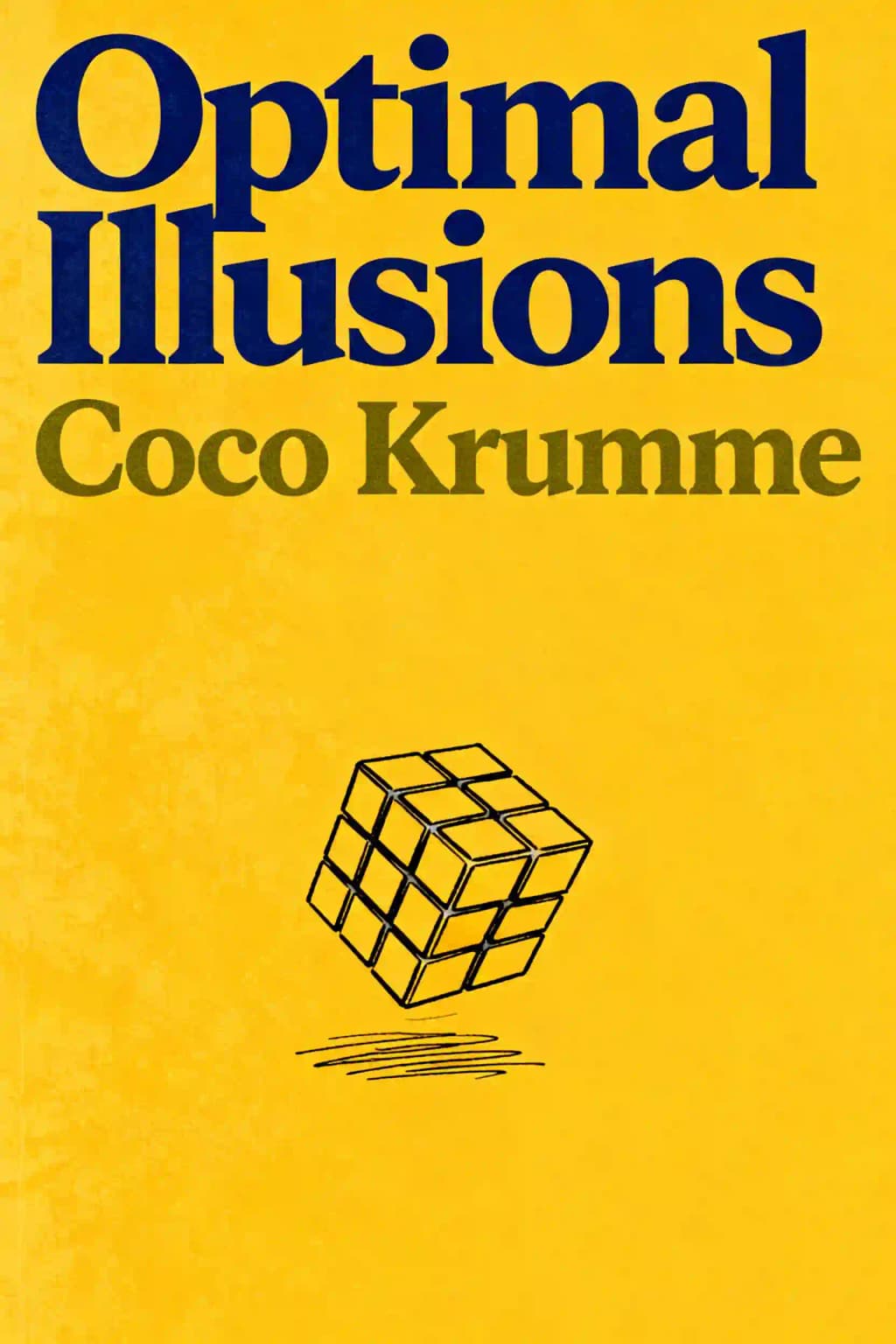
In "Optimal Illusions," mathematician Coco Krumme exposes how our obsession with optimization secretly limits our lives. Cal Newport calls it "incredibly timely" - a provocative wake-up call that questions whether efficiency algorithms are stealing what makes us human. What's your optimization blindspot?
Coco Krumme, applied mathematician and author of Optimal Illusions: The False Promise of Optimization, is a leading voice critiquing the cultural and systemic impacts of efficiency-driven technologies.
A MIT PhD graduate and Yale alumna, Krumme merges her academic rigor with firsthand Silicon Valley experience, where she witnessed optimization’s pitfalls while working as a data scientist and computational modeler. Her book, blending historical analysis and fieldwork—from interviews with North Dakota farmers to critiques of AI—exposes how the relentless pursuit of “best solutions” undermines resilience and human agency.
She founded Leeward Co., a scientific consultancy advising Fortune 500 companies and startups on sustainable data strategies. A featured speaker at venues like PBS’s The Open Mind and the NEXT Conference, Krumme’s insights bridge mathematics, ethics, and societal change. Optimal Illusions has been highlighted as a critical examination of tech culture, resonating in academic and industry circles alike.
Optimal Illusions examines how society’s obsession with efficiency and mathematical optimization has reshaped industries, technology, and daily life, often at the expense of human values. Coco Krumme combines historical analysis, personal anecdotes, and critiques of systems like Silicon Valley tech culture and industrial agriculture to argue for a more balanced approach to progress.
This book appeals to readers interested in technology ethics, societal impacts of algorithms, and critiques of modern efficiency culture. It’s particularly relevant for professionals in tech, data science, or policy-making, as well as general audiences concerned about unchecked optimization’s consequences.
While praised for its provocative ideas and interdisciplinary approach, some critics note uneven depth in technical explanations. It’s recommended for those seeking a thought-provoking exploration of optimization’s societal trade-offs, though readers wanting rigorous mathematical analysis may find it lacking.
Krumme highlights how optimization stifles diversity in agriculture, creates fragile systems in tech infrastructure, and dehumanizes workplaces by prioritizing metrics over creativity. She argues this pursuit often ignores long-term resilience and cultural heritage.
Unlike Merchant’s historical focus on labor movements, Optimal Illusions critiques modern systemic efficiency through a mathematical lens. While both address technology’s societal impacts, Krumme’s work leans more on personal narrative than exhaustive case studies.
With a PhD from MIT and experience in Silicon Valley, Krumme bridges technical expertise with philosophical inquiry. Her shift from optimizer to critic lends authenticity to discussions about tech’s limitations.
The book advocates for embracing imperfection, diversifying systems beyond pure efficiency metrics, and reintegrating human intuition into decision-making processes.
Krumme’s warnings about over-reliance on algorithmic systems resonate with concerns about AI ethics, biased models, and automation’s impact on employment.
Yes, it encourages readers to question “optimal” choices in daily life, prioritize resilience over convenience, and support locally adapted systems rather than globalized efficiency.
Krumme traces optimization from Enlightenment-era rationalism to its modern tech incarnation, showing how ideals of progress became entangled with narrow efficiency metrics.
Почувствуйте книгу через голос автора
Превратите знания в увлекательные, богатые примерами идеи
Захватите ключевые идеи мгновенно для быстрого обучения
Наслаждайтесь книгой в весёлой и увлекательной форме
Optimization transformed from mathematical technique to cultural religion.
Get big or get out.
Our vocabulary has been colonized by optimization's language.
Modern optimization looks forward, imagining all possible worlds to determine the best.
Scale distorts when short-term metrics override long-term community values.
Разбейте ключевые идеи Optimal Illusions на понятные тезисы, чтобы понять, как инновационные команды создают, сотрудничают и растут.
Погрузитесь в Optimal Illusions через яркие истории, превращающие уроки инноваций в запоминающиеся и применимые моменты.
Задавайте любые вопросы, выбирайте свой стиль обучения и создавайте идеи, которые действительно вам подходят.

Создано выпускниками Колумбийского университета в Сан-Франциско
"Instead of endless scrolling, I just hit play on BeFreed. It saves me so much time."
"I never knew where to start with nonfiction—BeFreed’s book lists turned into podcasts gave me a clear path."
"Perfect balance between learning and entertainment. Finished ‘Thinking, Fast and Slow’ on my commute this week."
"Crazy how much I learned while walking the dog. BeFreed = small habits → big gains."
"Reading used to feel like a chore. Now it’s just part of my lifestyle."
"Feels effortless compared to reading. I’ve finished 6 books this month already."
"BeFreed turned my guilty doomscrolling into something that feels productive and inspiring."
"BeFreed turned my commute into learning time. 20-min podcasts are perfect for finishing books I never had time for."
"BeFreed replaced my podcast queue. Imagine Spotify for books — that’s it. 🙌"
"It is great for me to learn something from the book without reading it."
"The themed book list podcasts help me connect ideas across authors—like a guided audio journey."
"Makes me feel smarter every time before going to work"
Создано выпускниками Колумбийского университета в Сан-Франциско

Получите резюме книги «Optimal Illusions» в формате PDF или EPUB бесплатно. Распечатайте или читайте офлайн в любое время.
A $1.5 billion Amazon Air Hub rises from Kentucky soil, positioned within a day's drive of 65% of America. This monument to efficiency represents more than logistics-it embodies a cultural religion. We've become devotees of optimization, worshipping at the altar of faster, cheaper, better. But what began as mathematical technique has metastasized into something far more consuming. From Dakota sugar beet fields to Texas oil rigs, the pursuit of "optimal" has reshaped not just our economy but our very way of seeing the world. The question isn't whether optimization works-it demonstrably does-but whether we've sacrificed something irreplaceable in our quest for perfection.
Optimization traces back to the Latin "optimus"-the best-but its modern incarnation emerged through Voltaire's 1759 satire "Candide." Through Professor Pangloss, who insists we live in "the best of all possible worlds" even as disasters pile up, Voltaire mocked philosopher Leibniz's optimism. Yet while Voltaire satirized retrospective justification, modern optimization looks forward, imagining every possible future to engineer the best one. Consider a lemonade stand. What makes the "best" lemonade? You define your objective, identify parameters like available ingredients, and work within constraints like budget and customer taste. This framework-objective, parameters, constraints-now governs everything from crop yields to dating apps. Norman Borlaug's "Green Revolution" exemplifies optimization's power: his disease-resistant dwarf wheat varieties increased productivity severalfold and reportedly saved a billion lives. His approach fundamentally altered our worldview. We began breaking everything into specialized components, shifting from observation to control, assuming technology could solve anything. Perpetual growth became not just desirable but inevitable.
Despite saving billions from starvation, the Green Revolution carried hidden costs. In North Dakota's Red River Valley, traditional four-crop rotations gave way to mono-cropping, triggering an arms race with weeds. Farms consolidated dramatically as new technologies allowed fewer farmers to manage exponentially more land. The directive was stark: "get big or get out." Farmers shifted from working soil to managing futures contracts. Traditional knowledge about soil health vanished, replaced by standardized industrial practices. The Midwest has lost over fifty billion tons of topsoil since cultivation began. Fertilizer runoff creates dead zones in the Gulf of Mexico spanning thousands of square miles. As food prices dropped to a third of what they were a century earlier, sugar infiltrated everything. Mid-Victorian Britain, despite limited medical knowledge, maintained remarkable health through diverse, seasonal diets - industrialization eventually undermined those gains. These transformations reveal optimization's hidden costs: slack - essential redundancy cushioning systems against shocks; place - specific knowledge connecting farmers to land through generations; and scale - vital connection between part and whole. In a single century, American farmers traded richness for yield, diversity for standardization, resilience for efficiency.
Our optimization journey required three conceptual shifts. First came atomization-breaking reality into measurable units. Newton's calculus divided continuous phenomena into infinitesimal slices. Adam Smith's pin factory showed how dividing labor into eighteen operations dramatically boosted productivity. Ford's assembly line reduced automobile production time eightfold through interchangeable parts and continuous flow. Las Vegas epitomizes this-everything from cards to labor breaks into discrete, measurable components. Second came increasing abstraction-creating complex models divorced from reality. Modern abstractions emphasize prediction through multiple layers of complexity. These abstractions-from climate forecasts to credit-default swaps-replace direct observation with pattern recognition, distancing us from what we're modeling. Third came automation-first material, then digital. While factory robots build cars deterministically, modern algorithms operate probabilistically at massive scale. A news recommendation system generates ten billion recommendations with barely more computing power than ten. We've disconnected from our technological systems' pace, place, and effects-exemplified by drone strikes controlled like video games from distant chambers.
February 2021: the polar vortex hits Texas, bringing record cold. As households crank up heat, the electric grid collapses. Natural gas pipelines freeze, windmills stop turning. Nearly five million lose power. Electricity prices skyrocket from $30 to $9,000 per megawatt hour. Systemic collapses follow Ernest Hemingway's description of bankruptcy: "First gradually, then suddenly." The 2008 financial crisis exemplified this - years of risky mortgage lending accumulated until sudden collapse triggered global meltdown. California's megafires emerged from decades of suppressing natural burns while allowing development in fire-prone areas. The era of optimization is entering decline. Breakdowns appear first at edges - small failures and lags - before suddenly engulfing entire systems. The pandemic exposed how just-in-time inventory left no margin for error. William Stanley Jevons revealed a paradox: as resource extraction becomes more efficient, demand increases rather than decreases. Similarly, better local optimization breeds greater reliance and less questioning. The Ever Given blocking the Suez Canal for six days disrupted 12% of global trade. Each case demonstrates how optimization eliminates the redundancy that provides resilience during crises.
Islands reveal optimization's double edge. In 1918, Western Samoa lost nearly a quarter of its population to Spanish flu after an infected ship arrived. Neighboring American Samoa suffered no losses through strict quarantine. Western Samoa's trade hub status-its former isolation transformed into vulnerability. American Samoa, with less trade, could afford offshore quarantine. Like Magritte's painting of a pipe captioned "This is not a pipe," optimization deceives us by mistaking models for reality. Economic projections, train schedules, school timetables aren't more true than alternatives, yet our bodies and habits shape around them. We mistake constructed systems for natural laws. Unwinding optimization has no recipe. In agriculture, if our industrial system isn't working, how would we determine the "right" farm size? Who would pay to replace half-million-dollar tractors? These aren't measurement questions but value judgments about how many people should farm and how food should be distributed. Jason, a Shoshone biologist, manages his tribe's bison-restoration project in Wyoming. Where seventy million bison once roamed North America, Western settlers reduced them to hundreds. Jason envisions restoring entire ecosystems through "decolonization of land"-reintroducing native plants, restoring natural water flows, rebuilding soil health. Unlike optimization with its clear formulas, this involves complex webs of interconnected changes that resist simple metrics.
America feels a growing malaise-optimization's gifts haven't delivered fulfillment. We face two impulses: intensify efficiency or escape it entirely. Both trap us by making optimization either entrenched or the thing we're fleeing from. Jane Jacobs observed that vigorous cultures balance redundancies and insularity-innovation incubates in tight circles while connecting to broader productive capacity. Railroad tycoon James Jerome Hill warned in 1910 that America had reached physical limits, anticipating resource depletion. Economist Tyler Cowen echoes this, calling recent decades "The Great Stagnation"-we've picked the low-hanging fruit. Today's yearnings for tangible experiences, slower rhythms, and local connection attempt to reclaim what optimization costs us. We can't solve these shortcomings within optimization's own framework. The remedy isn't doubling down or escaping, but choosing how to see. We must select work beyond seeking "the best," commit to beliefs defying calculated utility, and view the world as less controllable yet more worthy of reverence. In a world drunk on efficiency, the most radical act is choosing presence over productivity, connection over control, enough over optimal.