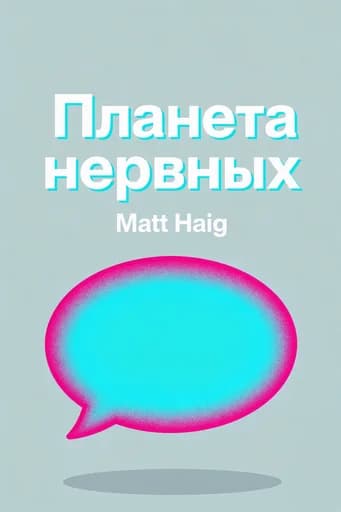
In "Notes on a Nervous Planet," Matt Haig offers a lifeline through our anxiety-inducing digital age. This Sunday Times bestseller has sparked global conversations about mental health, prompting thousands to reassess their relationship with technology. Can disconnecting actually help us reconnect with ourselves?
Matt Haig, the internationally bestselling author of Notes on a Nervous Planet, is celebrated for his profound explorations of mental health, resilience, and modern-day anxiety.
A British writer whose works span fiction, non-fiction, and children’s literature, Haig draws from his own struggles with depression and panic disorder, detailed in his memoir Reasons to Stay Alive. This memoir was a #1 Sunday Times bestseller that spent 46 weeks in the UK top 10.
His genre-defying narratives, from the speculative fiction of The Midnight Library to the alien perspective on humanity in The Humans, merge philosophical depth with accessible storytelling. Haig’s insights have been featured on BBC Radio 2 and in global media, amplifying his role as a mental health advocate.
With over three million books sold worldwide, his works, including How to Stop Time and The Radleys, have been translated into 40+ languages. His book A Boy Called Christmas was adapted into a major film.
Notes on a Nervous Planet explores how modern life—including technology overload, social media, and societal pressures—exacerbates anxiety and stress. Matt Haig blends personal anecdotes, philosophical reflections, and actionable advice to help readers navigate a world that often feels overwhelming. Key themes include mental health awareness, digital detox strategies, and redefining success beyond materialism.
This book is ideal for anyone feeling overwhelmed by modern life’s pace, particularly those struggling with anxiety, burnout, or digital fatigue. Fans of Haig’s Reasons to Stay Alive, mental health advocates, and readers seeking a blend of memoir and self-help will find it resonant. It’s also valuable for individuals reevaluating their relationship with technology.
Yes, for its relatable insights into managing anxiety in a hyperconnected world. Haig’s candid storytelling and practical tips—like prioritizing “less stuff to do” over productivity—offer solace. However, some critics note repetitive themes or a lack of depth in solutions. Overall, it’s praised for its accessibility and timely relevance.
Haig critiques social media’s role in fostering comparison, reducing attention spans, and distorting reality. He advises intentional usage—like designated offline hours—to mitigate its mental toll. A standout quote: “Being unhappy about your looks is not about your looks” challenges superficial digital narratives.
While both address mental health, Reasons to Stay Alive focuses on Haig’s personal depression journey, whereas Notes examines external societal triggers. Readers praise Reasons for its raw intimacy but favor Notes for its broader cultural critique.
Some reviewers find the advice oversimplified or repetitive, citing lists and bullet points as lacking depth. Others argue it states obvious truths about modern life without novel solutions. However, most agree its strength lies in validating shared struggles.
Haig advocates “unplugging” rituals, like tech-free mornings or nature walks, to reclaim mental space. He emphasizes mindful consumption: “Do something in the day that isn’t work or duty or the internet.” These practices aim to reduce overwhelm and foster presence.
Haig critiques hustle culture’s unsustainable pace, urging readers to reject the “race we’re losing.” He reframes balance as “stripping back” obligations, not multitasking. The goal: align daily actions with personal values, not societal expectations.
As AI and digital saturation intensify, Haig’s warnings about technology’s mental health toll grow more urgent. The book’s focus on intentional living, resilience, and redefining progress resonates amid rising burnout and screen-time debates.
Yes, Haig provides concise strategies:
These steps aim to build mental “buffer zones” against external chaos.
Почувствуйте книгу через голос автора
Превратите знания в увлекательные, богатые примерами идеи
Захватите ключевые идеи мгновенно для быстрого обучения
Наслаждайтесь книгой в весёлой и увлекательной форме
How do we stay sane on a planet that seems increasingly designed to drive us mad?
We're essentially cavemen in a world that arrived faster than our minds and bodies expected.
There is nothing either good or bad, but thinking makes it so.
We've temporarily solved the problem of scarcity and replaced it with the problem of excess.
Разбейте ключевые идеи Notes on a Nervous Planet на понятные тезисы, чтобы понять, как инновационные команды создают, сотрудничают и растут.
Погрузитесь в Notes on a Nervous Planet через яркие истории, превращающие уроки инноваций в запоминающиеся и применимые моменты.
Задавайте любые вопросы, выбирайте свой стиль обучения и создавайте идеи, которые действительно вам подходят.

Создано выпускниками Колумбийского университета в Сан-Франциско
"Instead of endless scrolling, I just hit play on BeFreed. It saves me so much time."
"I never knew where to start with nonfiction—BeFreed’s book lists turned into podcasts gave me a clear path."
"Perfect balance between learning and entertainment. Finished ‘Thinking, Fast and Slow’ on my commute this week."
"Crazy how much I learned while walking the dog. BeFreed = small habits → big gains."
"Reading used to feel like a chore. Now it’s just part of my lifestyle."
"Feels effortless compared to reading. I’ve finished 6 books this month already."
"BeFreed turned my guilty doomscrolling into something that feels productive and inspiring."
"BeFreed turned my commute into learning time. 20-min podcasts are perfect for finishing books I never had time for."
"BeFreed replaced my podcast queue. Imagine Spotify for books — that’s it. 🙌"
"It is great for me to learn something from the book without reading it."
"The themed book list podcasts help me connect ideas across authors—like a guided audio journey."
"Makes me feel smarter every time before going to work"
Создано выпускниками Колумбийского университета в Сан-Франциско

Получите резюме книги «Notes on a Nervous Planet» в формате PDF или EPUB бесплатно. Распечатайте или читайте офлайн в любое время.
Your phone buzzes. Again. It's 11 PM and you're scrolling through headlines about climate disasters, political chaos, and economic uncertainty while simultaneously checking how many likes your last post got. Your heart rate quickens. You tell yourself you'll put the phone down in just a minute, but an hour later you're still there, caught in an endless loop of refreshing, scrolling, comparing. Sound familiar? We're living in a strange contradiction-objectively, life has never been safer or more comfortable, yet anxiety and depression rates are climbing worldwide. Despite longer lifespans, better medicine, and technology that promises to connect us, we feel more isolated and overwhelmed than ever. This isn't coincidence. Our ancient brains are colliding with a modern world that moves faster than our biology can handle, creating what can only be described as a collective nervous breakdown. The question isn't whether modern life is making us anxious-it's how we stay sane in a world seemingly designed to drive us mad.
Humans have existed for 200,000 years, but writing only appeared 5,000 years ago. For most of history, change happened slowly across generations. Then everything accelerated. Technology doesn't just progress - its progress speeds up. Processing power doubles every few years. What took decades now takes months. Imagine someone from 50,000 years ago appearing outside a modern supermarket. The automatic doors, fluorescent lights, beeping scanners - all would trigger pure panic. Here's the uncomfortable truth: that person is us. Biologically, we haven't changed in 50,000 years. This mismatch explains why panic attacks frequently happen in supermarkets. These overwhelming environments trigger something primal. Everything moves faster now: mail, news, relationships, thoughts racing through our heads. We're conditioned for constant acceleration, always focusing on what's next rather than what's here. From preschool onward, we practice "reverse mindfulness" - perpetually fixating on future exams, careers, achievements. Learning transforms from wonder into merely a means to an end.
Despite unprecedented access to beauty products and procedures, appearance dissatisfaction has never been higher. A global study found this varies more by nation than gender, with Japanese, British, Russian, and South Korean people most unhappy with their looks. The paradox: the more tools we have to "fix" ourselves, the more broken we feel. Beauty standards rise alongside our ability to meet them. The beauty industry profits billions from insecurities it creates. Most fundamentally, no procedure can solve our deepest fear-that we're aging and mortal. Consider the beach. If it could speak: "I am created by waves and currents, made of eroded rocks, existing beside the sea for millions of years. And I don't care about your body." Even other beachgoers aren't scrutinizing you-they're obsessing over their own flaws. Research shows changing your appearance never solves appearance-related unhappiness. The problem isn't your body-it's viewing yourself through insecurity. As Hamlet observed, "there is nothing either good or bad, but thinking makes it so." Elderly people are more optimistic about aging than younger adults, having discovered what youth cannot: aging is inevitable, and the present moment is the only reality we truly know.
For most of human history, "quarter to five" would have been meaningless. Early humans lived by natural rhythms - day and night, light and dark. Mechanical clocks appeared in 14th-century Europe without minute hands. By the 16th century, pocket watches became status symbols - Samuel Pepys documented his compulsive watch-checking in 1665, behavior strikingly similar to our smartphone habits today. Despite longer lifespans and time-saving technologies - emails, washing machines, instant communication - we feel more rushed than ever. We claim we'd love to read more, learn an instrument, or exercise "if only I had the time." But the problem isn't a shortage of time; it's an overload of everything competing for our attention. During a phone call with his mother, the author admits he wasn't really listening because he was writing an email. When he confesses to having "no time at all," she sighs: "I know the feeling." The truth: feeling you have no time doesn't mean you have no time. We've become slaves to numerical time rather than natural rhythms, measuring our worth by productivity rather than presence.
Modern life drowns us in excess. By 2016, over 134 million books existed. In 16th-century England, just 40 books were published annually-avid readers could consume everything available. Today, we can only ever read a minuscule fraction of what exists. Panic is essentially overload-an excess of thought and fear that makes you feel psychologically trapped. This explains why panic attacks often occur in overstimulating environments: supermarkets, nightclubs, crowded trains. Modern life creates multiple forms of overload: consumer, work, environmental, news, information. Since the 19th century, global connectivity has exploded. By 2017, over half the world's population was online, up from just 0.4% in 1995. The internet enables incredible things-collective action, distant friendships, instant knowledge-but also encourages destructive behaviors: posting about experiences instead of having them, comparing our lives to others' highlight reels, seeking validation through likes. Throughout history, emotions have been contagious, from witch trials to Beatlemania. The internet amplifies this exponentially, spreading emotions like a virus through our connected world.
Our nervous planet faces real threats-political polarization, terrorism, climate change. What's changed isn't that terrible things happen (they always have), but how we experience them. Smartphones deliver global horrors directly and viscerally, multiplying psychological impact. As panic attack sufferers know, shock prevents clear thinking, making us passive and easily directed. How we react depends on delivery method. Breaking news channels disorient us, making everything feel worse. Yet despite media portrayal, the world is actually less violent than ever. In 1973, people got news twice daily-morning paper and evening broadcast. They still got rid of Nixon. Meanwhile, sleep has become a modern casualty. Since Edison's light bulb conquered darkness, we've gone to bed later. Edison declared sleep harmful and unnecessary. He was catastrophically wrong. The World Health Organization has declared a sleep loss epidemic in industrialized nations. Sleep deprivation weakens immunity, increases risks of heart disease, stroke, diabetes, and cancer, impairs concentration and memory, contributes to weight gain, and increases depression. Yet sleep remains consumerism's enemy-we can't shop while unconscious. Netflix's CEO considers sleep his main competitor. The best sleep solutions aren't expensive technologies but simple practices: consistent routines, avoiding late caffeine, exercising early, and getting natural daylight.
We're sold unhappiness because that's where profit lies. A former British Vogue fashion director admitted that despite empowerment messaging, fashion magazines leave readers "totally anxiety ridden" about having the wrong dinner parties or not meeting the right people. "In fashion we are always trying to make people buy something they don't need." Marketing expert Robert Rosenthal explicitly advocates using "fear, uncertainty, and doubt" to change consumer behavior. Even subtle advertisements sell the idea that we need products to achieve coolness or status. Don't let anyone make you feel insufficient. You are already enough and lack nothing. No one looks at a newborn and sees absence-they see perfection. We come complete, needing only basic sustenance, shelter, songs, stories, and people to love. In a world profiting from your self-doubt, the most radical act is recognizing you were born whole. The deficiencies you feel aren't real-they're manufactured by systems needing you to feel incomplete. Everything special about humans-our capacity for love, art, friendship, stories-isn't a product of modern life but of being human.