Глава 1
The Financial Revolution You've Been Waiting For
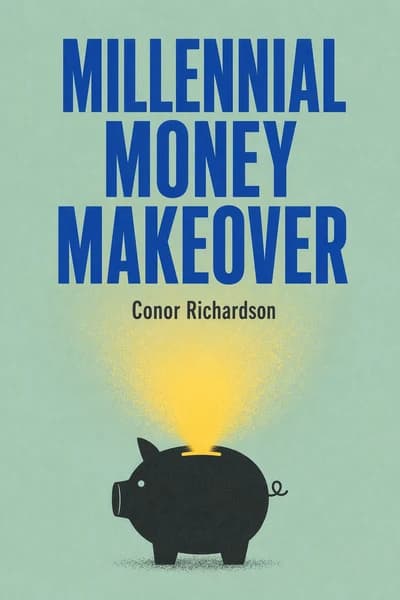
Millennial Money Makeover has become a sensation among young professionals seeking financial clarity. Featured in Business Insider's "Books Everyone Should Read in Their 20s" and endorsed by financial gurus like Ramit Sethi, this guide has transformed thousands of debt-burdened millennials into confident wealth builders. What makes Richardson's approach revolutionary is his background as a CPA who once lived the paycheck-to-paycheck reality despite his financial expertise. After his own financial awakening in a Brooklyn apartment, he developed a six-step system that combines psychological insights with practical strategies. Unlike typical finance books that feel like medicine, Richardson's approach feels like having a financially savvy friend guiding you through each step with humor and understanding. As one reader put it, "This isn't just about money-it's about reclaiming your future."
Глава 2
Breaking Free From Financial Chaos
The traditional success sequence-education, career, marriage, house, kids-has broken for millennials. We face unprecedented financial hurdles: stagnant incomes, crushing student loans, skyrocketing housing costs, and minimal retirement savings. Research by Annamaria Lusardi reveals alarming statistics: 76% of millennials are financially illiterate, 64% don't have retirement accounts, and 54% worry about student loan repayment. Despite being the most educated generation, we're financially struggling.
Getting unstuck begins with ownership. Stop saying "I don't know where to begin" or "Money isn't really my thing." The truth is, money management isn't intellectually difficult-it's a test of determination. Money can be your best friend: flexible, hardworking, and loyal. What people find challenging isn't money itself, but their behavior with it.
Rich people follow different rules: they focus on big wins by working hard on the right things; take action instead of hesitating; value financial freedom over depreciating assets; and practice delayed gratification. These principles help them eliminate debt and put their money to work effectively.
The quickest way to get rich? Act rich-but not how most Americans think. The filtered life portrayed in media distorts reality with luxury items and mansions. In reality, typical millionaires lead unsexy, frugal lives. As billionaire Chris Sacca advises, "My best piece of advice for the quickest way to get rich is to not spend any of your money." Living below your means, avoiding debt, and making your money work for you is the proven formula.
The Millennial Money Makeover provides a path to financial freedom through proper habits and rules. Adopting this outlook gives you higher confidence, better decision-making, increased career choices, and ultimately, financial freedom. The prescription for lifelong financial success is attainable by anyone determined to become a financial rock star.
Глава 3
The Decision That Changes Everything
If you want to find meaning in life, go to New York City. At twenty-eight, Richardson experienced his financial awakening in his Brooklyn apartment when creating his first real budget. That moment of clarity forced difficult decisions, including leaving New York. This transformation happens to everyone eventually-when you become tired of living paycheck to paycheck and realize change is necessary.
This moment represents a unique opportunity for complete transformation-escaping debt, building savings, creating a meaningful career, and living life on your terms. Making the conscious decision to "turn professional" with your finances will be life-changing. Despite constant marketing messages pushing consumption, recognizing your importance and taking control of your financial destiny is the first step.
Financial fear feeds on itself, proliferated by lacking three major aspects: autonomy, mastery, and purpose. As Daniel Pink explains, these qualities create fulfillment. Financial autonomy means freedom from paycheck dependence through eliminating debt and creating investment income. Mastery produces pride while its absence breeds fear-fortunately, it only requires basic math skills and desire for change. Purpose allows pursuing your life's calling. By developing these qualities, you build financial confidence despite a system designed to decrease it.
In today's information-saturated world, financial advice overwhelms us with endless options. This overload creates paralysis-the paradox of choice. Billionaire Marc Cuban understands this, advocating for fewer options to reduce anxiety. Like Amazon and Netflix using "suggestive programming," limiting choices reduces anxiety. A famous grocery store experiment proved this: a booth with 24 jam varieties attracted more visitors, but the booth with just 6 varieties sold ten times more jam.
Mastering money follows the J-Curve pattern-your skills may initially worsen before dramatically improving. This "investment in loss," as chess champion Josh Waitzkin calls it, is necessary for internalizing financial fundamentals. By persevering through initial difficulties, you'll eventually build successful financial habits. This temporary struggle is your tuition into financial knowledge.
Setting clear goals bridges your current situation with your desired future. Olympic champion Michael Phelps exemplifies this-at fifteen, he set competing in the Olympics as his goal and achieved it through day-by-day focus. Goal-setting activates your subconscious mind, creating an underlying current pulling you toward achievement. The book offers a structured goal framework with timeframes from three months to five years, encouraging ambitious targets since "greatness is never achieved through small goals."
Глава 4
Eliminating Debt: Your Path to Freedom
Debt has quietly infiltrated millions of millennials' lives, overstaying its welcome like an unwanted houseguest. The path forward presents a binary choice: keep debt or eliminate it entirely.
Debt creates a hollow existence that's difficult to recognize when under its intoxicating grip. Though acquiring debt is effortless, eliminating it requires focused effort against the internal "resistance" that generates excuses to delay repayment. By confronting this resistance and making consistent progress toward becoming debt-free, you'll experience life-changing momentum.
Interest dramatically increases purchases' total cost beyond their sticker price. Credit cards carry the highest rates (13-24%), followed by student loans (4-7%), consumer loans (4-6%), and mortgages (3-5%). This compounding effect is demonstrated through Lisa's story-her $2,000 MacBook balloons to $2,260 after just one year of unpaid interest, while her $80,000 student loan grows to $96,000 over the same period.
By 2017, Americans accumulated a record-breaking $1.021 trillion in credit card debt. This massive burden prevents young professionals from building wealth, as discretionary income goes toward servicing debt instead. Industry analyst Matt Schulz warns that even seemingly manageable debt leaves people vulnerable to financial disaster when unexpected emergencies arise. With credit card companies spending $850 million on advertising, they've successfully hooked 70% of Americans, including half of millennials who have at least three cards.
Managing multiple credit cards is like performing a dangerous high-wire act. What starts as a single card quickly multiplies as you shop for better rewards, leaving you juggling various balances and payment schedules. The solution? Pick your favorite card and eliminate the rest. Multiple cards lead to payment confusion, late fees, overconsumption, and using new cards to solve existing financial problems.
Richardson offers a seven-step strategy to break free from credit card debt. First, acknowledge the problem by examining three months of statements and highlighting unnecessary purchases. Second, list all credit cards in ascending order by balance, targeting the smallest balance first. Third, create a "flash budget" that redirects all surplus income toward debt elimination. Fourth, use the "snowball method" to build momentum-research shows paying off small balances first creates psychological wins that sustain motivation. Fifth, switch to cash payments to increase purchase awareness. Sixth, celebrate small victories. And seventh, share your success with others.
A simple phone call can save you money. Credit card companies value customer retention since the average American household pays hundreds in interest annually. When calling about annual fees or interest charges, be politely persistent-they'll often waive these charges rather than lose your business. The key is being "forcefully polite" and prepared to call back if necessary.
While credit cards seem essential today, Richardson advises having just one emergency card. To master credit cards: First, choose one with meaningful rewards-travel points often deliver higher value than cash back. Second, always pay your full balance. Third, monitor your credit utilization ratio. Fourth, negotiate a lower APR-most people don't realize this is possible. Fifth, keep your cards in a secure "lockbox" to prevent fraud.
Student loan debt has exploded into a $1.3 trillion crisis, growing 6% faster than inflation. This financial epidemic challenges the belief that education automatically guarantees success. While student loans provide education access, they often leave borrowers with years of debt that stifles the very dreams they set out to achieve.
To aggressively tackle student loans, three difficult but necessary lifestyle changes are recommended: First, move back in with parents to eliminate rent-your largest fixed expense. Second, sell your nice car and other valuable possessions to apply toward loan payments. Third, establish a buddy system with friends in similar financial situations to find free or inexpensive activities.
After eliminating credit card debt, tackle student loans using the SMART approach: Small balances first-focus on your smallest loan to build momentum; More than the minimum-gather all resources to exceed minimum payments; Always find more money-unleash your entrepreneurial spirit through side hustles; Reward yourself-celebrate milestones; Timeline from red to black-calculate how quickly you can eliminate debt and mark your "blackout date" on the calendar.
Глава 5
Passion Budgeting: Aligning Money With Joy
Budgeting isn't about cutting out everything you love-it's about creating a plan that keeps what's important and eliminates everything else. Rich people focus their energy on applying appropriate pressure to produce maximum results rather than getting distracted by small things.
Though budgeting may seem dull, it's a powerful tool used by the wealthy-54% of affluent investors create budgets and 84% stick to them. Successful organizations like startups, hospitals, universities, corporations, and non-profits all use budgeting to determine goals, strategies, and priorities.
The Pareto principle-that roughly 80% of effects come from 20% of causes-can revolutionize your financial efficiency. Popularized as the "80/20 rule" among Silicon Valley startups, this principle shows that focusing only on what truly matters while ignoring everything else produces better results with less effort.
Passion budgeting begins by examining what brings you joy and eliminating everything else. This approach optimizes financial decisions to accelerate debt payoff, increase savings, and reach the rich life faster. By clearing financial clutter, you free up decision-making capacity. Americans spend $1.2 trillion annually on non-essential items they don't need.
Marie Kondo's philosophy of keeping only items that "spark joy" applies perfectly to budgeting. Spend money in areas that make you happy while ruthlessly cutting expenses in areas that don't spark passion. Start with a clean slate by assuming you're eliminating all expenses, then gradually add back only items that spark joy. Examine your bank and credit card statements from the last three months. Highlight purchases that brought joy, then circle in black everything that wasn't highlighted. Most people discover they spend the majority of their money on things that don't matter to them.
Group your highlighted items into categories and assign weights (1 being best, 6 being least favorite). Select the top three weighted areas to continue spending in while reducing spending in the bottom three. Analyze the black-circled expenses-these represent your biggest opportunity for improvement. By cutting spending on things you don't care about, you can redirect thousands annually toward debt elimination, savings, or investing.
Generating passion in how you make money is just as important as spending on things that make you happy. As the most educated generation in history, Millennials often suffer from expectation dissonance when they discover the reality of their chosen professions. If your current job doesn't spark joy, focus on building skills in areas that do-through freelancing, side hustles, or new businesses.
Understanding the two main types of costs-fixed and variable-increases financial acumen. Variable costs fluctuate monthly based on consumption-food, entertainment, utilities, clothing, transportation. These costs are completely controllable and often represent unnecessary spending. Fixed costs are expenses with set contracted amounts regardless of consumption-rent/mortgage, gym memberships, student loans, car payments. While variable costs offer "low-hanging fruit," fixed costs contain the highest expenses. Adjusting these can disproportionately improve your budget, as demonstrated by the author's 45% rent reduction by moving from NYC to Austin.
How we spend money affects our happiness. Elizabeth Dunn and Michael Norton's research identified five spending approaches that increase financial satisfaction: 1) Buy experiences over material items; 2) Make purchases treats by rewarding yourself only after accomplishments; 3) Buy time by outsourcing tasks you dislike; 4) Pay first and consume later to increase anticipation; 5) Invest in others through charitable giving.
Financial success requires embracing the counter-cultural concept of socioeconomic downsizing-deliberately choosing to live one or two rungs lower on the economic ladder than your income allows. Take Jane and Bob, a couple earning $100,000 combined: by living on half their income, they can save $50,000 annually. Within three years, they'll accumulate $150,000, creating a foundation for future wealth.
Глава 6
Mastering Major Purchases
We struggle to grasp the true scale of large numbers, which affects our ability to make sound financial decisions about major purchases. When dealing with unfamiliar large sums, convert them into familiar units and compare them to your current savings. For example, a $45,000 car compared to $5,000 in savings means spending nine times your savings. This perspective helps reset our mental frame and converts abstract numbers into tangible reality.
Stanford researchers Walter Mischel and Ebbe Ebbesen's famous experiments tested delayed gratification by offering children marshmallows with the promise of more rewards if they could wait. Children with no distractions waited only 30 seconds before giving in, while those distracted by toys waited 8.59 minutes, and those thinking of "something fun" lasted 12.12 minutes. The lesson? Adults, like children, need distraction techniques to resist impulsive purchases.
When car shopping, follow these key principles: First, don't buy new-a new car loses approximately 10% of its value immediately upon leaving the dealership and another 10% by year's end. The sweet spot for purchasing is around years 4-5, when depreciation plateaus but the car still has modern features. Second, don't lease-despite seeming attractive with lower monthly payments, leasing almost always costs more than an equivalent loan, with hidden fees and penalties. Third, think long-term-research by Experian Automotive reveals that 61% of people earning over $250,000 annually don't buy luxury brands but choose dependable, affordable options. Fourth, calculate the total cost of ownership beyond just the sticker price. Fifth, pay with cash to shift from an affordability mindset to an ownership mindset. Finally, negotiate effectively by researching thoroughly and being prepared to walk away.
For relationship health, couples must have the "define the financial relationship" (DTFR) talk early on. Ask these five essential questions: How much do you have in savings? Do you have a plan for getting out of debt? Have you started saving for retirement? What is your ideal income? Can you be poor with me? These questions reveal financial habits, values, and compatibility.
The conventional wisdom that you should spend two to three months' salary on an engagement ring is marketing fiction created by De Beers. Research reveals an inverse relationship between ring cost and marriage success-the more spent on the ring, the higher the divorce rate. Diamonds depreciate up to 50% immediately after purchase, making them terrible investments.
With wedding costs averaging $32,641, maximizing your budget requires clear priorities. Share your budget openly with vendors, look for discounts and rising stars in the industry, and leverage your wedding registry strategically by being selective with quality items.
Contrary to popular belief, buying a house too early can be one of the worst financial decisions. With Millennials changing jobs every 3.7 years and Americans moving 11.4 times in their lives, the traditional utility of homeownership has diminished. Don't buy a house until you've accumulated at least one to two times your annual household income in cash or investments, eliminated all other debts, and saved a 20% down payment.
Interest dramatically increases the total cost of a home purchase. Comparing two scenarios with the same $362,000 house: Tom puts 5% down with a 30-year loan at 4.591% interest, paying $652,110 total ($290,110 in interest). Sarah, after following the money makeover principles, puts 20% down with a 15-year loan at 3.645%, paying only $448,777 total ($86,777 in interest). The difference is a staggering $203,333.
Millennials are shifting away from traditional homeownership timing. The dream seems increasingly unattainable due to student loans, consumer debt, and urbanization trends. Less than 20% of new home construction targets "entry-level" properties, down from over 30% pre-recession. Developers are focusing on larger houses for affluent Baby Boomers instead of building affordable first-time homes.
Глава 7
Building Wealth Through Saving and Investing
Building wealth is a habit. According to the Federal Reserve's survey, nearly half of working-age families have nothing saved for retirement, with the median family having only $5,000 saved. Our brains aren't naturally wired for saving-while our frontal lobe allows us to imagine the future, we enjoy visualizing completed goals more than doing the actual saving. Research shows we typically imagine our current selves in the future rather than our aged selves, which affects saving behavior. When participants in a study saw aged versions of themselves, they allocated twice as much money to retirement savings compared to those who only saw their current selves.
Having financial buffers creates positive psychological benefits. Without money worries, your mind has space to concentrate on other tasks, reducing stress that physically ages you. Research shows financial stress makes people appear older to others. Those without money worries can spend more time on fitness, appearance, nutrition, and quality products-all while frowning less.
To reach financial freedom, follow three critical steps: First, start an emergency fund of at least $3,000 to prevent dipping into savings or using credit for unexpected expenses. Next, build a slush fund that covers 3-6 months of living expenses. Finally, accelerate savings beyond six months of expenses to reach true "FU status"-the point where financial freedom allows you to pursue opportunities without financial constraints.
Once you've built your slush fund, it's time to put additional money to work through investing. Though all investing involves risk, it remains the single greatest way to accumulate wealth over time-it's how most millionaires achieve their status. The fundamental principle isn't how much you start investing, but that you start at all-even $100-200 monthly can grow substantially through compounding. Starting in your twenties or thirties puts you ahead of 78 percent of Americans over fifty who are behind on retirement savings.
Millennials are redefining retirement beyond the outdated definition of "leaving one's job and ceasing to work." Most expect to retire by sixty-two, with 40 percent wanting to semi-retire by fifty-seven. Rather than viewing retirement as doing nothing, Millennials envision pursuing passion projects, exploring hobbies, engaging in activism, and monetizing skills.
After understanding investing basics and defining retirement goals, you need to select the right accounts for retirement planning. The Roth IRA is ideal for younger investors, allowing contributions of up to $5,500 (2018) of post-tax money that grows tax-free. The Traditional IRA offers immediate tax advantages with tax-deductible contributions. The Traditional 401(k) is an exceptional workplace retirement account with a 2018 contribution limit of $18,500, with its key advantage being potential employer matching-essentially free money.
Employer matching programs are like having your boss hand you cash monthly just for saving. When your employer matches your contributions (for example, 5% of your income), you effectively double your savings rate. The dramatic difference this makes becomes clear when comparing two scenarios: "Compounding Colin" who maximizes his $18,500 contribution limit plus employer match versus "Lazy Larry" who only contributes enough to get the company match despite earning twice as much. After thirty years, Colin's savings vastly outpace Larry's.
Глава 8
The Automated Money System
The wealthy think about money differently-focusing on maximizing returns, reducing risk, and building automated financial ecosystems that work tirelessly for them. By mastering automation and outsourcing financial tasks, you create a wealth-generating machine that drastically changes your financial future without constant effort.
Success requires consistent routine, as demonstrated by 85-year-old sushi master Jiro Ono, whose 40+ years of daily discipline led to international recognition. This "success is bred in schedule" principle applies directly to finances. Most people approach money management haphazardly, watching paychecks arrive and disappear without structure.
The Triple D framework-design, delegate, and defer-creates a successful money system overnight. Begin by mapping all your accounts to create the scaffolding for your money system. With clear understanding of where money should flow monthly, design automatic transfers to reach both short and long-term goals. Once your money flow system is designed, delegate responsibility to the system itself. Stop checking accounts obsessively and trust the automation you've created. Finally, defer income to the future-for example, from a $5,000 monthly income, automatically direct funds to your 401(k), rent, emergency fund, slush fund, and vacation savings, leaving yourself $2,000 of guilt-free spending money.
Financial organization begins with knowing exactly where all your money is located. You should be able to recite an itemized list of all accounts and balances, then consolidate this information in one place for easy maintenance. Account aggregation becomes powerful when you link your checking account to your financial structure in the correct order: first to credit cards and student loans, then to your emergency fund, slush fund, retirement accounts, and finally to your "happy money" for vacations and special events.
Technology has revolutionized financial management, with robo-advisors emerging as powerful tools that democratize sophisticated investment services previously reserved for the wealthy. These automated platforms use algorithms to provide financial advice and investment management online. Since their mainstream debut after the 2008 recession, companies like Betterment have transformed investing by making it simple and accessible. Deloitte predicts assets under automated management will grow from $300 billion to $5-7 trillion by 2025.
Robo-advising offers four key advantages: ease of use with user-friendly platforms; lower management fees (around 0.50% compared to 1-2% for traditional managers); automated investment processes like rebalancing and tax-loss harvesting; and lower minimum balances, making professional management accessible to investors at all levels.
The future of investment management lies in a hybrid approach combining robo-advisors with human expertise. While algorithms handle the technical aspects, the human element remains crucial for personalized guidance on risk assessment, specific investments, retirement planning, and tax strategies.
Глава 9
The Rich Life Awaits
The decision to learn about money is transformational, and mastering it is a continuous journey full of highs and lows. The rich life is sought by many but attained by few-those who take necessary steps to gain financial freedom. This path brings new responsibility to help others and enjoy the rewards of the rich life. The truly rich give more than they take, driven by devotion to their passions rather than money itself.
Follow the Millennial Money Makeover principles: turn professional permanently, pay off debts quickly, create and refine a budget, optimize large purchases early, build a financial cushion, and invest while others spend. Your money makeover is complete-now it's up to you to act and secure the rich life.