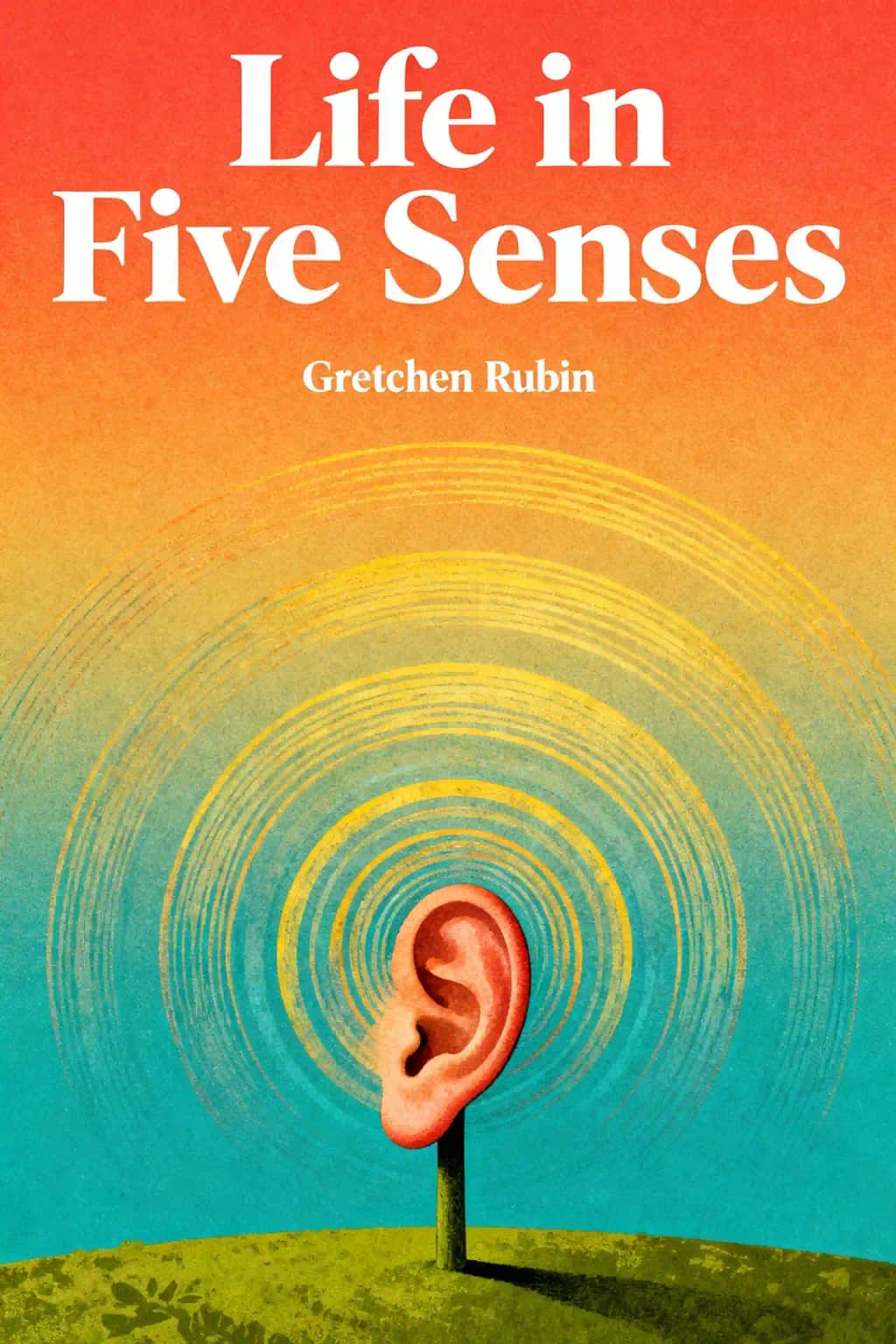
Life in Five Senses
How Exploring the Senses Got Me Out of My Head and into the World
Обзор книги Life in Five Senses
In "Life in Five Senses," bestselling author Gretchen Rubin reveals how reconnecting with our senses pulls us from digital distraction into vivid reality. Featured on Good Morning America, her sensory experiments - like visiting the Met daily for a year - offer a revolutionary path to mindfulness and joy.

Ключевые темы в Life in Five Senses
- sensory awareness
- digital era disconnection
- perceptual psychology
- mindful observation
- physical world engagement
Цитаты из Life in Five Senses
Our brains constantly manipulate what we see.
Our sight is both powerful and fragile.
The goal of all art is the human face.
All art is actually about death, but not in a bad way.
Hearing anchors us in the world.
Персонажи в Life in Five Senses
- Gretchen RubinAuthor and subject of the year-long experiment
- BarnabyThe author's dog who accompanies her on walks
- EleanorThe author's daughter
Об авторе
Об авторе книги Life in Five Senses
Gretchen Craft Rubin, the New York Times bestselling author of Life in Five Senses: How Exploring the Senses Got Me Out of My Head and Into the World, is a leading voice in happiness research, habit formation, and human behavior.
A Yale Law School graduate and former clerk for Supreme Court Justice Sandra Day O’Connor, Rubin pivoted to writing to explore themes of self-improvement and mindfulness. Her work blends personal experimentation with insights from philosophy and science, as seen in her groundbreaking The Happiness Project and Better Than Before, which have sold over two million copies globally in 35+ languages.
Rubin hosts the award-winning Happier with Gretchen Rubin podcast (220+ million downloads) and engages readers through her blog, newsletters, and speaking engagements. Named to Oprah’s SuperSoul 100, her ideas resonate across media, from The Today Show to Jeopardy!
Life in Five Senses builds on her signature approach, offering actionable strategies to deepen everyday joy through sensory awareness.
Скачать резюме книги «Life in Five Senses»
Получите резюме книги «Life in Five Senses» в формате PDF или EPUB бесплатно. Распечатайте или читайте офлайн в любое время.
Часто задаваемые вопросы об этой книге
Life in Five Senses explores how engaging with sight, sound, smell, taste, and touch can lead to a more mindful, joyful life. Gretchen Rubin combines personal experiments, scientific research, and philosophical insights to show how sensory awareness boosts happiness, creativity, and connection. Examples include savoring everyday moments like tasting ketchup or visiting museums to reignite wonder in daily experiences.
This book is ideal for readers seeking practical strategies to combat distraction and deepen their engagement with the world. Fans of Rubin’s previous work on habits (Better Than Before) or happiness (The Happiness Project), as well as mindfulness enthusiasts, will find actionable advice for reconnecting with the physical environment.
Yes—Rubin’s blend of relatable anecdotes, science-backed insights, and simple exercises offers a fresh take on mindfulness. It’s particularly valuable for those feeling mentally disconnected or seeking small, sustainable changes to enhance daily well-being through sensory exploration.
The book frames mindfulness through deliberate sensory engagement, like active listening or mindful tasting. Rubin argues that focusing on physical sensations grounds us in the present, reducing anxiety and fostering gratitude. For example, she describes how curating a playlist of meaningful songs sharpens auditory awareness and elevates mood.
- Sensory curiosity: Treat senses as tools for discovery, not passive inputs.
- Micro-joy: Find wonder in mundane moments, like the texture of a favorite fabric.
- Rituals: Create habits like daily museum visits to nurture sensory engagement.
- Science-meets-practice: Use research on perception to design personal experiments.
Unlike The Happiness Project’s year-long structure or Better Than Before’s habit frameworks, this book emphasizes immediacy—using sensory input as a gateway to joy. It retains Rubin’s signature self-experimentation but shifts focus from internal goals (happiness) to external awareness (sensory immersion).
- Flavor University: Attend workshops to refine taste perception.
- Sensory scavenger hunts: Identify specific smells or textures during walks.
- Playlist curation: Use music to evoke memories or boost energy.
- Art immersion: Observe details in familiar spaces, like museum galleries.
Rubin cites studies on neuroplasticity to show how sensory focus rewires the brain for heightened awareness. She also references philosophy (e.g., Aristotle on perception) and literature (e.g., Proust’s madeleine) to contextualize her experiments, blending empirical and existential perspectives.
Some readers may find its emphasis on small sensory acts overly simplistic for addressing deeper emotional challenges. Others might desire more diverse cultural examples beyond Rubin’s personal experiences (e.g., Metropolitan Museum visits). However, its strengths lie in accessibility and immediacy.
Yes—Rubin suggests shared sensory activities, like cooking together or nature walks, to strengthen bonds. By prioritizing presence (e.g., eye contact during conversations), the book argues that sensory attentiveness fosters empathy and connection.
The book counters screen-heavy lifestyles by advocating for tactile, real-world engagement. Rubin’s strategies—like limiting multitasking during meals—help readers reclaim attention from digital distractions, making it a timely guide for balancing technology with sensory richness.
Rubin links sensory input to creativity, proposing activities like texture collages or scent journals to spark inspiration. By disrupting routine perceptions, these exercises encourage novel thinking—a method she used to reignite her own writing process.