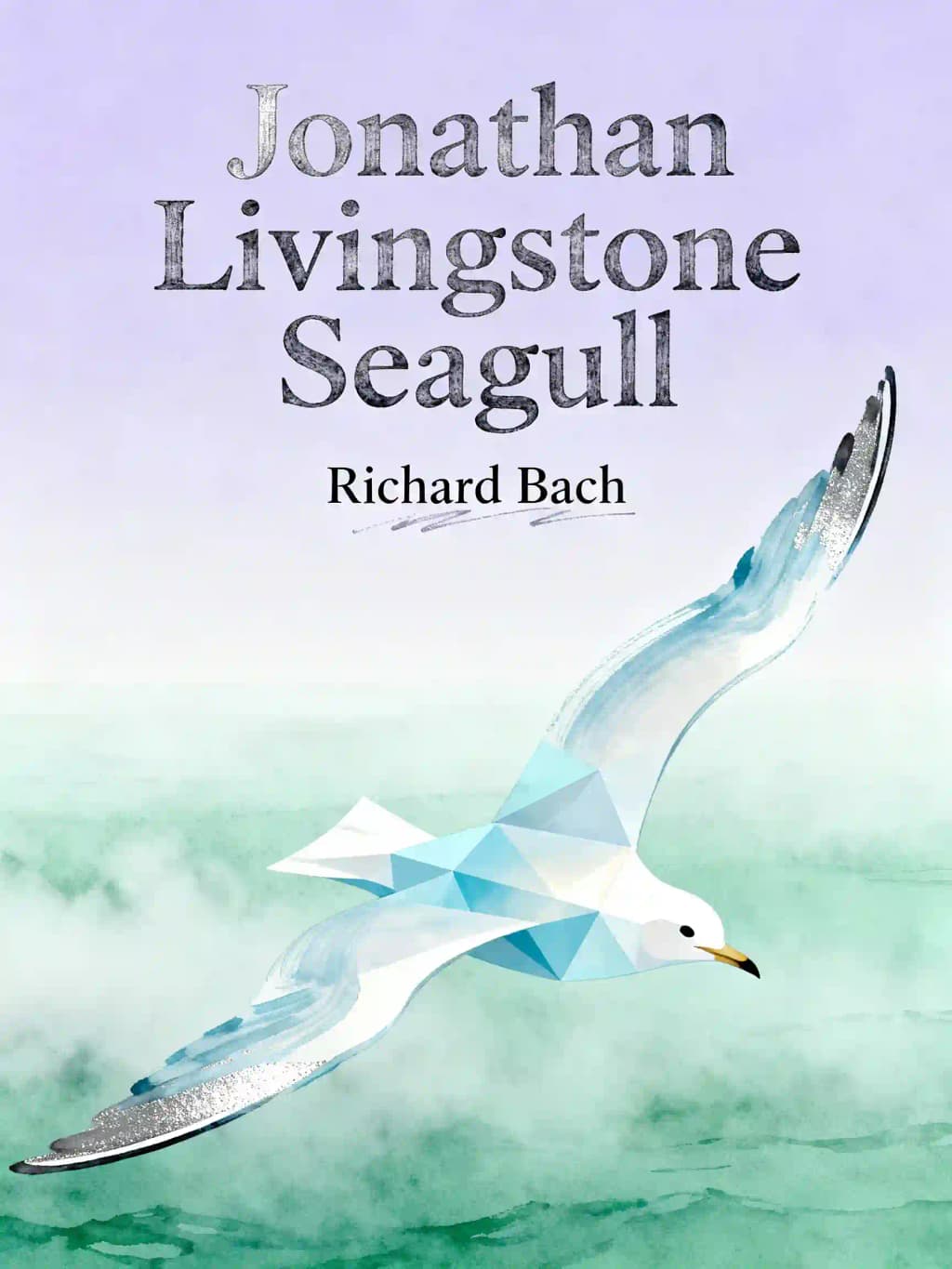
Jonathan Livingston Seagull
Обзор книги Jonathan Livingston Seagull
A seagull's quest for transcendence that sold 44 million copies worldwide. Bach's spiritual masterpiece captivated Ray Bradbury, graced TIME magazine's cover, and became a banned musical - all by asking: what heights could you reach if you dared break from the flock?

Ключевые темы в Jonathan Livingston Seagull
- individual vs society
- mastery of craft
- transcending physical limitations
- pursuit of excellence
- non-conformist philosophy
Цитаты из Jonathan Livingston Seagull
Most gulls don't bother to learn more than the simplest facts of flight - how to get from shore to food and back again - but Jonathan Livingston Seagull made a different kind of gull.
To fly as fast as thought, to fly anywhere that is, you must begin by knowing that you have already arrived.
The only true law is that which leads to freedom.
You have the freedom to be yourself, your true self, here and now, and nothing can stand in your way.
Персонажи в Jonathan Livingston Seagull
- Jonathan Livingston SeagullA non-conformist gull obsessed with flight.
- Richard BachThe author of the novella.
- Jonathan's motherA gull who urges Jonathan to be normal.
Об авторе
Об авторе книги Jonathan Livingston Seagull
Richard David Bach, bestselling author of Jonathan Livingston Seagull, is celebrated for blending aviation passion with philosophical themes. A descendant of composer Johann Sebastian Bach, he draws from his career as a U.S. Air Force pilot, flight instructor, and barnstormer to infuse his works with metaphors of flight and self-discovery.
His groundbreaking novella, a 1970s cultural phenomenon, explores spirituality and nonconformity through the allegory of a seagull’s quest for perfection. Bach’s other notable books include Illusions: The Adventures of a Reluctant Messiah, a philosophical exploration of reality, and The Bridge Across Forever, a memoir on love and soulmates.
A Long Beach State College alumnus, Bach’s articles have graced Flying and Air Facts magazines, cementing his authority in aviation literature. Jonathan Livingston Seagull has sold over 40 million copies globally, been translated into 30+ languages, and inspired a 1973 film adaptation. Nominated for an American Book Award, Bach’s works remain touchstones for readers seeking inspiration at the intersection of flight and metaphysics.
Скачать резюме книги «Jonathan Livingston Seagull»
Получите резюме книги «Jonathan Livingston Seagull» в формате PDF или EPUB бесплатно. Распечатайте или читайте офлайн в любое время.
Часто задаваемые вопросы об этой книге
Jonathan Livingston Seagull is a philosophical allegory about a seagull who rejects conformity to pursue mastery of flight as a form of self-discovery. Exiled by his flock, Jonathan transcends physical limits, learns from enlightened mentors, and returns to teach others about freedom, self-perfection, and breaking societal constraints. The story explores themes of individualism, spiritual growth, and the relentless pursuit of excellence.
This book appeals to readers seeking inspirational stories about personal transformation, spirituality, or nonconformity. Its concise, metaphorical style resonates with self-help enthusiasts, philosophy lovers, and anyone questioning societal norms. Though categorized as fiction, its lessons on perseverance and self-belief make it valuable for entrepreneurs, artists, and lifelong learners.
Yes. Its timeless themes of self-actualization and resilience remain relevant, especially in today’s achievement-driven culture. The 2014 expanded edition, including Part Four, adds depth by critiquing ritualistic conformity, making it timely for discussions about balancing tradition with innovation.
Key themes include:
- Freedom vs. conformity: Jonathan’s exile symbolizes breaking free from societal expectations.
- Self-perfection: Mastery of flight represents pursuing excellence for its own sake.
- Spiritual enlightenment: Mentors like Chiang teach transcending physical limits through mindset shifts.
- Legacy: Returning to share knowledge highlights the importance of mentoring others.
This line, spoken by Jonathan’s mentor Chiang, emphasizes self-belief as the foundation of growth. It encourages readers to act from a place of inherent capability rather than waiting for external validation—a core tenet of mindfulness and manifestation practices.
Flight symbolizes liberation from materialism and societal limits. Jonathan’s aerobatic experiments reflect creativity and curiosity, while his speed records represent pushing boundaries. The flock’s dismissal of his passion mirrors how society often undervalues nonconformists.
Critics argue its message oversimplifies self-actualization, ignoring systemic barriers to freedom. Some find the prose overly sentimental, while Part Four’s added critique of ritualism has been seen as contradicting earlier themes of mentorship.
Both use allegory to explore self-discovery, but The Alchemist focuses on external journeys and destiny, whereas Jonathan emphasizes internal mastery and rebellion. Bach’s seagull achieves growth through solitary practice, while Coelho’s protagonist learns through interconnected relationships.
Fletcher is Jonathan’s first student, representing the next generation of seekers. His near-death experience and resurrection symbolize transformative learning. By the end, Fletcher becomes a teacher, ensuring Jonathan’s ideals endure—a nod to paying knowledge forward.
- Career growth: Pursue skills for passion, not just practicality.
- Resilience: Use rejection as fuel for innovation.
- Leadership: Mentor others without forcing conformity.
The book encourages redefining success on personal terms.
The flock embodies rigid societal norms that prioritize survival over purpose. Their fear of Jonathan’s experimentation mirrors real-world resistance to disruptors. This contrast highlights the cost of conformity and the courage needed to pursue individuality.
Bach, a pilot, infuses his passion for flight into the narrative. His interest in existential philosophy and Eastern spirituality (e.g., Chiang’s teachings) shapes the book’s emphasis on self-transcendence and nonmaterial fulfillment.
Added in 2014, Part Four critiques blind adherence to rituals over practice. Centuries after Jonathan’s teachings, gulls venerate him without flying themselves—a cautionary tale about complacency in institutions like religion or education. Anthony Gull’s rebellion reignites the original spirit of curiosity.





