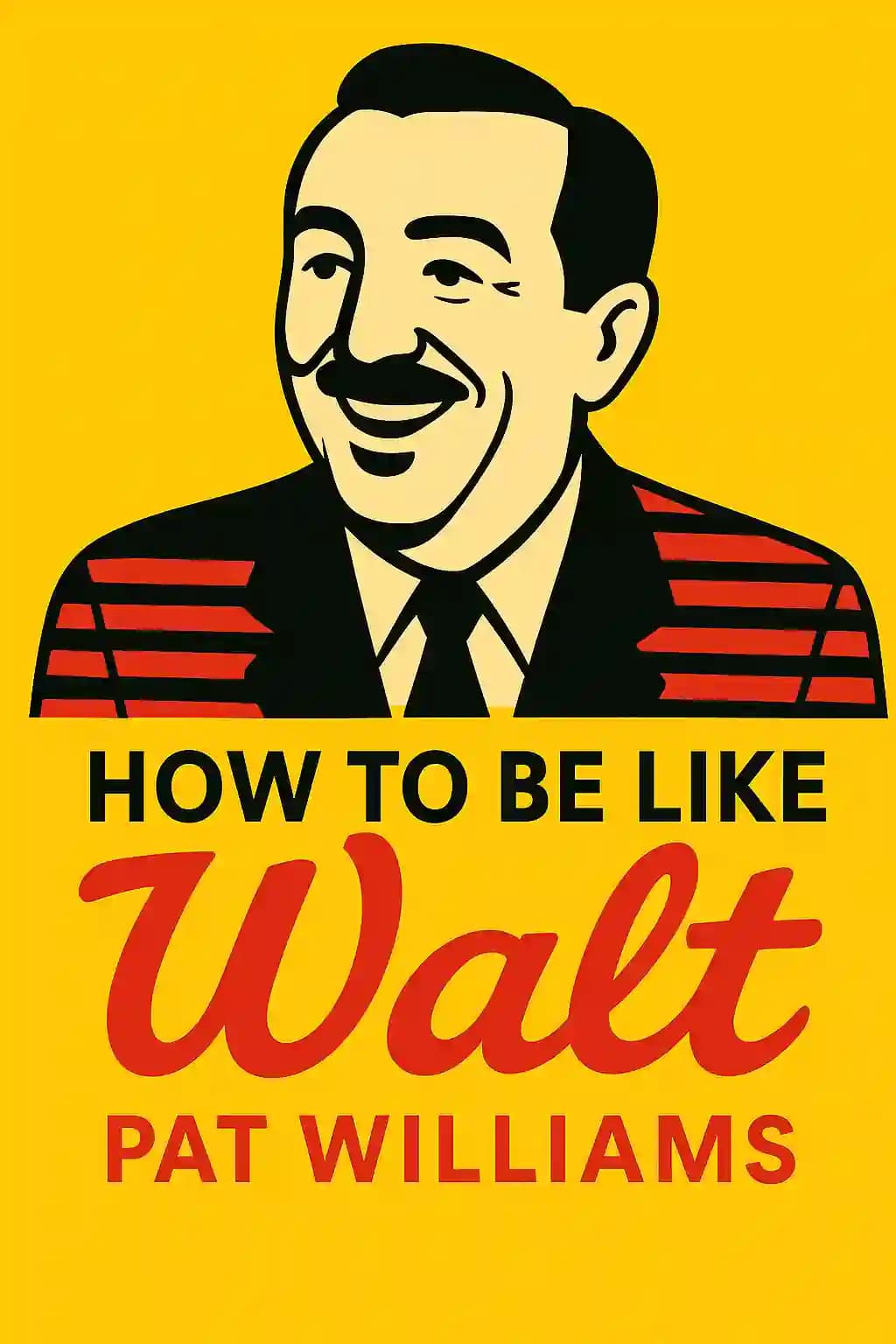
Discover the leadership genius behind the Disney empire. "How to Be Like Walt" reveals the vision, resilience, and creativity that transformed a struggling cartoonist into an entertainment legend. Learn the imagination principles that continue inspiring today's most innovative business leaders.
Pat Williams (1940–2024), co-author of How to Be Like Walt: Leadership Secrets from Disney’s Greatest Creator, was a Hall of Fame sports executive and prolific author on leadership, character, and innovation.
A co-founder of the NBA’s Orlando Magic and former general manager for the Philadelphia 76ers, Williams blended decades of team-building expertise with a passion for studying iconic leaders like Walt Disney.
His books, including Lead Like Walt and Coach Wooden, dissect the principles of visionary leadership through relatable anecdotes and actionable strategies. A Wake Forest University and Indiana University graduate, Williams frequently keynoted on organizational excellence and authored over 30 works spanning faith, cancer survival, and sports biography.
His collaboration with Jim Denney, including Character Carved in Stone and The Mission is Remission, solidified his reputation for merging motivational storytelling with practical wisdom. How to Be Like Walt remains a cornerstone of Disney-inspired leadership literature, reflecting Williams’ lifelong dedication to empowering leaders through historical exemplars.
How to Be Like Walt by Pat Williams explores the leadership principles and life lessons of Walt Disney, blending biography with actionable advice. It highlights Disney’s resilience, creativity, and ability to inspire teams, while offering strategies for embracing imagination, overcoming adversity, and building enduring legacies. Key themes include persistence (“stick-to-it-ivity”), innovation (“plussing”), and learning from failure.
This book is ideal for aspiring leaders, Disney enthusiasts, and professionals in creative or managerial roles. Entrepreneurs will gain insights into visionary thinking, while teams can apply lessons on collaboration. Artists, educators, and career-driven individuals seeking motivation from Walt’s resilience against setbacks will also find value.
Yes, for its blend of biography and practical leadership advice. Pat Williams distills Walt Disney’s philosophies into relatable strategies, such as turning grief into drive and fostering innovation. The book’s focus on perseverance, teamwork, and curiosity makes it a timeless resource for personal and professional growth.
“Plussing” refers to Walt’s practice of enhancing ideas beyond expectations, even in small ways. For example, Disneyland’s design included hidden details guests might never notice, elevating the overall experience. The book urges readers to apply this mindset to projects, relationships, and problem-solving for exceptional outcomes.
Walt faced profound losses, including financial ruin and family tragedies, yet used these challenges as fuel. The book outlines strategies for navigating grief, such as leaning on loved ones, refocusing on long-term goals, and viewing setbacks as temporary. Pat Williams emphasizes persistence and adaptive thinking.
Walt prioritized surrounding himself with talented, passionate individuals (e.g., animators, engineers) and fostering a collaborative culture. The book stresses clear communication, trust, and empowering team members to innovate—principles applicable to modern workplaces and creative projects.
Coined by Pat Williams, “stick-to-it-ivity” describes Walt’s relentless persistence. Despite setbacks like early studio bankruptcies and skepticism about Disneyland, Walt refused to abandon his visions. The book encourages readers to embrace tenacity in pursuing goals, even when faced with doubt or failure.
As an NBA executive and motivational speaker, Williams draws parallels between sports leadership and Walt’s strategies. His experience building teams like the Orlando Magic enriches the book’s lessons on collaboration, goal-setting, and maintaining morale during challenges.
Absolutely. The book’s emphasis on adaptability, innovation, and empathy resonates in today’s fast-paced, tech-driven world. For example, Walt’s “plussing” approach aligns with iterative design in startups, while his resilience mirrors strategies for navigating economic uncertainty or career pivots.
Unlike purely historical accounts, How to Be Like Walt combines storytelling with actionable frameworks, similar to Lead Like Walt (also by Williams). It stands out for focusing on mindset over tactics, making it complementary to books like Atomic Habits or Good to Great.
Some readers note the book idealizes Walt’s legacy without deeply addressing his flaws, such as management controversies. However, its strength lies in distilling actionable principles rather than providing a critical biography. Those seeking a balanced historical analysis may pair it with newer Disney biographies.
Почувствуйте книгу через голос автора
Превратите знания в увлекательные, богатые примерами идеи
Захватите ключевые идеи мгновенно для быстрого обучения
Наслаждайтесь книгой в весёлой и увлекательной форме
Everything Walt achieved in his life was something he was told he couldn't do.
Walt could "sell anything to anyone."
Walt genuinely believed in his ability to overcome any obstacle.
He didn't view imagination as merely an innate talent but as a learnable skill.
Accept the pain of the past...then dream big dreams and chase them with unwavering determination.
Разбейте ключевые идеи How to be like Walt на понятные тезисы, чтобы понять, как инновационные команды создают, сотрудничают и растут.
Погрузитесь в How to be like Walt через яркие истории, превращающие уроки инноваций в запоминающиеся и применимые моменты.
Задавайте любые вопросы, выбирайте свой стиль обучения и создавайте идеи, которые действительно вам подходят.

Создано выпускниками Колумбийского университета в Сан-Франциско
"Instead of endless scrolling, I just hit play on BeFreed. It saves me so much time."
"I never knew where to start with nonfiction—BeFreed’s book lists turned into podcasts gave me a clear path."
"Perfect balance between learning and entertainment. Finished ‘Thinking, Fast and Slow’ on my commute this week."
"Crazy how much I learned while walking the dog. BeFreed = small habits → big gains."
"Reading used to feel like a chore. Now it’s just part of my lifestyle."
"Feels effortless compared to reading. I’ve finished 6 books this month already."
"BeFreed turned my guilty doomscrolling into something that feels productive and inspiring."
"BeFreed turned my commute into learning time. 20-min podcasts are perfect for finishing books I never had time for."
"BeFreed replaced my podcast queue. Imagine Spotify for books — that’s it. 🙌"
"It is great for me to learn something from the book without reading it."
"The themed book list podcasts help me connect ideas across authors—like a guided audio journey."
"Makes me feel smarter every time before going to work"
Создано выпускниками Колумбийского университета в Сан-Франциско

Получите резюме книги «How to be like Walt» в формате PDF или EPUB бесплатно. Распечатайте или читайте офлайн в любое время.
Walt Disney's journey from a humble farm boy to entertainment pioneer wasn't just luck or genius-it was the result of specific qualities anyone might cultivate. Born in 1901 to a stern father and nurturing mother, Walt developed a unique combination of work ethic, integrity, and boundless optimism that would define his life's work. Despite experiencing hardships that would crush most spirits-including harsh discipline from his father and financial struggles-Walt chose to focus on positive memories while learning from painful ones. His childhood in Marceline, Missouri became the nostalgic template for much of his later work, from his love of trains to his vision of small-town America. Most remarkable was Walt's response to adversity: rather than becoming bitter, he channeled difficulties into creative fuel, developing an unwavering belief that anything was possible. As Ray Bradbury later noted, "Everything Walt achieved in his life was something he was told he couldn't do."
In 1928, Walt Disney faced disaster when he lost his character Oswald the Lucky Rabbit and most of his staff to a distributor. Rather than giving up, he created Mickey Mouse on his train ride home - a character that would transform entertainment history. This resilience was typical for Walt, who had previously arrived in California with just $40, a suitcase, and a film reel after earlier business failures following his World War I service. Walt's success stemmed from his genuine enthusiasm and honest salesmanship that made others believe in his vision. His premiere of "Steamboat Willie" as the first synchronized sound cartoon revolutionized animation, with Mickey Mouse becoming Walt's alter ego whose battles against adversity mirrored Walt's own. Disney viewed creativity not as innate talent but as a learnable skill, combining childlike wonder with courage and work ethic to transform his dreams into reality.
Walt Disney combined visionary thinking with practical management skills that transformed creative organizations. After early successes, he learned to balance artistic vision with business realities, forming with his brother Roy one of American business history's most successful partnerships. Walt's exceptional leadership stemmed from seven qualities: vision, communication skills, people skills, good character, competence, boldness, and a servant's heart. He insisted everyone call him "Walt" and dressed casually to create an approachable atmosphere. The studio functioned as a community rather than a hierarchy, with Walt encouraging honest opinions while testing who would stand by their convictions. Despite his admirable character, Walt's occasional harsh temperament was his notable flaw. Yet staff remained loyal for decades because, as animator Paul Carlson explained, "They loved him because they knew he was pulling for them." Walt demonstrated competence through his track record of successes, boldness by repeatedly betting his entire studio on single projects, and servant leadership by personally caring for injured friends, paying for employees' needs, and consistently putting others before himself.
In 1934, despite his success, Walt risked everything on a seemingly impossible dream others called "Disney's Folly." Against advice from both his wife and brother, Walt committed to creating the first feature-length animated film, Snow White and the Seven Dwarfs. When gathering his animators, he performed the entire story, embodying each character through voice and expression, energizing his team to believe in the impossible. Walt's commitment to excellence drove costs skyward - he cut completed sequences that disrupted story flow and invested in revolutionary technologies despite financial concerns. By summer 1937, production costs exceeded a million dollars, exhausting all funds. After a desperate bank loan saved the studio, Snow White premiered to a standing ovation and earned $8.5 million in its initial release. Walt's greatest genius was his boldness in betting everything on his vision - taking calculated risks with incomplete information and persevering until achieving his dreams.
Snow White's success gave Walt only a brief triumph before tragedy struck. In November 1938, his mother Flora died from a gas leak in the home he had purchased for his parents, leaving Walt devastated and blaming himself. Soon after, Pinocchio and Fantasia became artistic triumphs but commercial failures as World War II closed European markets. By 1941, Disney faced financial trouble and labor unrest. Despite creating what he believed was a "worker's paradise" at the Burbank studio, necessary layoffs triggered a bitter strike that wounded Walt deeply. After Pearl Harbor, the studio pivoted to producing government films at cost while losing one-third of animators to the draft. Throughout these challenges, Walt demonstrated remarkable resilience - learning to let go of needing to know why, forgiving himself for circumstances beyond his control, finding meaning in pain, and accepting what couldn't be changed. These qualities enabled his studio to produce masterpieces like Bambi that would only be fully appreciated years later. Walt's ability to weather storms without losing his creative vision exemplifies his greatest strength - transforming setbacks into stepping stones toward greater achievements.
Walt coined the term "plussing" in the 1940s - using "plus" as a verb meaning to improve something beyond expectations. This commitment to excellence defined his approach. When accountants suggested skipping Disneyland's expensive Christmas parade since "nobody's expecting it," Walt replied, "That's just the point. We should do the parade precisely because no one's expecting it. Our goal at Disneyland is to always give the people more than they expect." His battles with brother Roy over expenses became legendary, with Walt insisting, "Roy, we'll make the pictures - you get the money." Walt demanded perfection in even the smallest details, ordering immediate repair of chipped paint and ensuring the Pirates of the Caribbean figures were flawless despite guests passing quickly. This commitment transformed Cinderella and Peter Pan into classics and made Disneyland extraordinary. Walt's insistence on plussing - sometimes adding features, sometimes removing elements that slowed the action - created experiences that turned casual visitors into lifelong fans. Excellence and attention to detail weren't just perfectionism; they created experiences that endure for generations.
Walt Disney embodied a fascinating paradox - deeply nostalgic about the past yet obsessed with tomorrow. He recreated his boyhood Main Street while simultaneously developing Tomorrowland with equal passion. Unlike other Hollywood moguls who feared television, Walt embraced it to promote Disneyland, generate merchandising, and establish himself as "Uncle Walt" to American families. His "Man in Space" series with rocket scientist Wernher von Braun attracted 42 million viewers in 1955, inspiring thousands toward space science careers. Von Braun later told Disney animator Ward Kimball that NASA had followed their script for the Apollo moon landing fourteen years later. Walt's educational initiatives included The Mickey Mouse Club, True-Life Adventures documentaries, and CalArts - an interdisciplinary institution he considered his most important legacy, donating land and 45% of his estate to it. As Ray Bradbury noted, "Walt was a born teacher. Everything he did pointed to a moral or indicated a route for us to take." Walt's greatest gift was inspiring generations to believe in imagination, perseverance, and that dreams can come true.