Глава 1
When the World's Richest 30-Year-Old Imploded
In November 2022, a financial earthquake shook the cryptocurrency world. Sam Bankman-Fried, the disheveled wunderkind who had built a $32 billion crypto empire in just three years, watched it collapse in a matter of days. His exchange FTX, which had sponsored everything from the Miami Heat arena to Major League Baseball umpires' uniforms, suddenly froze customer withdrawals, leaving $8.8 billion in deposits inaccessible. This wasn't just another crypto crash - it was perhaps the most spectacular financial implosion since Bernie Madoff.
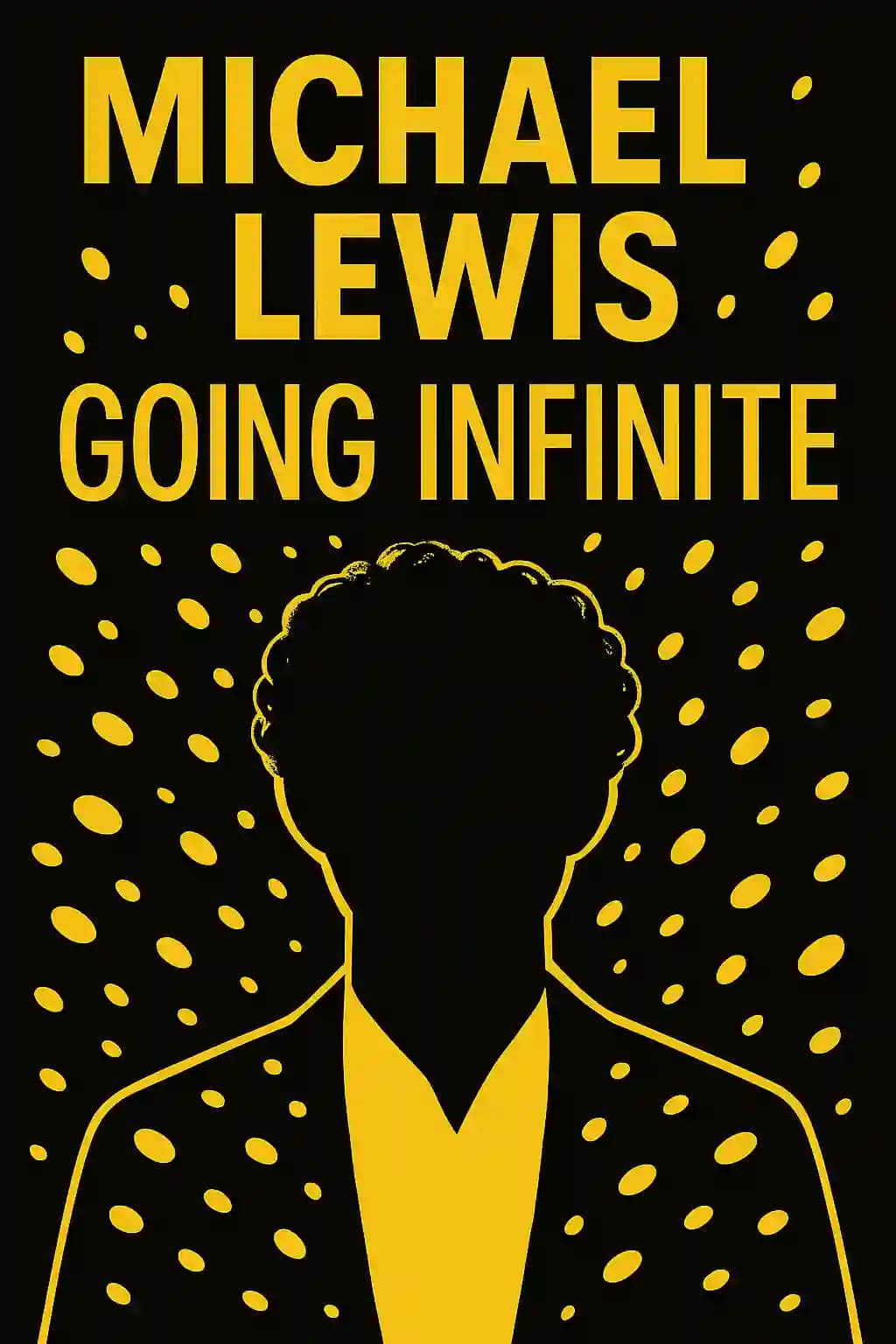
What makes "Going Infinite" so compelling is author Michael Lewis's unprecedented access. Having embedded with Sam for months before the collapse, Lewis delivers an intimate portrait that reads like a psychological thriller. The book has become a cultural phenomenon, with everyone from Wall Street executives to Silicon Valley engineers devouring it to understand how someone so brilliant could create such catastrophic failure. Even before publication, Netflix secured rights for a film adaptation, recognizing the universal fascination with this modern Icarus tale. At its core, this isn't just about cryptocurrency - it's about human psychology, ethics, and what happens when extraordinary intelligence meets profound social disconnection.
Глава 2
The Enigma in Cargo Shorts
Sam Bankman-Fried's interactions with people followed a distinctive pattern. When Anna Wintour invited him to the Met Gala, he responded with his characteristic string of agreeable phrases-"Yup," "Awesome!" "That makes a ton of sense"-leaving her believing he'd committed while he'd decided nothing. Though FTX's marketing team explored options (Louis Vuitton recreating his signature t-shirt and shorts, Tom Ford designing a conventional outfit with $65,000 cufflinks), Sam never truly engaged with the process.
Behind this indecision lay a fundamental disdain for the fashion industry. "There are very few businesses that I have strong moral objections to, and hers is one of them," he confessed. "I actually have disdain for fashion... and the importance that physical attractiveness has." When Sam ultimately declined to attend, Wintour's team was outraged: "They called and shouted and said Sam will never set foot in fashion again!" Unlike other organizations Sam had stood up, including the World Economic Forum, Wintour's people refused to accept that "Sam got to be Sam."
This pattern extended to his childhood recollections. When asked about his early years, Sam offered remarkably little: "I'm a little confused about my childhood. I just can't figure out what I did with it." Despite thirteen years of schooling and growing up with well-known professor parents who hosted intellectually stimulating Sunday dinners, Sam recalled few meaningful relationships or formative experiences.
He had essentially waited for childhood to end, finding it easier to talk with adults than children, though forming deep connections with neither. He had to consciously learn basic social skills: "Smiling was the biggest thing that I most weirdly couldn't do." Rather than automatically responding with expected emotional displays, he questioned their very purpose: "What's the whole point of facial expressions in the first place?"
His one childhood passion was games, particularly Magic: The Gathering, which consumed him from sixth grade onward. The game's unstable, ultimately unknowable nature rewarded adaptation and comfort with uncertainty-qualities Sam possessed in abundance. Through Magic, he formed his one meaningful childhood friendship with Matt Nass, who made "zero social or emotional demands" on him.
Unlike many intellectually isolated teenagers, Sam never embraced selfishness as a philosophy. He found libertarianism's focus on self-interest "unambitious" and was drawn instead to utilitarianism. "Not being super close to that many particular people made it more natural to care not about anyone in particular but about everyone," he explained. At age twelve, he surprised his mother by emerging from his bedroom to make an impassioned defense of utilitarianism, applying this thinking to complex issues like abortion through a framework of consequences rather than rights.
Глава 3
Finding His Game
In fall 2012, during his junior year at MIT, Sam Bankman-Fried's life changed through two nearly simultaneous events. Having lost interest in his physics major, Sam attended an MIT job fair out of growing uncertainty about his future. Though he'd always assumed he'd become a professor like his parents, college had shattered this illusion-lectures bored him to physical pain, and he saw academic life as a series of "canned talks" with little evidence of meaningful world impact.
At the job fair, Sam noticed Wall Street firms seeking different types of candidates. Knowing nothing about trading but feeling "not obviously unqualified," he submitted his resume to trading firms and was surprised when three high-frequency trading companies invited him to interview.
Jane Street's interview process was unlike anything Sam had experienced. They ignored his resume and academic background, instead testing him with progressively complex mental math problems. The in-person interview in New York was even more unusual-a full day of puzzles and games with high stakes: he received 100 poker chips and was warned that anyone who lost all their chips never got hired.
The games were designed to test quick probabilistic thinking under pressure. What struck Sam was how natural these strange games felt to him: "The thing that was surprising about them to me was the lack of things that were surprising." Unlike other candidates who sought perfect information before acting, Sam's instinct was to find "good enough" solutions and adapt quickly.
Jane Street's games weren't normal games but meta-games-games about games. The challenge was understanding what each game actually was. These puzzles tested Sam's ability to make messy judgments quickly with partial information under pressure. While most people's performance deteriorated under time constraints, Sam remained unaffected-he didn't feel emotions that typically clouded judgment.
By day's end, Sam realized Jane Street was testing qualities his mind had never been precisely measured for before. Unlike math or strategic games where he'd been very good but not exceptional, these trading simulations seemed perfectly calibrated to his unique mental abilities. "By the end of the day it was clear that it was by far the best I'd ever done at anything," he said.
In another pivotal event during his junior year, Sam was unexpectedly contacted by Will MacAskill, a 25-year-old philosophy lecturer from Oxford University who had found Sam through his writings on utilitarian message boards. MacAskill introduced Sam to effective altruism, a philosophy that framed career choice as a quantitative moral calculation: how to maximize lives saved during one's 80,000 working hours?
MacAskill's provocative argument focused on comparing direct service careers with high-earning ones. He calculated that an "altruistic banker" could earn enough to fund several doctors in developing countries, thus saving more lives than becoming a doctor directly. This "earn to give" philosophy suggested those with high earning potential had a moral obligation to pursue lucrative careers specifically to donate their earnings.
MacAskill noted these ideas particularly appealed to mathematically-minded young men-"the demographics of a physics PhD program" with "levels of autism ten times the average." After meeting Sam, MacAskill wrote to a colleague that he was "super impressed" by this junior physicist who "was brought up as a utilitarian by his parents" and was "serious, dedicated, and committed to doing good."
Глава 4
The Trading Floor Laboratory
Jane Street's trading floor was a cacophony of deliberately strange sound effects-glass shattering, Homer Simpson's "D'oh!", and video game sounds like Super Mario's "1-Up"-all designed to alert traders to various market conditions. While the noise "drove some people crazy," Sam loved the immersive experience.
The financial markets that would shape Sam had themselves been transformed in recent years. Following the 2008 financial crisis, traditional investment banks became more heavily regulated, while the real trading action shifted to secretive high-frequency trading firms like Jane Street. These largely unknown firms were setting global asset prices and generating unprecedented wealth for their partners.
The new financial markets had peculiar properties-increasingly automated with computers trading with other computers. Speed became the most valuable attribute, with milliseconds of advantage worth billions annually. This "information deforestation" aimed to reduce to zero the time it took for information to register in asset prices. "It's the most complex and efficient game in the world," Sam observed.
At Jane Street, Sam finally addressed his emotional communication issues. He practiced forcing his facial expressions to move in unnatural ways-"physically painful" at first, but gradually becoming easier. "My muscles started to loosen up. And it made people like me more. It made me able to fit in better."
Sam's job was keeping ETF prices aligned with their underlying assets-like ensuring a sandwich's price matched its ingredients. Each morning he spent 90 minutes determining what was inside various ETFs, then provided pricing when investors wanted to trade large blocks. This wasn't simple calculation-he had to consider how his own purchases would move markets, transaction taxes, timing of foreign market openings, and the possibility other traders might front-run him.
Sam approached trading as flipping weighted coins-rarely getting the luxury of 80-20 odds, more typically working with 53-47 advantages. Jane Street's business model relied on hundreds of traders collectively flipping millions of these slightly advantageous coins daily, trusting the law of averages would prevail. "The biggest risk was that we wouldn't find enough coins to flip," Sam explained.
Despite Jane Street's exceptional treatment-hiring his friends and brother, ranking him at the top of his class, and offering astronomical earnings potential ($15-75 million annually within ten years)-Sam remained deeply unhappy. In private writings, he confessed: "I don't feel pleasure. I don't feel happiness. Somehow my reward system never clicked."
After three years at Jane Street without vacation, Sam questioned whether this accidental career maximized his value. In summer 2017, he finally took time off to explore alternatives. While politics, journalism, and effective altruism advocacy all interested him, cryptocurrency markets caught his attention. Despite Jane Street's prohibition against personal crypto trading, Sam noticed the primitive $1 billion daily crypto market operated as if high-frequency trading had never been invented.
Глава 5
The Alameda Experiment
Caroline Ellison, daughter of MIT's Economics Department head and a Stanford graduate, met Sam when he taught her intern class at Jane Street. Despite sharing Sam's background in mathematics and effective altruism, Caroline felt unsure of herself, believing she was merely average at her job. In fall 2017, Caroline reconnected with Sam, who revealed he was secretly building a crypto trading firm. Sam's pitch contrasted Jane Street ("just a place where people come to work each day to play some games and increase the number in their bank account") with his vision for Alameda Research as "a vessel to save some vast number of lives."
The business had actually been Tara's idea, not Sam's. While at Jane Street, Sam had become one of her biggest donors to the Centre for Effective Altruism. Though initially romantically interested in Tara, Sam became more fascinated by her surprising success trading cryptocurrencies despite her lack of financial background. He determined her success wasn't luck but skill in exploiting market inefficiencies, leading him to believe he could make a billion dollars with a crypto hedge fund.
Sam's access to trustworthy effective altruists was his secret weapon, as crypto trading required deep trust to prevent theft. Despite having no management experience and dismissing leadership books as "bullshit," Sam recruited talent starting with Gary Wang, an exceptionally shy MIT coding genius who barely spoke to anyone except Sam. Next came Nishad Singh, his brother's best friend and a committed effective altruist who'd left a $300,000 Facebook job after just five months.
Their early trading was wildly profitable but ethically questionable. They exploited price differences between South Korean and US exchanges by using a Korean graduate student's identity, skirting regulations that prevented moving large amounts of won out of South Korea. The Ripple tokens traded at an even greater premium than Bitcoin, allowing them to make 5% on each trade cycle.
In February 2018, disaster struck when $4 million worth of Ripple vanished during their quarter-million daily trades. While Sam insisted there was an 80% chance the tokens would turn up eventually, the management team panicked, demanding they stop trading to investigate. This disagreement revealed Sam's fundamental approach to uncertainty-he viewed everything probabilistically, refusing to make binary judgments even when millions were at stake.
By April 2018, the management crisis reached breaking point. Crypto prices had crashed, erasing the Asian-US price gaps they'd exploited. Their daily profits of $500,000 turned into daily losses of the same amount. The missing Ripple was the final straw for the management team, who viewed Sam as dangerously incompetent.
The attempted coup revealed bizarre dynamics among these effective altruists. Despite their shared commitment to donate all earnings to the same causes, they fought over money with extraordinary ruthlessness. Investors charged 50% interest rates, Sam refused to share equity, and departing executives demanded millions in severance.
On April 9, half the company walked out with severance payments between one and two million dollars. Investors, uncertain whom to trust, reduced their investments from $170 million to $40 million. Then, remarkably, Sam was vindicated-they found the missing Ripple (a technical incompatibility between exchanges had prevented proper attribution), resumed profitable trading, and formed a tighter, more loyal team around Sam.
Глава 6
The Crypto Wild West
In October 2008, the mysterious Satoshi Nakamoto published the Bitcoin paper, proposing an electronic currency system based on "cryptographic proof instead of trust"-a clear response to the global financial crisis. Bitcoin eliminated the need for banks and governments to control money, appealing to those suspicious of institutional authority while functioning as both financial innovation and social protest.
By 2017, crypto had shifted from idealistic currency replacement to speculative gambling, with hundreds of new cryptocurrencies launching through questionable fundraising. Ironically, a movement founded on eliminating financial intermediaries created 254 new ones-crypto exchanges that required more trust than traditional finance. These unregulated exchanges acted as both trading platforms and custodians of assets, routinely losing customer funds, faking trading data, and falling prey to hackers or manipulative traders.
Despite his fear of flying ("Viscerally I've never believed that a hunk of metal would fly"), Sam traveled to a crypto conference in Macau. There, for the first time, he met major crypto players-many Asian-and revealed his identity and activities beyond his small circle of effective altruists, with powerful effects. Introducing himself as the mysterious trader "Hot-Relic-Fancier" and showing his trading accounts on his phone, Sam gained instant credibility. These face-to-face encounters yielded remarkable results-including the unfreezing of Alameda's account on a Chinese exchange that had previously ignored their calls.
By early 2019, Sam faced a problem: Alameda had generated only $1.5 million for effective altruist causes after expenses and taxes-far below his goals. With crypto markets becoming more efficient as Wall Street firms entered, Sam needed a new approach. He envisioned a crypto futures exchange with innovative features. His design would monitor positions by the second rather than daily, liquidating trades instantly when they went into the red, eliminating the "socialized losses" that plagued other exchanges.
Sam first met Changpeng Zhao (CZ), CEO of Binance, after sponsoring his conference for $150,000. Despite gaining "legitimacy in crypto" through this connection, Sam found little in common with CZ: "Sam lived in his head and thought his way to decisions... If CZ ever had an original thought he never expressed it, and he seemed to feel his way to his decisions." When Sam pitched CZ on paying $40 million for his futures exchange design in March 2019, CZ declined-then created his own futures exchange. Only after this rejection did Sam decide to launch his own exchange, though deeply uneasy about his lack of marketing and customer experience.
Глава 7
The FTX Empire Rises
Sam began assembling a team of people unlike any he'd worked with before-people with strong crypto connections. He recruited Ryan Salame, a "freedom-loving, tax-loathing Republican" who'd moved from tax accounting to crypto trading and become "a walking advertisement for worldly pleasure." Ryan noticed Alameda's trading prowess and Sam's social awkwardness: "You talk to Sam for five minutes and you realize something's different." Sam hired Ryan without a clear job description: "The job description was sort of make it all better."
To fund his exchange, Sam created FTT, a token entitling holders to roughly a third of FTX's annual revenues through "buy back and burn" mechanisms. It functioned essentially as stock in FTX, though it couldn't legally be sold within the United States. Sam initially offered tokens to employees at five cents each and to crypto influencers at ten cents. When FTT launched publicly on July 29, 2019, it opened at $1 and quickly rose to $1.50, making early buyers like Ryan Salame thirty times their money. Within weeks, CZ offered to buy a 20% stake in FTX for $80 million-revealing just how underpriced the initial token offering had been.
Sam's timing and location proved perfect, though accidental. He'd built "a casino that offered gamblers the chance to make bets bigger than their bank accounts justified," exactly when professional traders were entering crypto markets. Hong Kong provided regulatory flexibility while teaming with ambitious young people willing to join a crypto exchange run by "a person who was all but unknowable." Sam embraced hiring inexperienced people, making Natalie Tien head of PR and Constance Wang COO despite limited backgrounds. "It's a moderately bad sign if you are having someone do the same thing they've done before," Sam reasoned.
The boundaries between Alameda Research and FTX were perpetually blurred. Though legally separate, both companies were primarily owned by Sam, shared the same office space, and freely transferred funds between them. Alameda covered FTX's $5-10 million startup costs, while FTX sold FTT tokens and directed capital to Alameda's trading operations. Sam retained 90% ownership of Alameda (with Gary owning 10%) and over 50% of FTX after the VC investments.
As FTX grew, Sam struggled to find qualified people willing to work at Alameda rather than the more promising exchange. Eventually, he appointed two co-CEOs at Alameda: Sam Trabucco, who quickly "checked out" after his promotion, and Caroline Ellison, who ended up managing both people and trading risks while maintaining a complicated romantic relationship with Sam.
Глава 8
The Billionaire's Peculiar Mind
George Lerner, a psychiatrist who became the world's leading authority on effective altruists, found himself at the center of Sam and Caroline's relationship. After treating waves of lawyers and tech executives, George began seeing crypto enthusiasts around 2017. When effective altruists started arriving, beginning with Gabe Bankman-Fried and soon including Caroline and eventually Sam, George found their logical approach to emotions fascinating. Unlike his other patients, EAs didn't want empathy; they wanted to minimize feelings that interfered with their utilitarian calculations.
George found EAs fascinating-brilliant young people who approached life decisions with mathematical precision. They judged actions solely by consequences, often struggling to connect with individual people while professing care for "humanity" in the abstract. They brought rigorous logic to emotional decisions like whether to have children, with many choosing not to have kids because parenting would reduce their world impact.
Sam sought a new therapist after previous ones failed to accept his self-descriptions-his decision never to have children, his absence of feelings, his inability to feel pleasure (anhedonia). What he appreciated about George was that George took him as he was without pointless conversations about feelings Sam had long deemed "unsolvable." Sam didn't need therapy for himself-though he did need medication prescriptions-but found George useful for solving other people's problems. "Sam never wanted to talk about himself," George noted. "All we ever talked about was business."
By late summer 2021, Sam needed to relocate FTX from Hong Kong. After ruling out numerous locations, they discovered the Bahamas-which had new crypto regulations, great internet via undersea cable from Florida, neutral taxes, and abundant empty office space and luxury condos. When Sam visited, he met with the newly elected prime minister who confessed, "Sam, we're broke."
Sam was far from broke. Alameda Research had transformed from borrowing at loan shark rates to accessing $10-15 billion at rates as low as 6%. Trading profits soared from $50 million in 2018 to $1 billion in both 2020 and 2021. His Solana token investment-purchased at 25 cents each-had rocketed to $249 per token, with his 15% stake theoretically worth $12 billion. His FTT token holdings and equity in FTX (valued at $38 billion after VCs paid $2.3 billion for just 6%) made him, according to Forbes, the richest person under thirty in the world.
Despite his wealth, Sam pursued an unexpected strategy: establishing FTX as the world's most regulated, law-abiding crypto exchange. This approach contrasted sharply with Binance, whose founder CZ had fled to Dubai (which had no US extradition treaty) and often ignored regulations. Before implementing his regulatory plan, Sam needed to buy out CZ's $80 million stake in FTX, ultimately paying $2.2 billion plus an additional $75 million that CZ demanded at the last minute.
Глава 9
The Emperor's New Clothes
Sam's empire operated with virtually no checks and balances. When questioned about corporate governance, he dismissed conventional structures as unnecessary formalities. His board of directors consisted of just three people whose names he couldn't even recall, joking that "the main job requirement is they don't mind DocuSigning at three a.m." Despite pressure from venture capitalists to hire a serious CFO, Sam rejected the idea: "What the fuck do you think I do all day? You think I don't know how much money we have?" His brief experiment with hiring executives over 45 had failed because "all they did was worry" about regulatory concerns and tax implications that Sam considered low-probability risks not worth his time.
Sam's financial decisions were fragmented and impulsive, with no single person having a complete picture of his investments. In just three years, he deployed roughly $5 billion across 300 separate investments-averaging a new decision every three days, often with minimal deliberation. These ranged from crypto tokens like Solana to traditional companies like Anthony Scaramucci's SkyBridge. The money typically came from Alameda Research, which everyone considered Sam's private fund.
Despite his casual approach to business governance, Sam meticulously planned his political influence, allocating hundreds of millions for public policy. His spending fell into three categories: a small portion for crypto-friendly legislation, and two larger buckets for causes he believed would change the world. His political operation determined that primaries offered better return on investment than general elections, calculating that $1 million in a close congressional race gave them a one-in-five chance of success.
The effective altruism movement had transformed since Will MacAskill first convinced Sam to "earn to give" in 2012. No longer focused primarily on saving existing human lives, they now prioritized reducing existential threats to humanity's future. Toby Ord's book "The Precipice" had calculated the odds of various extinction scenarios-stellar explosion (one in a billion), asteroid strike (one in a million), nuclear war or climate change (one in a thousand), man-made pathogens (one in thirty), and most alarmingly, artificial intelligence (one in ten).
After distributing $30 million in 2021, FTX's philanthropic wing planned to give away $300 million in 2022 and $1 billion in 2023. Finding conventional philanthropy inefficient, they'd adopted a novel approach: identifying subject matter experts and giving them unrestricted $1 million grants to distribute as they saw fit. "We try not to be very judgy once they have the money," Sam explained. For Sam, this philanthropy game operated on a tight clock-he believed most people accomplished little after age forty, giving him perhaps ten to fifteen years to generate hundreds of billions to save humanity from extinction. As it turned out, he had just five weeks.
Глава 10
The House of Cards Collapses
The collapse began with a dustup between Sam and CZ in late October 2022. After an awkward encounter at a conference in Riyadh, Sam flew to Dubai where he told regulators he couldn't base FTX in the same place as Binance, claiming CZ "soiled the reputation" of wherever he operated. Days later, Sam tweeted a jab about CZ's inability to influence US regulations. Then on November 2, CoinDesk published a leaked document showing Alameda Research held $14.6 billion in assets with a third being FTT tokens.
While FTX insiders weren't initially alarmed, CZ seized the moment, announcing on November 6 that Binance would liquidate its $500 million FTT holdings. Caroline's tweet offering to buy CZ's tokens at $22 backfired spectacularly, triggering market speculation that Alameda needed to maintain that price level. Within days, FTT collapsed from $22 to $7, and customers withdrew $5 billion from FTX, which couldn't meet the demand.
The math was simple: FTX should have had $10 billion remaining of customer deposits, but most had vanished into Alameda's investments that couldn't be quickly liquidated. What remained of Alameda's holdings was mostly illiquid: FTT tokens, Solana tokens, various crypto tokens, $300 million in Bahamas real estate, and Sam's venture investments including Twitter.
On November 6, Sam urgently summoned Ramnik to his Albany unit. Ramnik was confused-he thought Sam was in Florida watching Tom Brady play, and he didn't know why Sam needed money so desperately. At Sam's place, he found only effective altruists: Nishad in the living room, Caroline on video, and Sam retreating to his bedroom. Caroline seemed clueless about Alameda's finances, surprisingly announcing discoveries of hundreds of millions as if finding them for the first time. They needed to raise $7 billion fast, but offered only fuzzy explanations for why the hole existed in the first place.
In desperation, Sam called his nemesis CZ, who initially agreed to acquire FTX minus its US operations in exchange for assuming its liabilities. The deal gave Binance rights to inspect FTX and Alameda's books. But by Wednesday, November 9, CZ tweeted that he was backing out after due diligence. This triggered a mass exodus from the Bahamas. By Friday, Nishad had fled, $450 million in crypto had mysteriously vanished from FTX wallets, and Bahamas financial regulator Christina Rolle had frozen FTX's assets while taking Sam's and Gary's passports rather than arresting them.
Глава 11
Aftermath: Searching for Answers
After FTX's collapse, investigators created a crude financial statement for "Sam's World"-treating FTX and Alameda as a single entity. The numbers showed approximately $23.3 billion had entered Sam's empire (including $15 billion in customer deposits, $2.3 billion from VCs, and trading profits), while only about $14.4 billion had exited (including $5 billion returned during the November run, $4.4 billion in private investments, and $1.4 billion to CZ).
This left nearly $9 billion unaccounted for. With $3 billion still on hand when FTX stopped withdrawals, roughly $6 billion remained missing. When pressed, Sam revealed one piece of the puzzle: FTX had secretly lost about $1 billion to hackers. The largest hack occurred in March-April 2021, when a trader cornered the market in two thinly traded tokens, inflating their prices to borrow valuable crypto against them before disappearing with $600 million.
Sam's explanation to Constance was that customer funds had ended up in Alameda through two channels. First, Alameda had borrowed from FTX using FTT tokens as collateral, which became worthless when FTX collapsed. Sam claimed Alameda had been exempted from FTX's risk limits back in 2019 because it was the exchange's biggest trader and needed flexibility to maintain market liquidity.
The more significant issue was the "fiat@" account containing $8.8 billion in customer funds. Sam claimed this account had been established in 2019 because FTX couldn't get its own bank accounts, so customer deposits went through Alameda instead. According to Sam, these funds simply never moved out of Alameda even after FTX established banking relationships with Silvergate Capital in July 2021. He insisted he wasn't managing Alameda-Caroline was-and that when Alameda's net asset value reached $100 billion in late 2021, the $8.8 billion didn't seem concerning: "It felt to us that Alameda had infinity dollars."
On December 12, Bahamian police arrived at the Orchid penthouse with a warrant for Sam's arrest. Just an hour earlier, Sam's lawyers had informed him that the US government was giving him an ultimatum: return voluntarily to the United States or face arrest in the Bahamas. As he was handcuffed, Barbara switched from arguing about his testimony to insisting he change out of his cargo shorts for jail-a battle Sam refused to concede.
Six months into the asset recovery, bankruptcy administrator John Ray had collected approximately $7.3 billion in liquid assets, with potential for at least $2 billion more from intelligent sale of the remaining portfolio. This suggested the answer to where the money went was simply: nowhere. It was still there. The most spectacular financial collapse of the crypto era may have been as much about incompetence and negligence as it was about fraud-a distinction that would ultimately be decided in the courts.