Глава 1
A World of Fire, Magic, and Betrayal
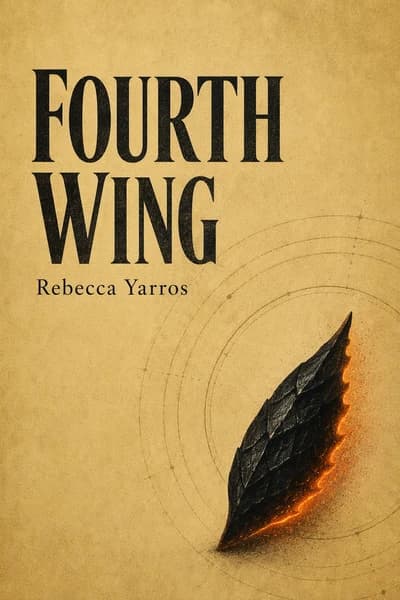
Fourth Wing has taken the literary world by storm, becoming TikTok's runaway book sensation of 2023 with over 2 million copies sold in its first year. Rebecca Yarros' fantasy masterpiece has captivated readers worldwide, including celebrities like Reese Witherspoon who featured it in her book club. The novel's meteoric rise parallels the trajectory of its protagonist-unexpected, powerful, and impossible to ignore. What makes this story particularly fascinating is Yarros' background as a military spouse whose experiences with deployment and sacrifice inform the novel's emotional core. As readers devour this first installment in the Empyrean series, Hollywood has already secured film rights, promising to bring this richly imagined world of dragons and dangerous magic to screens soon. But what exactly makes this story so addictive that readers can't put it down?
Глава 2
The Brutal World of Basgiath War College
In the kingdom of Navarre, twenty-year-old Violet Sorrengail arrives at Basgiath War College on Conscription Day with a death sentence hanging over her head. Unlike other candidates eagerly choosing their quadrants, Violet envies those entering the Scribe Quadrant-where she belongs with her scholarly mind and physical limitations. Her asthma and tendency to freeze under pressure make her particularly ill-suited for the path ahead. Instead, her powerful mother, General Sorrengail, has forced her into the deadly Riders Quadrant, where cadets either graduate bonded to dragons or die trying. The General's iron will and determination to maintain the family's military legacy leave Violet with no choice but to comply, despite knowing her chances of survival are slim.
The brutality of this world becomes immediately apparent when Violet faces her first test-crossing a treacherous parapet in stormy conditions. The ancient stone walkway, slick with rain and worn smooth by centuries of use, stretches between towers hundreds of feet in the air. When fellow candidate Dylan falls to his death attempting the crossing, his screams echoing off the castle walls before being suddenly silenced, the reality sinks in: this is a place where nearly twenty percent of candidates die on the first day alone. The instructors don't even pause to acknowledge the loss, treating it as merely the first of many inevitable casualties. Those who survive face years of challenges where only about a quarter will live to graduation, their bodies and spirits tested beyond normal human limits.
What makes Basgiath so compelling is its unapologetic harshness. There are no safety nets, no second chances, and certainly no mercy for those who show weakness. The college operates on a simple principle: only the strongest, smartest, or most adaptable survive. This creates an environment of "fatalistic hedonism and brutal military efficiency" where cadets form intense bonds knowing any day could be their last. Many turn to reckless behavior and passionate affairs, living each moment as if it were their last. The world-building is immersive and visceral-you can feel the stone beneath your feet on the parapet crossing and hear the thunderous roar of dragons landing on the citadel walls. The ancient fortress itself seems alive with history, its weathered stones holding centuries of similar stories of triumph and tragedy. The constant presence of dragons adds another layer of danger, their massive shadows passing overhead serving as a reminder of both the power cadets seek to harness and the deadly price of failure.
The college's four quadrants - Riders, Soldiers, Healers, and Scribes - each present their own unique challenges and mortality rates, but none more so than the Riders. Their training grounds are marked by scorch marks and memorial plaques, silent testimonies to those who came before and failed. The dining hall's walls are adorned with portraits of graduates, but it's the spaces between them - the gaps where portraits might have been - that tell the true story of Basgiath's merciless nature.
Глава 3
Dangerous Alliances and Deadly Enemies
From her first day, Violet faces threats from all directions in the brutal world of the quadrant. Her most dangerous enemy emerges in Xaden Riorson, a formidable third-year cadet whose father orchestrated the rebellion that killed Violet's brother. As son of the "Great Betrayer," Xaden bears the distinctive "rebellion relics" - dark markings etched into his skin that publicly brand him as a traitor's child. Despite this stigma, he has clawed his way to the powerful position of wingleader through sheer skill and determination. When Violet's squad is unexpectedly transferred to Xaden's Fourth Wing, she finds herself directly under his command-at the mercy of a man whose family history gives him every reason to want her dead.
Fellow first-year Jack Barlowe represents an immediate and visceral threat, attempting to murder Violet during a treacherous crossing of the parapet - a narrow walkway suspended hundreds of feet in the air. After she manages to survive and publicly humiliate him, Barlowe's vendetta becomes personal, transforming him from a mere bully into a calculated enemy watching for any opportunity to strike. The constant danger forces Violet to carefully cultivate strategic alliances, including strengthening her bond with childhood friend Dain Aetos, now a second-year rider with a bonded dragon who provides both protection and valuable insider knowledge of quadrant politics.
What elevates these relationships beyond typical fantasy rivalries is the intricate web of political tensions underlying every interaction. The rebellion that claimed Violet's brother left deep, festering societal wounds that continue to divide the quadrant's population. Children of rebels are permanently marked with "rebellion relics" and forced into military service as both punishment and control measure. This creates a fascinating social dynamic where personal vendettas intertwine with political loyalties and family histories, making every interaction fraught with hidden meanings and potential betrayal. Even simple training exercises become complex political maneuvers, with alliances shifting as quickly as the winds that carry the dragons.
The dragons themselves add another lethal layer of danger and alliance to this complex web. Far from being mere mounts or military assets, they're highly intelligent, deeply judgmental beings with their own complex hierarchies, preferences, and ancient grudges. Their loyalty, once earned, is absolute - but their wrath is equally absolute. This becomes horrifyingly clear when three terrified cadets attempt to flee after their first dragon encounter. Their attempt at desertion is met with immediate and brutal dragon fire, their bodies reduced to ash before they can even reach the gates - a stark reminder that to these ancient creatures, humans are often nothing but prey. The dragons' unpredictable nature means that even those with seemingly secure positions must constantly prove their worth or risk a fiery death.
The social hierarchy within the quadrant reflects this dangerous reality, with riders and their bonded dragons forming tight-knit units that function as both military squadrons and political factions. Success requires navigating both human and dragon politics, with failure in either realm potentially proving fatal.
Глава 4
Survival Through Cunning and Strategy
Despite her physical limitations, Violet refuses to become another name on the death roll at the Academy. She turns to her greatest strengths-her intelligence and resourcefulness-to survive in a system designed to eliminate her. Her approach to survival demonstrates a sophisticated understanding of how to leverage knowledge against brute force, particularly in her masterful use of botanical warfare. When faced with combat challenges against physically stronger opponents, Violet systematically poisons them using her extensive knowledge of herbs and plants, cultivated during her years helping at her mother's apothecary shop. She slips fonilee berries into Oren Seifert's eggs, causing him to vomit during their match; uses leighorrel mushrooms to cause hallucinations in another opponent; and employs nightshade derivatives to induce temporary weakness in a third. Each poison is carefully measured to incapacitate but never kill, showing both her expertise and her moral boundaries.
This strategy reveals Violet's core character: she's not trying to play by the established rules of strength and aggression-she's creating her own game where her intelligence becomes her weapon. Her methods challenge the Academy's traditional metrics of worth, proving that combat prowess isn't limited to physical dominance. It's a compelling subversion of typical fantasy hero tropes, showing that survival doesn't always go to the strongest, but often to the smartest. Her approach also highlights the often-overlooked value of traditionally feminine knowledge like herbalism in a martial setting.
When faced with the seemingly impossible Gauntlet obstacle course, Violet again relies on creative thinking and careful preparation. Unable to climb the chimney formation due to her height, she uses a rope woven from stolen practice dummy stuffing to overcome it. For the water pit, she develops a floating mechanism from hollowed-out gourds. For the final ramp, she unsheathes her ceremonial dagger and uses it to propel herself upward-citing the Codex rule that "any item carried across the parapet is considered part of the rider." Her meticulous study of the Codex reveals numerous such loopholes, demonstrating that rigid systems can be overcome through flexibility and creative interpretation of rules.
What makes this aspect of the story particularly engaging is how it validates different forms of strength and intelligence. As Professor Kaori tells Violet, "Not all strength is physical-the mind can overcome any obstacle if properly applied." This theme resonates throughout the novel as Violet repeatedly outsmarts those who underestimate her, from fellow students to instructors. Her success challenges the Academy's traditional definition of warrior-hood and suggests that true strength lies in adaptation and innovation rather than mere physical prowess. Through Violet's journey, we see how intelligence, preparation, and strategic thinking can triumph over seemingly insurmountable odds.
Глава 5
The Unexpected Bond with Dragons
The novel's most transformative moment unfolds during Threshing-an ancient ritual where first-year cadets venture into the sacred forest hoping to form lifelong bonds with dragons. While other cadets aggressively pursue powerful combat dragons like Windweaver and Stormscale breeds, Violet finds herself in an unexpected situation that reveals her true character. Limping on an injured ankle from earlier training, she discovers a small golden feathertail dragon cornered by Jack and his gang of elite cadets who view the creature as worthless due to its diminutive size and perceived lack of combat potential.
Despite her physical disadvantage and social isolation, Violet instinctively positions herself between the attackers and the defenseless dragon. Her stance is not one of aggression but of quiet determination, demonstrating the kind of innate compassion that traditional warrior training often overlooks. This seemingly simple act of protection triggers a cascade of unprecedented events that reshape the entire dragon rider hierarchy.
The massive black dragon Tairneanach (Tairn) emerges from the shadows like a living piece of midnight, initially appearing to defend the golden dragon. However, in a moment that leaves even the instructors speechless, Tairn chooses to bond with Violet. The significance of this cannot be overstated - Tairn is a legendary Morningstartail whose previous rider died in a tragic attempt to resurrect Violet's brother. Even more extraordinary, the small golden dragon Andarnaurram (Andarna) also forms a bond with Violet, making her the first rider in recorded history to simultaneously connect with two dragons.
This dual bond catapults Violet from social outcast to a position of unprecedented potential. Each dragon brings unique abilities: Tairn possesses immense physical power, magical strength, and centuries of wisdom, though his power comes with the weight of historical tragedy and danger. Andarna, while physically small, harbors the extraordinarily rare ability to manipulate time itself - a power that hasn't been seen in generations of riders.
The mental and emotional connections between Violet and her dragons prove particularly fascinating. Unlike traditional rider-dragon bonds, which are often described as simple magical links, these relationships develop into complex emotional partnerships. The dragons communicate directly into Violet's consciousness, their distinct personalities emerging in every interaction. Tairn's ancient wisdom comes wrapped in layers of sarcasm and dark humor, while his protective instincts often manifest as gruff advice. Andarna, despite her small stature, reveals herself to be fiercely loyal and surprisingly assertive, especially when it comes to Violet's safety or matters of the heart.
The physical manifestation of these bonds appears as magical signets on Violet's back - a black dragon intertwined with a golden silhouette, marking her as unique even among the already elite dragon riders. These marks become both a blessing and a burden, symbolizing her unprecedented power while also making her a target for those who fear change in the rigid hierarchy of dragon riders. The dual bond sets Violet on an uncharted path, challenging centuries of tradition and forcing both riders and dragons to reconsider what they thought possible in their ancient order.
Глава 6
A Forbidden Romance in the Midst of War
Despite their initial animosity, the attraction between Violet and Xaden becomes increasingly undeniable. Their relationship evolves from mutual distrust to grudging respect to passionate desire. What makes their connection particularly compelling is how it defies all logic-they should be enemies given their family histories, yet they're drawn to each other with an intensity neither can resist.
Their first kiss occurs during training, when Xaden pins Violet against a wall. Though he dismisses it as "a mistake" and a "colossal blunder," their chemistry continues to build through training sessions that often end with them in compromising positions. The tension reaches its breaking point on Reunification Day-the anniversary of Xaden's father's execution-when Violet seeks him out on the parapet where they first met.
In a moment of vulnerability, she confesses: "I'm so wildly in love with you that I can't imagine what my life would even look like without you in it." Their passionate encounter literally shatters windows as Violet's emerging lightning powers surge with her emotions, creating a physical manifestation of their explosive connection.
What elevates this romance beyond typical fantasy love stories is how it's inextricably linked to the larger political conflict. Their dragons, Tairn and Sgaeyl, are mated pairs that cannot be separated for long, forcing Violet and Xaden together despite the dangers. Their relationship challenges both personal and political loyalties, raising questions about whether love can transcend the divisions of war and rebellion.
The romance also serves as a catalyst for Violet's growth. Through Xaden, she begins to question the official narratives she's been taught and discovers strengths within herself she never knew existed. Their relationship becomes a mirror reflecting the larger themes of the novel-trust, betrayal, and the possibility of redemption.
Глава 7
The Manifestation of Power and Its Price
Throughout the novel, Violet struggles with her inability to manifest a signet power-the magical ability that emerges when a rider bonds with a dragon. While her siblings demonstrated extraordinary abilities early in their training-her sister's healing touch and her brother's earth-moving capabilities-Violet's power remains dormant despite her unprecedented dual dragon bond. This absence of power becomes a source of deep-seated insecurity, particularly given her family's prestigious lineage and her already controversial status as the first rider to bond with two dragons.
The power finally emerges during the War Games' crucial tournament battle, triggered by a moment of profound crisis. When Jack Barlowe, driven by jealousy and ambition, deliberately stabs Liam and sends him plummeting from his dragon hundreds of feet in the air, Violet's emotional dam breaks. Consumed by raw fury and desperate fear for Liam's life, she manifests lightning-an extremely rare and destructive signet not seen in generations. The power erupts from her hands in brilliant white-blue arcs, destroying an ancient stone tower and causing an avalanche that kills Jack Barlowe instantly.
This devastating moment marks a turning point for Violet, forcing her to confront multiple harsh realities. Beyond taking a life, she must grapple with wielding a power that makes her both invaluable and dangerous to the kingdom. The competing advice she receives reflects this duality: Dain, her mentor, advocates for complete suppression of the power, fearing its destructive potential, while Xaden sees it as a strategic advantage, declaring her "not just a weapon, but THE weapon" that could defend the entire kingdom against mounting threats.
The manifestation of power extracts significant costs. Each use of her lightning leaves Violet physically drained, with symptoms ranging from severe exhaustion to temporary paralysis. The emotional burden proves equally heavy-nightmares of Jack's death haunt her, and the knowledge that she can end lives with a thought fundamentally changes her self-perception. Yet paradoxically, this power also represents liberation. It validates her place among the riders and proves that her physical limitations-her small stature and perceived weakness-don't define her capabilities.
The story's exploration of power and responsibility becomes particularly nuanced as Violet navigates these complexities. She must learn to control her abilities through rigorous training sessions, often ending in failure and frustration. The choice of when to use her power becomes increasingly political, as various factions seek to influence or control her abilities. Through this journey, Violet's evolving relationship with her power mirrors her character development-from viewing it as a burden to understanding it as a tool that, like any other, can be used for both protection and destruction.
Глава 8
The Shocking Truth Beyond the Wards
The novel's most dramatic revelation comes when Xaden takes Violet beyond Navarre's protective wards for what she believes is a routine War Games exercise. The journey itself is fraught with tension, as they travel through increasingly desolate landscapes that bear silent witness to violence Violet never knew existed. There, she discovers the shocking truth: venin-dark wielders, creatures she believed were mere folklore used to frighten children, are terrifyingly real and systematically attacking villages outside Navarre's borders. These beings, with their shadow-like forms and ability to corrupt living things with a single touch, have been deliberately erased from official records.
Even more devastating, Xaden reveals his role in a vast underground resistance movement. He has been secretly supplying weapons and tactical support to fight the venin, working alongside the gryphon riders - the very people Violet and all of Navarre have been taught to revile as enemies of the state. The resistance includes a network of healers, fighters, and even some former Navarre military personnel who couldn't stomach the kingdom's isolationist policies.
This revelation shatters Violet's understanding of her world on multiple levels. The kingdom she's sworn to protect not only knows about these attacks but actively chooses to do nothing, hiding behind their protective wards while outer villages fall. The reason is both practical and horrifying: the same material powering their protective wards - the precious wardstone - is the only substance capable of killing venin. Rather than share this resource, Navarre hoards it, effectively condemning thousands beyond their borders to death. As Xaden explains with bitter wisdom, "Lies are comforting. Truth is painful."
The web of deception extends deep into personal betrayals. Violet discovers that everyone in Xaden's elite squad carries rebellion relics - marking them all as children of separatists. These items, from simple medallions to elaborate weapons, each tell a story of families torn apart by Navarre's policies. Even more shocking, her own dragons, whom she thought she knew completely, have been aware of these secrets all along, bound by ancient pacts that transcend human politics.
The most earth-shattering revelation comes after Violet is poisoned by a venin's dagger during an attack. Taken to Aretia - a city officially recorded as destroyed in the last war - she finds it thriving as a hidden sanctuary for the resistance. There, she discovers her brother Brennan, whose supposed death she has mourned for years, is not only alive but serves as a key leader in the revolution. His survival and chosen path force her to confront everything she believed about her family's history and loyalty to the crown.
These cascading revelations are particularly powerful because they force both Violet and the reader to question the very foundation of their moral certainties. The clear lines between good and evil, loyalty and betrayal become hopelessly blurred. The kingdom Violet has faithfully served reveals itself as morally bankrupt, protecting its citizens through a policy of deliberate ignorance and indirect genocide. Meanwhile, the "traitors" she was taught to hate emerge as complex figures fighting for a greater good, willing to sacrifice everything to protect those abandoned by Navarre's isolationist policies.
The novel concludes with this moral complexity deliberately unresolved. As Brennan welcomes Violet to "the revolution," she - and by extension, the reader - must grapple with fundamental questions about justice, loyalty, and what side of history they truly want to stand on. The choice before her is not simply between right and wrong, but between comfortable lies and difficult truths, between duty to one's kingdom and duty to humanity as a whole.
Глава 9
The Cost of Survival and the Price of Truth
At its core, Fourth Wing is a story about survival-not just physical survival in a brutal training environment, but surviving with one's humanity and principles intact. Throughout the novel, characters face impossible choices between self-preservation and protecting others, between comfortable lies and painful truths.
The death toll is staggering. Of the 301 candidates who survived the parapet crossing on the first day, many more fall during subsequent challenges. Each morning, Captain Fitzgibbons reads the names of the fallen-Calvin Atwater, Newland Jahvon, Aurelie Donans-in a ritual that becomes increasingly painful as Violet forms connections with these people before they're reduced to "names on stones."
The most devastating losses come during the battle at Athebyne, where Violet witnesses friends being killed by venin and wyverns. Soleil and her dragon Fuil are reduced to husks in seconds. Liam, who has become Violet's loyal friend and protector, dies when his dragon Deigh is killed in battle. His final request-that Violet take care of his sister Sloane-adds another layer of responsibility to her survival.
What gives these deaths meaning is how they shape the survivors. Violet begins the novel focused solely on her own survival but gradually expands her circle of concern to include friends, dragons, and eventually people beyond Navarre's borders. When faced with the choice to abandon the Poromish trading post under venin attack, the entire squad chooses to fight despite the near-certain death sentence, showing how their values have evolved through shared sacrifice.
The novel's final revelation-that Violet's brother Brennan is alive and part of the revolution-brings the theme full circle. Survival sometimes requires deception, and truth comes at a terrible price. As Violet stands at the threshold of this new reality, the question becomes not just whether she can survive, but what kind of world she's willing to fight for.
In this richly imagined world of dragons, magic, and political intrigue, Rebecca Yarros has created a story that resonates far beyond its fantasy elements. It speaks to universal questions about power, loyalty, and the courage to question established truths-even when those truths have shaped your entire identity. The novel leaves us, like Violet, poised between worlds, eager to discover what happens next in this revolution of fire and shadow.