Глава 1
The Dismal Science Made Accessible: Economics Demystified
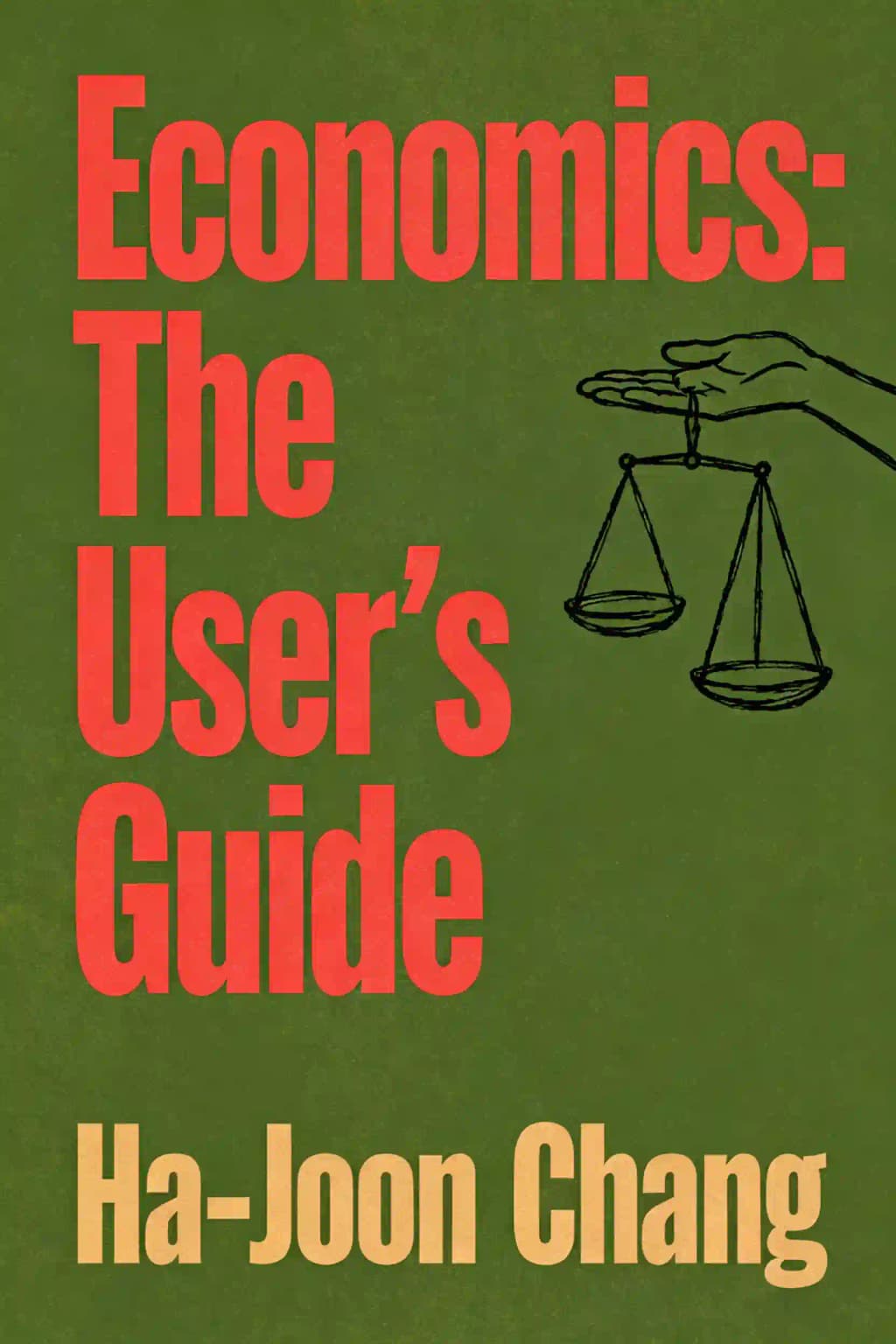
Economics has long been shrouded in mystique, presented as an impenetrable discipline that only experts can understand. Yet Ha-Joon Chang's "Economics: The User's Guide" shatters this perception with a refreshing take: economics is 95% common sense deliberately made to look difficult. The book has become something of a cult classic among those seeking to understand economic forces without drowning in jargon. Even Nobel Prize-winning economist Joseph Stiglitz praised it as "a much-needed breath of fresh air," while The Guardian called it "the most accessible and balanced assessment of different economic schools you'll find." What makes this guide so revolutionary is Chang's pluralistic approach-rather than presenting one "correct" economic theory, he introduces readers to multiple perspectives, empowering them to think critically about the economic forces shaping their lives.
Глава 2
Economics: Not a Science But a Political Argument
Economics isn't the objective science it's often portrayed to be. Unlike physics or chemistry, where experiments can be precisely replicated and natural laws remain constant, economics contains many competing theories emphasizing different aspects of reality and making different value judgments. When economists present their field as a science with only one correct answer, they discourage public engagement with economic issues that directly impact our lives. The mathematical models and complex terminology often mask the inherently political nature of economic decisions.
Consider how often people express strong opinions on complex topics like climate change or healthcare, yet remain disinterested in economic policies affecting their livelihoods. This reluctance exists partly because economics has been presented as a technical discipline where only professional consensus matters. For example, debates about minimum wage laws, trade policies, or taxation are often framed as purely technical issues, when they fundamentally involve questions of social values and priorities.
The truth is far different. Economics is fundamentally a political argument about how society should organize production, distribution, and consumption. When someone claims "there is no alternative" to a particular economic policy, they're making a political statement disguised as scientific fact. The 2008 financial crisis dramatically illustrated this reality, as supposedly infallible economic models failed to predict or prevent the collapse, revealing the limitations of treating economics as an exact science.
Chang's approach is refreshingly different. Instead of simplifying one supposedly eternal truth, he introduces multiple ways of analyzing the economy. By understanding different economic theories-from Neoclassical to Marxist to Austrian-readers can recognize the assumptions and values underlying economic arguments. Each school offers unique insights: Neoclassical economics emphasizes individual choice and market efficiency, Marxist economics focuses on power relations and systemic inequalities, while Austrian economics stresses entrepreneurship and spontaneous order.
This pluralistic approach matters because economic theories differ not just in their analytical frameworks but in their ethical and political values. When we understand this, we can engage with economics as informed citizens rather than passive recipients of expert pronouncements. For instance, debates about unemployment can be viewed through multiple lenses: as a market clearing problem (Neoclassical), a systemic feature of capitalism (Marxist), or a result of government intervention (Austrian). Each perspective reveals different aspects of the same phenomenon and suggests different solutions.
The democratization of economic discourse is essential for meaningful public debate. As Chang notes, "Economics is too important to be left to economists." This becomes particularly evident when examining real-world cases like environmental regulation, income inequality, or international trade agreements, where technical economic analysis intersects with fundamental questions about social justice, sustainability, and human welfare.
Глава 3
The Evolution of Capitalism: From Adam Smith to Amazon
To understand today's economy, we must recognize how dramatically capitalism has transformed since Adam Smith's time. In 1776, when Smith published "The Wealth of Nations," factories were owned by individuals or small partnerships personally involved in production. Workers labored 70-80 hours weekly with only Sunday mornings off for church, often in dangerous conditions without any labor protections. Markets were primarily local, with perfect competition among numerous small firms, and most business transactions occurred face-to-face within communities where reputation and personal relationships mattered deeply.
Today's capitalism operates through fundamentally different mechanisms. Modern enterprises are owned by corporations with shares distributed among countless investors who enjoy limited liability protection-a principle Smith actually opposed, believing managers would be less vigilant when playing with "other people's money." Giant corporations like Apple and Microsoft employ millions worldwide through complex bureaucratic structures spanning the globe, with supply chains stretching across dozens of countries and management layers that would have been unimaginable in Smith's era.
Markets are now dominated by large corporations with significant power-monopolies, oligopolies, monopsonies and oligopsonies-that can manipulate prices and output. Giant retailers like Walmart and Amazon exercise tremendous influence as buyers, shaping what gets produced, who profits, and what consumers purchase. For example, Amazon's marketplace algorithms can make or break small sellers, while Walmart's procurement decisions can determine the fate of entire manufacturing sectors in developing countries.
The financial system has undergone even more dramatic changes. In Smith's time, banking was primitive and fragmented, with most banks issuing their own notes with unique values to specific individuals. Banking services were accessible only to a small minority-three-quarters of French people lacked access until the 1860s. Today's financial system is vastly more complex, with sophisticated derivatives, composite products, and central banks acting as lenders of last resort. The rise of digital payment systems, cryptocurrency, and algorithmic trading has created entirely new forms of economic activity that Smith could never have envisioned.
These transformations extend beyond just scale and complexity. Modern capitalism features entirely new business models like platform economies, subscription services, and data monetization. Environmental concerns, social responsibility, and sustainable development have become crucial considerations that weren't relevant in Smith's time. Labor relations have evolved through unions, workplace regulations, and changing social expectations about work-life balance.
These fundamental changes mean that while Smith's basic principles about market forces and self-interest remain valid at general levels, applying them meaningfully requires understanding the technological and institutional forces characterizing particular markets, industries, and countries. Economic theories, no matter how brilliant, are specific to their time and space, and must be continuously updated to reflect new realities. The challenge for modern economists and policymakers is to adapt classical economic wisdom to an increasingly complex and interconnected global economy while addressing contemporary challenges like inequality, climate change, and technological disruption.
Глава 4
The Hidden History of Economic Development
The standard narrative about economic development presents free markets and free trade as the drivers of prosperity. Yet this story contradicts the actual historical experience of today's wealthy nations.
Britain, often portrayed as the pioneer of free trade, actually developed through protectionist industrial strategy initiated by Robert Walpole in 1721. Though Adam Smith advocated free trade in the 1770s, Britain only fully embraced it in 1860-nearly a century later-when its industrial supremacy was unquestioned. By then, Britain commanded 20% of world manufacturing output despite having only 2.5% of world population.
The United States, now often the loudest advocate for free trade, was actually "the champion of protectionism" during its developmental phase. Under British rule, American manufacturing was deliberately suppressed-British Prime Minister William Pitt declared colonists shouldn't "manufacture so much as a horseshoe nail." After independence, Alexander Hamilton championed the "infant industry argument," advocating tariffs, subsidies, and infrastructure investment to nurture American industry against superior foreign competition.
By the 1830s, America boasted the world's highest industrial tariffs-a position maintained for nearly a century. This protectionism enabled the North's industrial development, ultimately proving decisive in their Civil War victory against the agrarian South.
Even during the supposed "liberal golden age" of 1870-1913, protectionism actually increased in capitalism's heartlands. The U.S. became more protectionist following the Civil War, while European countries that had signed free trade agreements in the 1860s-70s allowed them to expire, raising tariffs to protect agriculture from New World imports and to nurture heavy industries.
Free trade spread in the 19th century not through voluntary adoption but largely through force. Non-colonized countries were forced to sign "unequal treaties" that stripped them of tariff autonomy, limiting them to 3-5% tariffs-enough for government revenue but insufficient for infant industry protection. This inability to protect infant industries contributed significantly to economic retrogression in Asia and Latin America.
This historical perspective reveals that economic development typically requires strategic government intervention, not unfettered markets.
Глава 5
The Many Schools of Economic Thought
Contrary to what most economists suggest, there isn't just one kind of economics-Neoclassical economics. In reality, there are at least nine different schools with fuzzy boundaries between them.
The Classical School, founded by Adam Smith and developed by Ricardo and Malthus, introduced the influential "invisible hand" metaphor-the idea that self-interested market participants unintentionally produce socially beneficial outcomes through competition. While outdated in some respects, its class analysis and comparative advantage theory remain relevant.
The Neoclassical School emerged in the 1870s, shifting focus from production to consumption, emphasizing demand alongside supply in determining value, and reconceptualizing the economy as collections of rational, self-interested individuals rather than classes. Its insistence on breaking phenomena down to the individual level gives it exceptional precision and logical clarity.
The Marxist School elevated the Classical school's class-based view, seeing class conflicts as history's central force. Marx was the first economist to recognize the contrast between firms' hierarchical planned order and markets' spontaneous order, describing capitalist firms as "islands of rational planning in an anarchic sea of the market."
The Developmentalist Tradition argues that backward economies can't develop if they leave things entirely to the market. For Developmentalists, economic progress isn't simply about increasing income, but acquiring sophisticated productive capabilities-the abilities to produce using and developing new technologies and organizations.
The Austrian School, founded by Carl Menger and extended by Ludwig von Mises and Friedrich von Hayek, defends free markets not because humans are perfectly rational, but precisely because we aren't. They view the world as highly complex and uncertain, arguing it's impossible for anyone, even socialist central planners, to acquire all information needed to run a complex economy.
The Schumpeterian School emphasizes technological development as capitalism's driving force. Schumpeter argued capitalism advances through innovations by entrepreneurs creating new production technologies, products and markets-creating "gales of creative destruction" that no firm, however dominant, remains safe from in the long run.
The Keynesian School redefined economics by inventing macroeconomics-analyzing the economy as an entity different from the sum of its parts. Keynes observed that economies don't consume everything they produce, and the difference-savings-must be invested for all products to sell and all workers to be employed.
The Institutionalist School challenged Classical and Neoclassical economics for ignoring individuals' social nature. They argued for analyzing institutions (social rules) that shape individuals, not just how individuals shape institutions.
The Behaviouralist School rejects the Neoclassical assumption that humans always behave rationally and selfishly, instead modeling actual human behaviors. Herbert Simon's central concept is "bounded rationality"-humans try to be rational but have limited capabilities, especially given the world's complexity.
No single school can claim superiority over others or monopoly over truth. All theories necessarily involve abstraction and cannot capture every aspect of reality, giving each particular strengths and weaknesses.
Глава 6
The Real Economic Actors: Beyond the Individual
While Neoclassical economics portrays individuals as the heroes making rational choices to maximize utility and profit, the reality shows large organizations-not individuals-as the most important economic decision-makers in modern economies. This fundamental misalignment between theory and practice has profound implications for how we understand economic behavior and policy.
The most important producers today are large corporations employing hundreds of thousands of workers across dozens of countries. The 200 largest corporations produce around 10% of world output, with 30-50% of international trade in manufactured goods actually being intra-firm transfers within multinational corporations. Companies like Walmart, with over 2.3 million employees, or Apple, whose supply chain spans 43 countries, demonstrate how corporate decisions impact economies on a scale far beyond individual action. These giants often have annual revenues exceeding the GDP of many nations.
While legally corporate decisions may be traced to individuals like CEOs or board chairs, these powerful figures don't make decisions as individuals do for themselves. Corporate decisions emerge through complicated bargaining processes involving shareholders, professional managers, workers, and government-demonstrating how corporate decisions differ fundamentally from individual ones. For instance, a CEO's decision to relocate production facilities must consider board approval, shareholder interests, labor contracts, environmental regulations, and political implications across multiple jurisdictions.
Beyond corporations, trade unions allow workers to make economic decisions collectively, helping extract better wages and working conditions by bargaining as a group. In several European countries, unions are recognized as key partners in national policy-making beyond just labor issues, extending to welfare policy, inflation control, and industrial restructuring. Germany's system of "co-determination," where workers have representation on corporate boards, exemplifies how collective decision-making can be institutionalized.
In all functioning states, government is the single most important economic actor, typically employing up to 25% of the workforce with expenditure representing 10-55% of national output. Governments own and run state enterprises, while also creating, shutting down and regulating markets through legislation and enforcement. They shape markets through monetary policy, infrastructure investment, education funding, and research support. The COVID-19 pandemic demonstrated governments' crucial economic role, with unprecedented intervention to support businesses and workers.
Even individuals themselves don't conform to economic theory's portrayal. Contrary to economic theory's view of individuals as irreducible units, people frequently exhibit "multiple-self" problems, behaving differently across various roles - as consumers, workers, citizens, and family members. Our preferences aren't internally generated but profoundly shaped by our social environment, education, media exposure, and peer groups. And rather than being purely self-interested, human motivation encompasses patriotism, class solidarity, fairness, honesty, ideology, duty, friendship, love, beauty, curiosity and more. Studies in behavioral economics repeatedly demonstrate how social norms, cognitive biases, and emotional factors influence decision-making in ways that deviate from rational economic models.
This complex reality of economic decision-making, dominated by large organizations and shaped by social factors, suggests we need economic theories that better reflect how modern economies actually function rather than idealized models of individual rational choice.
Глава 7
The Financial System: From Banking to Global Crisis
Banking's essence is that banks promise depositors immediate access to cash while keeping only a fraction of deposits as reserves. This normally works because few depositors withdraw simultaneously. But if doubt spreads about a bank's ability to pay, depositors rush to withdraw funds, creating a self-fulfilling prophecy of bank failure-a "bank run" like those seen at Northern Rock and Icesave during the 2008 financial crisis.
Banking operates as a kind of confidence trick-but one whose truth depends on collective belief. If enough depositors believe their bank can repay them, it will; if they don't, it won't. This "trick" is actually banking's purpose: creating more money than exists in cash by exploiting the fact that not everyone needs liquidity simultaneously.
Beyond traditional banking, investment banks operate behind the scenes, helping companies raise money by arranging and selling shares and bonds to large investors. Since the 1980s, they've increasingly focused on creating and trading new financial products like asset-backed securities and derivatives.
Asset-backed securities transform illiquid individual loans into tradable bonds by pooling thousands of mortgages, car loans, credit card debts, or student loans. Financial engineering evolved to create Collateralized Debt Obligations (CDOs) by combining multiple ABSs and dividing them into tranches with different risk levels.
The financial industry claimed to have reduced risk through pooling (safety in numbers) and structuring (creating safety zones within pools). But when the US housing bubble burst, even supposedly super-safe investments proved worthless, as they were ultimately based on shaky assets like subprime mortgages.
The new financial system that emerged over three decades featured complex instruments created through financial engineering and facilitated by deregulation. Despite assurances from financial leaders and regulators who denied the housing bubble's existence, the system collapsed in 2007-8 due to overwhelming complexity.
Financial crises have proliferated since deregulation began in the mid-1970s. The proportion of countries experiencing banking crises rose from zero pre-1970s to 35 percent after 2008. Without stricter financial regulation, financial crises will continue to repeat.
Глава 8
The Truth About Work and Unemployment
Work has defined humanity throughout history. Until the 19th century, most people in today's rich Western countries worked 70-80 hours weekly, typically having only Sunday morning off for church. Today, though working hours have decreased to 35-55 hours weekly, most adults still spend roughly half their waking hours at work.
Despite work's overwhelming presence in our lives, economics treats it as a relatively minor subject, mainly discussing its absence (unemployment). In Neoclassical economics, work is merely a means to income, with people enduring its disutility only for the utility derived from resulting income. Yet for most people, work profoundly affects physiological and psychological well-being, potentially shaping our very selves.
Cultural stereotypes about work ethic often prove completely wrong. Mexicans, stereotyped as "lazy Latinos" in the US, actually work longer hours than "worker ant" Koreans. Greeks, vilified as "spongers" during the Eurozone crisis, work longer hours than nearly every rich country except South Korea. These misperceptions arise from the mistaken belief that poverty results from laziness, when it's actually low productivity caused by insufficient capital, technology and infrastructure-failings of the rich and powerful, not the workers themselves.
We've become so accustomed to high unemployment that we're shocked to hear of places with virtually none. Yet during capitalism's Golden Age, many developed countries achieved near-full employment, showing unemployment isn't inevitable. Unemployment carries severe individual costs (economic hardship, loss of dignity, depression) and social costs (wasted resources, social decay, skills erosion), making it one of capitalism's most pressing problems.
Neoclassical economists argue that unemployment beyond the short term exists only because governments or unions prevent the labor market from clearing. Keynesians identify "cyclical unemployment" arising from insufficient aggregate demand. Marx called the unemployed the "reserve army of labour" who can be called upon if hired workers become too unwieldy.
All unemployment types coexist but their prominence varies by circumstance. Building a good economy requires taking work seriously-not just as a means to consumption, but as a fundamental part of human dignity and fulfillment.
Глава 9
Economics as a Political Argument
Economics remains fundamentally about the state's role in the economy-political economy, its original name, better captures this essence. Even economists who present economics as a "science of everything" are implicitly arguing about government's role, suggesting rational individuals need no paternalistic oversight.
The moral question of whether the state has the right to tell individuals what to do is central to debates about government intervention. Most economists today embrace individualism-the view that no authority can be higher than individuals. In its purest form, this leads to contractarianism, which holds that the state is merely a product of social contract between sovereign individuals.
Markets may fail to produce socially optimal outcomes-a concept known as market failure. Unlike private goods that only the purchaser can consume, public goods cannot prevent use by non-payers once supplied. The free-rider problem emerges: if you can benefit without paying, why contribute? Public goods therefore require government taxation of all potential users to ensure optimal provision.
Free-market economists argue that market failure doesn't automatically justify government intervention. They criticize the market failure argument for naively assuming the state acts as Plato's "philosopher king"-benevolent, all-knowing, and all-powerful. This perspective, known as government failure argument or public choice theory, suggests accepting imperfect markets is preferable to government intervention that could worsen outcomes.
The depoliticization proposal has a fundamental flaw: in democratic countries, "politics" represents the influence of people. Markets operate on a "one-dollar-one-vote" principle, while democratic politics follows "one-person-one-vote." Thus, depoliticizing the economy is essentially an anti-democratic project that transfers power from citizens to those with more money.
Even accepting the government failure theorists' economic framework, drawing a clear boundary between economics and politics is impossible because market boundaries themselves are politically determined. Before market transactions can occur, we need rules about what can be traded, who can trade, and how-all inherently restrictive and politically decided. Politics creates and shapes markets before any transaction begins.
Глава 10
Using Economics to Build a Better World
The author emphasizes that his aim has been to teach readers how to think, not what to think, about the economy. Economics is fundamentally a political argument, not a science-there are no objective truths that can be established independently of political and moral judgments. When faced with economic arguments, we should always ask "Cui bono?" (Who benefits?).
Despite what most economists claim, there isn't just one correct approach to economics. Though Neoclassical economics has dominated recent decades, at least nine different schools exist, each with unique strengths and weaknesses. Economic reality is too complex for a single theory. As the saying goes, "he who has a hammer sees everything as a nail"-approaching problems from just one theoretical viewpoint limits the questions you ask and how you answer them.
Goethe's observation that "everything factual is already a theory" applies especially to economic "facts." Numbers in economics, despite seeming objective, are constructed based on contested theoretical concepts. How we define economic indicators profoundly affects policy and life.
Modern economics overly focuses on markets, yet the economy extends far beyond market exchanges. Many economic activities occur through internal directives within firms or government influence. Herbert Simon estimated only about 20% of US economic activities are organized through markets. This market fixation has led policymakers to neglect crucial areas like manufacturing decline and work quality.
The Latin motto "Audite et alteram partem" (Listen even to the other side) should guide economic debates. Given the world's complexity and the partial nature of all economic theories, we should remain humble about our favorite theories and keep open minds. This doesn't mean having no opinion-strong views are valuable-but avoiding belief in absolute rightness.
Changing economic reality is difficult, but we shouldn't abandon efforts to create more dynamic, stable, equitable and sustainable economies. History shows that with persistence, "impossible" changes happen-from abolishing slavery to women's suffrage to decolonization. As Antonio Gramsci said, we need "pessimism of the intellect and optimism of the will."