Глава 1
The Intoxicating Path to Civilization: How Alcohol Shaped Human History
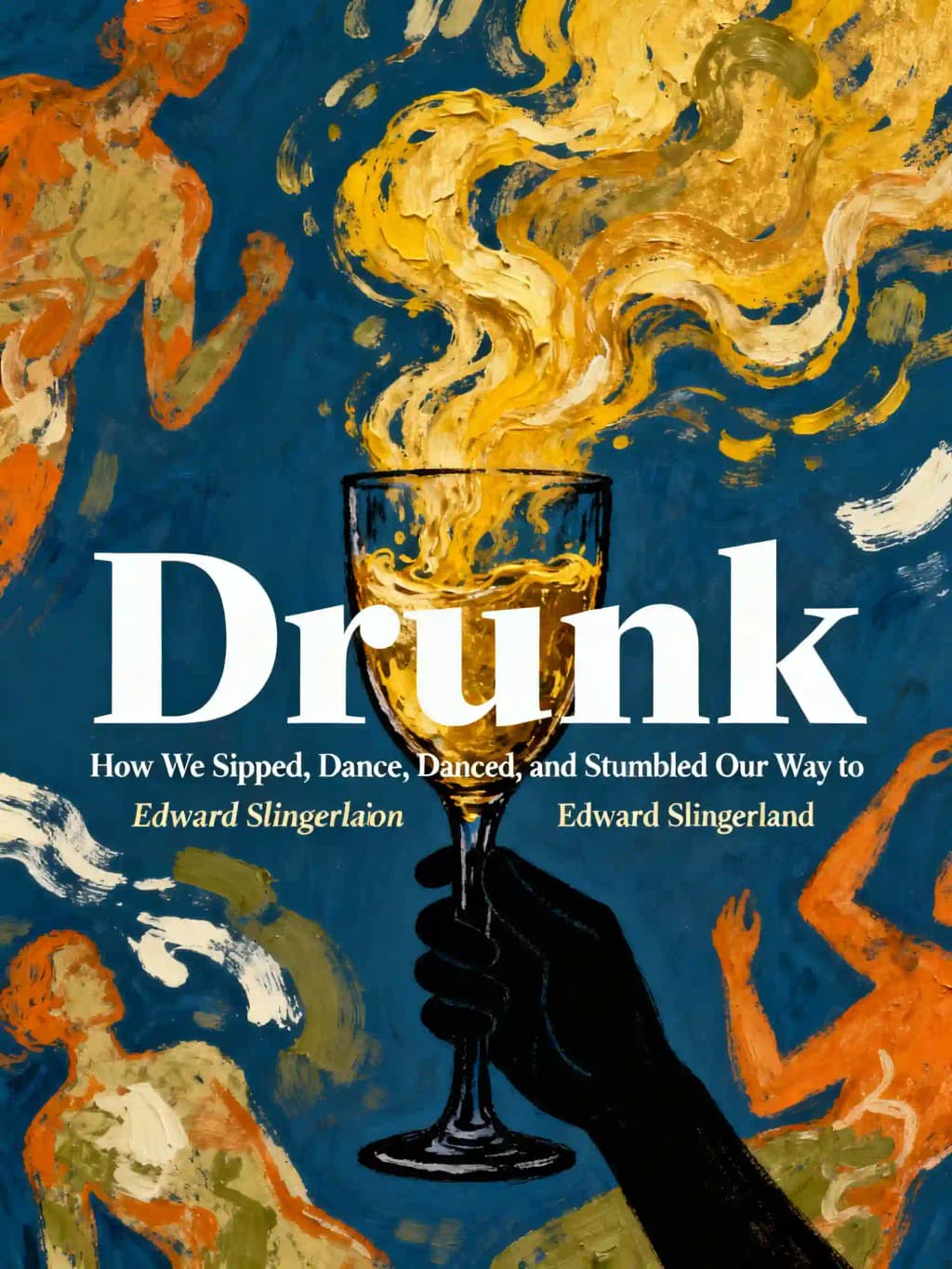
When Mark Zuckerberg wants to seal a business deal, he doesn't reach for a contract-he reaches for a drink. The Facebook founder reportedly takes potential acquisitions out for rounds of shots to build trust before making multi-billion dollar offers. This approach isn't unique to Silicon Valley; it reflects a pattern as old as human civilization itself. Edward Slingerland's "Drunk" explores a provocative thesis: our species' seemingly irrational love affair with alcohol isn't an evolutionary mistake but rather a sophisticated adaptation that helped transform selfish primates into cooperative civilization-builders. The book has earned praise from diverse quarters-Pulitzer Prize-winner Sapolsky called it "brilliant," while comedian Marc Maron described it as "mind-blowing." Its cultural impact extends beyond academia, influencing conversations from corporate happy hour policies to college drinking culture reforms. Slingerland challenges us to reconsider our relationship with intoxication, suggesting that our ancestors weren't just drunk-they were drunk with purpose.
Глава 2
Why Humans Everywhere Seek Intoxication
People love to drink. With over 2.4 billion active consumers-roughly one-third of Earth's population-alcohol stands as humanity's most widely consumed psychoactive substance. This isn't a recent development; archaeological evidence reveals our ancestors have been getting drunk for millennia. From a 20,000-year-old carving in southwestern France showing a woman drinking from a horn to chemical traces of wine in 9,000-year-old Chinese pottery, our relationship with alcohol runs deep.
The earliest direct evidence of deliberately produced alcoholic beverages dates to around 7000 BCE in China's Yellow River Valley, where archaeologists found pottery containing chemical traces of primitive wine made from wild grapes, fruits, rice, and honey. By 4000 BCE, wine production had become a major collective undertaking, evidenced by an Armenian cave site functioning as a full-scale winery with grape-stomping basins, fermentation vats, and drinking vessels.
Conventional wisdom suggests our taste for intoxication represents either an evolutionary "hijack" (like pornography tricking our sexual reward systems) or an evolutionary "hangover" (like our craving for sugar that once helped ancestors survive but now causes obesity). The "drunken monkey" hypothesis proposes that alcohol's volatility served as an olfactory signal leading our primate ancestors to ripe, calorie-rich fruit. Others suggest fermentation's preservation benefits made alcohol adaptive-converting perishable calories into durable form while enhancing nutritional content.
However, these theories fail to explain why humans worldwide expend enormous resources getting intoxicated. If alcohol were merely hijacking pleasure centers or an outdated adaptation, evolution should have eliminated our desire for it given its enormous costs. Even societies on the brink of starvation set aside precious food for alcohol production. The persistence of this seemingly irrational behavior presents a genuine evolutionary puzzle.
Evolution works faster than most realize. For our drive to get drunk to have survived this long, it must provide specific, targeted benefits that balance its costs. This suggests intoxication helps solve distinctively human challenges: enhancing creativity, alleviating stress, building trust, and enabling cooperation among tribal primates. We could not have civilization without intoxication.
Глава 3
The Human Ecological Niche: Creative, Cultural, Communal
Humans have adapted to an extreme ecological niche that requires intensive cooperation, creativity, and social skills. Unlike other animals, our primary adaptive challenge isn't the physical environment but navigating relationships with other humans. This social dependence explains our persistent attraction to intoxication despite its costs-we're attempting to reconcile our primate heritage with our insect-like social structures.
Unlike precocial birds like chickens that are born fully functional but cognitively limited, humans resemble altricial species like corvids that require extended parental care but develop remarkable behavioral flexibility. This extended developmental period enables greater cognitive sophistication and adaptability, though at the cost of early vulnerability. Humans take this strategy to an extreme, with exceptionally helpless offspring requiring extensive care. This vulnerability ultimately transforms into immense power because we've adapted to a unique ecological niche requiring us to be creative, cultural, and communal-the "Three Cs" that define our species.
The prefrontal cortex (PFC) matures last in human development, not reaching adult state until the early twenties. The mature PFC enables focus but inhibits lateral thinking-studies show jazz musicians downregulate their PFC when improvising, and adults with damaged PFCs perform better on creative tasks. Despite mature brains, adults can still access creativity by relaxing PFC vigilance. Humans display "neoteny"-retaining juvenile characteristics into adulthood-making us the "Labradors of the primate world." Our playfulness correlates with our large brains, and play remains crucial for innovation.
Humans' individual creativity is magnified exponentially through cultural accumulation-the ability to preserve and build upon past insights. No single person could create even the simplest iPhone component; all innovations are incremental, building on accumulated knowledge. Our brains function as nodes in a "collective brain" that solves problems beyond individual capacity.
While social insects like ants and bees form superorganisms with complete cooperation, humans occupy a unique middle ground. We're the "social insects of the primate world," capable of remarkable cooperation yet still burdened with selfish, backstabbing ape tendencies. This tension creates the "free-rider problem" or "tragedy of the commons"-when individual interests conflict with collective good.
Humans overcome these dilemmas through emotions-love, loyalty, honor, shame-that function as "pre-commitment devices." Like Odysseus binding himself to the mast to resist the Sirens, our emotions restrain our selfish impulses. These emotions work precisely because we can't consciously control them; a love you can switch off when inconvenient isn't true love. The prefrontal cortex-seat of rational thought-is actually the enemy of cooperation.
Глава 4
The Drunken Mind
We need something low-tech that temporarily disables the prefrontal cortex, makes us happy, and lasts just a few hours. Ideally, it should be easily produced anywhere, taste good, pair with food, and promote social bonding. Alcohol fits perfectly-naturally occurring in rotten fruit, easily discoverable, and uniquely broad in its effects.
Unlike drugs that work like "pharmacological scalpels" targeting specific brain circuits, alcohol is a "pharmacological hand grenade" affecting nearly everything. Its dual solubility in water and fat allows quick absorption and easy crossing of cell membranes. Alcohol is biphasic-first stimulating (releasing dopamine, serotonin, and endorphins like mild morphine), then depressing (enhancing inhibitory GABA receptors while suppressing excitatory glutamate).
Other intoxicants have parallel effects: cannabis boosts dopamine while impairing memory; kava reduces anxiety; and hallucinogens disrupt the default-mode network, creating cognitive fluidity characteristic of both dreaming and childhood. Non-chemical practices can produce similar effects-extreme exercise creates a "runner's high" by stimulating dopamine while downregulating the PFC, and religious practices like Sufi dancing, meditation, or self-flagellation boost dopamine while diverting energy from the PFC.
But these alternatives are inefficient. Cannabis is hard to dose with unpredictable effects, mushrooms cause gastrointestinal distress, and non-chemical methods require tremendous effort. Alcohol, by contrast, is the perfect drug-easy to dose, predictable in effects, short-lived, and pleasurable. Our livers work constantly to break down ethanol, making it a convenient and controlled way to temporarily disable our prefrontal cortex.
The prefrontal cortex-our most evolutionarily novel brain region and the last to mature-is what makes us distinctively human. It enables impulse control, abstract reasoning, delayed gratification, and error correction. Yet when facing the Three Cs-creativity, cultural openness, and communal bonding-this same PFC becomes our enemy.
Greek mythology perfectly captures this tension through Apollo and Dionysus. Apollo, the sun god of rationality and order, represents the PFC-making us efficient, focused, and disciplined like wolves. Dionysus embodies our need for playfulness, creativity, emotion, and trust. Wine, as Dionysus's gift, paralyzes the PFC for a few hours, narrowing attention to immediate surroundings, freeing conversation to meander unpredictably, creating happiness unconcerned with consequences, and even improving fluency in second languages while impairing motor skills. We temporarily become children again, with all their benefits and limitations.
Глава 5
A Visit from the Muse: Intoxication and Creativity
Throughout history and across cultures, intoxication has been linked to creative inspiration. In Chinese tradition, wine paradoxically serves as both intoxicator and facilitator of artistic imagination, with many ancient poets composing "Written While Drunk" series. Similarly, Greek tradition held that "wine is the horse of Parnassus that carries a bard to the skies," while Norse mythology features Kvasir, the god of inspiration whose blood was mixed with alcohol to create the "mead of inspiration."
Despite occasional denials from modern writers, an inordinate proportion of artists and musicians have been heavy substance users, willing to accept physical costs for mental liberation. As the alcoholic writer in "The Lost Weekend" puts it: alcohol "tosses the sandbags overboard so the balloon can soar." Beyond alcohol, cannabis has fueled Sufi mystics and Beat poets, while psychedelics have powered shamanic traditions for millennia.
Modern cognitive science confirms this ancient association between intoxication and creativity isn't accidental. The prefrontal cortex inhibits lateral thinking when overly focused on goals. Studies show people with reduced cognitive control do better at solving problems requiring creativity, and those with increased alpha-wave activity (indicating relaxed mental states) outperform others in lateral thinking tasks.
Science confirms what ancient cultures knew: alcohol enhances creativity. Jarosz's 2012 study "Uncorking the muse" showed intoxicated subjects outperforming sober ones on Remote Associates Tests, solving problems faster through inspiration rather than methodical reasoning. Another study found drunk participants mind-wandered more frequently without noticing it-ideal conditions for creative insight. This explains why Google maintains whiskey rooms where coding teams gather when stuck on problems. The "Ballmer Peak"-named after Microsoft's former CEO-describes the narrow BAC sweet spot where coding ability supposedly peaks.
Alcohol's creativity boost amplifies in group settings, where it not only opens individual minds but lowers communication barriers. Historical examples abound: Persian leaders reviewed decisions both drunk and sober; Japanese "water trade" drinking sessions allowed junior employees to speak freely to seniors; Marx and Engels developed communism during "ten beer-soaked days." Economist Michael Andrews' research on "collective invention" suggests alcohol-serving gathering places drive innovation-a theory he tested using American Prohibition as a natural experiment, which eliminated social drinking venues and forced consumption into private isolation. His findings showed a 15% annual reduction in new patents in previously "wet" counties compared to consistently dry ones.
Глава 6
The Chemical Handshake: In Vino Veritas
Trust-based relationships, while crucial for human cooperation, are vulnerable to hypocrisy-where someone can fake commitment without paying any costs. To navigate this challenge, humans have evolved sophisticated abilities to evaluate others' trustworthiness through micro-facial expressions, voice tone, and body language.
We make these assessments with remarkable speed-studies show we judge facial trustworthiness within 100 milliseconds, judgments that remain stable even with additional information. These instant evaluations appear early in childhood development, with three-year-olds readily classifying faces as "mean" or "nice." Such gut-level assessments are consistent across cultures and significantly influence even formal contexts like court cases and elections.
In experimental settings, strangers allowed to interact briefly before playing Prisoner's Dilemma games accurately identify potential cooperators or defectors based on implicit cues. We instinctively rely on emotional expressions and body language because they operate relatively independently of conscious control, bypassing the prefrontal cortex's calculated self-interest. People quickly recognize genuine versus forced expressions-the former involving different muscular systems less subject to conscious manipulation-and trust partners more when they display authentic emotional reactions.
This evolutionary arms race between cheaters and cheater-detectors has produced our seemingly supernatural ability to detect lies, matched by increasingly sophisticated deception abilities. Cultures have intervened in this contest by targeting cognitive control-the chink in the cheater's armor. Since lying requires effort while honesty flows effortlessly, alcohol serves as the perfect tool to impair cognitive control in social settings, making deception more difficult.
This explains why "in vino veritas"-in wine there is truth-appears across cultures. From ancient China to Greece, Rome, and Viking societies, intoxication has functioned as a truth serum, with drunken declarations given special weight. No political agreement in ancient China occurred without carefully calibrated doses of alcohol; Germanic tribes consulted on important matters only during feasts; and Pacific Islanders used kava similarly. Intoxication allows us to cognitively disarm, laying our prefrontal cortices on the table like a handshake demonstrates we carry no weapons.
Глава 7
Intoxication and the Origins of Civilization
The traditional narrative suggests agriculture came first, with alcohol production as its accidental byproduct. However, mounting archaeological and anthropological evidence increasingly supports "beer before bread" theories-that the fundamental human desire for intoxication actually drove agricultural development and the rise of complex societies.
Archaeological sites like Gobekli Tepe in modern-day Turkey provide compelling evidence of large-scale, alcohol-fueled feasting occurring millennia before settled agriculture. The site features intricate stone carvings and massive architectural elements, with pillars weighing 10-20 metric tons that required coordinated efforts of up to 500 laborers to transport and erect. Chemical analysis of stone vessels found at the site shows traces of fermented beverages, suggesting these gatherings centered around ritual, feasting, and communal alcohol consumption. The presence of wild cereal remains further supports the theory that early humans were collecting and processing grains primarily for fermentation rather than nutrition.
Evidence from across the Fertile Crescent reveals sophisticated tools and specialized grain varieties more suited to beer-making than bread-baking. At Shubayqa 1, a site in Jordan, researchers discovered evidence of bread/beer production dating back 14,400 years ago-at least 4,000 years before systematic agriculture emerged. The world's oldest surviving recipe, inscribed on Mesopotamian clay tablets, is for beer production, while early Sumerian art extensively depicts alcohol consumption at ceremonial feasts. Genetic analysis of ancient yeast strains shows evidence of intentional domestication dating back over 12,000 years, suggesting deliberate cultivation for fermentation purposes.
This pattern of intoxicant-driven agricultural development appears consistently across different cultures and continents. In the Americas, archaeological evidence shows teosinte (primitive maize) was cultivated 9,000 years ago-a crop poorly suited for flour production but excellent for producing chicha beer. In Australia, indigenous communities developed sophisticated cultivation practices around pituri, a narcotic plant, long before other forms of agriculture. Throughout the Americas, tobacco cultivation appears to have preceded and possibly inspired broader agricultural practices, with elaborate ceremonial pipes found in contexts predating traditional farming.
The implications of these findings fundamentally reshape our understanding of human civilization's origins. Our ancestors' desire for intoxicants that temporarily suppress prefrontal cortex activity may have been the crucial catalyst for settled agricultural life and the development of complex societies. These substances temporarily enhanced human creativity, cultural expression, and communal bonding-making humans behave more like eusocial insects despite our primarily individualistic ape nature. This chemically-induced sociability provided the essential spark for large-scale group formation, technological innovation, and ultimately the emergence of civilization itself. The metaphorical significance is clear: Dionysus, with his intoxicating wineskin, may have been the true founder of civilization, with Apollo's rational order following in his wake.
The biochemical effects of these early intoxicants-particularly their ability to temporarily alter consciousness and promote social bonding-created the conditions necessary for the sustained cooperation required to build the first cities and develop complex cultural institutions. This suggests that altered states of consciousness played a far more fundamental role in human cultural evolution than previously recognized.
Глава 8
The Dark Side of Dionysus
While alcohol brings people together, it simultaneously threatens social order. From ancient China to Greece, alcohol has been viewed with ambivalence-central to diplomacy and community yet potentially destructive. Dionysus represented both divine ecstasy and chaotic violence. Throughout world literature, from Noah's drunken embarrassment to Aztec warnings about pulque as "an infernal storm," alcohol inspires powerful regulation and strong emotions. This ambivalence is pharmacologically justified: alcohol begins as a stimulant before becoming a depressant, creating effects ranging from joyful sociability to belligerent aggression.
Alcoholism has been a devastating human affliction since ancient times, with evidence appearing in Egyptian correspondence describing a student who forsakes studies for taverns, smelling of beer and frightening others away. Today, alcoholism affects 1.5-5% of the global population with significant variation by country. In the US alone, 15.1 million adults suffer from alcoholism, causing 88,000 annual deaths and costing the economy $249 billion. From an evolutionary perspective, alcoholism's persistence is puzzling-it's strongly heritable (up to 60% genetic contribution) yet profoundly maladaptive.
Two modern developments have dramatically worsened alcohol's dangers. First, distilled spirits became widespread relatively recently-around the 13th century in China and 16th-18th centuries in Europe. For most of alcohol's 9,000-year history, humans consumed only relatively weak beers and wines. While wine at 11% ABV represented a jump from overripe grapes at 3%, brandy at 40-60% ABV was a quantum leap that would have horrified the ancient Greeks who feared even undiluted wine.
Second, throughout human history, alcohol consumption has been primarily social and regulated by cultural practices. In ancient China, elaborate wine-drinking rituals required multiple salutations and ceremonial washing before drinking could begin, with hosts controlling toast frequency to regulate guests' inebriation levels. Similar cultural safeguards appear worldwide: Greek symposium hosts controlled water-to-wine ratios; the Tohono O'odham forbid drinking one's own home-brewed alcohol; Georgian tamadas space out toasts judiciously; and Japanese Shinto rituals include monitoring of participants' drunkenness.
Modern drinking has become dangerously disconnected from traditional safeguards. In suburban communities, people commute long distances, lack walkable social drinking venues, and increasingly drink alone at home. This private consumption outside social observation resembles the alcohol feeding tubes given to stressed lab rats rather than traditional communal drinking practices centered on meals and ritual pacing.
Глава 9
Taming Dionysus for Modern Times
While we await the worldwide takeover of teetotaler religiosity and the replacement of bars with holotropic breathing stations, alcohol will remain our preferred method for enhancing creativity and social connection. Dionysus is undeniably dangerous-he can turn you into an animal or give gifts that become curses. We must consider how to mitigate these risks.
The "sober curious" movement represents a middle ground between total abstinence and regular drinking. This trend has spawned "sober bars" where people socialize in bar-like settings while enjoying virgin cocktails. These establishments tap into the expectancy effect-if you think you're getting drunk, you often feel a little drunk even with non-alcoholic beverages. Research shows that merely thinking about alcohol through exposure to related cues can produce mild intoxication-like effects.
Practical moderation strategies include using smaller glasses (ancient Greeks deliberately used shallow cups that required motor control to avoid spilling) and alternating alcoholic drinks with non-alcoholic ones. For workplace drinking, sensible limits like drink tickets instead of open bars can prevent excess-though some organizations implement such policies only after problems become severe.
We're apes built to drink beer and wine, not 100-proof vodka, and we're not equipped to control drinking without social help. Distilled spirits should be treated as a separate, more dangerous drug and regulated accordingly. People under twenty-five should avoid them entirely, and campus liquor bans and higher taxation on spirits are sensible policies.
Southern European drinking cultures offer protection against modern alcohol problems through their integration of moderate drinking with meals and social life. In contrast, American drinking culture represents the extreme of Northern European patterns, further complicated by Puritanical attitudes toward pleasure. America's fraught relationship with alcohol makes it an "all or nothing drinking nation," swinging between abstinence and extreme indulgence. This cultural ambivalence, combined with college freedoms and advertising that glorifies drinking, creates what Chrzan calls a "cultural trifecta almost perfectly designed to encourage abuse among youth."
Creating inclusive environments where both drinkers and non-drinkers can participate equally presents a significant challenge. Tech community manager Kara Sowles offers practical suggestions for integrating alcohol into professional gatherings without marginalizing non-drinkers: provide equal numbers of alcoholic and non-alcoholic options displayed together; advertise both equally; offer an equal number of mocktails alongside cocktails; and ensure water is freely available and visible.
Глава 10
The Enduring Power of Dionysus
Jesus's first miracle-turning water into wine at the wedding in Cana-underscores alcohol's fundamental connection to human sociality. This biblical story reflects a universal truth found across cultures and millennia: alcohol has been central to human gatherings, celebrations, and sacred ceremonies. Our desire for alcohol is not an evolutionary mistake but rather a deeply ingrained adaptation that has served important social functions throughout history. From ancient Mesopotamian beer halls to medieval taverns to modern bars, alcohol has consistently facilitated human connection and community building.
The cognitive effects of alcohol represent an elegant response to the challenge of getting selfish, suspicious primates to connect with strangers. Alcohol's ability to lower inhibitions, reduce social anxiety, and increase empathy creates a temporary state of openness that enables deeper social bonds to form. This biochemical intervention helps bridge the gap between our inherent wariness of outsiders and our need for broader social connections. Studies have shown that groups who drink together display increased trust, cooperation, and social bonding compared to non-drinking control groups.
In our modern world, we face new challenges that our ancestors never encountered. Distilled spirits with high alcohol content, widespread social isolation, and the pressures of urban life have changed how we interact with alcohol. While non-alcoholic alternatives might sometimes be preferable, we must recognize that even excess has its place in human society. Well-timed collective intoxication can forge powerful group bonds, whether at wedding celebrations, religious ceremonies, or cultural festivals. On an individual level, moderate drinking can help people navigate relationship difficulties, process emotional challenges, or temporarily escape from life's pressures.
The ability to chemically disarm ourselves, to honestly become vulnerable to others, has provided essential social benefits that have consistently outweighed the obvious costs throughout human history. This is evidenced by alcohol's persistence in nearly every human society, from ancient civilizations to modern times. Traditional cultures often developed sophisticated rituals and social norms around drinking that helped maximize its benefits while minimizing its dangers.
We must move beyond both "evolutionary hijack" theories that view drinking as merely a maladaptive behavior and outdated moral discomfort about intoxication. Today's technocratic, ascetic, and moralistic climate makes this particularly challenging, as anything that doesn't directly increase lifespan or productivity is often deemed categorically bad. Modern society's obsession with health optimization and efficiency threatens to overlook alcohol's vital social and cultural roles. We need to rescue alcohol from both "cheery New Age ascetics and dour neo-Puritans" to recognize its profound meaning, as the Chinese poet Tao Yuanming eloquently expressed: "In the midst of wine there is profound meaning!"
As the ancient Homeric hymn to Dionysus teaches, few recognize him as a god, but only those who do retain their humanity. This wisdom suggests that embracing the role of intoxication in human life - while respecting its power and potential dangers - is essential to maintaining our full humanity. We must find ways to cautiously tap alcohol's social power while leaving space for occasional ecstasy in our lives, understanding that controlled abandonment of control has been a crucial part of human social life for millennia.