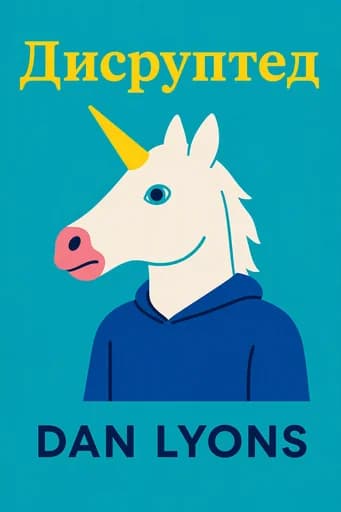
When tech journalist Dan Lyons joined HubSpot at 52, he discovered a "frat house" culture that sparked FBI investigations and industry-wide debates. Called "the best book on Silicon Valley" by LA Times, this darkly hilarious expose reveals what really happens when startups prioritize culture over experience.
Dan Lyons, a New York Times bestselling author known for Disrupted: My Misadventure in the Start-Up Bubble, is a seasoned technology journalist and a keen observer of Silicon Valley culture. He brings decades of experience covering tech giants to his work.
Lyons is a former senior editor at Forbes and a writer for Newsweek. His experiences working at Boston startup HubSpot led him to write his incisive memoir, which reveals ageism, harmful corporate practices, and the ridiculous aspects of tech's "bro culture." He is also known for his satirical blog The Secret Diary of Steve Jobs (written as "Fake Steve Jobs") and his Emmy-nominated work as a writer on HBO's Silicon Valley.
Lyons has continued to explore modern workplace dynamics in his subsequent books, Lab Rats: How Silicon Valley Made Work Miserable for the Rest of Us and STFU: The Power of Keeping Your Mouth Shut in an Endlessly Noisy World. As a regular commentator in The Guardian and Wired, and a guest on NPR and BBC programs, Lyons combines thorough investigation with dark humor. Disrupted quickly became a cultural phenomenon, appearing on bestseller lists in the New York Times, Wall Street Journal, and San Francisco Chronicle due to its uncompromising critique of startup mythology.
Disrupted chronicles Dan Lyons' chaotic two-year stint at HubSpot, exposing Silicon Valley's toxic startup culture through absurd workplace rituals, age discrimination, and growth-at-all-costs mentalities. The memoir blends dark humor with sharp critiques of venture capital-driven tech bubbles, "bro culture" management tactics, and the dehumanizing effects of data-obsessed corporate environments.
Tech professionals, startup employees, and anyone analyzing modern corporate culture will find value. It’s particularly relevant for mid-career workers navigating ageism, HR leaders addressing workplace toxicity, and readers who enjoyed exposés like Bad Blood or Brotopia.
Yes – it’s a gripping, darkly comic insider account that became a New York Times bestseller. While some criticize Lyons’ cynical perspective, the book remains essential for understanding Silicon Valley’s cultural pitfalls.
Lyons lambasts toxic positivity (forced enthusiasm), ageism (50+ workers as "dinosaurs"), and growth hacking ethics that prioritize vanity metrics over sustainable products. He details cult-like employee indoctrination via "culture code" slide decks and mandatory fun activities.
HubSpot emerges as a dystopian "adult daycare" with:
"HubSpotters are like white blood cells attacking a virus when they sense dissent." This line captures Lyons’ view of the company’s aggressive conformity demands. Another viral quote: "Startups are a human contact sport played without rules."
While Siva Vaidhyanathan analyzes systemic tech monopolies, Lyons focuses on grassroots cultural rot – making Disrupted a visceral complement to academic tech criticism. Both books warn of unchecked corporate power over daily life.
His 20+ years covering tech (Forbes, Newsweek) provide razor-sharp observations about Silicon Valley’s evolution from innovation hub to "money-laundering scheme for rich investors".
Detractors argue Lyons:
Its warnings about AI-driven productivity monitoring, quiet cutting layoffs, and Gen Z/Millennial managerial gaps anticipate current workplace crises.
Lab Rats expands Disrupted’s critiques into a systemic analysis of dehumanizing workplaces, citing case studies from Amazon to Uber. Read together, they form a manifesto against modern corporate "science experiment" management.
Почувствуйте книгу через голос автора
Превратите знания в увлекательные, богатые примерами идеи
Захватите ключевые идеи мгновенно для быстрого обучения
Наслаждайтесь книгой в весёлой и увлекательной форме
HubSpot is leading a revolution.
Make love not spam.
Harder to get into than Harvard.
Bleeding orange with religious devotion.
Change is constant.
Разбейте ключевые идеи Disrupted на понятные тезисы, чтобы понять, как инновационные команды создают, сотрудничают и растут.
Погрузитесь в Disrupted через яркие истории, превращающие уроки инноваций в запоминающиеся и применимые моменты.
Задавайте любые вопросы, выбирайте свой стиль обучения и создавайте идеи, которые действительно вам подходят.

Создано выпускниками Колумбийского университета в Сан-Франциско
"Instead of endless scrolling, I just hit play on BeFreed. It saves me so much time."
"I never knew where to start with nonfiction—BeFreed’s book lists turned into podcasts gave me a clear path."
"Perfect balance between learning and entertainment. Finished ‘Thinking, Fast and Slow’ on my commute this week."
"Crazy how much I learned while walking the dog. BeFreed = small habits → big gains."
"Reading used to feel like a chore. Now it’s just part of my lifestyle."
"Feels effortless compared to reading. I’ve finished 6 books this month already."
"BeFreed turned my guilty doomscrolling into something that feels productive and inspiring."
"BeFreed turned my commute into learning time. 20-min podcasts are perfect for finishing books I never had time for."
"BeFreed replaced my podcast queue. Imagine Spotify for books — that’s it. 🙌"
"It is great for me to learn something from the book without reading it."
"The themed book list podcasts help me connect ideas across authors—like a guided audio journey."
"Makes me feel smarter every time before going to work"
Создано выпускниками Колумбийского университета в Сан-Франциско

Получите резюме книги «Disrupted» в формате PDF или EPUB бесплатно. Распечатайте или читайте офлайн в любое время.
At 52, you're supposed to have figured things out. Career stable. Reputation solid. Life on cruise control. Then one Friday morning, everything implodes. The call comes: your position at Newsweek-technology editor, dream job, covering fusion energy and artificial intelligence-is being eliminated. Two weeks' notice. No severance. Health insurance gone. Your editor's parting words cut deeper than the pink slip itself: "I think they just want to hire younger people. They can take your salary and hire five kids right out of college." Welcome to the modern economy, where experience becomes a liability and gray hair marks you for extinction. With twins at home, a wife who'd just left her teaching job due to chronic illness, and zero income, desperation makes strange bedfellows. That's how a respected journalist who once interviewed Bill Gates and ran a wildly popular satirical blog impersonating Steve Jobs ended up at HubSpot-a Boston marketing software startup preparing for its IPO. What followed wasn't just a career pivot. It was a descent into corporate absurdity so extreme it triggered an FBI investigation.
HubSpot's office was a sensory assault: orange walls, beanbag chairs, toys, a candy wall, roaming dogs, Nerf battles, and a nap room with hammock. No private offices existed. Every three months, a mandatory "seating hack" shuffled desks to reinforce "change is constant." Reception didn't know who I was despite my announced hire. My boss "Cranium" was absent. Instead, 27-year-old Zack toured me through the "content factory" - a cramped room where twenty young women with identical shoulder-length hair churned out posts like "5 Ways to Make Your Landing Pages Awesome." At twice most employees' age, I felt like an anthropologist. The aesthetic - free beer, foosball, kindergarten decor - made young, cheap labor feel special while working grueling hours for modest pay. HubSpot didn't want employees - it wanted believers. The company claimed it was "harder to get into than Harvard." New hires wore HubSpot-branded ID bracelets with transponders. People spoke of being "HubSpotty" and "bleeding orange" with religious devotion. The company created "HubSpeak" - jargon stored on a corporate wiki. The 128-slide "HubSpot Culture Code" defined "HubSpotty" through HEART: humble, effective, adaptable, remarkable, transparent. Despite claiming "radical transparency," the company called firings "graduations." Then came Dharmesh's innovation: bringing teddy bear Molly to meetings as a customer stand-in. Grown adults placed this stuffed animal at conference tables as legitimate business practice. A friend outside HubSpot assessed bluntly: "This is cult-like behavior."
After three months at HubSpot, my role remained undefined. When asked to critique the blog, I provided honest feedback - not realizing it would be shared with the team running it, instantly creating tension. I soon discovered the blog's true purpose: lead generation, not quality content. The team needed 14,000 leads monthly, requiring a million visitors. My articles generated traffic but didn't "convert" into sales leads. Everything targeted "Mary the Marketer" - a fictional persona seeking basic marketing advice at a remedial reading level. During lunch, the verdict arrived: our "experiment with smarter content" had failed. We needed to dumb it down further. As one manager explained, if publishing the word "dogshit" repeatedly would generate leads, he'd do it without hesitation. HubSpot had hired a former Newsweek technology editor to write articles like "What Is CRM?" for Marketing Mary's elementary comprehension. Twenty-five years building expertise, interviewing tech luminaries, covering breakthrough innovations - only to explain basic acronyms to an imaginary character. When I proposed creating a high-end online magazine targeting sophisticated readers, the idea was rejected within a week. Middle managers didn't welcome outsiders suggesting improvements.
My workspace became a telemarketing boiler room-dozens of young salespeople packed in rows, barking identical scripts into headsets all day. The noise was deafening. The irony: HubSpot preached "inbound" marketing while running an old-fashioned call center where reps earned just $35,000 plus bonuses to make hundreds of cold calls daily. This revealed HubSpot's split personality: Dharmesh's touchy-feely culture code versus ruthless sales where the only rule was "make your numbers or get fired." Sales reps faced insane pressure with monthly quotas that reset their lives every thirty days. The young workers weren't hired for careers-they were disposable fuel for the growth engine. While Dharmesh obsessed about HEART principles, Halligan focused on VORP (value over replacement player)-a ruthless metric to drive labor costs as low as possible. Despite all the "delightion" rhetoric, the boiler room represented HubSpot's true soul. The cruelty extended beyond sales. Isabel, with a one-year-old baby, was fired after returning from medical leave. Denise, a four-and-a-half-year veteran, was told her job no longer existed while her department actively hired. Paige got fired during "Fearless Friday"-our feminist empowerment exercise-just weeks before her stock options would vest. This was the New Work: exploitation with a smiley face.
HubSpot's August 2014 IPO revealed Silicon Valley's new playbook: $118 million in losses over seven years. In 2013, they earned $77.6 million but lost $34.2 million-spending $1.50 for every dollar earned. Their strategy? Pour $53 million into sales and marketing (68% of revenues, triple their R&D budget). The prospectus warned they "might never become profitable." Investors didn't care-they were betting on finding a greater fool. This became the Valley's formula. Unlike profitable predecessors like Microsoft and Lotus, today's startups lose enormous sums while enriching insiders. The recipe: grow fast, lose money, go public. Buy dollar bills for a buck, sell them for seventy-five cents-investors only watch revenue growth. The "unicorn" game is rigged. Late-stage investors get "ratchets" guaranteeing extra shares if valuations drop, plus 20% returns. Founders cash out early through private share sales. Employees with high-strike-price options get nothing. The young workers "bleeding orange" are the ones who'll truly bleed when reality hits.
About a month after the IPO, Gawker Media offered me a writing position covering Silicon Valley-arriving the same day as my annual HubSpot review. In a tiny glass-walled room, my manager delivered crushing news using HubSpot's grading system. I received a three (average) for performance, and twos (below average) for both HEART and VORP. He claimed two colleagues ignored his requests for peer feedback. "What do you think that says about you?" One was Tracy, a VP I considered a friend. As I expressed feeling lonely and unwanted, he weaponized my vulnerability, claiming someone from my past called me "smart but acerbic." Perhaps no one had actually liked me. When I asked who said this, he refused, adding with a grin, "Consider that my gift to you." I left numb and immediately accepted Gawker's offer. Weeks after submitting my manuscript, HubSpot issued a shocking press release: Cranium (the CMO) had been fired for violating ethics codes "in his attempts to procure" my book manuscript. Another executive resigned before facing termination, while CEO Halligan received unspecified sanctions. The FBI investigated but declined to press charges. Despite the scandal, all three executives emerged unscathed-one quickly landed another VP role, Halligan remained CEO, and another reinvented himself as a diversity champion. HubSpot ranked fourth on Glassdoor's best places to work. Many employees genuinely loved the company. But I saw age discrimination, groupthink, diversity issues euphemized as "culture fit," poorly trained managers, and an organization spiraling out of control.
The tech industry has demolished the old social compact of lifetime employment and pensions, treating workers as "disposable widgets." LinkedIn's Reid Hoffman promotes this in "The Alliance" with temporary "tours of duty." Netflix pioneered it with their culture code declaring "We're a team, not a family" - language HubSpot copied directly. This might work for highly-paid athletes, but terrifies ordinary workers facing replacement by someone cheaper or aging past thirty-five. Tech isn't about technology anymore - it's about getting big fast while exploiting cheap labor. HubSpot hires young people because they're cheap and pack densely. Give them free beer and foosball, create mythology making work seem meaningful, dangle wealth prospects while distributing it unevenly. Work them until burnout, then replace with fresh graduates. Most concerning: HubSpot holds private data for 15,000 customers, yet executives allegedly invaded a former employee's privacy so seriously the FBI investigated. Like Uber and Facebook, they can't be trusted with our data. The New Work isn't progress - it's exploitation with better marketing. Behind candy walls lies brutal reality: you're disposable, your experience worthless, and you'll "graduate" for someone younger and cheaper.