Глава 1
When Insurance Companies Break Their Promises
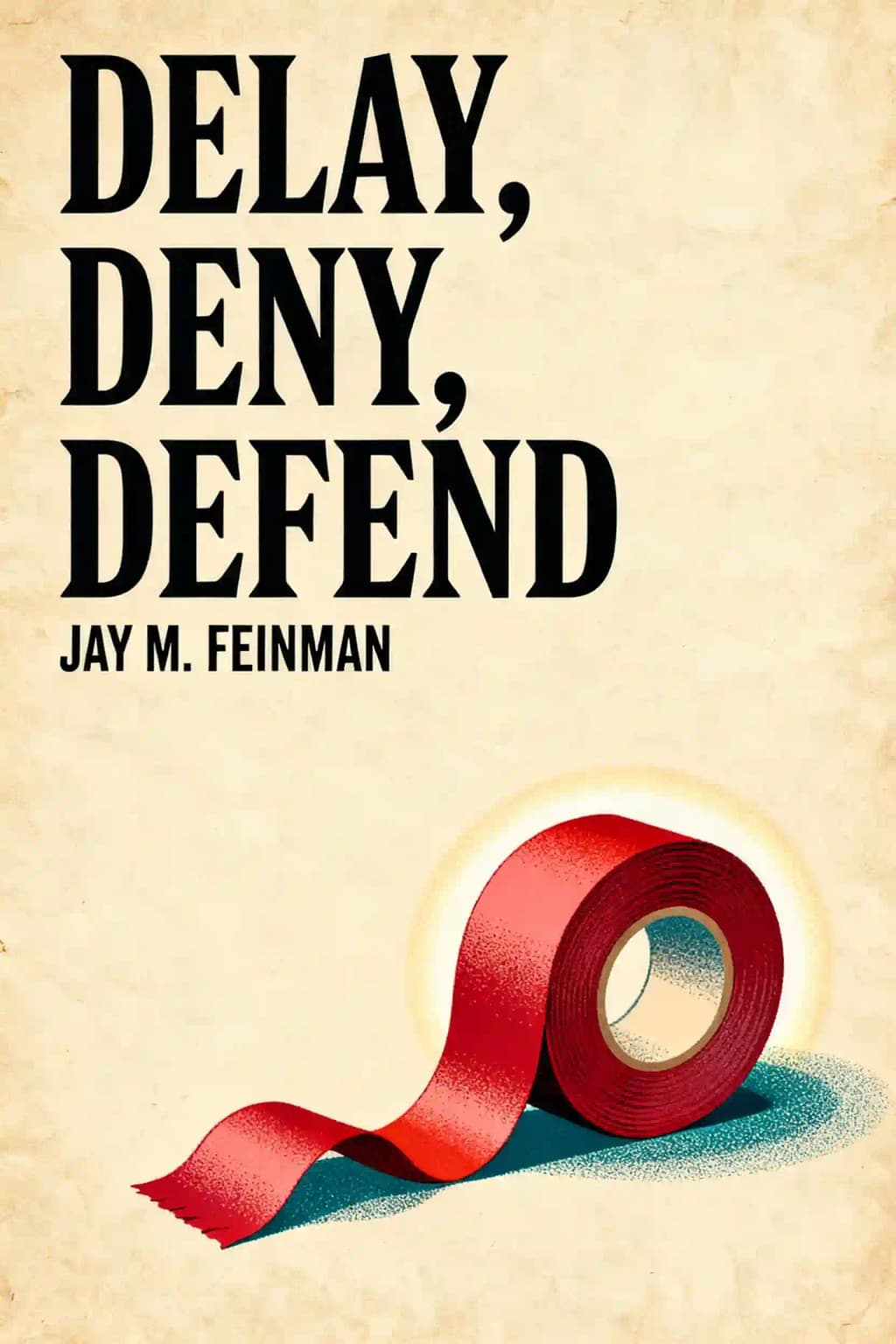
Insurance is meant to be your safety net, the financial guardian that protects you when disaster strikes. Yet increasingly, Americans are discovering a troubling reality: the companies they trust to protect them are systematically breaking their promises. Delay, Deny, Defend by Jay M. Feinman exposes how insurance giants like Allstate and State Farm transformed from service-oriented protectors into profit-maximizing machines that routinely deny valid claims. The book became a New York Times bestseller upon its 2010 release, with consumer advocate Ralph Nader calling it "required reading for anyone concerned about the corruption of insurance in America." Even Warren Buffett, whose Berkshire Hathaway owns GEICO, admitted in a shareholder letter that insurance companies profit most when they collect premiums and avoid paying claims-exactly the dynamic Feinman examines. When your wheel falls off causing injury, or your home floods from a burst pipe, will your insurance company stand by you or leave you fighting for years? This book reveals the systematic tactics that leave millions of Americans vulnerable precisely when they need protection most.
Глава 2
The Insurance Promise and How It Works
Insurance operates on a fundamental principle dating back to Benjamin Franklin's Philadelphia Contributionship in 1752: risk sharing among many to protect individuals from uncertain losses. When you pay premiums, you're essentially trading a small, certain cost for protection against potentially devastating financial losses. This exchange relies on trust-you trust the insurance company will be there when needed, and they trust that not everyone will suffer losses simultaneously.
Behind the scenes, insurance companies employ actuaries who analyze statistical data about accident frequencies, repair costs, and demographic factors to establish pricing structures. Underwriters then define policy limitations and coverage terms before marketers sell these products to consumers. The business model aims for companies to pay out less than they collect-in 2007, the property/casualty industry earned $451 billion in premiums while paying $251 billion in claims, a "pure loss ratio" of 56%.
This ratio has "improved" from the industry's perspective, dropping from 67% in 1987 to 56% twenty years later. Beyond direct claim payments, companies incur "loss adjustment expenses" (adjusters' salaries, offices) totaling $54 billion in 2007, plus another $121 billion in underwriting, commissions, marketing, and overhead.
What makes insurance unique is the "float"-the time between collecting premiums and paying claims-which generates substantial investment income. As Warren Buffett explained, "float is money we hold but don't own." This investment potential creates a fundamental tension: every dollar not paid in claims and every day payment is delayed increases profit. This tension becomes problematic when companies prioritize profit over their promise to policyholders.
Insurance isn't just another product-it's the great protector of middle-class American living standards, securing homes, cars, education, and retirement against life's uncertainties. This trillion-dollar industry processes millions of claims annually, with State Farm alone handling twelve million claims each year. When functioning properly, insurance provides not just financial compensation but peace of mind and stability during life's most challenging moments.
But what happens when this promise is broken? What happens when the system designed to protect us becomes weaponized against us?
Глава 3
The Delay, Deny, Defend Playbook
Insurance fails when companies break their fundamental promise: to pay claims promptly and fairly. The breakdown occurs when insurers prioritize profits over policyholders by implementing a systematic "delay, deny, defend" strategy.
The first tactic-delay-wears down claimants while increasing investment income from the float. Every dollar held and every day delayed means more profit. Vulnerable claimants facing mounting medical bills or rebuilding costs face increasing pressure to accept lowball offers. Some insurers simply stall, as with Kim Zilisch's case against State Farm after a devastating accident. Others deploy excessive investigation tactics, as Theodore Price experienced with NJM's decade-long delay, or Terry Buttery faced with Hamilton Mutual's deliberate stalling after his home was burglarized.
After grinding victims down through delay, insurers often deny valid claims through "lowballing" and "stonewalling" tactics. Companies may use unreasonable policy interpretations, as State Farm did with Kristen Dhyne's uninsured motorist claim, or make unfounded medical judgments, like 21st Century's baseless rejection of Reagan Wilson's injury claim. Some even resort to intrusive investigations, exemplified by Progressive hiring investigators who infiltrated Leandra Pitts's church under false pretenses.
For claimants who persist, insurance companies deploy aggressive litigation strategies to wear down all but the hardiest. The SFXOL approach-"Settle For X Or Litigate"-presents take-it-or-leave-it offers based on predetermined computer calculations. When litigation ensues, insurers implement DOLF-"Defense Of Litigated Files"-fighting claims "to the teeth" with protracted discovery, extended pretrial processes, and expensive trials. Companies often spend far more defending MIST (Minor Impact, Soft Tissue) cases than fair settlement would cost, knowing few attorneys can afford to pursue these claims.
Consider Marc Goddard's case. After he was killed in a collision with a drunk driver insured by Farmers, the company let the case "ripen" despite clear liability. Even after the driver was convicted of manslaughter, Farmers denied he was drunk or caused the collision. Refusing reasonable settlement offers, Farmers stonewalled until trial, where the jury awarded $863,274. Farmers' bad faith ultimately cost them $2.7 million in punitive damages.
Or Leslie Joe Nance's experience. When he filed an uninsured motorist claim after suffering serious injuries in an accident where the other driver was clearly at fault, Kentucky National created "bogus issues" to delay payment. They falsely claimed brake defects and speeding, hired investigators to follow the injured Nance, forced him to travel for unnecessary medical exams, and dragged litigation for years. Despite expert valuations of $750,000-$1.3 million, they offered only $60,000 on the eve of trial, after the financially devastated Nance had been "beat down."
These aren't isolated incidents. Delay, deny, defend is so widespread that even defense lawyers admit insurers fight cases with "no good defense" as a "business decision." The practice is so common that specialized "Claims Dispute Insurance" now exists to protect against wrongful denials. Despite media exposes by major outlets, insurance companies dismiss these cases as mere "anecdotes." The true extent remains unknown because most consumers never complete the "naming, blaming, and claiming" process. Many don't recognize wrongful denials, know their rights, or pursue complaints.
Глава 4
The Perfect Storm: How We Got Here
How did we arrive at this troubling state of affairs? The origins of delay, deny, defend as a corporate strategy emerged from a confluence of factors in the 1990s that fundamentally transformed the insurance industry.
The story begins with an unusually extended soft market (1988-2000) combined with a series of catastrophic natural disasters. Auto insurance faced particular pressure as injury costs rose 140% over a decade, far outpacing inflation. Then came devastating natural disasters: Hurricane Hugo (1989), Hurricane Andrew (1992), the San Francisco earthquake (1989), the Northridge earthquake (1994), and major wildfires. Hurricane Andrew alone caused $16 billion in insured losses, bankrupted eleven companies, and depleted reserves of thirty others. The Northridge earthquake generated 600,000 claims totaling $15 billion, with companies like State Farm paying out nearly triple what they'd collected in premiums.
These financial pressures triggered new corporate strategies. Farmers Insurance, after having its quality rating downgraded, launched "Bring Back A Billion"-requiring all employees, including claims staff, to help restore capital surplus by reducing costs, primarily claims payments. Allstate took a different approach after suffering nearly $2 billion in losses in 1992. Following its separation from Sears through a 1993-1995 stock offering, Allstate's executive compensation became directly tied to company profitability.
Simultaneously, the insurance industry underwent a fundamental shift from policyholder orientation to shareholder value maximization. Richard Stewart, former superintendent of insurance for New York, noted the direct effect on claims: "Through dividends and appreciation, stockholders get the benefit of what is not paid out for claims." This shift manifested in dozens of insurance companies demutualizing-converting from mutual companies owned by policyholders to stock companies answerable to shareholders.
The 1990s also saw a vicious war for market share fought mainly through price cutting in auto insurance. This competition was enabled by new flexibility in premium rate-setting following decades of industry cartels and regulated pricing. As insurance became treated more like a commodity, price became the dominant factor in consumer decisions. State Farm's market share fell from 21.6% to 18.9% between 1995-1999, while direct marketers GEICO and Progressive gained ground.
GEICO transformed the industry by pioneering direct marketing instead of using agents. Originally limiting its clientele to government employees as a substitute for agent screening, GEICO's model proved so successful that Warren Buffett eventually acquired the entire company for Berkshire Hathaway. By 2007, Allstate had followed suit, cutting 12% of its workforce and expanding into call centers and internet sales to reduce annual expenses by $600 million.
Insurance companies entered what Allstate CEO Edward Liddy called "an advertising arms race." While traditional advertising emphasized security and claims payment reliability (like Allstate's "You're in Good Hands" and State Farm's "Like a good neighbor"), modern campaigns increasingly focused on price. GEICO's "Fifteen minutes could save you 15 percent" became the new standard, supported by quirky campaigns featuring geckos and cavemen that helped increase its market share from 5.1% to 7.2% between 2003-2007.
This perfect storm of financial pressure, shareholder demands, and price competition set the stage for the most transformative development in modern insurance claims handling: the arrival of McKinsey & Company.
Глава 5
McKinsey Reengineers the Claims Process
At precisely this moment of industry vulnerability, Allstate hired McKinsey & Company to reengineer its claims practices to make them more profitable. This decision would transform not just Allstate but the entire industry's approach to claims handling.
McKinsey wasn't merely documenting changes but actively architecting them. Founded in 1926 by accounting professor James McKinsey and built by Harvard-educated Marvin Bower, the firm became the gold standard in management consulting, serving 147 of the world's 200 largest corporations with annual fees reaching $10-50 million. Their approach involved gathering extensive facts, defining problems, generating initial hypotheses, and implementing "immoderate redesign" that fundamentally transformed organizational cultures.
McKinsey's own white paper "Factory and Firm: The Future of Claims Handling" chronicles the transformation of claims processing. In the 1970s, claims was viewed as an art where experienced adjusters had autonomy to determine fair claim values based on underwriting promises. By the 1980s, cost pressures led to efficiency measures focused on reducing loss adjustment expenses. The pivotal shift came in the 1990s when McKinsey introduced the concept of "leakage"-the gap between what companies were paying and what they could minimize payments to-creating "huge indemnity opportunities" by spending strategically on claims processes that would ultimately reduce payouts.
McKinsey's strategy for Allstate and other insurers explicitly framed claims as a "zero sum game" to be won through "better plays and new game plans" followed by changing the rules entirely. Allstate chairman Jerry Choate explained in 1997: "If we don't win on the claim side of this business we don't win. Because that's where all the leverage is." The strategy worked-by 2007, Allstate reported a Property-Liability combined ratio below 90 percent, which they explicitly linked to their "ability and commitment to shareholder value."
McKinsey implemented similar profit-centered claims systems across the insurance industry. At State Farm, Claims VP G. Robert Mecherle told superintendents in 1986 that the bottom line meant "being better than the competition in everyday claim handling" by focusing on loss ratio. "You can't do a whole lot about the frequency but severity is strictly in our ballpark." State Farm's program, called Advancing Claims Excellence (ACE), focused on identifying "shortfall" (the difference between what was paid and what should have been paid) without any corresponding measure for underpayments.
Farmers Insurance developed its own acronym-laden program called ACME (Achieving Claims Management Excellence). While its manual claimed noble principles like "We pay what we owe, nothing more, nothing less" and "We will do everything in our power to restore people's lives to order," the operational focus was identical to competitors: identifying "overpayments or leakage" to "control loss costs."
Across the industry, McKinsey's principles transformed claims from a service operation into a profit center by systematically reducing payments to policyholders and claimants through comprehensive redesign of the claims process.
Глава 6
From Professional Judgment to Assembly Line Processing
The transformation of insurance claims departments into profit centers fundamentally altered how claims are handled. Once centered around experienced adjusters using their judgment, the modern claims process now relies on rigid systems that prioritize corporate profits over fair settlements.
The traditional claims adjuster-once romanticized as a professional combining "brains and integrity" who needed to be "a doctor, and a bloodhound, and a cop, and a judge"-has been systematically deskilled. In the 1970s, adjusters exercised substantial discretion with the goal of settling claims fairly, even telling researchers "We are not in business to chisel the public." Today's adjuster, like Bob Parr in "The Incredibles," is reminded that the company helps "our people, starting with our stockholders" rather than claimants. Modern adjusters have less independence, spend careers inside offices rather than in the field, and function primarily as data-entry specialists within highly structured systems.
Claims handling has been industrialized, with specialized units processing specific claim types. This factory-like approach requires less skilled workers, with many companies providing minimal training. The knowledge is built into the system rather than held by adjusters, who primarily input data. Courts have characterized adjusters as "rank and file production workers" handling only "routine and unimportant" tasks. Systems dictate process and results, with adjusters evaluated on adherence rather than judgment. One Farmers adjuster was "repeatedly and severely criticized for using discretion and judgment" in claims evaluation.
Information technology drives these systems through programs like Claims Desktop, ClaimSearch, and Allstate's $125 million Next Gen system. Two widely used programs are Colossus (for valuing bodily injury claims) and Xactimate (for estimating property repairs), both subject to manipulation by insurers despite their claims of precision.
Insurance companies have fundamentally transformed how they evaluate adjusters, following McKinsey's principle: "We get what we measure." Rather than tracking claim processing speed, companies now primarily measure severity-the average paid per claim. Adjusters' compensation, bonuses, and job security increasingly depend on meeting targets for reducing payouts, despite this practice being ethically questionable and sometimes illegal.
Allstate gave adjusters small but frequent bonuses on company credit cards for meeting payout reduction goals. State Farm avoided documenting numerical targets while still pressuring adjusters in meetings. Farmers Insurance implemented elaborate programs like "Partners in Progress," "Bring Back a Billion," and "Quest for Gold," explicitly tying compensation to combined ratio improvement-which adjusters could only impact by reducing claim payments.
When claimants refuse low settlement offers, insurance companies deploy tightly managed litigation strategies. Following McKinsey's recommendation that litigation management could save millions, insurers transformed defense attorneys into "superadjusters"-the next step in systematic claims processing. Companies now control legal costs through internet-based bidding systems for cases, auditing software for bills, and flat-fee arrangements instead of hourly rates. Attorneys must follow detailed litigation plans and obtain approval for routine litigation steps.
McKinsey's 1994 Allstate strategy explicitly recommended "significantly higher levels of litigation" not to win individual cases but to "establish more consistent values"-making claimants accept unfair offers knowing litigation costs would exceed potential recovery. One defense lawyer lamented: "It's getting to the point where it's almost an adversarial relationship... like the companies who are hiring us don't trust us enough to do the best job."
Глава 7
Segmentation: Targeting Auto Claims and MIST Cases
Auto insurance represents the largest segment of noncommercial property/casualty insurance, with Americans spending $160 billion annually-three times the amount spent on homeowners insurance. With companies paying $90 billion in claims yearly, this area presents the greatest opportunity for implementing delay, deny, defend strategies to increase profits.
Insurance companies have recognized that treating different types of claims differently-what they call "segmentation"-can maximize their financial gains. Segmentation reverses traditional claim handling. Instead of treating each claim individually based on its unique facts to provide fair compensation, claims are now categorized and processed systematically. McKinsey's redesign of Allstate's claims process explicitly divided claims into "homogenous groups" with tailored strategies for each segment. Their analysis quantified potential profit increases of 15% in reduced payouts plus 1% in expense reduction, totaling $550-600 million in "opportunity."
One key segmentation strategy focuses on keeping attorneys out of the process. McKinsey's studies confirmed the obvious: represented claimants recover significantly more money-90% more in uninsured motorist claims and two to five times more overall. Their solution wasn't to pay unrepresented claimants fairly, but to "focus on reducing the need for attorney representation." Insurers employ tactics like early contact, empathetic handling, and quick property damage resolution to build trust while discouraging legal representation. Adjusters use scripted language that emphasizes attorney costs (25-40% of settlement) without mentioning the substantially higher recoveries attorneys typically secure.
Allstate's "Quality Service Pledge" promises fair treatment while actively discouraging attorney involvement. In Priscilla Young's case, despite suffering serious injuries in a rear-end collision where liability was clear, Allstate offered just $5,300 against $6,000 in medical expenses alone. When she finally sued, a jury awarded her $198,971. Similarly, adjuster Christy Klein built a "trusting relationship" with accident victim Janet Jones before sending her a release that would have eliminated claims against both the at-fault driver and potential product liability claims against Chrysler for a defective seatbelt.
MIST (Minor Impact Soft Tissue) claims represent a particularly controversial but profitable segment for insurers. These involve low-speed accidents with modest vehicle damage and soft-tissue injuries like whiplash that aren't easily visible on diagnostic tests. The insurance industry has long targeted these claims, dating back to the Defense Research Institute's 1960s publications attacking "whiplash" as psychological or fraudulent.
McKinsey identified MIST claims as an "opportunity" for Allstate, recommending aggressive defense with "no compromise settlements." The strategy: treat small cases as major litigation, exploiting "the economics of the practice of law" by making litigation costs exceed potential recovery. This approach forces claimants to accept minimal settlements or abandon claims entirely. The strategy reduced Allstate's average MIST payouts by 38%, from $4,500 to $2,783, projecting $100-150 million in increased profits.
Soft tissue injuries have a complex medical history dating back to "railway spine" in the 1860s. Charles Dickens described experiencing delayed symptoms after a train crash, including weakness and dizziness days after appearing only "shaken" initially. The National Institute of Neurological Disorders recognizes these injuries can cause delayed symptoms including neck stiffness, muscle and ligament damage, headaches, dizziness, and various neurological symptoms.
Insurance companies implement the MIST strategy systematically. Adjusters first identify potential "fraud" cases to transfer to special investigations. For remaining claims, they offer nominal settlements on a take-it-or-leave-it basis. If rejected, companies launch exhaustive investigations including complete medical and employment records reviews, biomechanical experts, accident reconstruction, surveillance, and insurance company medical examinations. They use medical-bill review systems to reduce reimbursements and software like Colossus to minimize pain and suffering valuations.
Глава 8
Homeowners Insurance: The Complex Game of Claim Denial
Homeowners insurance evolved from marine insurance traditions dating back to Edward Lloyd's London coffeehouse in the 17th century. Modern homeowners policies emerged in the 1950s when regulators allowed companies to offer both property and liability coverage together. Today, 96% of homeowners carry insurance, paying $55 billion in annual premiums, with an average cost of $804 yearly.
Homeowners policies are notoriously complex documents. The standard HO-3 policy contains numerous pages of declarations, definitions, covered properties, covered risks, exclusions, conditions, and liability coverage. "All risks" coverage for dwellings sounds comprehensive but actually contains fifteen paragraphs of exclusions with various exceptions to those exclusions. Personal property receives only "named peril" coverage with additional limitations. This complexity allows insurance companies to manipulate claims, as McKinsey advised Allstate to achieve a "positive impact on severity" (paying less) while maintaining customer satisfaction.
Every homeowners claim involves complex policy interpretations and unique facts. For homeowners to receive what they're owed, they must understand their coverage-but policy complexity means most rely entirely on what adjusters tell them. Adjusters have a legal responsibility in many states to disclose all benefits, coverages, and time limits, yet they frequently fail to meet this obligation. When a homeowner reports a collapsed chimney, the adjuster might correctly state that "collapse" is excluded without explaining that damage from lightning, falling objects, or wind would still be covered.
Proper investigation frequently fails due to inattention, carelessness, or worse. In a 2007 California case, Allstate denied Mary Ann Jordan's claim for fungus damage by classifying it as excluded "rot" but failed to investigate potential coverage under the policy's collapse provisions-despite warnings from experts that the house was in "imminent danger of collapse." The company left evaluation to an adjuster with no background in structural engineering.
Sometimes investigations appear deliberately inadequate. When Ioan and Liana Nicolau discovered foundation cracks in their Texas home, multiple experts determined leaking sewer lines were causing soil to swell and damage the structure-a covered cause. State Farm hired Haag Engineering, which concluded without examining the pipe or taking soil samples that the leak didn't affect the foundation. Evidence revealed Haag conducted 80-90% of its work for insurance companies and had a "general opinion" that leaks couldn't cause foundation damage.
The traditional adjuster with "vast knowledge of property values, costs, and methods of repair" has been replaced by "a guy with a ladder and a laptop." Xactimate software produces cost estimates from regional pricing databases updated monthly, taking "the guesswork out" and making handwritten claims "essentially over." Common scoping errors include failing to specify all necessary repairs, taking inaccurate measurements, not accounting for material waste, and improperly calculating wall dimensions.
Even when claims are settled, homeowners often don't receive what they expected. While many homeowners purchase "replacement cost" insurance to fully protect themselves, this coverage has been significantly weakened. After catastrophic losses from 1990s natural disasters, companies eliminated "guaranteed replacement cost" coverage that paid full rebuilding costs regardless of policy limits. Today's replacement cost policies contain multiple limitations: coverage applies only if insurance equals at least 80% of full replacement cost; payment is capped at policy limits; and companies often interpret "equivalent construction" narrowly.
Underinsurance is rampant-over two-thirds of homes nationwide are underinsured, and United Policyholders reports 75% of California homeowners affected by 2007 wildfires were underinsured by an average of $240,000. Insurance companies have little incentive to ensure full coverage, as additional premiums may not justify the risk, especially with price competition keeping premiums low.
Глава 9
The Insurance Fraud Smokescreen
The insurance industry has developed a vigorous campaign to convince the public that insurance fraud, not company misconduct, is the real problem. They categorize fraud as "hard fraud" (faking losses) and "soft fraud" (exaggerating claims), with colorful terms like "fibbers," "padders," and techniques such as "swoop and squat." The Coalition Against Insurance Fraud defines insurance fraud broadly but targets only policyholders, not companies that defraud customers.
This campaign represents sophisticated social marketing that directly benefits insurers. It combines narratives of "the immoral insured" and threats to public interest, claiming fraud increases during disasters like Hurricane Andrew, 9/11, and the mortgage crisis. The industry promotes dramatic statistics: fraud supposedly costs $30 billion annually, with 10% of claims payments attributable to fraud.
However, these figures come from the insurance industry itself. A more reliable Massachusetts study found that of 17,274 fraud referrals over ten years, only 368 involved provable criminal fraud-suggesting actual fraud rates below 0.5%, not the claimed 10%.
The modern campaign against insurance fraud began in the early 1990s, coinciding with McKinsey's redesign of claims processes. Organizations like the National Insurance Crime Bureau (NICB) and Coalition Against Insurance Fraud (CAIF) were formed to coordinate enforcement and marketing efforts against fraud. The industry developed a sophisticated three-part strategy: creating national databanks of fraud claims, marketing insurance fraud as a crisis through media campaigns, and partnering with legislators to create new anti-fraud laws.
The insurance industry's campaign has been remarkably successful in shaping public perception, with polls showing 78% of people concerned about insurance fraud and 92% believing it leads to higher rates. Ironically, this aggressive anti-fraud environment may actually encourage fraudulent behavior, as noted by risk consultant Thomas Laffey who observed that treating policyholders honorably would significantly reduce fraud.
The fraud narrative has transformed the claims process, with adjusters now functioning more as investigators than helpers. Adjusters are trained in "interrogation with a smile" techniques-appearing supportive while searching for evidence of fraud. Companies use elaborate "red flag" systems that assign point values to claim characteristics, with accumulated points triggering fraud investigations. These systems often flag legitimate claims by treating common circumstances as suspicious-such as multiple family members injured in the same accident or patients seeing the same doctor.
The Camerons' case illustrates how allegations of fraud are weaponized in claims processing. After their Dallas home burned from arson while they were away, Texas Farmers Insurance initially paid for temporary living expenses but then denied their claim, citing "red flags" such as their absence during the fire, modest savings, previous claims history, and a recently purchased policy. However, Farmers failed to conduct a proper investigation that would have revealed the Camerons couldn't have set the fire, they were financially stable with $90,000 annual income, had no gambling debts, and actually suffered financial loss from the fire.
Глава 10
Protecting Yourself in a Broken System
Insurance companies aren't your friends despite their warm, fuzzy commercials-they're businesses focused on profit, which means paying less on claims. Yet they aren't your enemies either, as they need to maintain reputation and retain customers. This special business relationship is governed by specific duties insurers owe policyholders when handling claims, including prompt action, policy explanation, claim assistance, fair investigation, and payment without forcing litigation.
Start by avoiding companies with poor claim-handling records. Check state insurance departments' websites for complaint data, the National Association of Insurance Commissioners' Consumer Information Source, and Consumer Federation of America reports. Consumer Reports surveys show Amica, USAA, and Chubb provide better-than-average claim handling, while Farmers, Allstate, and Travelers rate worse.
Careful policy selection prevents future claim problems. Auto policies are relatively standardized, but homeowners policies contain fine print that often contradicts consumer expectations. "All-risks" policies actually exclude numerous perils, while "replacement cost" coverage rarely covers full replacement. Consider supplemental disaster insurance for floods, earthquakes, or wind if you live in vulnerable areas. Read exclusions carefully and purchase riders for specific risks like oil tank leaks. To avoid underinsurance, obtain accurate replacement cost estimates from agents or contractors, and consider extended replacement-cost endorsements for additional protection.
When filing claims, remember three lessons: understand your coverage, understand the claims system, and get help when needed. Start by surveying your policy's forms and endorsements, determining coverage for your loss, identifying additional coverages, learning payment procedures, and rereading for clarity. Recognize that adjusters operate within a profit-driven system, not as independent actors. Approach claims by being polite, prompt and persistent while documenting everything thoroughly. Provide necessary documentation but know what isn't required. Question computer-generated estimates like Xactimate or Colossus, as contractor estimates are often more accurate.
The decision to hire professional help depends on your claim's complexity and your personal circumstances. For minor fender benders, self-representation makes economic sense. For serious injuries or complex homeowners claims, professional help is essential. Consider whether you have the expertise, time, resources, and emotional detachment to handle the claim yourself. Lawyers typically charge hourly or contingent fees, while public adjusters take 10-15% of your recovery. Despite insurance companies discouraging representation, bringing in professionals helps even the odds against experienced claim handlers.
Глава 11
Reforming the System: Transparency, Accountability, and Regulation
The problem of insurance companies that delay, deny, and defend is substantial. While the exact scale remains unknown, thousands of policyholders aren't receiving their rightful benefits, and public confidence in the insurance industry is eroding as awareness grows. Consumers can take steps to protect themselves, but they cannot prevent or cure bad practices that persist due to inadequate regulatory oversight.
Insurance is America's most heavily regulated business, yet the system fails to protect consumers from unfair claim practices. Insurance regulation began at the state level through charter conditions, with early efforts focusing on company solvency following disasters like the 1835 Great New York Fire. The McCarran-Ferguson Act preserved state regulation, which continues today despite proposals for federal oversight.
Government regulation of insurance rests on two principles: first, insurance affects the public interest by controlling access to financial security and the middle class; second, insurance markets work poorly without oversight. "Destructive competition" can drive prices too low, leading to insolvency and unpaid claims. Insurance policies are difficult for consumers to evaluate, and market-based decisions can produce socially unacceptable results like discriminatory redlining.
Insurance regulators perform three functions with varying degrees of success. They excel at regulating solvency through licensing, financial reporting requirements, and investment controls. They do reasonably well regulating rates to ensure they're adequate without being excessive or discriminatory. However, they perform poorly on market conduct regulation, including claims practices, which receives minimal attention and resources.
There's a simple if cynical explanation for why claims practices regulation fails while solvency and rate regulation succeed: the interests of insurers and consumers diverge most widely in claims handling, and insurers wield greater influence with regulators. Many industry executives view regulators as "part of the industry," not separate entities. The revolving door between regulation and industry is constantly spinning-half of all state insurance commissioners over a seventeen-year period went to work for insurance companies after leaving office.
Expanding the NAIC's market conduct project is crucial for reform. Regulators should require insurers to publicly report claims data including claims opened and closed, payment rates, processing times, litigation frequency, settlement outcomes, and payment adequacy. Despite industry resistance claiming such information is "proprietary" or "trade secrets," this transparency would allow consumers to make informed choices.
Most states have adopted the NAIC's Model Unfair Claims Settlement Practices Act, but these laws need strengthening. Two critical flaws must be fixed: First, the requirement that violations must occur "with such frequency as to indicate a general business practice" before punishment-a bizarre qualification that essentially makes first offenses free. Second, some statutes only protect "insureds" rather than both "insureds and claimants," leaving accident victims vulnerable.
Every state allows policyholders to sue for "bad faith" claims handling, but these laws vary widely. Studies show claims payments are higher in states with strong bad faith laws. The legal standard should be strengthened-currently companies must have "known or recklessly disregarded" their lack of reasonable basis, giving them too much latitude to act carelessly. Instead, the standard should reflect policyholders' reasonable expectations of fair treatment.
Insurance fraud perpetrated BY insurance companies should be prosecuted, not just fraud against them. Systematic corporate delay-deny-defend programs should be criminalized, with executives facing real consequences. As one observer noted, "video on the evening news of the claims vice president being hauled away in handcuffs" would effectively change behavior.
The insurance industry transformed itself from a service-oriented business into a profit-maximizing machine that routinely breaks its promises to policyholders. Through systematic delay, deny, defend tactics engineered by management consultants, companies have found ways to increase profits at the expense of the very people who rely on them for protection. Until meaningful reform occurs, consumers must arm themselves with knowledge and vigilance to ensure they receive the protection they've paid for when disaster strikes.