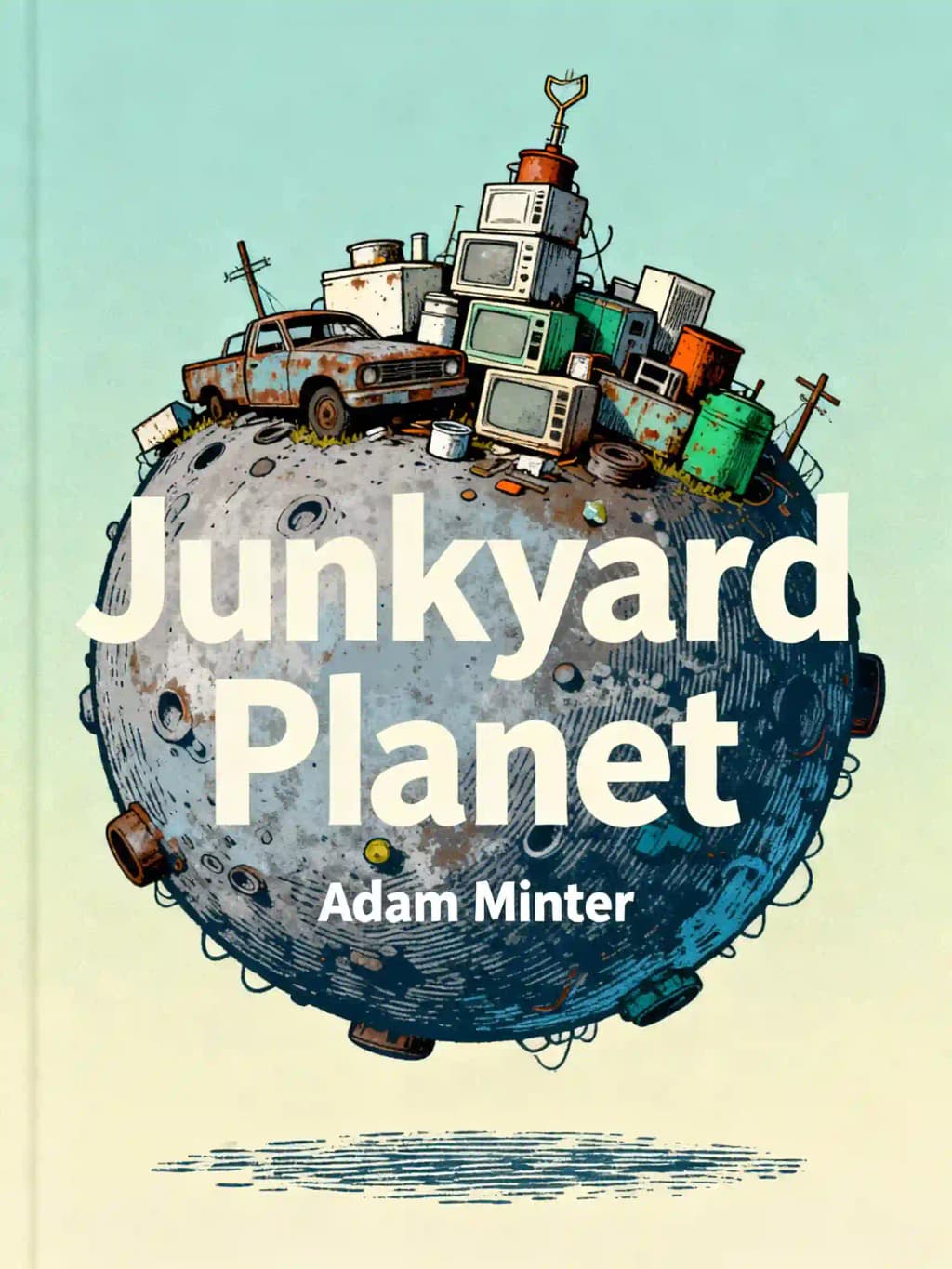
Junkyard Planet
Travels in the Billion-Dollar Trash Trade
Overview of Junkyard Planet
Discover how your trash becomes treasure in the billion-dollar recycling industry. "Junkyard Planet" reveals the surprising economics behind global waste, challenging environmental assumptions with vivid storytelling that earned it "Best Non-Fiction" honors and sparked crucial conversations about consumption's true cost.

Key Themes in Junkyard Planet
- global scrap trade
- recycling economics
- waste commodity markets
- industrial resource recovery
- entrepreneurial waste management
Quotes from Junkyard Planet
One person's trash becomes another's treasure.
Recycling isn't driven by altruism but by market forces.
Chinese recognize that recyclables have monetary value.
Recycling has always been about economics first.
Without extraterrestrial mining, reusing existing materials remains our best option.
Characters in Junkyard Planet
- Adam MinterAuthor and journalist from a scrapyard family
- Raymond LiOwner of Yong Chang Processing in Shijiao, China
- Alan BachrachManager at a Houston Waste Management facility
- Leonard FritzFounder of Huron Valley Steel Corporation
About the Author
About the Author of Junkyard Planet
Adam Minter is the acclaimed author of Junkyard Planet: Travels in the Billion-Dollar Trash Trade and a leading voice on global recycling and sustainable economies.
A Bloomberg Opinion columnist covering China, technology, and the environment, Minter’s work is rooted in his multigenerational scrap industry heritage—his family has operated scrap yards for over a century. This deep personal connection informs his exploration of the intricate networks transforming discarded materials into valuable commodities.
His critically acclaimed debut, Junkyard Planet, unravels the environmental and economic realities of international waste trade, while his follow-up, Secondhand: Travels in the New Global Garage Sale, examines the lifecycle of used goods.
Recognized with the Stephen Barr Award for investigative journalism, Minter’s insights have been featured in prominent platforms like TTBook.org and the Impact Podcast. Junkyard Planet remains a seminal work, praised for making complex supply chains accessible and highlighting recycling’s role in globalization.
Download Summary of Junkyard Planet
Get the Junkyard Planet summary as a free PDF or EPUB. Print it or read offline anytime.
FAQs About This Book
Junkyard Planet by Adam Minter explores the $500 billion global recycling industry, tracing how discarded materials like metals, plastics, and electronics are transformed into valuable resources. Through firsthand accounts from scrapyards in China, India, and the U.S., Minter reveals the economic interdependence between nations, environmental trade-offs, and how consumer habits fuel this hidden supply chain.
Environmental advocates, economics enthusiasts, and readers interested in global trade will find value in this book. It appeals to those curious about sustainability’s complexities, the circular economy, or the unseen journeys of everyday waste. Minter’s blend of memoir and investigative journalism also suits fans of narrative nonfiction.
Yes—it combines rigorous reporting with engaging storytelling, offering a rare look into an industry critical to modern consumption. Minter’s deep expertise (shaped by his family’s scrapyard) and global perspective make it essential for understanding how recycling sustains economies and mitigates environmental harm.
- Global interdependence: How developed nations’ waste fuels manufacturing in developing countries.
- Economic vs. environmental trade-offs: Recycling’s profitability often clashes with ecological goals.
- Cultural attitudes: Wealthier societies discard more, while others innovate with limited resources.
“The clean, crisp picture of waste dumping that exists in the West is an illusion... [It’s] the emergence of a truly global market in old goods.” This underscores how recycling is driven by demand, not altruism.
Minter acknowledges criticisms of labor conditions and pollution in developing-world scrapyards but argues recycling’s economic benefits often outweigh alternatives like landfills. He highlights innovations reducing environmental harm, like automated sorting systems.
While Junkyard Planet focuses on industrial recycling, Secondhand examines the global secondhand-goods trade. Both reveal hidden economies but differ in scope: one tracks raw materials, the other consumer reuse.
Minter contrasts U.S. “single-stream” recycling with developing nations’ labor-intensive methods. For example, Chinese entrepreneurs profitably repurpose U.S. scrap metal, while American consumers remain disconnected from waste’s afterlife.
As the son of a scrapyard owner and a journalist covering China, Minter combines personal nostalgia with decades of industry access. His reporting blends technical detail (e.g., metal grading) with human stories of waste pickers and magnates.
With circular economies gaining traction, the book clarifies challenges in scaling recycling sustainably. It remains a primer on balancing economic growth with environmental stewardship amid rising e-waste and climate pressures.
Some argue Minter downplays labor exploitation and pollution in unregulated recycling hubs. Critics also note his optimism about market-driven solutions contrasts with calls for stricter environmental regulations.
The book reframes trash as a commodity: an aluminum can’s value lies in its potential reuse, not its initial purpose. Minter shows how markets determine whether items are recycled, landfilled, or repurposed.