Глава 1
The Courage to Burn Your Boats
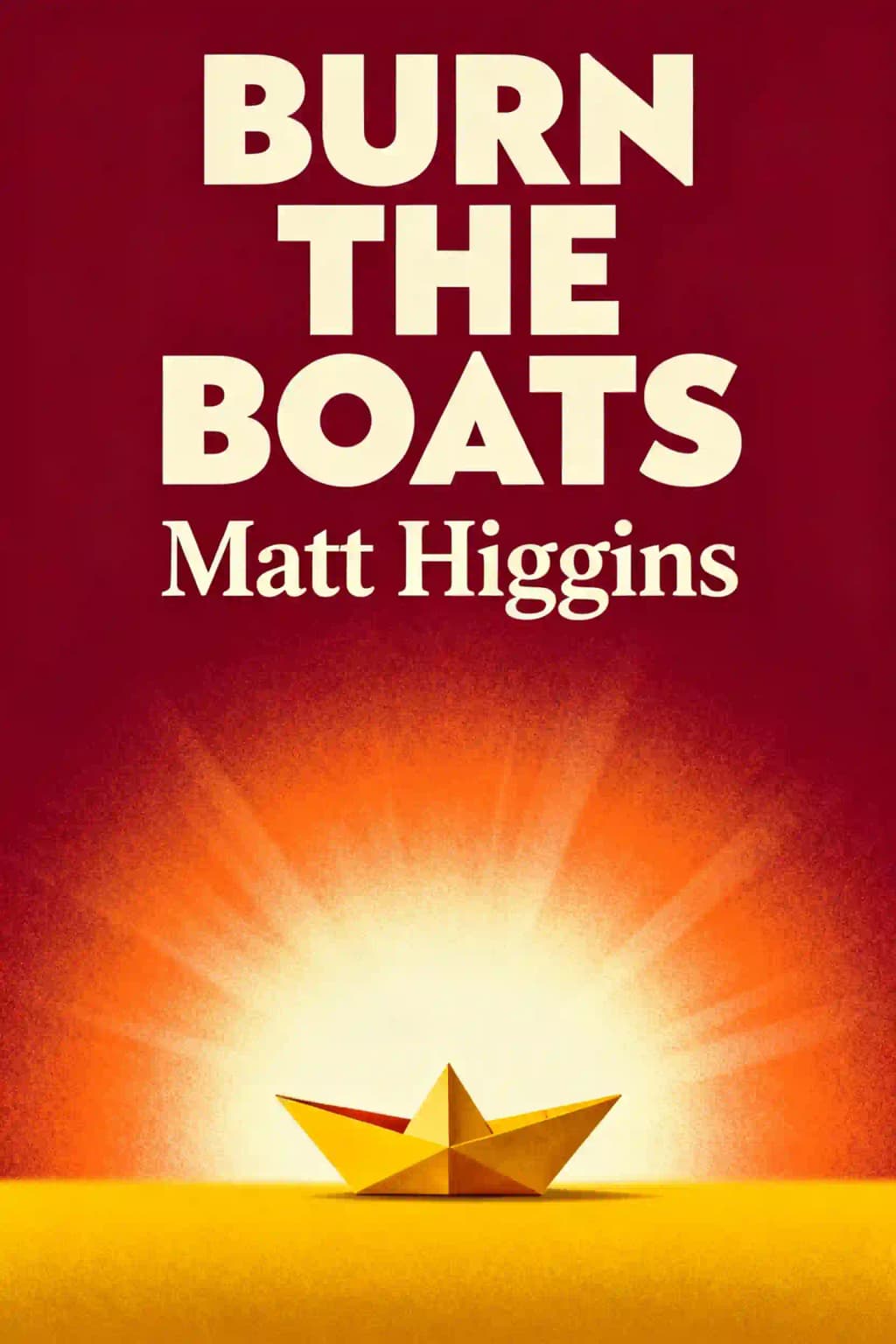
In a moment that would change his life forever, Matt Higgins sat behind a desk on a TV pilot set, reflecting on his extraordinary journey from a roach-infested Queens apartment to becoming a Guest Shark on Shark Tank. This transformation-from high school dropout to business leader-embodies the philosophy that drives his approach to life and success: Burn the Boats. When Oprah named it one of her most anticipated books of 2023, she highlighted its central message: to accomplish something truly great, you must give yourself no escape route. This philosophy has resonated with everyone from Silicon Valley entrepreneurs to professional athletes, offering a radical alternative to conventional wisdom that tells us to always build safety nets and backup plans.
Глава 2
Trust Your Instincts: The First Step to Greatness
Growing up in poverty with a desperately ill mother, Matt Higgins realized early that conventional paths wouldn't work for him. At fourteen, he hatched a plan to escape his circumstances: deliberately fail high school classes, take the GED at sixteen, and jump straight to college to access better-paying jobs. When he finally dropped out, his science teacher humiliated him, saying, "I'll see you at McDonald's." Matt fired back, "If you see me at McDonald's, it's because I own it."
His gamble worked brilliantly. He aced the GED, entered Queens College, and landed a job on a political campaign that launched his career. This experience taught him a crucial lesson: trust your instincts. We all have visions of our future that others don't validate or understand. As Emerson wrote, we dismiss our own thoughts "because they are ours." But listening to yourself is how you find your future.
When your vision contradicts conventional wisdom, making what Higgins calls a "gut sandwich" is essential-decisions that appear data-driven but are actually intuition wrapped in supporting evidence. Steve Jobs didn't rely on market research when creating the iPod; he solved his own problem of wanting his entire music collection in his pocket. Katrina Lake reimagined personal shopping with Stitch Fix, now generating $2 billion yearly. Jeff Bezos expanded Amazon far beyond books with his "Day One" philosophy.
This instinct-trusting muscle grows stronger with each use. When denied a promotion to deputy press secretary at 23, Higgins quit rather than wait his turn. The move paid off when City Hall called him back months later with the very position he wanted. Jason Feldman's career shows similar instinct-driven pivots-from State Department to retail to Amazon to healthcare, where his "generalist" background perfectly positioned him to pivot Vault Health toward COVID-19 testing during the pandemic.
Most importantly, your instincts are what will save you when things fall apart. April 2, 2001, Higgins' first day as press secretary, should have been triumphant. Finally earning enough to help his ailing mother, he ignored warning signs of her deteriorating health to start his new job. When she called an ambulance, he arrived at the hospital too late-"She passed away five minutes ago." Despite this devastation, he still had a professional future because he'd trusted his instincts along the way. The circumstances of your life don't make your journey inevitable-trusting your instincts gives you a way out, even when that inner voice strains to be heard.
Глава 3
Overcome Your Demons and Enemies
As children, we imagine that adulthood will bring wisdom and self-possession, freeing us from childhood traumas and inner demons. But that magical moment of complete clarity never arrives. Even after successfully managing crises like the 9/11 recovery effort and building a career with the New York Jets, Higgins still struggled with deep insecurities. When diagnosed with testicular cancer, he hid his condition and returned to work immediately after surgery, driven by fear of showing weakness.
When innovators pursue bold ideas, they inevitably face skepticism. Dave Chang encountered this when introducing the Impossible Burger at Momofuku Nishi in 2016. Critics, including the New York Post, ridiculed the concept, claiming no one would want vegan burgers. But Dave sensed the coming climate crisis and ethical trends toward plant-based foods before others did. His instincts proved right-Impossible Foods later reached a $4 billion valuation.
Rather than feeling wounded by criticism, view naysayers as sources of useful data and tests of your resolve. If you can't defend your idea against questioning, perhaps it doesn't deserve to exist. Haters often attack from their own brokenness, and understanding their motivations helps prevent their negativity from sticking. Critics typically fall into four categories: those missing information (like early critics of Maya Lin's Vietnam Veterans Memorial), those driven by envy (research shows executives make poor decisions after rivals win awards), those uncomfortable with change (like NFL executives resistant to social media), and those who fear your success will expose their mediocrity (Tall Poppy Syndrome).
The most impactful conversations are with ourselves. Research shows that using your own name rather than "I" in self-talk creates self-distance that makes pep talks more effective by creating a superego authority figure you don't question. Written affirmations are even more powerful-studies show students from marginalized groups who wrote about their important values received higher grades. We must train the voice in our head to be our ally and surround ourselves with "pragmatic optimists" rather than critics.
Our struggles often become our greatest assets. Dave Chang, despite his restaurant empire success, struggled with bipolar disorder. By going public with his mental health challenges, he connected deeply with audiences beyond the food industry. Similarly, photographer Isaac Wright transformed his 100-day jail sentence for trespassing into inspiration. Just one year after release, his NFT "First Day Out" became the highest-selling photograph ever, earning $6.8 million, with over $1 million pledged to help free inmates.
The highest achievers incorporate wins into their identity while extracting lessons from failures without letting those failures define them. This approach counteracts our evolutionary loss aversion-the tendency to feel losses more acutely than gains. As Sean Harper of Kin notes, "There's a limit to what you can lose... But on the flip side, you can gain so much."
Глава 4
Take the Leap: Overcoming Mental Barriers
Standing at the precipice of change requires overcoming the thoughts that hold us back. While instincts aren't perfect, great things don't happen when you stand still or leap half-heartedly. Four common mental barriers prevent us from taking necessary leaps:
First, the belief that "it's too risky." Jesse Derris was a PR genius who remained terrified of entrepreneurship despite his extraordinary talent. With encouragement from his girlfriend Jordana and $2 million in backing, he finally took the leap to start Derris and Company. Seven years later, BerlinRosen acquired his firm, making Jesse a self-made millionaire many times over. What seems risky often isn't-depending on others for your prosperity carries its own uncertainty. The safest bet is on yourself because you know what makes you tick.
Second, the belief that conventional wisdom must be right. Emmett Shine and his partners at Gin Lane made a radical decision to transition from marketing others' brands to creating their own company, Pattern. Within twelve months, Pattern was worth tens of millions-far exceeding Gin Lane's potential valuation. While colleagues questioned why they'd abandon success, they knew conventional wisdom keeps you in place-burning the boats gets you to the next level.
Third, the sunk cost fallacy. After four grueling years at Fordham Law during his time working for NYC post-9/11, Higgins received an offer from prestigious Skadden, Arps. But he realized the partner track would take at least eight years of tedious work, while his current role leading Lower Manhattan redevelopment was accelerating his career. Despite all he'd invested in his law degree, he returned the signing bonus and never took the bar exam. The right time to leap isn't when all hope is lost, but as soon as you see something better.
Fourth, the belief that you must stick with what you're best at. Sarah Cooper spent fifteen years in tech, designing Google Docs, but dreamed of comedy. She started with blog posts satirizing Silicon Valley, but found fame lip-syncing Trump press conferences on TikTok, eventually landing a Netflix special and guest-hosting for Jimmy Kimmel. Your skills don't evaporate when you change paths-they make you more effective in the long run.
Taking half-measures undermines success. Wharton researchers found that merely creating a Plan B reduces motivation and performance. Arnold Schwarzenegger explains: "Plan B becomes a safety net... and people perform better when there is no safety net." Going all in doesn't mean risking homelessness-use common sense to mitigate risk-but it does mean committing fully. Our relationship with risk is inverted-we don't need fully-formed solutions before taking action. Problems naturally generate solutions when we commit.
Глава 5
Optimize Your Anxiety: Finding the Performance Sweet Spot
When NFL coach Eric "Mangenius" Mangini wanted to prepare his Jets team for playoff chaos, he moved practices to a cavernous indoor field where the 120-foot ceiling created deafening echoes. He then blasted heavy metal and rap music so loudly players couldn't hear each other at the line of scrimmage, forcing them to communicate with hand signals amid chaos-exactly what he wanted. This deliberate discomfort exemplifies how properly channeled anxiety can drive peak performance.
Self-awareness is our greatest untapped resource. If you're comfortable, something's wrong-it means you have excess capacity and aren't maximizing potential. Research by Professors Woolley and Fishbach confirms that personal growth is driven by discomfort; subjects experiencing the most discomfort during emotionally risky activities showed the greatest growth. Only helicopters hover-humans are either ascending or descending.
At 45, Higgins craved proving himself academically, wondering how life might have been different without his difficult childhood. Though he couldn't attend Harvard as a student, he pursued teaching there instead. His anxiety drove him to extreme preparation-setting up a mock classroom at home, practicing penmanship, and constantly refining materials. The course became one of HBS's most popular intensives, with students calling it the most impactful experience of their education.
Fear can be a powerful catalyst when channeled correctly. At sixteen, working in Congressman Gary Ackerman's office for $9/hour, Higgins was terrified of being exposed as an unknowledgeable kid. When Ackerman's campaign manager needed help with a mail merge-something he'd never done before-he volunteered immediately despite having no computer experience. He stayed up all night teaching himself the process, eventually mastering it by morning. This early lesson taught him to make himself indispensable at any task.
While fear can drive success, unchecked anxiety can become devastating. Comedian Gary Gulman battled anxiety and depression throughout his twenty-year career, eventually requiring hospitalization and electroconvulsive therapy. Rather than returning to his old routines, Gulman channeled his struggles into a new show, "The Great Depresh," which HBO picked up with Judd Apatow producing. Critics marveled at how he transformed such dark material into something hilarious, launching his career to new heights.
When anxiety threatens to overwhelm, turn to science for reassurance. Data is power-finding a study that validates your approach can instantly dispel doubts. With eight billion people on earth, someone has likely faced whatever challenge you're confronting. Find that study or that person and learn from their experience.
Most wildly successful CEOs practice transcendental meditation-from Ray Dalio to Bill Gates to Arianna Huffington. Meditation boosts resilience, emotional intelligence, creativity, relationships, and focus. Start small habits but be consistent. The simplest anxiety-management strategy is often overlooked-admitting weaknesses and seeking help. When Mike Tannenbaum's anxiety-driven intensity threatened his career as Jets GM, he got help from an industrial psychologist, transforming both his office environment and management approach.
Глава 6
Embrace Each Crisis: Finding Opportunity in Disaster
The morning of 9/11, just months into his job as press secretary for NYC's Mayor's Office, Higgins was setting up for a press conference near the World Trade Center when the second plane hit. For the next hundred days, he managed the media response to history's worst terrorist attack, with barely any sleep. Though tragic beyond belief, this experience changed everything-he realized his traumatic upbringing had prepared him to manage through anything.
The first step in any crisis is finding a way to survive another day. When you don't know what to do, just show up. Michael Lastoria of &pizza exemplifies crisis survival during COVID-19. Instead of cutting jobs or freezing wages, he provided immediate $1/hour raises, free pizza for employees and hospital staff, commuting cost reimbursements, expanded sick leave, health and safety pay, paid time off for activism, a $15 minimum wage nationwide, and $500 vaccination bonuses. Though this meant pausing expansion plans, Michael knew survival meant doubling down on his people.
To manage any crisis, imagine the worst-case scenario and get practical. What do you need to survive? Processing the worst case frees your mind from fear and unlocks mental capacity for moving forward. Then ask yourself: "If I were starting from scratch today, what would I do?" Milk Bar founder Christina Tosi faced potential business collapse during COVID-19 store closures. Within days, she pivoted dramatically to e-commerce, launched a daily Instagram Live baking show that drew 50,000+ viewers per episode, and secured deals to sell her cookies in Whole Foods and Target nationwide.
There's an ancient Taoist parable about a farmer whose horse runs away. When villagers express sympathy, he simply responds, "Good, bad, who's to say?" The horse returns with two more horses; the farmer maintains the same perspective. When his son breaks his leg trying to ride one of these horses, the farmer remains philosophical. Later, war breaks out and all village boys except his injured son are sent to battle and die.
This wisdom applies to modern crises. What initially seems devastating often becomes the catalyst for unexpected growth. Taylor Lindsay-Noel's story exemplifies this transformation-a 14-year-old Olympic gymnast who broke her neck in a fall, becoming quadriplegic. Yet she found new purpose, creating a tea podcast, launching Cup of Te, making Oprah's Favorite Things list, and reaching million-dollar sales. She insists she's happier now than before her accident, calling it "a rebirth" that forced her to reexamine her identity.
Crisis forces action by limiting our choices to only those that ensure survival. Without crisis, we face a paradox of choice that often leads to paralysis. Harvard professor Francesca Gino's research shows that workers with no backup options outperform those with alternatives. By running toward challenges instead of away from them, we can find new and greater paths forward.
Глава 7
Break the Patterns That Stand in Your Way
Pattern recognition, honed through years as a reporter, helps us identify both opportunities and obstacles. These same patterns can either propel us forward or hold us back. The worst buyer's remorse comes from realizing you could have spotted issues in advance but failed to scrutinize the facts or ignored warning signs due to cognitive bias or overconfidence.
External obstacles often include wrong partners. A common pattern emerges when founders seek partners: believing they need industry experts, they recruit co-founders too entrenched in conventional thinking to innovate. Michelle Cordeiro Grant of Lively took a smarter approach. She listed her knowledge gaps, then built a network of specialists she could consult without surrendering control. Research shows solo founders have higher business survival rates, yet teams of two or more are more likely to build billion-dollar companies.
Bad investors can become roadblocks when they don't support your vision. The Juicero story exemplifies this-when investors forced out visionary founder Doug Evans in favor of a corporate executive, they doomed the company. The energy leakage from pandering to others' needs diminishes your chance of success. Don't give people power unless absolutely necessary.
Insufficient funding is another common obstacle. Kozmo.com, an ahead-of-its-time delivery startup, burned through hundreds of millions without achieving profitability. Founder Joe Park had incredible foresight about e-commerce's future, but the world wasn't ready yet. Unlike Amazon or Tesla, which survived their "death moments" with massive capital raises, Kozmo simply didn't have enough runway to wait for the market to catch up.
We also can't predict the timeline of success. If you're uncertain whether you're early or late to a market, you're almost certainly early. Structure your big bets to give yourself time to be right-it's impossible to predict exactly when you'll be right.
Internal obstacles can be equally challenging. Highly capable CEOs often fall into the trap of wanting to handle everything themselves, hiring reluctantly and holding employees to impossible standards. Great leaders must render themselves obsolete at virtually all tasks by hiring people better than themselves. Nicholas Horbaczewski from Drone Racing League exemplifies this by hiring Rachel Jacobson as president, who helped take the company to new heights.
When you find a winner, go all in. Stephen Ross understands this fundamental principle: "The less you bet, the more you lose when you win." We often make small bets to avoid feeling bad if we're wrong, but this "spray and pray" approach just leads to spinning wheels. Playing small guarantees you'll never achieve big dreams.
Don't follow the herd thinking others know best. The "availability cascade" explains how stories gain credibility simply by spreading, with prominence substituting for accuracy. While the greater fool theory might work temporarily, karma is real. Stick with entrepreneurs who deliver actual value.
Sometimes the business might be great and the leader might be great, but it's not the right match-what Ben Lerer calls "founder/product fit." The best leaders blend confidence with humility-knowing they can succeed while being unafraid to pivot when necessary. They admit when they're wrong and act decisively on that information.
Глава 8
Submit to the Greatness of Others: The Power of Partnership
When Higgins met Gary Vaynerchuk in 2009 while working for the Jets, he immediately recognized his genius despite his unconventional style. Rather than dismissing Vaynerchuk's frenetic bravado, he made the Jets the first client of VaynerMedia, his yet-to-be-launched marketing firm. VaynerMedia now generates a quarter billion in annual revenue with global offices and major clients like TikTok and PepsiCo.
The key to professional success is finding people better than you at everything and submitting to what makes them incredible. Look for four characteristics predictive of success: empathy (understanding others' needs), defiance (insisting on your vision), attention to detail (believing incremental effort makes disproportionate difference), and the ability to finish strong (applying maximum effort through completion).
In any organization, four distinct archetypes make it structurally sound: the Visionary, who sees around corners and predicts the future; the Catalyst, who organizes the pieces and brings the vision to life; the Executor, who masters specific roles like legal, finance, or technology; and the Communicator, who articulates the organization's mission and capabilities. The founder can't fill all roles-we must recognize which best fits our skills and partner with geniuses for the rest.
Problems arise when team members suffer from "vision envy," attempting to toggle between roles rather than embracing their expertise. Rachel O'Connell exemplifies the ideal Executor-someone who finds fulfillment in supporting creative visionaries rather than resenting them. After taking Higgins' Harvard class, she connected with cosmetics legend Bobbi Brown, helping launch a new product line as the analytical counterpart to Brown's creativity.
Avoid difficult people whenever possible. When negotiating with others, remember you're seeing their best selves-if that's already problematic, it will only worsen. Five toxic personalities to avoid include Withholders (those who can't deliver praise), Hijackers (who leave people feeling desperate with nowhere to turn), Victims (who see every setback as confirmation they're being unfairly targeted), Martyrs (who take on excessive burdens to reinforce their narrative of being unjustly burdened), and Gaslighters (who rewrite reality to everyone's detriment).
By unlocking the full potential of others, you gain freedom to reach further yourself. When SKOUT CyberSecurity CEO Aidan Kehoe shared his brutal leadership assessment with his entire team, he created a path forward with no retreat possible. Despite facing tremendous personal challenges and relentless pressure from investors, he persevered, eventually selling the company for nine figures. Helping others unlock their potential brings immense joy-research shows helpers experience greater happiness and a "warm glow" visible in brain scans.
Глава 9
Consolidate Your Gains and Build More Boats
When you reach the end of one journey, burn the boats and begin another. Marc Lore exemplifies this approach-from The Pit ($5.7 million sale to Topps) to Diapers.com (Amazon acquisition) to Jet (Walmart purchase). After leaving Walmart in 2021, Lore announced plans to build Telosa, a "city of the future," founded Wonder (which Higgins invested in), and became co-owner of NBA's Minnesota Timberwolves.
Use every advantage you currently possess. NFL cornerback Byron Jones exemplifies this mindset-living on just $13,000 monthly despite his $82 million contract, strategically preparing for post-football success. Everyone has leverageable assets-skills, access, or unique perspectives. Ask yourself: What do you do better than anyone else? Who or what do you have special access to? How does your past give you unique perspective?
Too many people wait for promotions that never come, believing they must follow incremental paths to success. Skip unnecessary steps and make jumps that position you for even higher leaps. Traditional business models trap people in hierarchies, moving them slowly up the chain-expedient for firms but soul-crushing for individuals. Never hesitate to quit if your growth is stunted-it's faster to leap up in a new organization where you're born anew.
Taking risks becomes simpler with experience. The first time leaving a secure job is intimidating without reassurance from past experiences, but each subsequent leap gets easier through habituation. However, habituation has downsides-we can become desensitized to workplace limitations and accept poor conditions. Don't be a "grasshopper" jumping between ideas; see your great ideas through to execution before moving on, or you'll miss the rewards and accumulate half-finished projects that diminish your self-esteem.
Every achievement opens doors to new possibilities. Jesse Palmer transformed from NFL backup quarterback to television personality by recognizing potential beyond football and saying yes to unexpected opportunities. Success requires asking: How can you make your dream happen? What ingredients do you need? How can you leverage past gains for your next endeavor?
Глава 10
Manifest Your Boldest Dreams: The Journey Never Ends
The final lesson of burning the boats is that there is no final destination-only a continuous journey of growth and impact. Former MLB second baseman Micah Johnson discovered a passion for art while playing baseball. Rather than continuing to bounce around the league, he retired at 28 to pursue art full-time. His NFT art has generated over $2 million in sales, with his character Aku becoming the first NFT property optioned by a television studio. His story proves that "when you think you've reached the apex of your career, you might just be standing in the nadir of your destiny."
The pursuit of goals brings more joy than their achievement. Marathon runners experience emotional letdowns after races, and even Olympians face depression when returning home without a plan for what's next. Success and contentment come from perpetual pursuit, not reaching a destination. Harvard professor Francesca Gino reframed tenure not as a goal but as "a milestone in a larger journey of having impact on the world."
We often fall into the trap of sequential thinking-believing we'll pursue our passions after finishing current projects or retiring. But the time will never be right. To live a life of perpetual growth, you must leverage what you're doing today to move closer to tomorrow's dreams, even if that means juggling multiple pursuits simultaneously. Your point of greatest leverage is when you're busiest-when you have momentum, connections, and excitement behind your current work.
Find your point of greatest impact. Michael Rubin exemplifies this impulse through REFORM Alliance, addressing criminal justice inequities with $50 million in funding. Curtis Martin, NFL Hall of Famer who grew up amid violence in Pittsburgh, uses his platform to help others, spending time with homeless people and creating safe spaces for struggling individuals. Higgins established the Linda J. Higgins Empowerment Scholarship at Queens College for single mothers, helping women like Ekaterina Kalmanson who fled Russia and battled cancer while pursuing education.
The more we conquer, the greater our capacity to help others and improve our own futures. While you may find islands to rest on during your journey, staying in one place forever rarely brings the same joy as continuing to strive. The greatest deathbed regret is never pursuing your boldest dreams. Scott Tannen exemplifies this by founding Boll & Branch after already having a huge exit, spotting an opportunity to create an ethical luxury home goods brand that's now raised over $100 million.
Burning boats requires a purpose larger than personal enrichment-a "why" that makes the striving worthwhile. By giving yourself no escape route, you unlock your fullest potential and discover paths you never imagined possible. The journey never ends-there is always another boat to burn, another horizon to explore, and another dream to manifest.