Глава 1
The Information Overload Epidemic: Why Brevity Is Our New Superpower
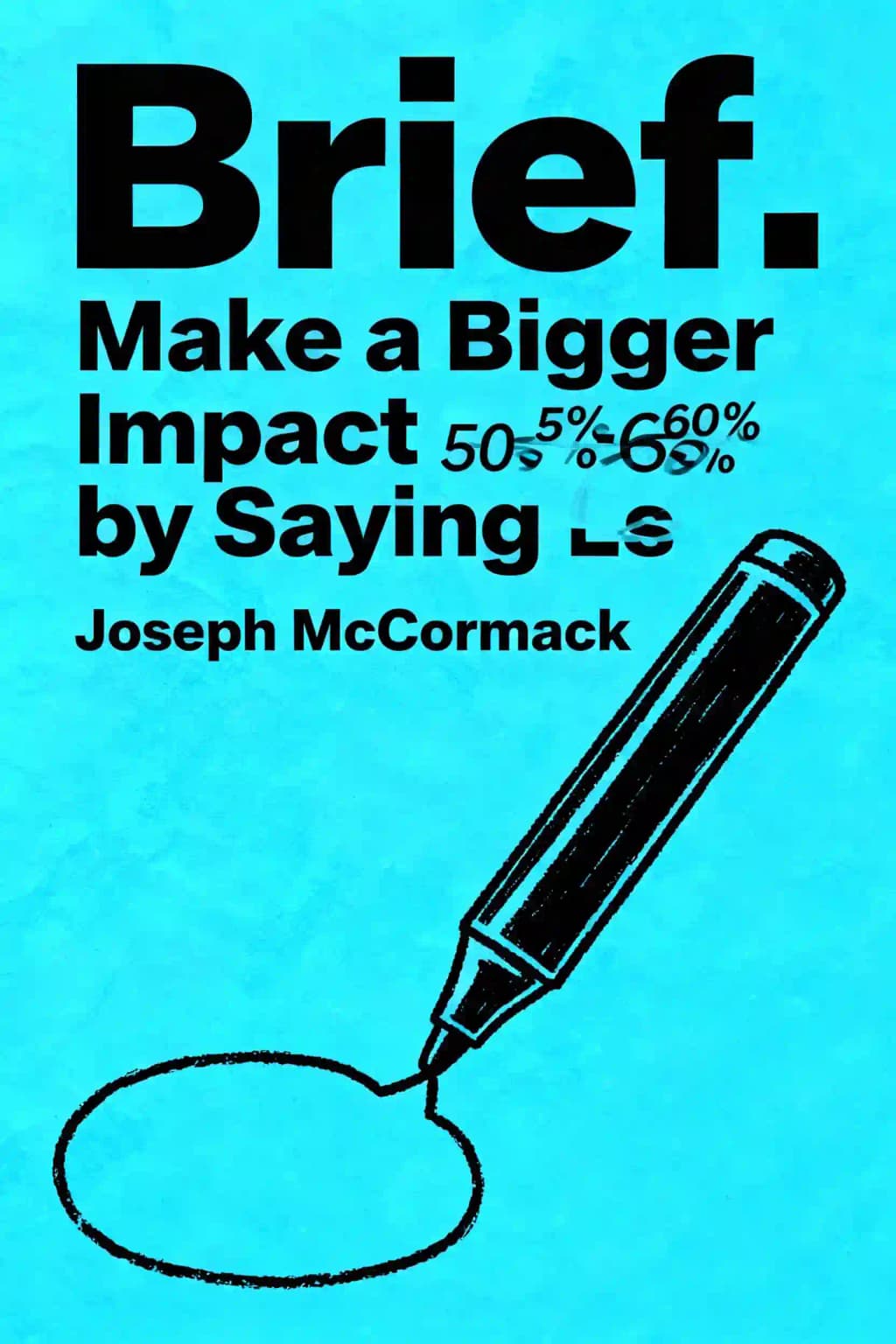
In a world where the average professional receives 304 emails weekly, checks their phone 150 times daily, and consumes over 100,500 words per day, our collective attention span has plummeted from 12 seconds to a mere 8 seconds in just five years. Joseph McCormack's "BRIEF: Make a Bigger Impact by Saying Less" arrives as a critical survival guide for our attention-deficit economy. The book has become required reading at companies like Harley-Davidson and MasterCard, where executives recognize that in today's distracted world, you must get to the point in 5 minutes, not 50. Even Special Operations military units have embraced McCormack's techniques, with one participant noting, "The difference is dramatic. Our briefs prove that less is more." As information continues to flood our lives-with business email traffic alone exceeding 100 billion emails daily-mastering brevity isn't just a communication skill; it's the difference between success and failure in a world where, as McCormack warns, "if you can't capture people's attention with brevity, you'll lose them."
Глава 2
The Four Horsemen of the Attention Apocalypse
Our mental capacity is under constant assault from four powerful forces that make brevity not just desirable but essential. First, information inundation overwhelms us like "trying to take a drink from a fire hose." The sheer volume of content bombarding us from morning until night means that by the time you enter someone's day, their attention is severely taxed.
Second, inattention has become epidemic as our focus muscles weaken. Frequent interruptions deplete mental energy-changing focus 10-20 times per hour drastically reduces productive thinking time. Executives report feeling exhausted and unfocused by day's end, with research suggesting constant information intake can temporarily lower IQ by up to 10 points. Frequent multitaskers struggle to filter irrelevant information, further slowing their processing. Like a muscle, attention span weakens with overuse and treats all information equally.
Third, interruption has become our normal state. Workers experience one interruption every 8 minutes-50 to 60 daily interruptions. We also interrupt ourselves, switching from difficult tasks to easier ones almost instinctively. Research shows workers spend just 11 minutes on a task before interruption and need 25 minutes to return to the original task. These interruptions cost businesses $588 billion annually in lost revenue. Email is particularly disruptive, with office workers checking their inbox 30-40 times hourly, though they'll report doing so much less frequently.
Fourth, impatience has become our default setting. Technology has created expectations of instant gratification. We spend mere seconds on webpages (56 seconds average) and minutes on videos (3.95 minutes). This impatience extends to meetings, where almost 50% fail to use people's time efficiently. Google addresses this by projecting giant stopwatches on walls during meetings, making each passing minute visibly precious.
The implications are clear: adding more information, interruption, time, or complexity to others' days only encourages them to tune you out. Without developing awareness of this issue, you're training people to block you permanently. Ideas must be packaged smaller, made easier to consume and digest. You must boil down your message and get to the point quickly, or be forgotten.
Глава 3
The Seven Deadly Sins of Verbosity
Why is brevity so difficult to master? McCormack identifies seven subtle, unconscious "capital sins" that interfere with concise communication.
Cowardice manifests when you hide behind meaningless words and lack the courage to be clear and take a stand. You fear being challenged or disagreed with, so you mask your message in jargon and buzzwords while taking the middle road. This impacts your perceived leadership ability as management wonders what your actual recommendation is.
Excessive confidence turns you into a know-it-all who can't resist explaining every painful detail. Even as a subject matter expert, your talks become long, dry and technical. People avoid conversations with you because once you start, they can't stop you. Your emails get ignored, and your specialty knowledge combined with verbosity impedes your career growth.
Callousness shows when you're selfish and disrespect others' time. While you're in a hurry when people speak to you, time stands still when you have the floor. Your "got a minute" questions turn into extended conversations that frustrate colleagues on deadlines. When people see you don't respect their time, they stop respecting you.
The comfort sin occurs when you become loose and wordy with familiar people. You maintain a double standard: succinct with important people but long-winded with those you know well. Even casual conversations about weekend plans can turn into 15-minute verbal tours that leave listeners wishing they'd taken another route.
Confusion happens when you think out loud before your ideas are clear. When thoughts are still germinating, they're often out of order, indistinct and blurry. As a senior director who loves brainstorming, your enthusiasm for half-formed ideas forces others to sit through your meandering thought process, negatively impacting their perception of your abilities.
The complication sin stems from believing some concepts are too complex to simplify, despite the world highly valuing those who can simplify difficult ideas. When clients ask simple questions about delays, providing lengthy explanations not only frustrates them but raises concerns about quality issues.
Carelessness manifests as verbal sloppiness where your mind and message get mixed up. Leaving rambling voicemails or sending unclear emails about important client matters signals that you might not be ready for the next assignment-or even be the right person for the job.
Глава 4
Map It: The Power of Visual Outlines
Working from an outline is essential but often abandoned by professionals who believe they can "wing it" or are too pressed for time. Without outlines, we create "semicoherent" communications that force others to wade through disorganized thoughts, jumping between topics, and backtracking to cover missed points. This lack of preparation causes mental agony for recipients of unstructured presentations, emails, and meetings, often leading to confusion, misunderstandings, and wasted time in follow-up clarifications.
McCormack developed BRIEF Maps as specialized mind maps to simplify complex messages into one-page visual outlines. These maps help explain progress reports, capture meeting summaries, synthesize strategies, articulate corporate visions, or simplify complex initiatives. Each letter in BRIEF represents a specific function: B (Background/beginning) provides context and history, R (Reason/relevance) explains why this matters now, I (Information for inclusion) presents key data points and evidence, E (Ending/conclusion) summarizes actions and recommendations, and F (Follow-up questions) anticipates and prepares for likely inquiries.
Consider Bob, who needs to update his CEO on a crucial technology replacement project facing challenges like cost overruns and delays. Without preparation, Bob starts well with key highlights but soon gets lost in details about vendor negotiations, becomes flustered when questioned about timeline specifics, and leaves the meeting with both him and the CEO doubting the project's success. His scattered presentation creates uncertainty and erodes confidence in his leadership.
With a BRIEF Map, however, Bob organizes his update with a clear headline ("The project is on schedule"), relevant background information about initial goals and milestones, reasons for the update including market conditions and stakeholder concerns, three key information points about progress and needs (budget status, team performance, technical achievements), a defined ending with next steps and resource requirements, and anticipated follow-up questions about risk mitigation and contingency plans. This preparation allows him to deliver a focused 5-minute update that satisfies the CEO and earns his continued support.
BRIEF Maps provide "no assembly required" messages that save your audience time and mental effort. By preparing and preassembling your key points, you deliver a ready-to-use message with no loose parts-like a bicycle that comes fully assembled, ready to ride. This visual approach helps speakers maintain focus, avoid tangents, and respond confidently to questions. The map becomes both a planning tool and a mental anchor during delivery, ensuring key messages are conveyed clearly and completely. Organizations that adopt BRIEF mapping often report shorter meetings, clearer communication, and faster decision-making across all levels.
Глава 5
Tell It: The Strategic Power of Narrative
Steve Jobs' 2007 iPhone launch exemplifies masterful narrative storytelling in business. Rather than listing features, Jobs built a strategic narrative: stating his purpose ("Apple is going to reinvent the phone"), establishing context with Apple's history of breakthrough products, introducing the villain (competitors' hard-to-use smartphones), explaining Apple's intentions to create something "way smarter" and "super-easy to use," and demonstrating how they would deliver on this promise.
Organizations are increasingly recognizing storytelling as a strategic way to capture attention and create lasting understanding. While most corporate communications remain forgettable because they sound identical, companies with compelling narratives-like Southwest Airlines with Herb Kelleher's vision for a thrifty, focused, and fun airline-stand out and inspire employees.
McCormack developed Narrative Mapping by evolving traditional corporate message maps into visual storytelling tools. Narrative Maps provide structure for creating clear, contextual business stories. They follow a clockwise build starting with a focal point (central message), then addressing the setup/challenge (market problem), opportunity (unmet need), approach (how the story unfolds), and payoff (resolution and benefits).
The Universal Commerce narrative created for a payment processing company became a powerful tool that crystallized understanding for thousands. The story explained how commerce evolved from traditional shopping to e-commerce to today's mobile-integrated experience through a relatable scenario of a father buying a birthday present. This narrative successfully communicated that in a world of increasing consumer expectations, payments need to adapt to deliver integrated experiences.
When implementing storytelling in business, McCormack warns of three common pitfalls: keeping stories too long, falling in love with fables and "once upon a time" structures, and promoting storytelling without teaching the skills needed to create compelling narratives. Effective business storytelling isn't about fairy tales-it's about creating corporate narratives that explain the why, how, who, when, where and so what of business issues in human terms.
Глава 6
Talk It: The Art of Controlled Conversations
Brevity doesn't mean killing conversations-it means having meaningful, controlled exchanges where both parties feel engaged without feeling trapped. The key is creating a disciplined rhythm where active listening guides the interaction, allowing you to maintain control while respecting the other person's time and interests. This requires developing awareness of conversational dynamics and learning to read subtle social cues that indicate engagement or fatigue.
Effective conversations aren't like golf where each person takes turns waiting to speak. They're like tennis-a balanced back-and-forth rhythm emerges through active listening and thoughtful questions. Brevity becomes possible when you have one shared conversation rather than two parallel monologues. This tennis-match analogy extends to maintaining appropriate energy levels and knowing when to serve versus when to return, creating natural momentum that keeps both parties invested.
TALC Tracks (Talk, Active Listening, Converse) provide a framework for balanced exchanges. First, let the other person talk without interruption, giving them space to fully express their thoughts and feelings. Second, actively listen for key words and narrative threads rather than passively hearing or planning your response - notice their tone, emphasis, and emotional undertones. Finally, converse by contributing relevant comments or questions that build on what was said, showing you've truly absorbed their message.
Being brief means understanding what matters to your audience and adapting your communication style accordingly. Some people prefer direct, fact-based exchanges while others respond better to stories and analogies. Focusing on their priorities demonstrates respect for their time and attention. Watch for signs of engagement like maintained eye contact, responsive body language, and relevant follow-up questions.
Controlled conversation isn't about controlling the conversation itself but controlling yourself within it. Like social media expert Brad Farris who shares only high-value content, respecting your audience's time by being disciplined and relevant earns their attention even when your agenda differs from theirs. This might mean resisting the urge to share tangential stories, keeping responses focused and pertinent, or knowing when to wrap up a discussion that has served its purpose.
The most successful communicators master the art of "productive silence" - those brief pauses that allow others to process information and formulate thoughtful responses. They understand that brevity isn't just about talking less; it's about making every word count and creating space for genuine dialogue. This approach builds trust and rapport while ensuring conversations remain purposeful and engaging for all participants.
Глава 7
Show It: The Visual Revolution in Communication
Visual communication is far more effective than words alone, with studies showing we remember 80% of what we see compared to just 10% of what we hear and 30% of what we read. As we transition from a text-based world to a visual one, finding ways to show rather than tell becomes essential for brevity and impact.
USA Today founder Al Neuharth exemplifies the BRIEF approach by recognizing people's preference for seeing over reading. He revolutionized journalism with short stories that rarely continued to second pages and featured abundant visuals, pioneering the infographic industry. Neuharth understood the shift in attention spans and reading habits, prioritizing showing readers what reporters meant rather than telling them.
Though creating effective visuals is challenging-with less than 3% of companies using visual communication-the effort pays dividends in comprehension. Finding the right visual to match your narrative is essential. During the 2008 recession, McCormack illustrated a presentation about workplace communication by sharing a story about his grandmother who sewed buttons at Sears during the Depression. Her strategy-"Make sure they always see you working"-was powerfully paired with a simple Google image of a jacket with buttons.
Video storytelling has become a powerful tool for education, marketing, and engagement. Companies worldwide are creating YouTube and Vimeo channels, recognizing that "if a picture is worth a thousand words, then a video is worth a million." However, brevity remains crucial-viewers typically lose interest after 3.5 minutes. For maximum impact, videos should be short, professional-quality, and potentially episodic.
Beyond infographics and videos, simple document formatting significantly improves visual communication. Today's audiences respond with "TL;DR" (too long; didn't read) to messages lacking brevity. Effective written communication should be inviting (with strong titles), limited to the original window (no scrolling), embrace white space (3-4 sentence paragraphs), highlight key ideas in bold, use bullets and numbers, and eliminate fluff.
Глава 8
Brevity in Action: From Meetings to Digital Communication
Meetings are notorious time-wasters, with CEOs spending an alarming 60% of their working hours in them. To make meetings more productive through brevity, leaders must defeat three key villains: Time (scheduling excessive meeting lengths and defaulting to hour-long blocks), Type (using ineffective meeting formats that don't match the objective), and Tyrants (allowing dominant voices to control discussions while quieter team members remain unheard).
General William B. Caldwell IV's transformation of military media briefings in Iraq serves as a masterclass in meeting innovation. He boldly replaced the traditional podium-based lecture format, which created artificial distance and formality, with a conversational approach that revolutionized military-media relations. Instead of delivering formal prepared statements from behind a barrier, he placed an executive table in the center of the room and engaged journalists from CNN, New York Times, and BBC in direct dialogue. This physical repositioning broke down hierarchical barriers and created psychological safety. By shifting from an official tone to an open dialogue, he created a more comfortable environment where journalists felt their questions were being genuinely addressed rather than deflected with prepared statements.
In the digital realm, brevity becomes even more critical as attention spans shrink and information overload grows. With people checking their smartphones an average of 150 times daily and spending 28% of work time managing emails, digital communication must be economical and purposeful to break through the noise. Verne Harnish, the "Growth Guy" columnist for Fortune Magazine, exemplifies brevity mastery in digital communication through several specific techniques. His messages feature attention-grabbing headlines in bold, consistently short paragraphs (never exceeding three sentences), tightly written content that eliminates unnecessary words, and time-saving references with clear links. His newsletters are deliberately structured to be scanned in 30 seconds, with clear indicators of how long deeper dives will take - typically 3, 5, or 7 minutes.
Adam Brown, who pioneered corporate social media strategies at Coca-Cola, Dell, and Salesforce.com, has discovered through extensive testing that the most effective social media posts contain approximately 80 characters - half of Twitter's original character limit and proven to be twice as effective at driving engagement. He argues that our traditional education system has actually hindered our social media effectiveness by training us to write to minimum word counts rather than maximum brevity. His research shows that most social media is consumed on mobile devices by people on the move - what he terms "brand in the hand" - meaning users are typically multitasking while walking, commuting, or waiting in line. This mobile-first behavior requires content that is not just concise but instantly compelling, with clear headlines, scannable formatting, and immediate value proposition. Brown advocates for a "less is more" approach, where every word must earn its place in the message.
Глава 9
Mastering Brevity in Critical Moments
In high-stakes situations-presentations, sales pitches, interviews, and difficult conversations-brevity becomes even more crucial.
For presentations, TED's 18-minute format has revolutionized public speaking by prioritizing brevity and clarity. Emily McManus, TED's website editor, emphasizes that effective compression requires significant upfront effort in structuring content. Rather than attempting to cover an entire field, successful TED speakers tell "an intriguing single story" with a clear arc-reaching the middle of the story within five minutes.
In sales, the art requires mastering brevity-knowing when to speak and when to listen. As one sales manager wisely advised: "Don't talk through the close-shut up and sell." Kristi Faulkner, president of Womenkind, believes that brevity in advertising is essential-"Three words are better than four, or four words are better than six." When pitching to clients, she finds that a singular, distilled idea has more impact than overwhelming prospects with multiple concepts.
For interviews, both candidates and interviewers benefit from brevity. When people get nervous in interviews, they tend to talk too much. Brevity is your weapon, starting with a trimmed resume that highlights successes in context. Doug Hinderer, head of human resources at the National Association of Realtors, notes that talking too much is the most common interview mistake. Skilled interviewers often use silence strategically, making undisciplined candidates uncomfortable.
When delivering bad news, brevity helps minimize the pain. John Challenger, CEO of Challenger, Gray and Christmas, advises that termination meetings should be straight, brief (5-10 minutes), and humane. When people hear bad news, "the blood rushes to their head and they just can't think." Don't overexplain or try to become their friend-deliver information with kindness but firmness.
Even when sharing good news, brevity highlights success while leaving people wanting to hear more. Bruce Smith, a top designer at Steelcase, faced the challenge of communicating complex design concepts clearly. When developing their innovative Gesture chair, his team distilled mountains of research into a simple "taxonomy of posture"-30 images showing different ways people interact with technology at work, presented on a single page. "All we had to say was this: 'Technology, along with a new demographic in the workplace, is changing our behaviors, and here's the output: this little chart of 30 postures.' And boom. People just got it."
Глава 10
The Discipline of Brevity: A Daily Practice
Mastering brevity requires more than understanding why it's needed-you need specific techniques to develop "mental muscle memory." McCormack presents four proven approaches: 1) Map it: using BRIEF Maps to condense volumes of information; 2) Tell it: employing narrative storytelling for clear, concise communication; 3) Talk it: using TALC Tracks to transform monologues into controlled conversations; and 4) Show it: utilizing visuals to attract attention and capture imagination.
Brevity isn't just about using less time-it's about how long it feels to the audience. It's about making the most of the time you have, not simply using the least amount of time. True brevity requires deep expertise and thorough knowledge. You must first go deep, experience confusion, then emerge with clarity from a deeper perspective. The hard work of digging and analysis on your own time saves your audience from doing the labor themselves.
W.W. Grainger transformed its complex five-year strategy into an accessible narrative through a collaborative mapping process. When strategic planning head John Borta recognized they were drowning in "mounds of research, insights, data, and recommendations," they turned to Narrative Mapping to communicate their vision more effectively. During a four-hour session with senior leadership, they personified their two distinct customer types as "Al" (a time-conscious janitor concerned with convenience and quality) and "Betty" (a budget-focused accountant prioritizing price and value).
This simple storytelling approach aligned the leadership team and provided a clear framework for communicating the strategic vision. The Al and Betty narrative became so embedded in company culture that employees created jewelry, music videos, and even left chairs for these fictional characters at meetings. The story compelled 13,000 employees to think about how they could personally connect with customers.
In today's attention-deficit economy, brevity isn't optional-it's essential. By mastering the discipline of saying less to achieve more, we can cut through the noise, respect others' time and attention, and make a bigger impact in every interaction. As McCormack reminds us, in a world drowning in information but starving for wisdom, brevity isn't just about being concise-it's about being clear, compelling, and considerate in a way that truly connects.