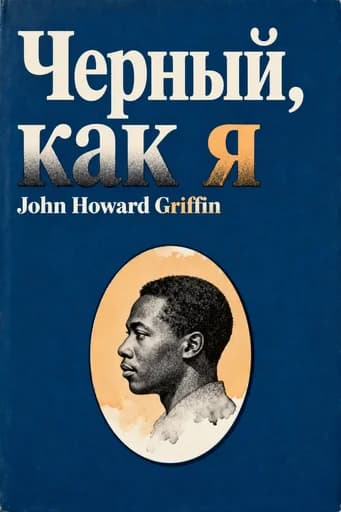
In 1961, a white journalist darkened his skin to experience Jim Crow's brutal reality. "Black Like Me" shocked America, selling 10 million copies despite death threats forcing Griffin to flee to Mexico. This dangerous experiment validated what Black voices had been saying all along.
John Howard Griffin (1920–1980) was an acclaimed journalist and social activist, best known as the author of the groundbreaking nonfiction classic Black Like Me, a seminal work on race relations in America.
Born in Dallas and educated in France, Griffin's early career spanned diverse fields including music, medicine, and wartime service. He served as a French Resistance medic and also enlisted in the U.S. Air Force.
After being blinded during military service, Griffin turned to writing, producing novels such as The Devil Rides Outside and Nuni. In 1957, he regained his sight.
In 1959, Griffin undertook a transformative experiment: darkening his skin to experience racial segregation firsthand. This experience became the basis for Black Like Me, which The New York Times hailed as an essential portrait of Jim Crow-era oppression. The book’s unflinching account earned Griffin global recognition, consideration for the Nobel Prize, and enduring hostility from segregationists.
A devoted Catholic and civil rights advocate, Griffin later wrote memoirs like Scattered Shadows and lectured widely on social justice. Translated into over 30 languages and adapted into a 1964 film, Black Like Me remains a cornerstone of antiracism literature, with its 50th-anniversary edition reaffirming its relevance in ongoing dialogues about equity and identity.
Black Like Me chronicles John Howard Griffin’s 1959 experiment darkening his skin to experience racial segregation in the Jim Crow South as a Black man. The non-fiction account exposes systemic racism, from workplace discrimination to violent hostility, while highlighting moments of solidarity in Black communities. Griffin’s journey reveals the psychological toll of racism and argues for urgent dialogue to bridge racial divides.
This book is essential for readers interested in civil rights history, social justice, or American sociology. Educators, students, and activists will find its firsthand insights into systemic racism valuable. Its narrative style also appeals to readers of immersive non-fiction seeking to understand racial dynamics pre-Civil Rights Movement.
Yes—it remains a landmark text for its unflinching portrayal of 1950s racism and its call for empathy. Praised as a “modern classic” by the New York Times, it offers historical context still relevant to discussions about race today. However, critics note Griffin’s temporary experience limits his perspective compared to lifelong Black lived experiences.
Griffin writes, “The Negro is treated not even as a second-class citizen, but as a tenth-class one.” This line encapsulates the dehumanizing racism he witnessed, emphasizing how segregation enforced a racial caste system. The quote is often cited in discussions about institutionalized inequality.
A former medic in the French Resistance and a temporarily blind writer, Griffin’s empathy for marginalized groups drove his activism. His Catholic faith and experiences with disability informed his commitment to social justice, fueling his radical experiment to expose racism.
Critics argue Griffin’s temporary racial passing oversimplifies the Black experience and centers a white perspective. Others note his focus on Southern racism overlooks Northern inequities. Despite this, the book is recognized for sparking national conversations during the Civil Rights era.
Both address racism, but Griffin’s work focuses on short-term immersion, while Malcolm X’s memoir details a lifelong journey from oppression to activism. Black Like Me emphasizes interpersonal racism, whereas Malcolm X critiques structural inequities and advocates for Black empowerment.
The book’s themes resonate amid ongoing debates about racial justice, police brutality, and systemic inequality. Its exploration of “walking in another’s shoes” remains a framework for discussions about allyship and anti-racism in education, workplaces, and policy.
The transformation symbolizes how race socially constructs identity. By altering his appearance, Griffin demonstrates that racism stems from external perceptions, not inherent traits. This physical change forces readers to confront the absurdity of racial prejudice.
The book shocked white audiences with its stark depiction of racism, galvanizing support for Civil Rights reforms. Griffin received death threats, underscoring the era’s tensions. Today, it’s taught in schools as a historical document and catalyst for empathy-driven activism.
The book highlights how unchecked bias fosters toxic environments. Modern applications include promoting inclusive policies, addressing microaggressions, and prioritizing diversity training. Griffin’s call for dialogue mirrors today’s emphasis on listening to marginalized voices.
Почувствуйте книгу через голос автора
Превратите знания в увлекательные, богатые примерами идеи
Захватите ключевые идеи мгновенно для быстрого обучения
Наслаждайтесь книгой в весёлой и увлекательной форме
"I became two men," he wrote, "the observing one and the one who panicked."
"put us low, then blame us for being down there."
"You are black. You are condemned."
The artificial gaiety served as a thin mask for deep despair.
Разбейте ключевые идеи Black Like Me на понятные тезисы, чтобы понять, как инновационные команды создают, сотрудничают и растут.
Погрузитесь в Black Like Me через яркие истории, превращающие уроки инноваций в запоминающиеся и применимые моменты.
Задавайте любые вопросы, выбирайте свой стиль обучения и создавайте идеи, которые действительно вам подходят.

Создано выпускниками Колумбийского университета в Сан-Франциско
"Instead of endless scrolling, I just hit play on BeFreed. It saves me so much time."
"I never knew where to start with nonfiction—BeFreed’s book lists turned into podcasts gave me a clear path."
"Perfect balance between learning and entertainment. Finished ‘Thinking, Fast and Slow’ on my commute this week."
"Crazy how much I learned while walking the dog. BeFreed = small habits → big gains."
"Reading used to feel like a chore. Now it’s just part of my lifestyle."
"Feels effortless compared to reading. I’ve finished 6 books this month already."
"BeFreed turned my guilty doomscrolling into something that feels productive and inspiring."
"BeFreed turned my commute into learning time. 20-min podcasts are perfect for finishing books I never had time for."
"BeFreed replaced my podcast queue. Imagine Spotify for books — that’s it. 🙌"
"It is great for me to learn something from the book without reading it."
"The themed book list podcasts help me connect ideas across authors—like a guided audio journey."
"Makes me feel smarter every time before going to work"
Создано выпускниками Колумбийского университета в Сан-Франциско

Получите резюме книги «Black Like Me» в формате PDF или EPUB бесплатно. Распечатайте или читайте офлайн в любое время.
In 1959, John Howard Griffin embarked on what many considered a dangerous, even suicidal mission: to chemically darken his skin and travel through the segregated South as a Black man. What drove this white novelist, musicologist, and former French Resistance fighter to undertake such a radical transformation? The communication between races had broken down completely - Southern Black Americans wouldn't tell whites the truth about their conditions, having learned that honesty made life miserable. Griffin's burning question was simple yet profound: What is discrimination based on skin color truly like? Despite being considered a specialist in race issues, he realized how little he actually knew about the Black experience in America. The physical transformation was grueling. A dermatologist prescribed medication normally used for vitiligo patients, combined with ultraviolet treatments that left Griffin constantly nauseated while doctors monitored potential liver damage. After days of treatment and shaving his head, Griffin first confronted his new reflection - a fierce, bald, very dark-skinned stranger staring back from the mirror. "I became two men," he wrote, "the observing one and the one who panicked." That night, stepping into darkness as a Black man, Griffin experienced his first taste of what would become a profound journey across America's racial divide - one that would ultimately sell over 10 million copies worldwide and remain required reading decades later.
Griffin entered Black society through Sterling Williams, a one-legged shoe-shine man in New Orleans who taught him expected Black behaviors. The transformation was stark - the same drugstore clerk who had warmly served Griffin as a white man now treated him with cold detachment. At Sterling's stand, he observed how whites seeking illicit services treated them as equals, while others looked through them as if invisible. The economic barriers facing Black Americans were systemic. Even accomplished college graduates faced severely limited prospects, contrary to white youth who knew education meant opportunity. Griffin spent hours searching for basic necessities whites took for granted - places to eat, drink water, or use restrooms. Drugstores would sell him anything except water, directing him to distant "colored" cafes. Job hunting revealed blatant discrimination. A plant foreman told Griffin directly: "We're gradually getting you people weeded out from the better jobs. Pretty soon the only jobs you can get here are ones no white man would have." When questioned about survival, he admitted their goal: "We're going to do our damnedest to drive every one of you out of the state."
In Hattiesburg, Mississippi, what appeared to whites as Black celebration - the jukeboxes, shouts, constant movement - masked deep despair. Griffin recognized these weren't expressions of joy but attempts to escape a crushing reality: "You are black. You are condemned." White teenagers terrorized Black neighborhoods, hurling threats and bottles while seeking confrontation. Black residents maintained blank expressions, knowing any reaction could be dangerous. Griffin visited P.D. East, a white newspaperman whose fair reporting on race cost him everything - subscribers, advertisers, friends. Only two Jewish families maintained contact, understanding persecution firsthand. East's story demonstrated how moral courage often required profound sacrifice.
Griffin mastered a technique of alternating between racial identities using specialized skin dyes. Though his mind, education, and character remained unchanged, his treatment shifted dramatically with each transformation of his skin tone. As a white man, he received friendly nods from whites while Black Americans viewed him suspiciously. When Black, those same white faces showed contempt or ignored him entirely, while Black strangers offered immediate fellowship. These stark reversals - occurring without any change to his fundamental self - exposed the arbitrary nature of racial prejudice. His most profound realization came from comparing Black children's limited prospects to his own children's boundless opportunities. Watching equally bright, innocent Black children being systematically denied the possibilities his children took for granted struck him deeply. This was racism's cruelest aspect - the destruction of potential, the crushing of young dreams, and the psychological toll on children forced to internalize a false sense of inferiority.
In Atlanta, Griffin found hope through the Black community's unwavering passive resistance under Martin Luther King Jr.'s Gandhian-inspired leadership. Despite facing jail, humiliation, and threats, they maintained their dignity - frustrating white supremacists who sought violent confrontation. T.M. Alexander, founder of Southeastern Fidelity Fire Insurance, exemplified Atlanta's visionary Black leadership: "There is no 'big Me' and 'little you.' We must pool all our resources, material and mental, to gain the respect that will enable all of us to walk the streets with the dignity of American citizens." At a Trappist monastery in Conyers, Griffin found peace amid brown-robed monks in quiet contemplation. The guest-master monk discussed how racists misused religion, citing Shakespeare about fools finding Scripture to justify their errors. He shared Maritain's insight that these people "believe in God and yet do not know God" - revealing how their false religion, though dressed in Christian terminology, was fundamentally anti-Christian.
After concluding his experiment and reclaiming his white identity, Griffin felt profound sadness - as if he were evading his moral duty to witness racial injustices. Flying home to Texas, he struggled between patriotic love and fear for his family's safety. The publication of his "Journey Into Shame" articles in Sepia magazine triggered immediate backlash. His family received death threats, and in April 1960, Griffin was "lynched in effigy" on Mansfield's Main Street - a dummy painted half black, half white bearing his name. What hurt most wasn't the act itself but his neighbors' complete silence - not one person expressed disapproval of this public threat. Life in Mansfield became unbearable. Griffin faced constant hostility, from gas station loafers to teenagers on corners, while longtime friends avoided him in public. The psychological strain eventually forced his parents to flee to Mexico, with Griffin and his family following soon after.
Griffin's experiment exposed the absurdity of judging people by skin color. As a white man he moved freely; as a black man he faced restrictions based on pigmentation alone. Living with Black families quickly dissolved his preconceptions as he witnessed the universal nature of family life through daily routines. Throughout his journey, Griffin encountered profound kindness. In Montgomery, an elderly preacher living in poverty offered to share his modest home without hesitation, maintaining that whites were "God's children, just like us" and warning that "When we stop loving them, that's when they win." Griffin never claimed to speak for Black people, acknowledging that while whites once had to advocate for justice when Black voices weren't heard, those days were over. "It is absurd for a white man to presume to speak for black people when they have superlative voices of their own." He discovered that "blackness was not a color but a lived experience." While prejudice stems from cultural conditioning, Griffin learned we can break free by confronting it. His journey revealed that the Us-and-Them divide is artificial - there's only one human family united by shared experiences of love, suffering, and aspiration.