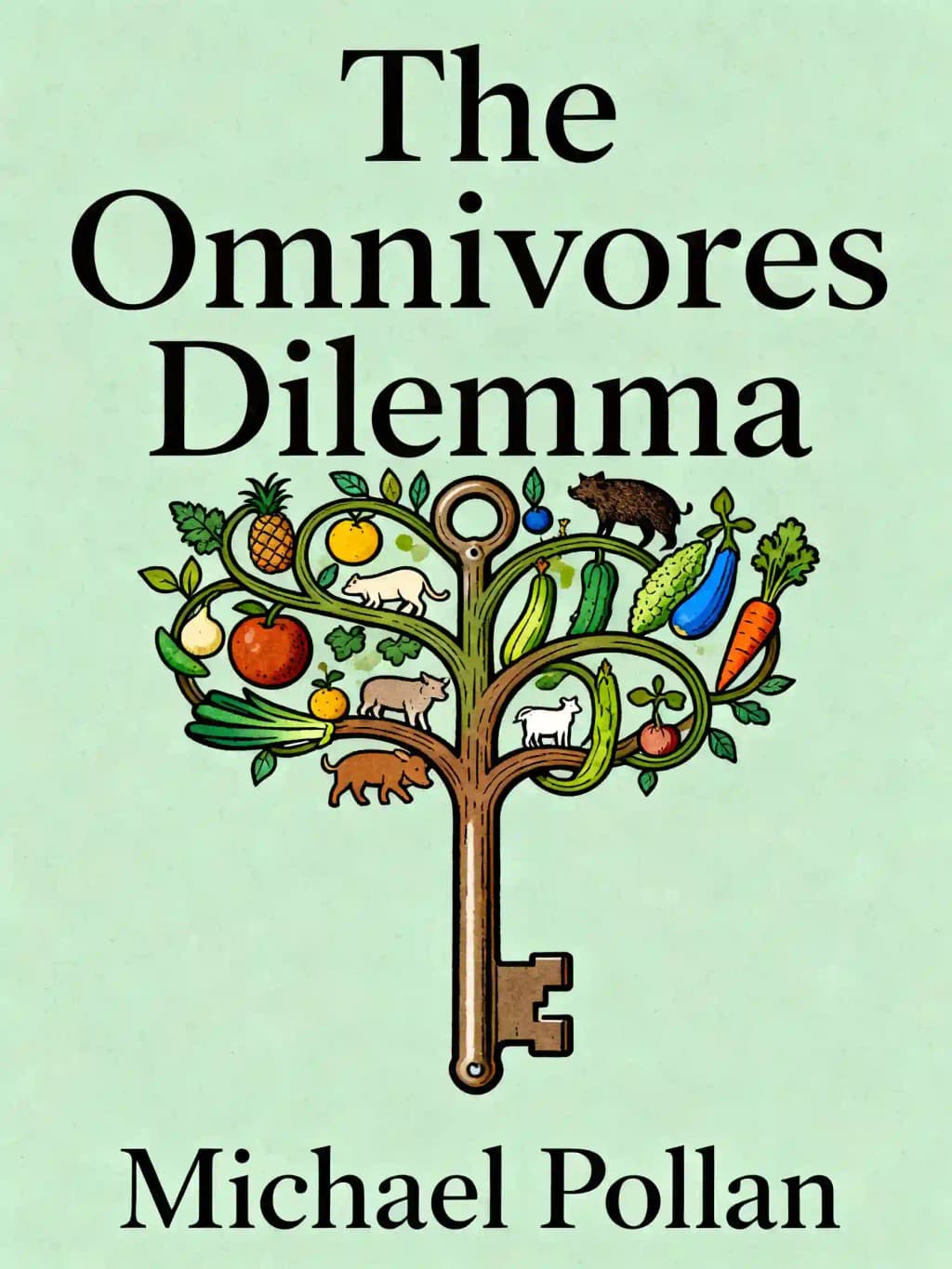
The Omnivore's Dilemma
A Natural History of Four Meals
Overview of The Omnivore's Dilemma
Unmasking America's "national eating disorder," Michael Pollan's bestseller traces food from farm to plate, revolutionizing how we eat. Endorsed by Alice Waters and taught in universities nationwide, this New York Times-acclaimed investigation reveals why what's on your fork might be our greatest environmental dilemma.

Key Themes in The Omnivore's Dilemma
- industrial food systems
- agricultural monoculture
- corn production history
- ethical eating choices
- factory farming impact
Quotes from The Omnivore's Dilemma
Americans today are, quite literally, walking corn.
The modern farm has become a strange entity-incredibly productive yet economically fragile.
We planted thirty thousand identical hybrid corn seeds per acre, creating what Naylor calls a "city of corn."
The feedlot becomes a strange pre-modern city, complete with waste management problems and pharmaceutical dependencies.
Cheap corn creates incentives to find new uses for it.
Characters in The Omnivore's Dilemma
- Michael PollanAuthor and investigative journalist
- George NaylorIowa corn farmer and case study subject
About the Author
About the Author of The Omnivore's Dilemma
Michael Kevin Pollan, acclaimed author of The Omnivore’s Dilemma: A Natural History of Four Meals, is a leading voice in exploring food systems, environmental journalism, and the cultural impacts of dietary choices. He is a professor at Harvard University and the UC Berkeley Graduate School of Journalism—where he co-founded the Center for the Science of Psychedelics.
Pollan combines investigative rigor with accessible storytelling to dissect industrial agriculture, organic farming, and the ethics of modern eating. His bestselling works, including In Defense of Food, Cooked, and How to Change Your Mind, blend science, history, and personal narrative to challenge conventional views on nutrition and consciousness.
A New York Times contributor and 2010 Time 100 honoree, Pollan’s research has earned accolades like the James Beard Award and a National Book Critics Circle Award finalist spot. The Omnivore’s Dilemma, lauded by the New York Times and Washington Post as a top book of 2006, has sold millions of copies, been translated into over 20 languages, and remains essential reading in sustainability curricula worldwide.
Download Summary of The Omnivore's Dilemma
Get the The Omnivore's Dilemma summary as a free PDF or EPUB. Print it or read offline anytime.
FAQs About This Book
The Omnivore's Dilemma examines modern food systems through three food chains: industrial (corn-based agriculture), organic (small-scale and industrial), and hunter-gatherer (foraging/hunting). Pollan explores how humans navigate food choices in an era of abundance, addressing environmental, ethical, and health implications. The book critiques industrial agriculture’s reliance on corn and advocates for mindful eating.
This book suits readers interested in food sustainability, environmental ethics, or nutrition. It’s ideal for those questioning where their food comes from or seeking insights into industrial farming’s impact. Policymakers, educators, and health-conscious consumers will find its blend of journalism and analysis compelling.
Yes. A New York Times bestseller and award-winning work, it reshapes how readers view food production. Pollan’s investigative rigor and engaging storytelling make complex topics like agricultural economics accessible. It remains a cornerstone of food literature.
Pollan traces:
- Industrial: Relies on corn-fed systems, factory farms, and processed foods.
- Organic: Compares large-scale organic brands with local, sustainable farms.
- Hunter-gatherer: Examines foraging, hunting, and preparing a meal from scratch.
Humans face a paradox: as omnivores, we can eat diverse foods but struggle to choose wisely. Unlike animals with instinct-driven diets, we grapple with cultural, ethical, and nutritional conflicts—a dilemma amplified by modern food industries.
Pollan highlights corn’s dominance (e.g., high-fructose corn syrup, feedlot cattle) and its environmental toll, including soil depletion and fossil fuel dependency. He argues industrialized systems prioritize profit over health or sustainability.
While organic farming avoids synthetic chemicals, Pollan distinguishes between “industrial organic” (large corporations) and local, regenerative practices. He praises the latter for ecological benefits but critiques organic labels for becoming diluted by mass production.
- Most processed foods derive from corn.
- Industrial meat production has ethical and environmental costs.
- Sustainable eating requires understanding food origins.
- Meal choices reflect deeper cultural and ecological values.
Pollan participates in hunting and butchering to confront the moral complexities of meat consumption. He argues that respecting animals and ecosystems—rather than abstaining—can lead to more ethical choices.
Corn underpins the industrial food chain, found in 25% of supermarket items. Pollan traces its journey from subsidized monocrops to feedlots and processed foods, illustrating how it distorts diets, economies, and ecosystems.
Some argue Pollan oversimplifies solutions (e.g., privileging local food) or neglects socioeconomic barriers to sustainable eating. Others note his focus on U.S. systems limits global applicability.
It spurred debates about farm subsidies, food labeling, and ethical consumption. Many credit it with popularizing the “farm-to-table” movement and increasing scrutiny of industrial food production.