Глава 1
The Management Maestro: Drucker's Timeless Wisdom for Modern Leaders
Peter Drucker changed the world without ever running a major corporation. While tech titans and Wall Street wizards capture headlines, this unassuming Austrian immigrant quietly revolutionized how organizations function across every sector of society. When Warren Buffett needed management advice, he turned to Drucker. When Jack Welch transformed GE, he applied Drucker's principles. Even Rick Warren built Saddleback Church-one of America's largest congregations-using Drucker's mentorship.
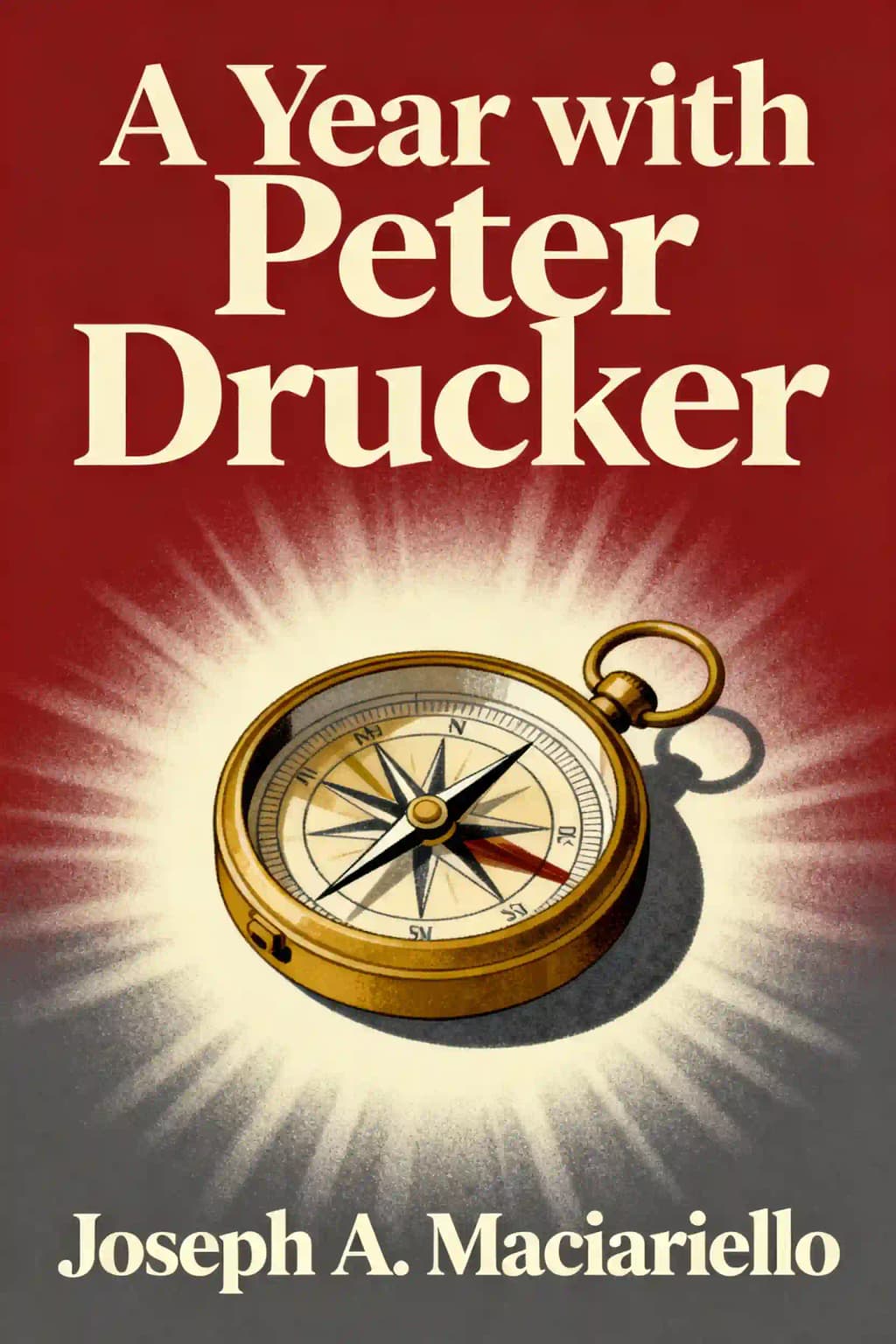
What made this soft-spoken professor so influential? Drucker possessed an uncanny ability to identify emerging trends decades before others and translate complex management challenges into practical wisdom. His insights weren't just theoretical-they worked. Through Joseph Maciariello's "A Year with Peter Drucker," we gain unprecedented access to the mentor who shaped modern management, distilled into 52 weeks of transformative lessons that remain startlingly relevant in today's rapidly changing world.
Глава 2
Leadership Is About Trust, Not Charisma
Drucker maintained a profound skepticism about charismatic leadership throughout his life. Having witnessed firsthand the rise of totalitarian regimes in Europe during the 1930s, he observed that the 20th century's most charismatic leaders-Hitler, Stalin, Mao, and Mussolini-had caused unprecedented human suffering. In contrast, the constructive leaders he most admired, like General George Marshall and President Eisenhower, were "highly disciplined, highly competent, and deadly dull."
For Drucker, effective leadership boiled down to two essential qualities: getting the right things done and earning complete trust. When he worked at the Pentagon during World War II, Drucker witnessed General Marshall's leadership firsthand. What impressed him most wasn't Marshall's charisma but his absolute trustworthiness. As Drucker later wrote, "You knew that if Marshall said it, it was so." This integrity-the alignment between words and actions-formed the bedrock of effective leadership.
Drucker believed leadership was fundamentally about responsibility rather than rank or privilege. He defined it as "lifting a person's vision to higher sights, raising performance to a higher standard, and building personality beyond normal limitations." True leaders focus on contribution rather than status, understand their strengths and weaknesses, and consistently deliver on their commitments.
Perhaps most importantly, effective leaders develop other leaders rather than mere functionaries. They aren't threatened by talented subordinates but actively seek them out. As Andrew Carnegie wished for his epitaph: "Here lies a man who knew how to put into his service more able men than he was himself." This approach creates organizations that can thrive beyond any single leader's tenure-the ultimate test of leadership effectiveness.
Глава 3
Management as a Human Activity
Drucker revolutionized how we understand organizations by recognizing that management is fundamentally a human activity. During his 80th birthday celebration in 1989, when presented with a calligraphic print showing interwoven hands of various colors representing human transactions, Drucker simply remarked, "This is my life." This profound statement encapsulated his core belief that management exists to satisfy human needs in society.
Throughout his career, Drucker emphasized three fundamental questions that guide effective organizations: "What is our business?", "Who is our customer?", and "What does the customer consider value?" These questions, while sometimes expressed differently, always focused on meeting human needs. The first question can only be answered by looking from the outside, from the customer's perspective. When helping ServiceMaster's board answer this question, Drucker surprised them by stating: "Your business is simply the training and development of people. You package it in different ways to meet customer needs, but your basic business is people training and motivation."
The second question-"Who is the customer?"-is equally crucial but not always straightforward. Most businesses have at least two customers who must both "buy" for a sale to occur. For branded consumer goods, both the housewife and the grocer are customers. Satisfying only one means there is no performance.
The third question-"What does the customer value?"-recognizes that customers never buy products; they buy the satisfaction of wants. Drucker illustrated this with teenage girls valuing fashion in shoes while young mothers prioritize durability and comfort. Customer value is so complex it can only be answered by customers themselves through systematic inquiry.
Drucker saw effective management as the alternative to tyranny, believing that functioning organizations that satisfy citizens' needs safeguard against dictatorships. His work across business, nonprofit, and government sectors demonstrated his conviction that management principles apply universally wherever humans organize to achieve common purposes.
Глава 4
Education and Management: Twin Engines of Development
Drucker challenged conventional wisdom about economic development by arguing that education and management-not capital investment-are the true drivers of sustainable growth. He illustrated this through the example of E-Veritas in Manila's Tondo District, an electronic trading network that trained former scavengers to become knowledge workers who handle ordering, purchasing, and distribution of food at lower prices. By building human capital through education and management principles, E-Veritas created sustainable development that corruption cannot take away.
South Korea's remarkable transformation provides perhaps the most compelling evidence for Drucker's thesis. After the Korean War's devastation, President Eisenhower prioritized education, sending 200,000 Korean students annually to the United States. Despite being more devastated than post-war Japan and having suffered from systematic Japanese suppression of Korean enterprise and education, South Korea transformed itself into a highly developed country within 25 years. This occurred by educating young Koreans in American colleges and universities and by importing and applying management concepts-proving that knowledge transfer, not just capital, creates economic transformation.
Drucker predicted that education would become central to the knowledge society, as new jobs require formal education and the ability to acquire theoretical knowledge. Unlike traditional craftsmen who learned everything they needed by young adulthood, today's workers need continuous learning to prevent obsolescence. He believed the acquisition and distribution of formal knowledge would occupy the place in politics that property and income held during the Age of Capitalism.
The case of Yuhan-Kimberly during the Asian financial crisis demonstrates how investing in employee development trumps layoffs. Rather than cutting jobs, Y-K implemented a "four crew/two shift system" with paid training days. The company subsidized education in computer skills, languages, and job-related areas, transforming manual workers into knowledge workers who generated more ideas and made independent decisions. This "lifelong learning paradigm" produced impressive financial results within two years.
Ultimately, Drucker asserted that a country, industry, or company's competitive position will be determined by knowledge productivity. No natural advantages exist-only the ability to exploit universally available knowledge matters. In both national and international economics, management's performance in making knowledge productive will be the decisive factor for success.
Глава 5
Prioritizing the Important Over the Urgent
One of Drucker's most practical insights addresses a universal challenge: distinguishing between what merely demands our immediate attention (the urgent) and what truly contributes to our purpose (the important). Drucker's approach to prioritization came from his own life example. During his later years, he deliberately declined many opportunities to concentrate on what he considered most important: developing human potential through mentoring and writing. Despite energy limitations as he aged, Drucker maintained a detailed calendar with his wife Doris, abandoning committee work and travel to focus on his true calling.
Drucker expressed regret about prioritizing urgent matters earlier in his career but rectified this by dedicating his final twenty years to advising social sector organizations-work he considered truly important. He pointed to severely ill or handicapped people as masters of prioritization, citing Harry Hopkins, Roosevelt's wartime adviser, who despite severe illness became extraordinarily effective by eliminating everything except vital matters. Churchill called him "Lord Heart of the Matter" because his physical limitations forced him to focus only on what was truly essential.
Effective leaders begin with the question "What needs to be done?" rather than "What do I want to do?" Drucker emphasizes that concentration is the secret of effectiveness, particularly for executives who face continuous demands on their time. While multitasking may be necessary, leaders must learn to give priority and focused attention to important matters rather than merely urgent ones.
This principle extends to organizational management as well. CEOs must balance short-term results with long-term success, making difficult resource allocation decisions that affect both present operations and future opportunities. While it's tempting to cut research, development and employee training during challenging times, such decisions must be temporary and carefully calculated. Drucker warns that consistency between short-term actions and long-term organizational welfare is essential, stating that plans to "regain what we have lost in the past, and then build for the future" never work.
A manager must, in Drucker's memorable phrase, "keep his nose to the grindstone while lifting his eyes to the hills-quite an acrobatic feat." This dual focus ensures that immediate needs don't sacrifice long-term viability, and that future dreams don't ignore present realities.
Глава 6
Concentration: The Key to Personal Effectiveness
Economic results require managers to concentrate efforts on the smallest number of products, services, and markets that will produce the largest revenue. Most importantly, scarce human resources-particularly managerial talent-must be concentrated on major opportunities. This focused allocation of resources, especially high-grade knowledge workers, is essential for effectiveness.
Rick Warren, who built Saddleback Church into one of America's largest congregations, emphasizes Drucker's principle: "Concentrate on the smallest number of activities that will focus on the greatest productivity." Since time is limited and not everything is worth doing, knowing your purpose enables concentration on what matters most. Focus on core competencies and strengths rather than "majoring in the minors." Just as focused light through a magnifying glass gains power, a focused life or organization has greater impact.
Effective concentration requires systematic abandonment of the past that has ceased to be productive. Drucker warns: "There is nothing as difficult and as expensive, but also nothing is as futile, as trying to keep a corpse from stinking." First-class resources, especially human talent, must be immediately redirected to tomorrow's opportunities. Without purposeful abandonment, organizations squander resources on activities they should never have started or should no longer continue, leaving insufficient resources for emerging opportunities.
Drucker recommends asking this essential question for abandonment: "If we did not do this already, would we go into it now?" If the answer is no, action must follow. Three cases always warrant outright abandonment: products with "a few years of life" left that tie down the most productive people; assets kept only because they're "fully written off"; and declining products maintained at the expense of growing ones.
When abandonment isn't possible, organizations should at least limit further investment in dying products to avoid wasting productive resources. This maintains organizational health by eliminating "waste products" that would otherwise poison the system. Drucker notes, "Nothing so powerfully concentrates a man's mind on innovation as the knowledge that the present product or service will be abandoned within the foreseeable future."
Глава 7
Information Literacy for Executive Effectiveness
In the modern organization, information has replaced hierarchy as the central organizing principle. Drucker cites hospitals and symphony orchestras as examples of "knowledge organizations" where specialists must communicate effectively across a flat structure. Executives in such organizations must be technologically literate and able to coordinate team members' efforts.
Information literacy requires executives to answer two critical questions: "What information does my organization need?" and "What information do I need?" Drucker identifies two fundamental questions executives must ask to produce the information they need: "What information do I owe to others and in what form and timeframe?" and "What information do I need myself, from whom, in what form and timeframe?" He emphasizes that what one owes comes first because it establishes communication channels, without which there can be no information flow.
The ultimate test of an information system is the absence of surprises. Drucker cites American financial institutions that avoided losses during the late 1990s Asian financial collapse by properly analyzing meaningful economic data rather than relying on internal reports from regional subsidiaries. These executives recognized warning signs in the ratio between portfolio investment and countries' balance of payments, allowing them to make strategic decisions before action became necessary.
Drucker emphasizes that major changes always originate outside an organization. For effective strategy development, executives need organized information about the external environment-markets, customers, non-customers, technology across industries, worldwide finance, and the changing economy. He notes that while inside an organization there are only cost centers, "The only profit center is a customer whose check has not bounced." Significant changes invariably begin with non-customers, making external information gathering crucial for strategic decision-making.
This information-based approach transforms how organizations make decisions. Rather than relying on hierarchy or intuition, effective organizations systematically gather and analyze relevant data to anticipate changes before they become crises. The Sabermetrics revolution in professional sports exemplifies this approach, applying data analytics to exploit market inefficiencies in talent evaluation, a practice that has since spread across industries.
Глава 8
Professional Leadership and Management
Drucker distinguishes between leadership and management while acknowledging their interconnection. He defines leadership as "lifting a person's vision to higher sights, raising performance to a higher standard, and building personality beyond normal limitations." While skeptical about teaching leadership, Drucker believes organizations with high performance standards create environments where leaders can emerge.
Drucker outlines nine leadership principles: (1) seeing the vision and opportunities; (2) defining an operational mission rather than a motto; (3) matching resources to needs like a tailor making a suit; (4) catalyzing action by connecting internal resources to external opportunities; (5) taking responsibility and accepting criticism; (6) making tough decisions with courage and intelligence; (7) recognizing that popularity and charisma aren't leadership criteria; (8) sometimes creating controversy to prevent organizational complacency; and (9) making boards effective, which is the CEO's responsibility.
Effective decision-making is central to leadership. Drucker illustrates this through the Nakamura Lacquer case study, where the company received two different offers from American businesses. The first from National China offered immediate profit with a three-year contract but no brand recognition, while SSW proposed establishing Nakamura's brand in the US market with no immediate profit but potential long-term growth. Drucker emphasizes that effective decisions must satisfy boundary conditions-what the decision must accomplish and what objectives it must achieve. Mr. Nakamura cannot make an informed choice without first determining his strategic objectives: whether he wants to expand globally or remain domestic, whether he needs immediate capital or long-term brand development.
Boards play three essential functions in effective organizations. First, they serve as a review body of experienced people who counsel top management, ensuring the company defines its business purpose, sets objectives, develops strategies, and monitors performance. Second, an effective board must be capable of removing incompetent top management when necessary. Third, boards serve as "public and community relations" organs that facilitate communication between the enterprise and its constituencies-shareholders, employees, communities, consumers, suppliers, and distributors.
Глава 9
The Spirit of an Organization
Drucker's work on management aims to create organizations with a high spirit of performance, making common people perform uncommonly well. This requires operating in what he calls the "moral realm" to overcome natural entropic forces toward bureaucracy and decay.
After Rick Warren described Saddleback Church's growth, Drucker advised him to become a "disturbing element" in his organization-someone who shakes things up to prevent bureaucratic behavior. This role supplies outside energy, holds values before people, and sets standards-all "conscience activities" necessary to sustain organizational spirit.
An organization with performance spirit is led by executives committed to effectiveness (getting right things done) and efficiency (doing things right). These leaders possess character integrity, organizational purpose vision, focus on opportunities, lead change, and follow essential management practices.
The disturbing element consists of leaders who prod people to develop, improve, innovate, and sustain organizational spirit by pursuing destabilizing, systematic innovation. Entrepreneurship isn't natural or merely creative-it's disciplined work that must be constantly striven for.
Spirit of performance means an organization's energy output exceeds input efforts-possible only in the moral sphere through practices like: maintaining high performance standards, focusing on opportunities rather than problems, making people decisions that express organizational values, and requiring integrity as an absolute management requirement.
"Conscience activities" remind the organization what it should be doing but isn't-holding up ideals against everyday reality, defending unpopular positions, and fighting expedient solutions. This requires self-discipline from conscience executives and organizational acceptance of their competence and integrity.
The first priority in management is establishing effective top leadership that creates this spirit of performance. Without this spirit, organizations stagnate. The human resource is uniquely capable of significant performance expansion through proper selection, placement, training and leadership. This spirit must start from and be modeled by those at the top.
Глава 10
From Success to Significance: The Second Half of Life
As lifespans extend, knowledge workers face a unique opportunity-and challenge-in the second half of their careers. Drucker observed that while physically able to work beyond traditional retirement age, many knowledge workers become "mentally finished" in their forties or fifties. The primary cause isn't stress but boredom, what Drucker called mid-career "burnout." This reality necessitates deliberate preparation for life's second half to avoid mental stagnation and maintain fulfillment.
Drucker suggests that as people age, they face a choice between continuing what they do well or attempting new significant contributions. He believed "the best way to predict the future is to create it"-a philosophy shared by inventor Alan Kay and Abraham Lincoln. Knowledge workers with longer lifespans may now pursue second careers that offer greater significance for society after achieving professional success.
Bob Buford, founder of Leadership Network and the Halftime Institute, collaborated with Drucker to develop frameworks for this transition. Buford suggests that significance doesn't require a complete career change but rather "retrofitting" to apply one's gifts in ways that allow more time for activities aligned with personal strengths and values. The Halftime process follows entrepreneurial principles: identifying an opportunity, testing the concept, proving the hypothesis, and scaling up.
Drucker emphasizes that creating a meaningful second half of life requires beginning long before entering it. Those who don't volunteer before forty typically won't after sixty. He notes that successful social entrepreneurs started their second enterprises while still active in their original careers, like the lawyer who began volunteer legal work for schools at thirty-five before eventually founding his own educational enterprise.
The transition to significance requires understanding what Drucker calls "managing oneself"-knowing your strengths, values, work preferences, and potential contribution areas. He advises taking control of your career by regularly asking: What must I learn? What are my strengths? How can I build on them? Do I belong in this company? Beyond career planning, he emphasizes developing "a genuine, true, major outside interest"-not just a hobby, but something that allows you to live in a different world with peers whose opinions matter to you.
Drucker notes that our unique contributions emerge where our strengths and values meet, producing enthusiasm for our work. He emphasizes that "what one does well may not be worth devoting one's life to"-suggesting that sometimes our values conflict with our strengths. As George Bernard Shaw wrote, true joy comes from being "used up for a purpose recognized by yourself as a mighty one" rather than being a "selfish little clod" focused only on personal happiness.
Глава 11
Legacy: What Do You Want to Be Remembered For?
At age thirteen, Drucker's religion teacher asked his class, "What do you want to be remembered for?" When none could answer, the teacher said, "If you still can't answer it by the time you're fifty, you will have wasted your life." Drucker adopted this question as a tool for self-renewal throughout his life, explaining that it pushes you to see yourself as the person you can become.
Our legacy aspirations naturally evolve over time, as illustrated by economist Joseph Schumpeter. At twenty-five, Schumpeter wanted to be remembered as Europe's best horseman, greatest lover, and a great economist. By sixty, his answer had matured-he wished to be remembered as the man who gave early warning about the dangers of inflation, which indeed became his legacy.
"One thing worth being remembered for is the difference one makes in the lives of people," Drucker reflected. In a pivotal conversation with Schumpeter, he learned that books and theories aren't enough-one doesn't make a difference unless it impacts people's lives. This conversation taught Drucker three essential lessons: first, we must ask what we want to be remembered for; second, our answer should evolve with our maturity and world changes; and finally, making a difference in others' lives is truly worth remembering.
This perspective explains Drucker's career shift from investment banking, where he was "doing extremely well" but couldn't see himself making a meaningful contribution. As he put it, "I saw no point in being the richest man in the cemetery." When considering your legacy, focus away from yourself toward the contribution you can make to others.
Drucker's own legacy demonstrates this principle. He mentored Rick Warren for over twenty years, helping develop the purpose-driven paradigm for church management that transformed thousands of churches worldwide. As Drucker neared life's end, he could look back at those he mentored and see his substantial contributions multiplied through their impact on countless others. Warren considered Drucker one of the three most influential people in his life.
Drucker's ten principles for finding significance in life include: finding out who you are, repositioning yourself when successful (not when failing), identifying your existential core, making your life your endgame, being ready for unexpected opportunities, knowing your values, defining what "finishing well" means to you, understanding the difference between harvesting and planting seasons, defining specific results beyond good intentions, and continuing to learn to avoid stagnation in midlife.
By applying these principles, we can create legacies that extend far beyond our lifetimes-not through fame or fortune, but through the meaningful difference we make in the lives of others.