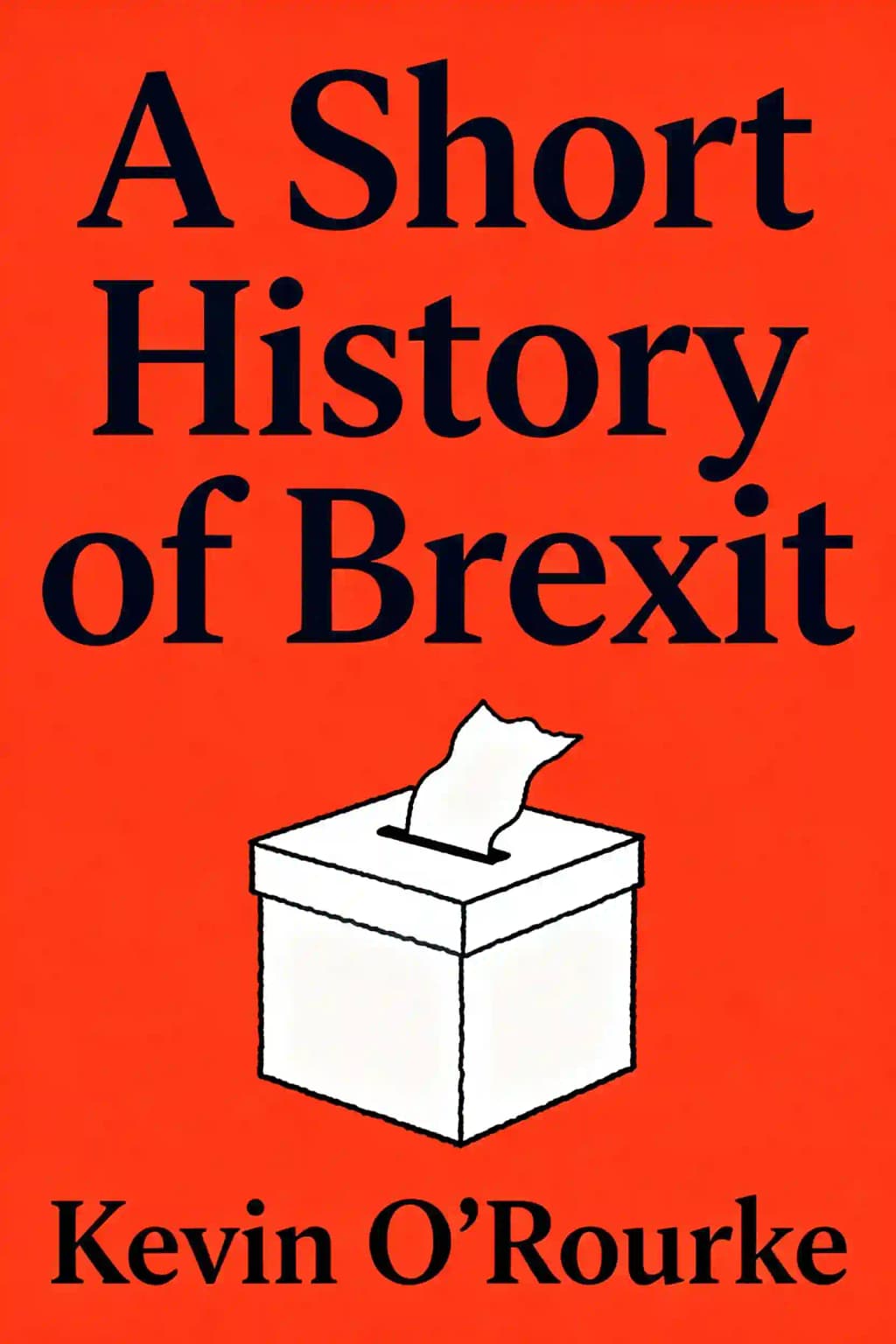
Oxford economist Kevin O'Rourke unravels Brexit's complex history, revealing centuries-old British-European tensions beyond today's headlines. Praised for its "quietly devastating" analysis by political scholars, this book exposes why the Irish border represents not just trade issues, but the EU's very foundation.
Kevin O’Rourke is an Irish economic historian and Professor of Economics at NYU Abu Dhabi, acclaimed for his incisive analysis of European integration in A Short History of Brexit: From Brentry to Backstop.
A former Chichele Professor of Economic History at Oxford and Research Director of the Centre for Economic Policy Research, O’Rourke combines academic rigor with a keen understanding of geopolitical dynamics. His work explores the UK’s fraught relationship with the EU, emphasizing economic roots and the Irish border’s pivotal role, informed by his dual perspective as both a scholar and an Irish citizen.
O’Rourke co-authored influential titles like Globalization and History and Power and Plenty, which examine trade and conflict across millennia. A Fellow of the British Academy and the Royal Irish Academy, his expertise bridges historical scholarship and contemporary policy debates.
A Short History of Brexit has been praised as an essential guide to understanding the referendum’s complexities, cementing O’Rourke’s reputation as a leading voice on Europe’s economic past and present. The book is widely cited in academic and political circles for its balanced, data-driven approach to one of the 21st century’s most divisive issues.
A Short History of Brexit by Kevin O’Rourke provides a historical analysis of the UK’s complex relationship with the European Union, tracing the economic, political, and social factors that culminated in the 2016 referendum. It examines British Euroscepticism, the EU’s institutional evolution, and the Irish border’s pivotal role in Brexit negotiations, offering context for understanding this transformative event.
This book is ideal for readers seeking a nuanced understanding of Brexit’s origins and implications, including students of European history, policymakers, and anyone interested in UK-EU relations. O’Rourke’s accessible style makes it suitable for both academic audiences and general readers navigating post-Brexit debates.
Yes, O’Rourke’s book is praised for its clarity and depth, distilling decades of political tension into a concise narrative. It provides fresh perspectives on Brexit’s historical roots and its global impact, making it a vital resource for understanding contemporary European politics.
The book highlights the Irish border as a microcosm of Brexit’s complexities. O’Rourke argues that the border symbolizes the EU’s commitment to preserving its single market and peace in Northern Ireland, making it a non-negotiable issue during talks. Historical Anglo-Irish tensions and the Good Friday Agreement further complicated resolutions.
Key arguments include Britain’s longstanding ambivalence toward European integration, the role of UKIP in pushing for a referendum, and the EU’s institutional rigidity during negotiations. O’Rourke emphasizes how economic policies and national identity clashes shaped the Brexit outcome.
As a leading economic historian, O’Rourke combines rigorous analysis of trade agreements, sovereignty debates, and EU governance structures. His expertise lends authority to discussions of Brexit’s economic ramifications and historical precedents.
The book spans post-WWII European integration, the UK’s 1975 EC membership referendum, the Maastricht Treaty, and the rise of Euroscepticism. It also delves into the 2016 referendum’s aftermath and Theresa May’s failed withdrawal agreements.
O’Rourke explains “hard Brexit” as a clean break from the EU’s single market and customs union, prioritizing sovereignty over economic ties. “Soft Brexit” refers to retaining closer economic integration, akin to Norway’s model, which faced opposition from hardline Leavers.
Economics is central, with O’Rourke analyzing how trade dependencies, regulatory alignment, and financial services influenced Brexit strategies. He critiques the Leave campaign’s oversimplified economic claims and underscores the risks of disrupting integrated supply chains.
Unlike journalistic accounts, O’Rourke’s work offers a long-term historical lens, linking Brexit to centuries of British isolationism and EU institutional evolution. It balances academic rigor with accessibility, distinguishing it from politicized narratives.
O’Rourke argues that understanding the EU’s priorities—like preserving the single market and avoiding fragmentation—is key to grasping Brexit’s stalled negotiations. The EU’s history of crisis management and unity shaped its inflexibility on issues like the Irish border.
The book warns that unresolved tensions over trade, immigration, and regulatory autonomy will continue to strain relations. It advocates for pragmatic cooperation while acknowledging the lasting cultural and political divides exposed by Brexit.
Почувствуйте книгу через голос автора
Превратите знания в увлекательные, богатые примерами идеи
Захватите ключевые идеи мгновенно для быстрого обучения
Наслаждайтесь книгой в весёлой и увлекательной форме
Brexit wasn't born in a vacuum.
Traditional nation-state competition had become existentially dangerous.
Churchill declared he wouldn't preside over the liquidation of the British Empire.
Only America and Russia were truly Great Powers.
Britain had been central to European integration; afterward, it became increasingly peripheral.
Разбейте ключевые идеи Short History of Brexit на понятные тезисы, чтобы понять, как инновационные команды создают, сотрудничают и растут.
Погрузитесь в Short History of Brexit через яркие истории, превращающие уроки инноваций в запоминающиеся и применимые моменты.
Задавайте любые вопросы, выбирайте свой стиль обучения и создавайте идеи, которые действительно вам подходят.

Создано выпускниками Колумбийского университета в Сан-Франциско
"Instead of endless scrolling, I just hit play on BeFreed. It saves me so much time."
"I never knew where to start with nonfiction—BeFreed’s book lists turned into podcasts gave me a clear path."
"Perfect balance between learning and entertainment. Finished ‘Thinking, Fast and Slow’ on my commute this week."
"Crazy how much I learned while walking the dog. BeFreed = small habits → big gains."
"Reading used to feel like a chore. Now it’s just part of my lifestyle."
"Feels effortless compared to reading. I’ve finished 6 books this month already."
"BeFreed turned my guilty doomscrolling into something that feels productive and inspiring."
"BeFreed turned my commute into learning time. 20-min podcasts are perfect for finishing books I never had time for."
"BeFreed replaced my podcast queue. Imagine Spotify for books — that’s it. 🙌"
"It is great for me to learn something from the book without reading it."
"The themed book list podcasts help me connect ideas across authors—like a guided audio journey."
"Makes me feel smarter every time before going to work"
Создано выпускниками Колумбийского университета в Сан-Франциско

Получите резюме книги «Short History of Brexit» в формате PDF или EPUB бесплатно. Распечатайте или читайте офлайн в любое время.
Brexit wasn't merely a 2016 referendum-it was the culmination of centuries of British exceptionalism colliding with European integration. While continental Europeans built deep institutions after experiencing devastating wartime losses (France lost 1.5% of its population in WWII, Germany a staggering 9%), Britain's relatively lighter suffering (0.7% population loss) left it with a fundamentally different perspective. For Europeans, integration meant survival; for Britain, protected by the Channel and clinging to imperial dreams, it seemed optional. This fundamental disconnect explains why Franco-German reconciliation became the cornerstone of European unity while Britain remained skeptical. As French politician Maurice Faure bluntly stated in 1957, only America and Russia were truly Great Powers-a reality Britain wasn't yet ready to accept.
Britain's hesitation toward Europe was deeply rooted in its imperial past. As the first industrial nation, Britain had become dependent on imported food and raw materials, paid for with manufactured exports. This created a nation requiring naval supremacy to protect vital supply lines and a political divide between agricultural interests and manufacturing classes. The Conservative Party particularly cherished the settler colonies of Australia, Canada, and New Zealand. By 1932, Britain had established an "imperial preference" system - a network of preferential tariffs that successfully increased intra-Empire trade. This Commonwealth provided Britain with a model of international cooperation without formal supranational institutions where Britain naturally maintained significant influence. Why surrender sovereignty to European institutions when you could lead a global Commonwealth? This imperial mindset would profoundly shape British attitudes toward European integration for decades.
Ironically, Britain initially took a leading role in post-war European cooperation. Winston Churchill called for a "United States of Europe" in 1947, positioning Britain at the center of "three interlinked circles": the Commonwealth, the English-speaking world, and a united Europe. By 1950, Britain was a founding member of several key European organizations. The turning point came when Britain declined to join the European Coal and Steel Community proposed by French Foreign Minister Robert Schuman in May 1950. Later, during the Messina process that created the European Economic Community, Britain participated briefly before withdrawing. The fundamental difference was structural: Britain wanted a free trade area where members eliminate tariffs while maintaining independent trade policies, whereas Europeans created a customs union with a common external tariff. Britain confidently presented "Plan G" as an alternative, believing UK cooperation would be welcomed on their terms. This confidence proved misplaced. After France vetoed the proposal, Britain instead established the European Free Trade Association with six other countries in 1960 - a pale shadow of the dynamic EEC.
By 1961, economic reality forced a reversal - Prime Minister Harold Macmillan applied for EEC membership. Three factors drove this: increased EEC trade over Britain's free trade group; declining Commonwealth trade; and the EEC's economic boom highlighting British underperformance. Britain's diminished international standing meant maintaining US relations increasingly required joining the Common Market. Macmillan's diary revealed his fear of being caught between a hostile America and a powerful "Empire of Charlemagne" under French and German control. This prompted his "grim choice" despite potential sacrifices to British agriculture and Commonwealth ties. French President Charles de Gaulle vetoed Britain's application in 1963 and 1967, fearing diminished French influence and Britain acting as an American "Trojan horse." Britain finally joined in 1973, with a 1975 referendum resulting in a two-to-one rejection of what we now call Brexit. The "Yes" campaign portrayed opponents as extremists, noting both the IRA and Soviet Union opposed membership. The matter seemed settled - yet forty years later, Britain would vote to leave.
Britain joined the EC just as the post-war economic "Golden Age" ended. The 1973 oil shock caused immediate problems, and European growth slowed permanently as catch-up opportunities disappeared. Britain suffered severely, with inflation averaging 15.4% between 1973-1980 (compared to Germany's 4.9%), eventually requiring an emergency IMF loan in 1976. Despite her distrust of Germans and continental political traditions, Margaret Thatcher became an enthusiastic supporter of the Single Market programme - the most significant European integration since the 1950s. The 1985 Cockfield White Paper identified 297 barriers to eliminate by 1992, introducing qualified majority voting. Thatcher's government backed these changes as creating "Thatcherism on a European scale," with Hugo Young noting, "Everyone in the Thatcher Cabinet backed it... storing up trouble for the day when it became an inconvenient memory." The Irish border question, overlooked during the 2016 referendum, later became central to Brexit. While this border had been an international frontier since 1923, the 1998 Good Friday Agreement combined with EU membership had made it virtually invisible. The EU didn't solve the Northern Irish conflict alone, but it normalized UK-Ireland relations and eliminated border controls.
EU membership transformed Ireland's economy by reducing British dependence, with exports to Britain dropping from 61% in 1972 to just 14% by 2015. The 1992 Single Market propelled Ireland to remarkable economic success in the 1990s, stemming from two key factors: political independence providing policy flexibility and EU membership ensuring market access. By the mid-1990s, British politics had reversed on European integration. Labour became pro-European while the Conservative Party moved in the opposite direction. The 2004 EU enlargement had significant consequences when Britain, unlike most existing members, allowed immediate free movement from new member states, triggering large-scale Eastern European immigration with profound political effects. In the 2016 referendum, the Leave campaign used controversial tactics - from Leave.EU's poster showing Syrian refugees to Vote Leave's false claim about sending "350 million a week" to the EU. On June 23, 2016, the UK voted to leave by 51.9% to 48.1%, with Scotland, Northern Ireland, Gibraltar, and London voting Remain while the rest of England and Wales voted Leave.
What explains Brexit? While Europe faced Eurozone stagnation and refugee crises in 2015-16, Britain wasn't directly affected by either, yet Brexiteers effectively portrayed the EU as incompetent and crisis-ridden. Globalization's unequal benefits were decisive-areas with low pay, high unemployment, manufacturing traditions, lower-skilled workers, and recent Eastern European migration favored Leave. Cameron and Osborne's austerity program cut government support when communities needed it most. Studies show austerity influenced the Brexit vote more than immigration-a modest reduction might have changed the outcome. Brexit negotiations exposed a fundamental contradiction: Britain wanted to restrict EU immigration and escape regulations while maintaining frictionless trade. This "cakeism" ignored economic realities facing industries dependent on just-in-time supply chains. The Irish border presented a unique challenge, with security officials warning that any physical infrastructure would become targets for dissident republicans. Brexit revealed deep contradictions in British politics-a desire to "take back control" while maintaining frictionless trade, to assert sovereignty while avoiding a hard Irish border, to be both European and exceptional. These contradictions, rooted in centuries of history, would not easily resolve. The Brexit story demonstrates how nations, like individuals, can be trapped between competing identities, with history's shadows determining our future as much as present choices.