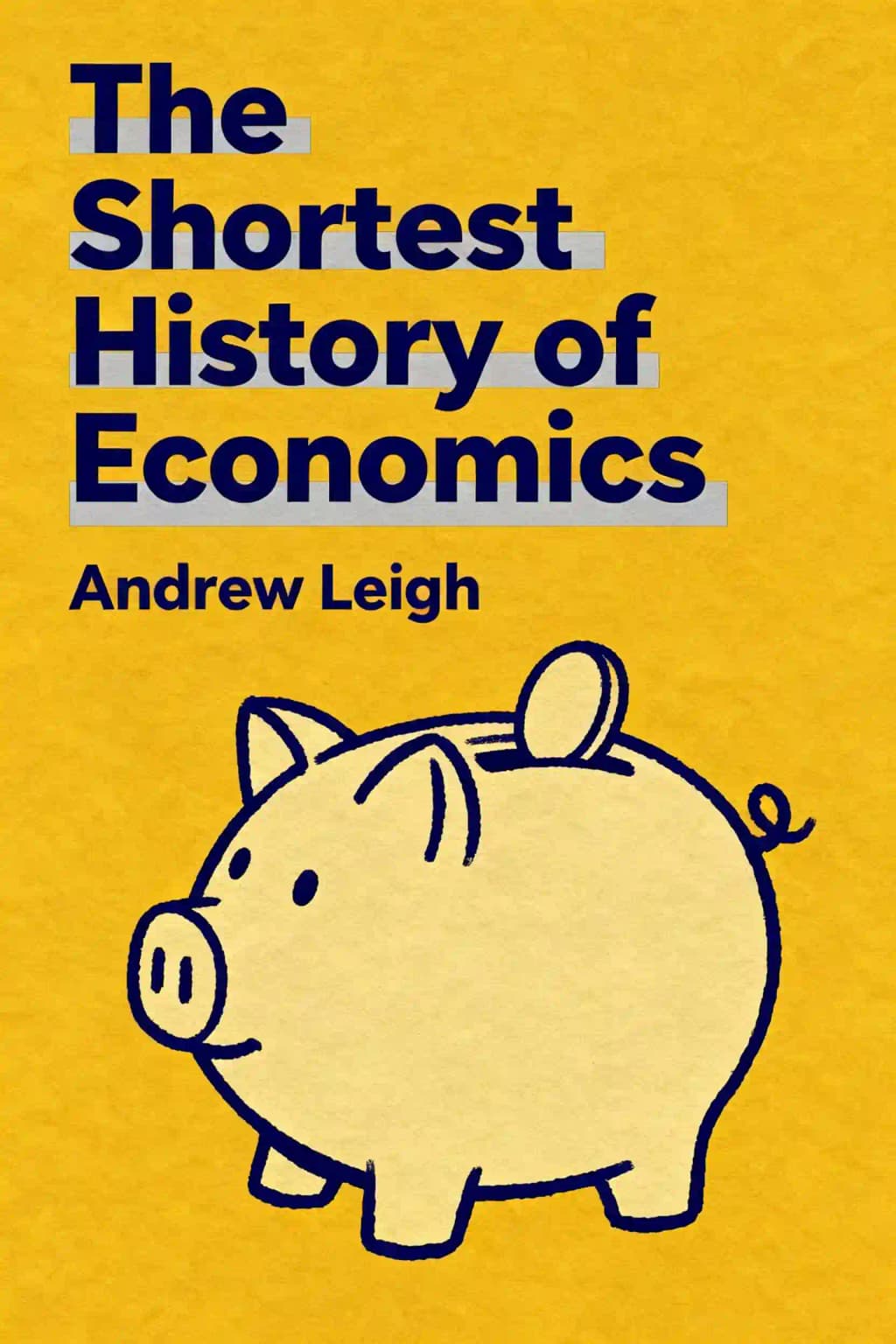
The Shortest History of Economics
Overview of The Shortest History of Economics
From prehistoric ploughs to AI, Nobel Laureate Claudia Goldin's "one economics book to read" unpacks how invisible forces shape our world. Harvard-trained economist Andrew Leigh reveals surprising connections between disease and colonization, challenging readers to rethink everything they know about markets and human progress.

Key Themes in The Shortest History of Economics
- technological innovation history
- scarcity and abundance
- intergenerational social mobility
- geographic determinism
- agricultural revolution impacts
Quotes from The Shortest History of Economics
Incentives matter.
Agriculture initially worsened human health.
Water transportation revolutionized commerce.
Social status has been remarkably persistent.
The plague dramatically shifted power balances.
Characters in The Shortest History of Economics
- Andrew LeighAuthor, economist, and Australian parliamentarian
- Gregory ClarkEconomist who researched dynastic persistence
About the Author
About the Author of The Shortest History of Economics
Andrew Leigh, award-winning economist and Australian policymaker, is the author of The Shortest History of Economics, a concise non-fiction guide exploring economic principles through pivotal global events.
A Harvard-trained PhD and former economics professor at the Australian National University, Leigh brings academic rigor and real-world policy experience as Australia’s Assistant Minister for Competition, Charities, and Treasury.
His prior works, including the critically acclaimed Randomistas on evidence-based policymaking and Fair Game on economic lessons from sports, establish his knack for translating complex ideas into engaging narratives.
Leigh hosts the podcast The Good Life, discussing ethics and societal well-being, and his writings frequently appear in major Australian media outlets. A Fellow of the Australian Academy of Social Sciences, he blends historical analysis with contemporary relevance in this book, part of a bestselling series praised for making niche topics accessible to general readers.
Download Summary of The Shortest History of Economics
Get the The Shortest History of Economics summary as a free PDF or EPUB. Print it or read offline anytime.
FAQs About This Book
The Shortest History of Economics by Andrew Leigh provides a concise 200-page journey through global economic evolution, tracing capitalism’s emergence, pivotal ideas from thinkers like Adam Smith, and how markets shaped modern prosperity. It demystifies concepts like scarcity and free markets using real-world examples, while highlighting humanity’s progress in health, longevity, and poverty reduction through economic principles.
This book suits economics newcomers, students seeking foundational insights, and professionals wanting historical context. Leigh’s clear explanations (e.g., defining economics as “how people maximize well-being amid scarcity”) make it ideal for readers seeking a jargon-free primer. Policy enthusiasts will appreciate its analysis of growth strategies and existential risks in modern economies.
Yes – reviewers praise its crisp storytelling and ability to connect economic theories to real-world progress. Leigh, an economist-politician, balances scholarly rigor with accessible prose, offering actionable lessons like applying marginal decision-making to daily life. A 2025 Goodreads reviewer called it “miraculous” for explaining free markets’ role in improving living standards.
- Scarcity & Choice: How societies allocate limited resources.
- Market Equilibrium: Supply-demand dynamics shaping prices.
- Industrial Revolution: Catalyzing productivity and global trade.
- Existential Risks: Modern challenges like climate change and AI.
Leigh argues these forces explain humanity’s leap from subsistence farming to digital economies.
Leigh defines economics as “a social science studying how people maximize well-being in the face of scarcity.” This framework threads the narrative, explaining behaviors from barter systems to cryptocurrency. He emphasizes practicality, showing how concepts like sunk costs apply to personal decisions (e.g., leaving a bar before overindulging).
- The Agricultural Revolution’s mixed impacts.
- 19th-century industrialization boosting living standards.
- Post-WWII globalization and digital innovation.
Leigh critiques settled agriculture for initially worsening diets but credits later innovations for transformative growth, linking past policies to today’s economic resilience.
Yes – Leigh discusses AI, inequality, and pandemic recovery, framing them through historical patterns. He advocates for policies balancing innovation with equality, citing lessons from the Industrial Revolution to avoid repeating mistakes like environmental neglect.
Unlike Randomistas’ focus on experimental methods, this book offers a panoramic historical narrative. However, both share Leigh’s trademark blend of data-driven analysis and storytelling. Fans of his labor economics research will recognize his optimism about evidence-based policy.
Some note limited coverage of non-Western economies (e.g., India’s role) and brevity sacrificing depth on complex topics. However, most praise Leigh’s ability to simplify without oversimplifying, calling it a “launchpad” for deeper exploration.
Drawing parallels from his earlier work Fair Game, Leigh compares economic competition to sports, illustrating concepts like incentive structures through teamwork narratives. This approach makes abstract ideas like market equilibrium relatable.
As debates on AI regulation and climate policy intensify, Leigh’s historical lens helps readers contextualize current crises. His analysis of past disruptions (e.g., steam power) provides frameworks for navigating today’s tech-driven transitions.
- “The secret of economics is that the most powerful insights come from a handful of big ideas”.
- “Free markets, flawed yet indispensable, remain worth rooting for”.
- “Progress isn’t inevitable—it’s a choice shaped by policy”.