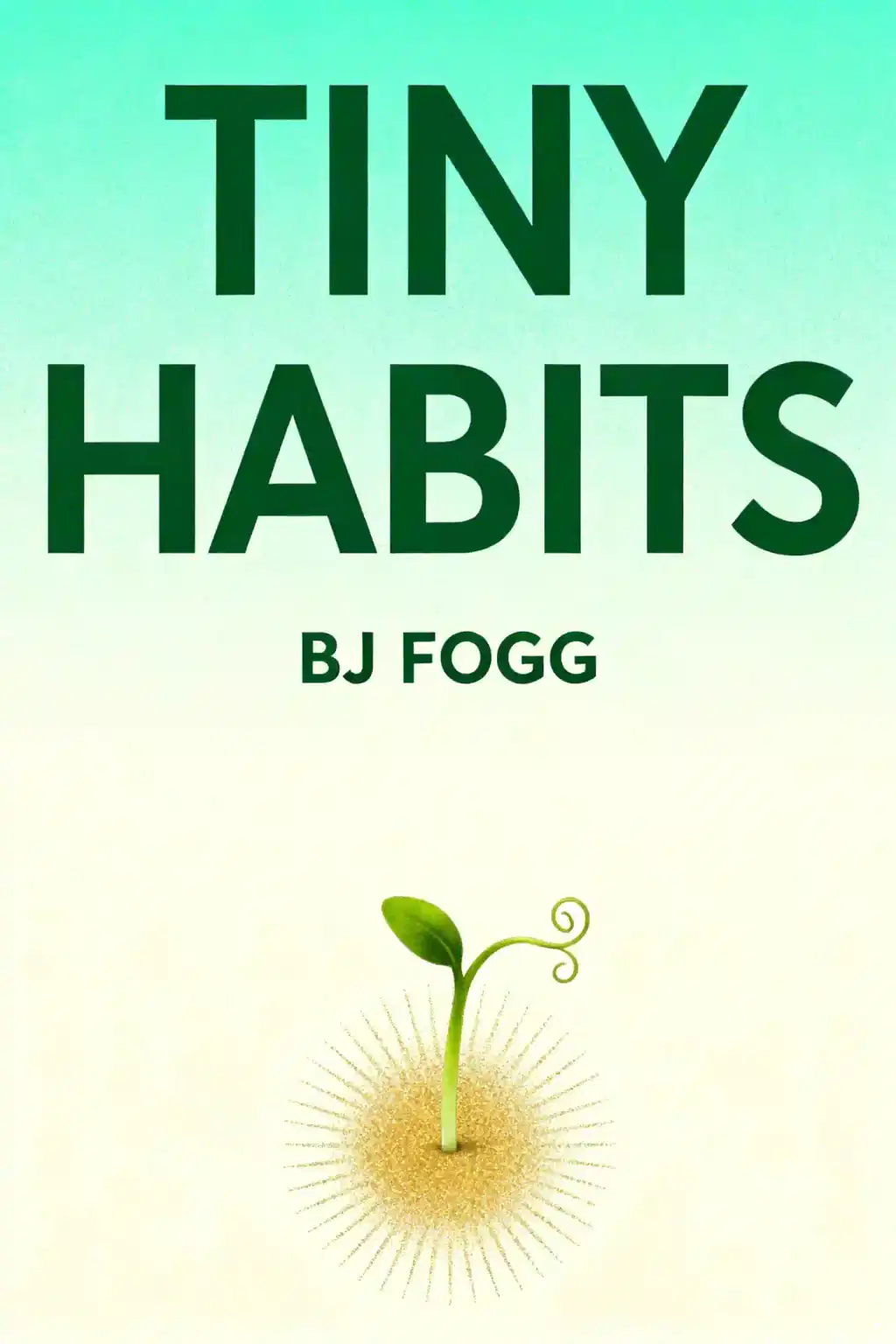
Tiny Habits
The Small Changes That Change Everything
Overview of Tiny Habits
Tiny Habits reveals Stanford scientist BJ Fogg's revolutionary approach to behavior change through microscopic actions. Endorsed by Arianna Huffington as "a blueprint for redefining self-improvement," this counterintuitive method has helped 60,000+ people transform their lives by celebrating small wins instead of relying on motivation.

Key Themes in Tiny Habits
- behavior design
- habit stacking
- willpower bypass
- micro-habit formation
- motivation mapping
Quotes from Tiny Habits
Change doesn't require heroic willpower or radical transformation.
The problem isn't you-it's your approach to change.
Motivation [is] a party-animal friend.
Help people do what they already want to do.
Making behaviors tiny is the key to sustainable change.
Characters in Tiny Habits
- BJ FoggStanford behavior scientist and author
- KatieCase study who replaced social media with exercise
- DennyCase study who improved household habits
About the Author
About the Author of Tiny Habits
BJ Fogg, bestselling author of Tiny Habits and a pioneering behavioral scientist, is the founder of Stanford University’s Behavior Design Lab. A leading authority on habit formation and behavior change, Fogg’s work bridges psychology and technology, with his Fogg Behavior Model (FBM) — which identifies motivation, ability, and prompts as key drivers of action — widely applied in health, tech, and product design.
His earlier book, Persuasive Technology: Using Computers to Change What We Think and Do, established the field of captology (computers as persuasive tools) and inspired global academic conferences.
Fogg’s research, cited over 20,000 times, has earned recognition from Fortune Magazine, which named him a “New Guru You Should Know.” He founded Stanford’s Mobile Health conference and mentored innovators behind Instagram and the Center for Humane Technology.
Tiny Habits, a New York Times bestseller, distills his decades of research into practical strategies for personal growth, emphasizing small, sustainable changes. The book has become a cornerstone of modern behavior science, endorsed by professionals and readers worldwide for its evidence-based approach to lasting transformation.
Download Summary of Tiny Habits
Get the Tiny Habits summary as a free PDF or EPUB. Print it or read offline anytime.
FAQs About This Book
Tiny Habits by BJ Fogg outlines a science-backed method for building lasting behavior change through small, incremental steps. The book emphasizes starting with "tiny" actions (e.g., flossing one tooth) anchored to existing routines, paired with immediate celebration to reinforce habits. Fogg’s Behavior Design framework focuses on aligning motivation, ability, and prompts (MAP) to create sustainable transformations.
This book is ideal for anyone struggling to adopt new habits or overwhelmed by traditional self-help approaches. Fogg targets everyday individuals seeking manageable changes, rather than those focused on peak performance. It’s particularly useful for people recovering from setbacks or prioritizing mental health, relationships, or stress reduction.
Yes, especially if you’ve struggled with habit formation. Unlike willpower-dependent methods, Fogg’s approach uses behavioral science to make changes effortless. The book provides actionable templates, like the ABC (Anchor-Behavior-Celebration) recipe, and includes 60 pre-designed habits for stress relief and focus.
The method involves three phases:
- Clarify aspirations and identify "Golden Behaviors" (high-impact actions).
- Design tiny habits by scaling behaviors down (e.g., "do two push-ups" instead of a full workout).
- Anchor habits to existing routines and celebrate immediately to create positive reinforcement.
While both focus on small changes, Atomic Habits targets performance-driven audiences seeking mastery, whereas Tiny Habits prioritizes accessibility for everyday challenges. Fogg’s method relies more on environmental design and emotional celebration, while James Clear emphasizes identity-based systems.
Golden Behaviors are high-impact actions that align with your goals and are easy to execute. Fogg uses a focus map to identify behaviors that maximize results with minimal effort, such as drinking water first thing in the morning to improve hydration habits.
Celebration triggers a neurochemical "shine" (e.g., saying “Nice!” or fist-pumping) that wires habits into the brain. Fogg argues this immediate positive feedback is critical for habit retention, making behaviors 3x more likely to stick.
Yes. The book includes habits specifically designed to lower stress, like taking a deep breath after sitting down or jotting down one gratitude note daily. These micro-actions build emotional resilience without overwhelming users.
Some argue the approach oversimplifies complex behavioral issues or dismisses deeper psychological barriers. However, Fogg counters that starting tiny creates a foundation for tackling bigger challenges over time.
As a Stanford behavior scientist and founder of the Behavior Design Lab, Fogg draws on 20+ years of research and boot camps testing his methods. His academic rigor ensures strategies are grounded in psychology and neuroscience.
The ABC recipe (Anchor-Behavior-Celebration) structures habits by:
- Anchor: Linking the new habit to an existing routine (e.g., “After I brush my teeth…”).
- Behavior: Performing the tiny action (e.g., flossing one tooth).
- Celebration: Reinforcing success with a positive emotion.
Consistent tiny habits build "success momentum," increasing confidence and motivation. For example, starting with two daily push-ups often naturally expands into longer workouts as the habit becomes automatic.