The Charity Trap: Why the Daily Grind Persists
Explore how corporate philanthropy acts as a moral smokescreen, keeping workers trapped in a grueling cycle that preserves the status quo for the elite.

Melhor citação de The Charity Trap: Why the Daily Grind Persists
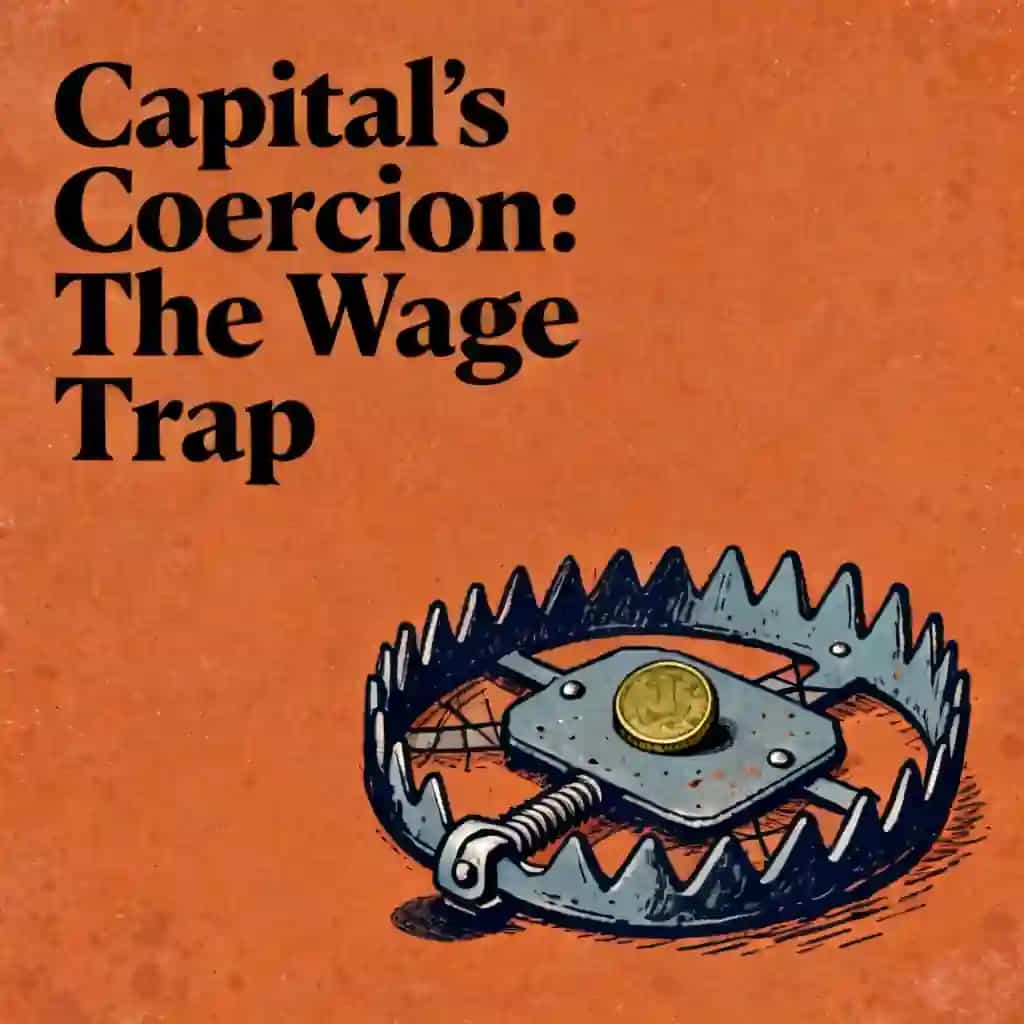
The wage is the mask that makes it look like a clean, voluntary transaction, but it is actually economic compulsion disguised as a contract where we sell our life-activity in hourly increments just to survive.
Generated by hassan mujtaba
Due to modern economic system we are all tied up in daily grind to earn living and fulfill responsibilities for families which eventually benefits the rich and powerful. Companies fool people by doing some sort of charity which is needle in haystack. Therefore we don't have time and energy to do something about the causes we care.


Perguntas frequentes
The wage mask is a concept describing how a paycheck disguises the actual extraction of value from an employee. While a wage appears to be a fair and voluntary exchange of time for money, the script argues that companies only hire individuals if they can produce more value than they are paid. This "surplus value" vanishes into corporate profit, while the worker is left with the illusion of a clean transaction. Furthermore, the choice to work is often not truly voluntary but is instead a form of economic compulsion, as most people must sell their labor in hourly increments simply to avoid starvation or homelessness.
Corporate Social Responsibility (CSR) and high-profile charity projects are often used as a public relations framework to "greenwash" a company's image. By performing small, visible acts of kindness, corporations can defuse public anger regarding systemic inequality without changing the exploitative nature of their business models. This acts as a safety valve that protects the status quo. In many cases, the cost of these "feel-good" initiatives is actually pushed down the supply chain, forcing local suppliers to squeeze their own workers even harder to meet the headquarters' new "ethical" standards.
The script explains that the wages system was not a natural evolution but a social relation imposed through systemic dispossession. Historically, people lived through communal ownership or subsistence farming. In Europe, this changed through the "enclosure" of common lands, which forcibly removed peasants from the land they used to survive, leaving them with no choice but to work in factories. Similarly, during colonization, indigenous modes of life were dismantled to create forced labor markets. This manufactured a class of people, known as the proletariat, who own nothing but their ability to work.
The "negative infinity" refers to the psychological toll of a system where money is the only source of security against constant precarity. Because money is purely quantitative, there is no natural stopping point where a person feels they have "enough" to be safe from risks like losing health insurance or housing. This leads to a "rat race" of overwork and burnout, where individuals are so focused on individual survival and chasing more wealth that they lose their capacity for community involvement, personal relationships, and political activism.
Reclaiming life involves building "dual power" by creating structures of solidarity that exist outside of the market, such as cooperatives, community gardens, and mutual aid networks. The script suggests "de-commodification"—reducing one's dependence on the cash-nexus by sharing tools and skills with neighbors. On a larger scale, it advocates for "workplace democracy" and institutional shifts like a job guarantee or universal basic income. These changes aim to treat basic needs as social rights rather than corporate favors, giving people the breathing room to act as citizens rather than just "human capital."
Criado por ex-alunos da Universidade de Columbia em San Francisco
"Instead of endless scrolling, I just hit play on BeFreed. It saves me so much time."


"I never knew where to start with nonfiction—BeFreed’s book lists turned into podcasts gave me a clear path."


"Perfect balance between learning and entertainment. Finished ‘Thinking, Fast and Slow’ on my commute this week."
"Crazy how much I learned while walking the dog. BeFreed = small habits → big gains."
"Reading used to feel like a chore. Now it’s just part of my lifestyle."

"Feels effortless compared to reading. I’ve finished 6 books this month already."
"BeFreed turned my guilty doomscrolling into something that feels productive and inspiring."

"BeFreed turned my commute into learning time. 20-min podcasts are perfect for finishing books I never had time for."
"BeFreed replaced my podcast queue. Imagine Spotify for books — that’s it. 🙌"

"It is great for me to learn something from the book without reading it."
"The themed book list podcasts help me connect ideas across authors—like a guided audio journey."
"Makes me feel smarter every time before going to work"
Criado por ex-alunos da Universidade de Columbia em San Francisco
"Instead of endless scrolling, I just hit play on BeFreed. It saves me so much time."
"I never knew where to start with nonfiction—BeFreed’s book lists turned into podcasts gave me a clear path."
"Perfect balance between learning and entertainment. Finished ‘Thinking, Fast and Slow’ on my commute this week."
"Crazy how much I learned while walking the dog. BeFreed = small habits → big gains."
"Reading used to feel like a chore. Now it’s just part of my lifestyle."
"Feels effortless compared to reading. I’ve finished 6 books this month already."
"BeFreed turned my guilty doomscrolling into something that feels productive and inspiring."
"BeFreed turned my commute into learning time. 20-min podcasts are perfect for finishing books I never had time for."
"BeFreed replaced my podcast queue. Imagine Spotify for books — that’s it. 🙌"
"It is great for me to learn something from the book without reading it."
"The themed book list podcasts help me connect ideas across authors—like a guided audio journey."
"Makes me feel smarter every time before going to work"
"Instead of endless scrolling, I just hit play on BeFreed. It saves me so much time."
"I never knew where to start with nonfiction—BeFreed’s book lists turned into podcasts gave me a clear path."
"Perfect balance between learning and entertainment. Finished ‘Thinking, Fast and Slow’ on my commute this week."
"Crazy how much I learned while walking the dog. BeFreed = small habits → big gains."
"Reading used to feel like a chore. Now it’s just part of my lifestyle."
"Feels effortless compared to reading. I’ve finished 6 books this month already."
"BeFreed turned my guilty doomscrolling into something that feels productive and inspiring."
"BeFreed turned my commute into learning time. 20-min podcasts are perfect for finishing books I never had time for."
"BeFreed replaced my podcast queue. Imagine Spotify for books — that’s it. 🙌"
"It is great for me to learn something from the book without reading it."
"The themed book list podcasts help me connect ideas across authors—like a guided audio journey."
"Makes me feel smarter every time before going to work"
"Instead of endless scrolling, I just hit play on BeFreed. It saves me so much time."
"I never knew where to start with nonfiction—BeFreed’s book lists turned into podcasts gave me a clear path."
"Perfect balance between learning and entertainment. Finished ‘Thinking, Fast and Slow’ on my commute this week."
"Crazy how much I learned while walking the dog. BeFreed = small habits → big gains."
"Reading used to feel like a chore. Now it’s just part of my lifestyle."
"Feels effortless compared to reading. I’ve finished 6 books this month already."
"BeFreed turned my guilty doomscrolling into something that feels productive and inspiring."
"BeFreed turned my commute into learning time. 20-min podcasts are perfect for finishing books I never had time for."
"BeFreed replaced my podcast queue. Imagine Spotify for books — that’s it. 🙌"
"It is great for me to learn something from the book without reading it."
"The themed book list podcasts help me connect ideas across authors—like a guided audio journey."
"Makes me feel smarter every time before going to work"