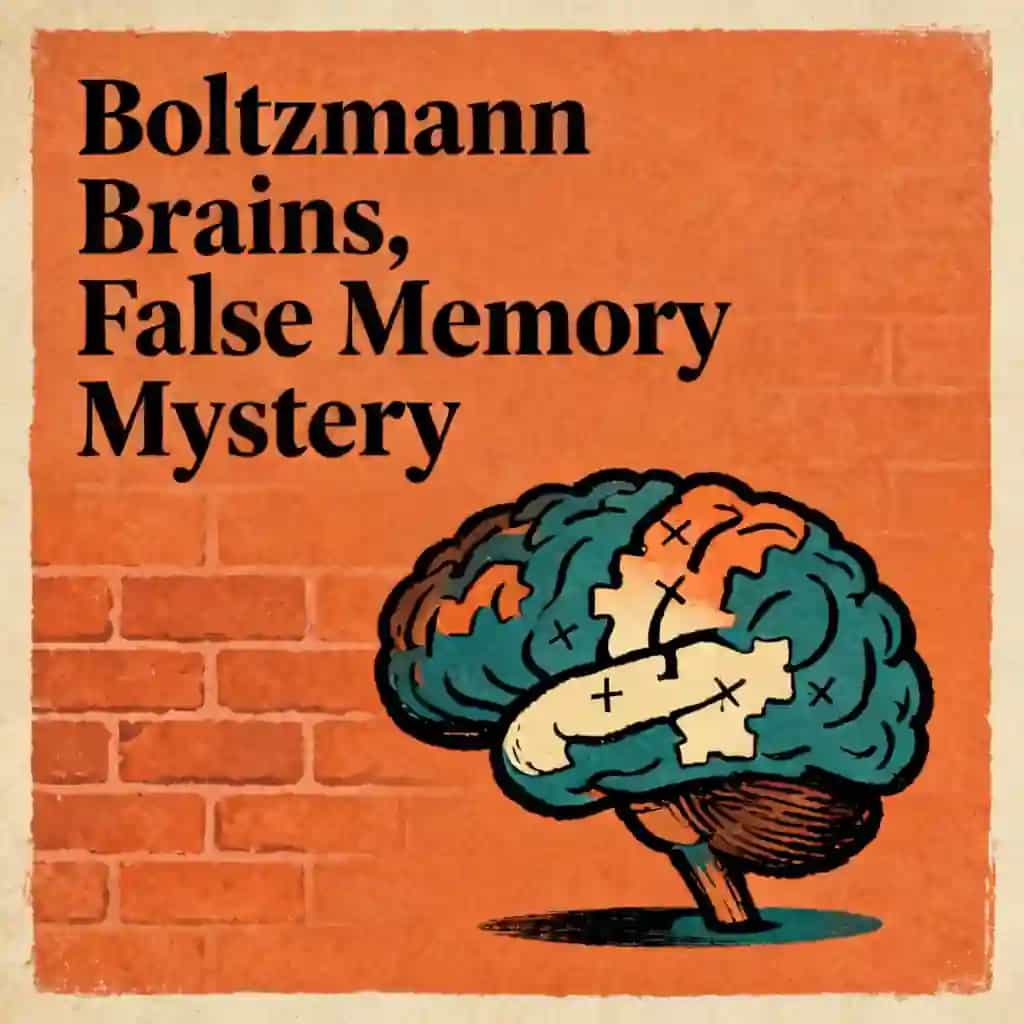
The Boltzmann Brain Paradox and Why You Might Not Exist
Is your memory just a glitch? Explore why physics suggests a lone brain in the void is more likely than the universe, and what it means for reality.

Melhor citação de The Boltzmann Brain Paradox and Why You Might Not Exist
The math of statistical mechanics is ruthless. It says that the smaller the fluctuation, the more often it happens. Statistically, the 'cheapest' way to get an observer who thinks they are in a universe is to just make the observer, not the whole universe.
Generated by Entropy
I want to know everything about the whole Boltzmann Brain thing.


Perguntas frequentes
A Boltzmann Brain is a theoretical "disembodied" brain that spontaneously flickers into existence in the vacuum of space due to random thermal fluctuations. According to the laws of statistical mechanics, in an infinite or eternal universe, it is mathematically more probable for a single brain with "fake" memories of a life to fluctuate into existence for a brief moment than it is for an entire, complex universe with billions of years of history to form. This creates a paradox because it suggests that you are statistically more likely to be a momentary hallucination in the void than a human being with a real past.
This concept is based on "entropy cost." To create our observable universe, trillions of particles must be arranged into a very specific, low-entropy state, which requires a massive amount of statistical "luck." In contrast, arranging just enough particles to form a three-pound human brain configured to perceive a universe requires far fewer resources and less luck. Because smaller fluctuations happen much more frequently than large ones, the math suggests the universe would produce "budget" observers (lone brains) far more often than "luxury" observers (humans evolved over billions of years).
Physicists use the Boltzmann Brain as a "diagnostic tool" or a reductio ad absurdum to identify flaws in cosmological models. If a specific theory about the universe—such as certain versions of Eternal Inflation—predicts that Boltzmann Brains should vastly outnumber ordinary observers, scientists generally consider that theory "cognitively unstable" or disqualified. The logic is that if we were Boltzmann Brains, we couldn't trust the very observations and memories used to create the theory in the first place, meaning the theory effectively undermines itself.
While it is difficult to prove from the "inside," some cosmologists suggest that if the universe is not eternal—meaning it decays or ends before Boltzmann Brains have time to dominate the statistics—then ordinary observers remain the majority. Recent data regarding Dark Energy suggests the universe might not be stable forever, which would "save" our reality by preventing the infinite production of freak observers. Additionally, the fact that we experience a continuous flow of time and can verify our memories against external records (like photo albums or historical sites) makes our existence "more expensive" and less likely to be a random, momentary glitch.
Criado por ex-alunos da Universidade de Columbia em San Francisco
"Instead of endless scrolling, I just hit play on BeFreed. It saves me so much time."


"I never knew where to start with nonfiction—BeFreed’s book lists turned into podcasts gave me a clear path."


"Perfect balance between learning and entertainment. Finished ‘Thinking, Fast and Slow’ on my commute this week."
"Crazy how much I learned while walking the dog. BeFreed = small habits → big gains."
"Reading used to feel like a chore. Now it’s just part of my lifestyle."

"Feels effortless compared to reading. I’ve finished 6 books this month already."
"BeFreed turned my guilty doomscrolling into something that feels productive and inspiring."

"BeFreed turned my commute into learning time. 20-min podcasts are perfect for finishing books I never had time for."
"BeFreed replaced my podcast queue. Imagine Spotify for books — that’s it. 🙌"

"It is great for me to learn something from the book without reading it."
"The themed book list podcasts help me connect ideas across authors—like a guided audio journey."
"Makes me feel smarter every time before going to work"
Criado por ex-alunos da Universidade de Columbia em San Francisco
"Instead of endless scrolling, I just hit play on BeFreed. It saves me so much time."
"I never knew where to start with nonfiction—BeFreed’s book lists turned into podcasts gave me a clear path."
"Perfect balance between learning and entertainment. Finished ‘Thinking, Fast and Slow’ on my commute this week."
"Crazy how much I learned while walking the dog. BeFreed = small habits → big gains."
"Reading used to feel like a chore. Now it’s just part of my lifestyle."
"Feels effortless compared to reading. I’ve finished 6 books this month already."
"BeFreed turned my guilty doomscrolling into something that feels productive and inspiring."
"BeFreed turned my commute into learning time. 20-min podcasts are perfect for finishing books I never had time for."
"BeFreed replaced my podcast queue. Imagine Spotify for books — that’s it. 🙌"
"It is great for me to learn something from the book without reading it."
"The themed book list podcasts help me connect ideas across authors—like a guided audio journey."
"Makes me feel smarter every time before going to work"
"Instead of endless scrolling, I just hit play on BeFreed. It saves me so much time."
"I never knew where to start with nonfiction—BeFreed’s book lists turned into podcasts gave me a clear path."
"Perfect balance between learning and entertainment. Finished ‘Thinking, Fast and Slow’ on my commute this week."
"Crazy how much I learned while walking the dog. BeFreed = small habits → big gains."
"Reading used to feel like a chore. Now it’s just part of my lifestyle."
"Feels effortless compared to reading. I’ve finished 6 books this month already."
"BeFreed turned my guilty doomscrolling into something that feels productive and inspiring."
"BeFreed turned my commute into learning time. 20-min podcasts are perfect for finishing books I never had time for."
"BeFreed replaced my podcast queue. Imagine Spotify for books — that’s it. 🙌"
"It is great for me to learn something from the book without reading it."
"The themed book list podcasts help me connect ideas across authors—like a guided audio journey."
"Makes me feel smarter every time before going to work"
"Instead of endless scrolling, I just hit play on BeFreed. It saves me so much time."
"I never knew where to start with nonfiction—BeFreed’s book lists turned into podcasts gave me a clear path."
"Perfect balance between learning and entertainment. Finished ‘Thinking, Fast and Slow’ on my commute this week."
"Crazy how much I learned while walking the dog. BeFreed = small habits → big gains."
"Reading used to feel like a chore. Now it’s just part of my lifestyle."
"Feels effortless compared to reading. I’ve finished 6 books this month already."
"BeFreed turned my guilty doomscrolling into something that feels productive and inspiring."
"BeFreed turned my commute into learning time. 20-min podcasts are perfect for finishing books I never had time for."
"BeFreed replaced my podcast queue. Imagine Spotify for books — that’s it. 🙌"
"It is great for me to learn something from the book without reading it."
"The themed book list podcasts help me connect ideas across authors—like a guided audio journey."
"Makes me feel smarter every time before going to work"