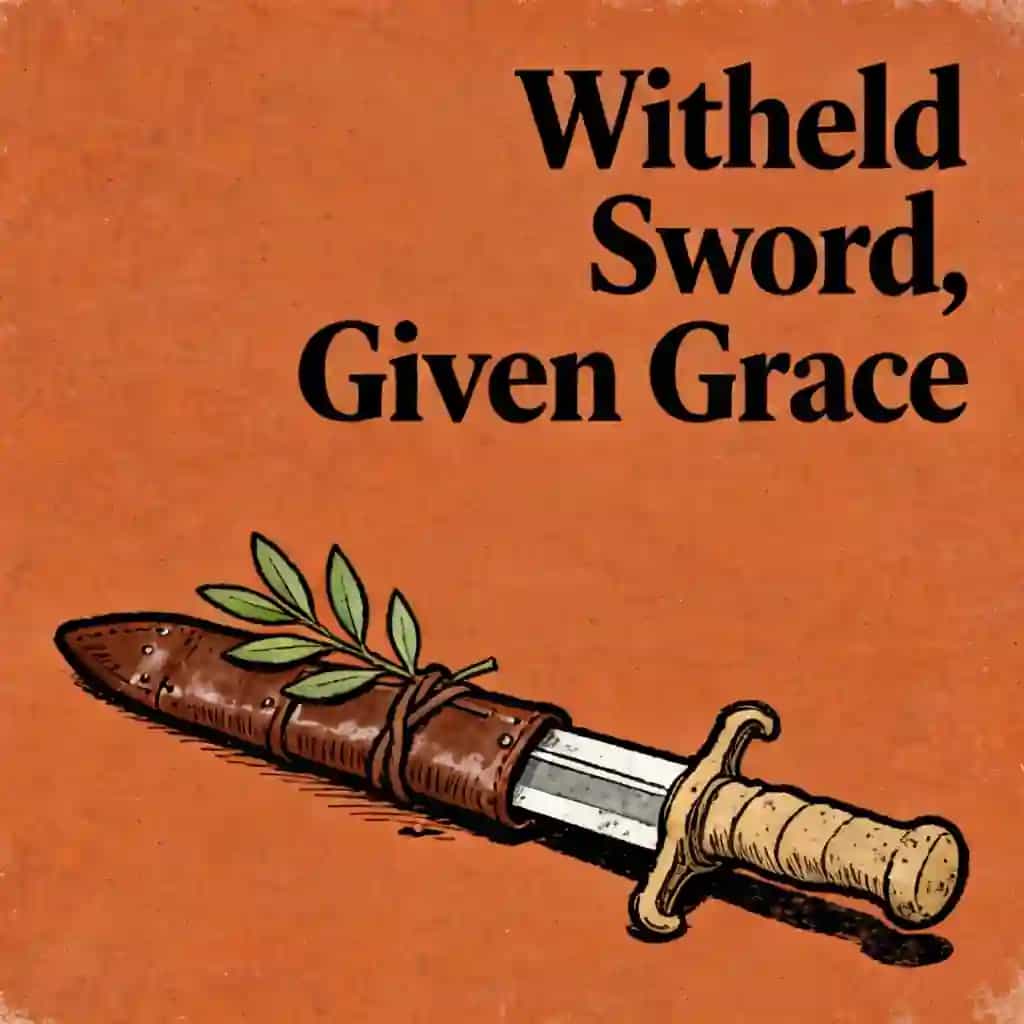
The Arrow's Flight: Covenant Grace in 1 Samuel 20
Experience the high-stakes drama of David and Jonathan through the theological lens of Thomas Boston. This episode explores the 'Fourfold State' and the Covenant of Grace, revealing how a secret signal in a field points directly to the redemptive work of Christ.

Melhor citação de The Arrow's Flight: Covenant Grace in 1 Samuel 20
There is but a step between a normal day and a life-or-death crisis, yet in the state of grace, that step always leads toward the 'sure mercies' of an everlasting covenant. We are called to be 'spirit-learned,' recognizing that even in the wilderness, every closure of an earthly door is the opening of a divine one.

Esta aula em áudio foi criada por um membro da comunidade BeFreed
First, vividly reconstruct 1 Samuel20] as a sensory-rich, dramatic narrative immersing readers in its motion, emotions, and divine tension, staying faithful to the text. Then, deeply research Thomas Boston's works to exegete verse-by-verse with his doctrines (Fourfold State, Covenant of Grace, Marrow free offer), historical context, and quotes, building to Christ as the living fulfillment—His death, resurrection, and sovereignty making Him pulse alive for sinners. Fin

Perguntas frequentes
The stone Ezel serves as a powerful sensory and spiritual signpost in the narrative. Its name suggests a "departure" or a "signpost," marking the moment David must leave his old life behind. In the script, it is described as the place where David’s world collapses, forcing him to move from a state of seeking security in the flesh—such as his position in the palace or his relationship with Saul—to a state where he must find his "eternal rest" in God’s promise alone.
The conflict illustrates the transition between the "State of Entire Depravity" and the "State of Grace." Saul represents the natural man in a state of depravity, where his faculties are "disjointed" by jealousy and a willful transgression against God’s anointed. In contrast, Jonathan represents the "begun recovery" of the State of Grace. His "bias of spirit" has shifted away from his own dynastic ambition and toward the "vessel of honor," which is David, reflecting a heart that has been "set right" by a covenant.
The arrows are more than a simple warning; they represent a "coded message of exile" and a "convincing discovery" of the truth. For David, the sound of the arrows is the "voice of the covenant" that ends his suspense and confirms he can no longer stay in Saul’s court. In a theological sense, the arrows symbolize the painful but necessary grace that pushes a believer out of a false sense of security and into the wilderness where they must rely entirely on God’s providence.
Drawing from "Marrow of Modern Divinity" theology, the covenant is a "free offer" because it is not based on David’s merit or performance. Jonathan does not demand that David prove himself before offering protection; instead, he gives his robe, sword, and identity freely. This mirrors the Gospel, where grace is "passively received" by the sinner. Jonathan acts as an agent of the covenant, choosing to be "gracious" rather than "great" by sacrificing his own right to the throne to preserve the messianic line.
The story serves as a "type" or shadow of Christ’s own sacrifice. Jonathan, a king’s son, leaves the palace to find a rejected man in a field and enters into a self-emptying covenant to save him, much like Jesus left heaven to save humanity. The script suggests that Jonathan reflects the "image of the Son" by taking the heat of his father’s anger so that David can go free. Ultimately, the "sure mercies of David" begin at the stone Ezel, pointing toward the everlasting covenant established through Christ’s death and resurrection.
Descubra mais

Study the book of James in the bible
This study is essential for believers seeking to bridge the gap between theological knowledge and daily conduct. It is ideal for anyone wanting to transform their faith into action through practical biblical principles on relationships, speech, and endurance.

Exodus: Between History and Myth
This plan bridges the gap between biblical tradition and historical reality, offering a critical look at one of humanity's most influential narratives. It is ideal for history buffs, theology students, and anyone interested in how ancient identities are constructed through storytelling and archaeology.

Bible, Quantum Physics & Theology Link
This plan bridges the perceived gap between ancient scripture and modern science, offering a unique interdisciplinary perspective on the nature of reality. It is ideal for theologians, science enthusiasts, and seekers curious about how quantum theory illuminates divine mystery.
Strengthen my Christian faith
This plan is designed for believers seeking to move beyond surface-level knowledge into a robust, defensible, and lived-out faith. It benefits anyone looking to bridge the gap between theological understanding and practical daily discipleship within a supportive community.
The Way of the Fathers
This course bridges the gap between ancient Christian wisdom and modern spiritual struggles, offering a practical roadmap for inner transformation. It is ideal for seekers and believers wanting to move beyond surface-level religion into a deep, therapeutic experience of faith.

The New Testament Story Arc
This learning plan provides a comprehensive overview of the New Testament's narrative and theological development. It is ideal for students of theology or anyone seeking to understand how the life of Jesus transformed into a global movement through the early church.

Understand the Book of Philippians
This learning plan offers a comprehensive bridge between academic biblical study and practical spiritual application. It is ideal for students of theology, small group leaders, or any believer seeking to find authentic joy and resilience through a deeper understanding of Paul’s prison epistles.

Deliver powerful Bible-based sermons
Effective preaching is the cornerstone of spiritual leadership and congregational growth, requiring both deep biblical knowledge and masterful communication skills. This comprehensive learning path is essential for pastors, ministry leaders, and anyone called to teach God's Word who wants to move beyond surface-level presentations to deliver sermons that truly transform hearts and minds. Whether you're a new preacher building foundational skills or an experienced minister seeking to deepen your impact, this plan provides the complete toolkit for powerful, biblically-grounded proclamation.
Criado por ex-alunos da Universidade de Columbia em San Francisco
"Instead of endless scrolling, I just hit play on BeFreed. It saves me so much time."


"I never knew where to start with nonfiction—BeFreed’s book lists turned into podcasts gave me a clear path."


"Perfect balance between learning and entertainment. Finished ‘Thinking, Fast and Slow’ on my commute this week."
"Crazy how much I learned while walking the dog. BeFreed = small habits → big gains."
"Reading used to feel like a chore. Now it’s just part of my lifestyle."

"Feels effortless compared to reading. I’ve finished 6 books this month already."
"BeFreed turned my guilty doomscrolling into something that feels productive and inspiring."

"BeFreed turned my commute into learning time. 20-min podcasts are perfect for finishing books I never had time for."
"BeFreed replaced my podcast queue. Imagine Spotify for books — that’s it. 🙌"

"It is great for me to learn something from the book without reading it."
"The themed book list podcasts help me connect ideas across authors—like a guided audio journey."
"Makes me feel smarter every time before going to work"
Criado por ex-alunos da Universidade de Columbia em San Francisco
"Instead of endless scrolling, I just hit play on BeFreed. It saves me so much time."
"I never knew where to start with nonfiction—BeFreed’s book lists turned into podcasts gave me a clear path."
"Perfect balance between learning and entertainment. Finished ‘Thinking, Fast and Slow’ on my commute this week."
"Crazy how much I learned while walking the dog. BeFreed = small habits → big gains."
"Reading used to feel like a chore. Now it’s just part of my lifestyle."
"Feels effortless compared to reading. I’ve finished 6 books this month already."
"BeFreed turned my guilty doomscrolling into something that feels productive and inspiring."
"BeFreed turned my commute into learning time. 20-min podcasts are perfect for finishing books I never had time for."
"BeFreed replaced my podcast queue. Imagine Spotify for books — that’s it. 🙌"
"It is great for me to learn something from the book without reading it."
"The themed book list podcasts help me connect ideas across authors—like a guided audio journey."
"Makes me feel smarter every time before going to work"
"Instead of endless scrolling, I just hit play on BeFreed. It saves me so much time."
"I never knew where to start with nonfiction—BeFreed’s book lists turned into podcasts gave me a clear path."
"Perfect balance between learning and entertainment. Finished ‘Thinking, Fast and Slow’ on my commute this week."
"Crazy how much I learned while walking the dog. BeFreed = small habits → big gains."
"Reading used to feel like a chore. Now it’s just part of my lifestyle."
"Feels effortless compared to reading. I’ve finished 6 books this month already."
"BeFreed turned my guilty doomscrolling into something that feels productive and inspiring."
"BeFreed turned my commute into learning time. 20-min podcasts are perfect for finishing books I never had time for."
"BeFreed replaced my podcast queue. Imagine Spotify for books — that’s it. 🙌"
"It is great for me to learn something from the book without reading it."
"The themed book list podcasts help me connect ideas across authors—like a guided audio journey."
"Makes me feel smarter every time before going to work"
"Instead of endless scrolling, I just hit play on BeFreed. It saves me so much time."
"I never knew where to start with nonfiction—BeFreed’s book lists turned into podcasts gave me a clear path."
"Perfect balance between learning and entertainment. Finished ‘Thinking, Fast and Slow’ on my commute this week."
"Crazy how much I learned while walking the dog. BeFreed = small habits → big gains."
"Reading used to feel like a chore. Now it’s just part of my lifestyle."
"Feels effortless compared to reading. I’ve finished 6 books this month already."
"BeFreed turned my guilty doomscrolling into something that feels productive and inspiring."
"BeFreed turned my commute into learning time. 20-min podcasts are perfect for finishing books I never had time for."
"BeFreed replaced my podcast queue. Imagine Spotify for books — that’s it. 🙌"
"It is great for me to learn something from the book without reading it."
"The themed book list podcasts help me connect ideas across authors—like a guided audio journey."
"Makes me feel smarter every time before going to work"