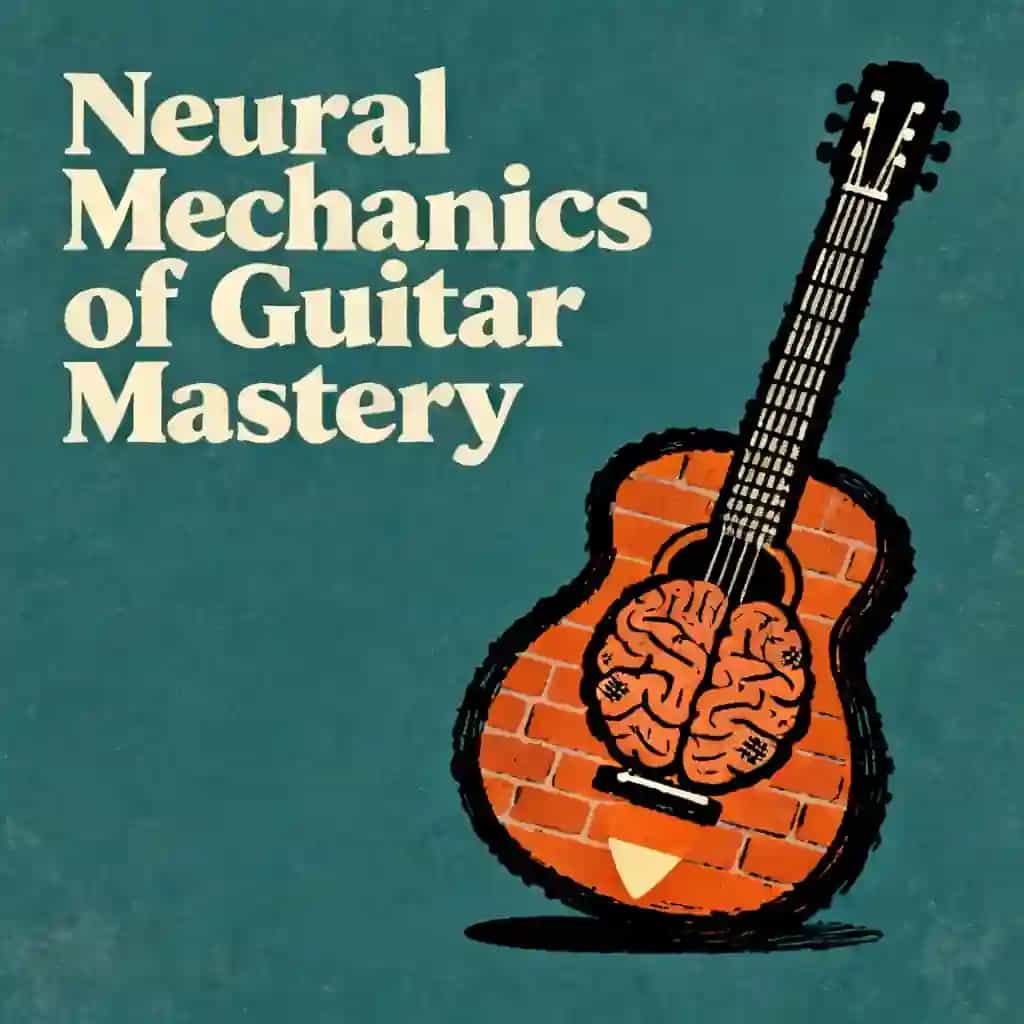
The 90-Day Guitar Fretboard Mastery Roadmap
Skip the frustration of memorization with a 12-chord shortcut and interval hacks. Learn to navigate the neck and master essential shapes using this practical 90-day playbook for beginners.

Melhor citação de The 90-Day Guitar Fretboard Mastery Roadmap
By thinking in shapes rather than static positions, you are building a flexible vocabulary. This shift in perspective turns the fretboard from a chaotic mess of strings into a logical grid.
Generated by Dale
Learning guitar cheat sheets

Perguntas frequentes
The half-step rule is a fundamental memory aid for understanding the guitar neck, stating that every note is two frets apart except for the transitions between B to C and E to F. Because these specific pairs are only one fret apart, they break the standard geometric pattern of the fretboard. Mastering this rule allows a player to move beyond memorizing individual dots and start seeing the logical grid of the instrument.
The CAGED system is a mental map based on five core finger shapes: C, A, G, E, and D. Instead of memorizing thousands of individual positions, a guitarist learns that these five shapes are movable templates that can slide up the neck to create any major chord. By treating the guitar's nut as a "zero fret" or using the index finger as a movable nut, a player can repurpose familiar open shapes to play in any key across the entire fretboard.
To overcome the physical difficulty of barre chords, players should stop using their thumb as a high-pressure clamp, which leads to cramping. Instead, the "lever" technique involves using the strumming arm to pull the body of the guitar back slightly, which naturally pushes the fretboard into the fretting hand. Additionally, rolling the index finger slightly onto its side utilizes the hard bone rather than the soft flesh, creating cleaner contact with the strings with less effort.
Intervals represent the distance between notes, such as the root, third, and fifth that make up a standard chord. Understanding intervals allows a player to recognize that many six-string chords actually only contain three distinct notes that are simply repeated. This knowledge enables a "cheat" where a player can perform "triads"—smaller, three-string versions of chords—which are much easier to fret and often sound cleaner in a band setting than full structural barre chords.
These techniques focus on finger efficiency to create smooth, professional-sounding transitions. Anchored fingers are those that stay on the same string or move very little during a change, such as keeping the index and middle fingers still when moving from A minor to C major. Gliding fingers remain in light contact with a string while sliding to a new position, acting as a guide rail to reduce the cognitive load of finding an entirely new spot on the neck.
Criado por ex-alunos da Universidade de Columbia em San Francisco
"Instead of endless scrolling, I just hit play on BeFreed. It saves me so much time."


"I never knew where to start with nonfiction—BeFreed’s book lists turned into podcasts gave me a clear path."


"Perfect balance between learning and entertainment. Finished ‘Thinking, Fast and Slow’ on my commute this week."
"Crazy how much I learned while walking the dog. BeFreed = small habits → big gains."
"Reading used to feel like a chore. Now it’s just part of my lifestyle."

"Feels effortless compared to reading. I’ve finished 6 books this month already."
"BeFreed turned my guilty doomscrolling into something that feels productive and inspiring."

"BeFreed turned my commute into learning time. 20-min podcasts are perfect for finishing books I never had time for."
"BeFreed replaced my podcast queue. Imagine Spotify for books — that’s it. 🙌"

"It is great for me to learn something from the book without reading it."
"The themed book list podcasts help me connect ideas across authors—like a guided audio journey."
"Makes me feel smarter every time before going to work"
 Ask ChatGPT
 Ask Claude
Criado por ex-alunos da Universidade de Columbia em San Francisco
"Instead of endless scrolling, I just hit play on BeFreed. It saves me so much time."
"I never knew where to start with nonfiction—BeFreed’s book lists turned into podcasts gave me a clear path."
"Perfect balance between learning and entertainment. Finished ‘Thinking, Fast and Slow’ on my commute this week."
"Crazy how much I learned while walking the dog. BeFreed = small habits → big gains."
"Reading used to feel like a chore. Now it’s just part of my lifestyle."
"Feels effortless compared to reading. I’ve finished 6 books this month already."
"BeFreed turned my guilty doomscrolling into something that feels productive and inspiring."
"BeFreed turned my commute into learning time. 20-min podcasts are perfect for finishing books I never had time for."
"BeFreed replaced my podcast queue. Imagine Spotify for books — that’s it. 🙌"
"It is great for me to learn something from the book without reading it."
"The themed book list podcasts help me connect ideas across authors—like a guided audio journey."
"Makes me feel smarter every time before going to work"
"Instead of endless scrolling, I just hit play on BeFreed. It saves me so much time."
"I never knew where to start with nonfiction—BeFreed’s book lists turned into podcasts gave me a clear path."
"Perfect balance between learning and entertainment. Finished ‘Thinking, Fast and Slow’ on my commute this week."
"Crazy how much I learned while walking the dog. BeFreed = small habits → big gains."
"Reading used to feel like a chore. Now it’s just part of my lifestyle."
"Feels effortless compared to reading. I’ve finished 6 books this month already."
"BeFreed turned my guilty doomscrolling into something that feels productive and inspiring."
"BeFreed turned my commute into learning time. 20-min podcasts are perfect for finishing books I never had time for."
"BeFreed replaced my podcast queue. Imagine Spotify for books — that’s it. 🙌"
"It is great for me to learn something from the book without reading it."
"The themed book list podcasts help me connect ideas across authors—like a guided audio journey."
"Makes me feel smarter every time before going to work"
"Instead of endless scrolling, I just hit play on BeFreed. It saves me so much time."
"I never knew where to start with nonfiction—BeFreed’s book lists turned into podcasts gave me a clear path."
"Perfect balance between learning and entertainment. Finished ‘Thinking, Fast and Slow’ on my commute this week."
"Crazy how much I learned while walking the dog. BeFreed = small habits → big gains."
"Reading used to feel like a chore. Now it’s just part of my lifestyle."
"Feels effortless compared to reading. I’ve finished 6 books this month already."
"BeFreed turned my guilty doomscrolling into something that feels productive and inspiring."
"BeFreed turned my commute into learning time. 20-min podcasts are perfect for finishing books I never had time for."
"BeFreed replaced my podcast queue. Imagine Spotify for books — that’s it. 🙌"
"It is great for me to learn something from the book without reading it."
"The themed book list podcasts help me connect ideas across authors—like a guided audio journey."
"Makes me feel smarter every time before going to work"