EU Law for EPSO AD5: Mastering the Treaties
Struggling with the OLP or QMV math? Learn to navigate the TEU and TFEU hierarchy and avoid common traps to score higher on your EPSO exam.
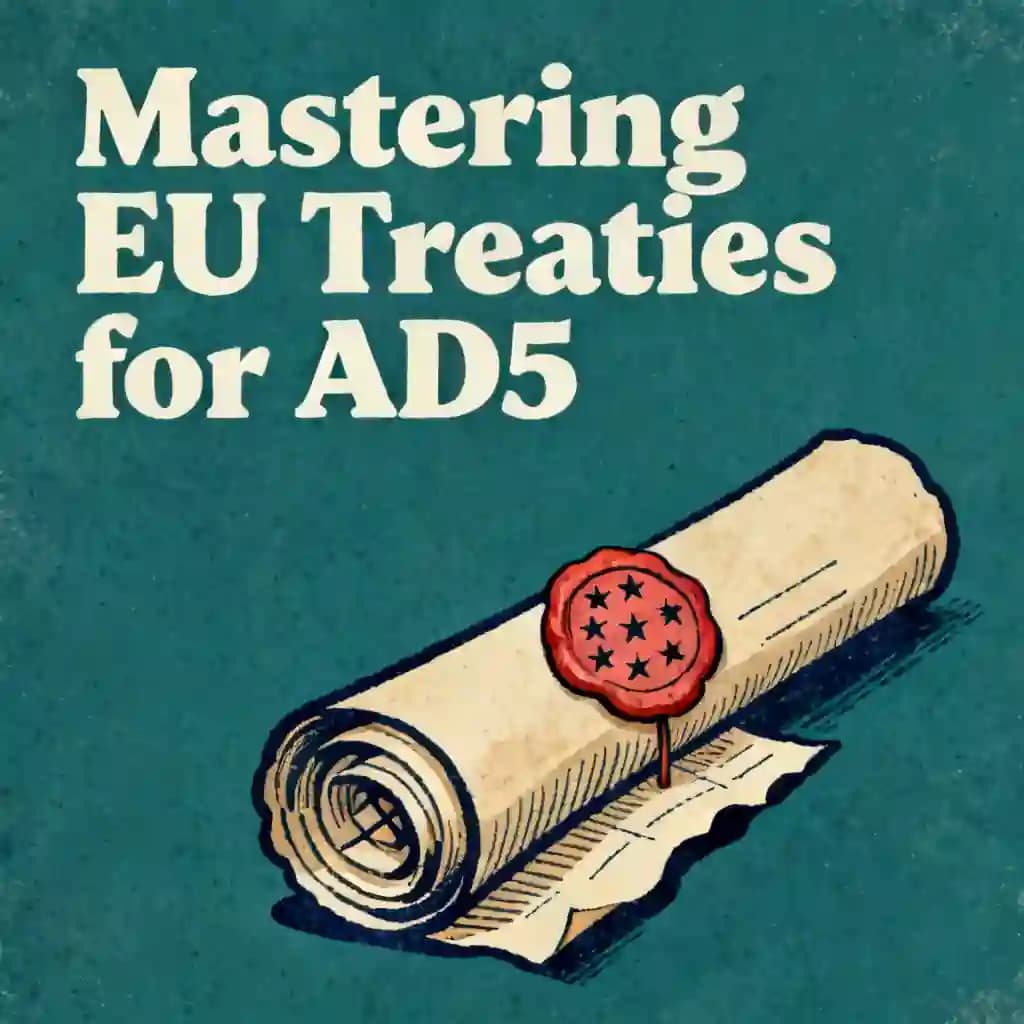
Melhor citação de EU Law for EPSO AD5: Mastering the Treaties
The TEU is the constitutional foundation containing the big-picture values and objectives, while the TFEU is the detailed schematic spelling out specific policies and the actual mechanics of legislative procedures.
Generated by Dragos
'EU Instructions in Detail' for EPSO AD5 preparation. EU Treaties core TEU/TFEu Legislative procedures (OLP, Special, delegated/implementing acts)(8min), Principles (subsidiarity, proportionality)(), Institutions roles (Commission initiative, Council QMV, EP co-decision)(), EPSO tricks/examples from real tests(3mi), Use official sources

Perguntas frequentes
The Treaty on European Union (TEU) acts as the constitutional foundation, outlining the Union's values, broad objectives, and the general roles of the institutions. In contrast, the Treaty on the Functioning of the European Union (TFEU) serves as the detailed operational manual. It specifies the 85 legal bases for the Ordinary Legislative Procedure, defines policy areas, and dictates the mechanics of how the EU functions and exercises its conferred powers.
To pass a law in the Council under the standard QMV rule, a proposal must satisfy two specific thresholds: it needs the support of at least 55% of Member States (currently 15 out of 27) and those states must represent at least 65% of the total EU population. To block a proposal, a "blocking minority" must include at least four Member States representing more than 35% of the EU population, a rule designed to prevent a few large countries from stopping legislation alone.
A Delegated Act, under Article 290 of the TFEU, allows the Commission to supplement or amend non-essential elements of a legislative act, with the Parliament and Council retaining strong veto powers. An Implementing Act, under Article 291, is used when uniform conditions are needed to execute existing law across all Member States. The oversight for Implementing Acts is handled through "Comitology" committees consisting of national experts rather than direct parliamentary vetoes.
Subsidiarity is the "level of action" filter, ensuring the EU only acts in non-exclusive areas if an objective cannot be sufficiently achieved by Member States but can be better achieved at the Union level. Proportionality is the "intensity" filter, requiring that the form and content of EU action do not exceed what is necessary to achieve treaty objectives. National parliaments monitor these principles through an "Early Warning System," using "Yellow" or "Orange" cards to challenge proposals they believe overstep these boundaries.
The European Council consists of Heads of State or Government and is responsible for setting the EU's overall political direction and strategic priorities; it does not pass laws. The Council of the European Union (often just "the Council") consists of national ministers who act as co-legislators alongside the European Parliament. While the European Council provides the "vision," the Council of the EU handles the actual negotiation and adoption of specific legislation.
Criado por ex-alunos da Universidade de Columbia em San Francisco
"Instead of endless scrolling, I just hit play on BeFreed. It saves me so much time."


"I never knew where to start with nonfiction—BeFreed’s book lists turned into podcasts gave me a clear path."


"Perfect balance between learning and entertainment. Finished ‘Thinking, Fast and Slow’ on my commute this week."
"Crazy how much I learned while walking the dog. BeFreed = small habits → big gains."
"Reading used to feel like a chore. Now it’s just part of my lifestyle."

"Feels effortless compared to reading. I’ve finished 6 books this month already."
"BeFreed turned my guilty doomscrolling into something that feels productive and inspiring."

"BeFreed turned my commute into learning time. 20-min podcasts are perfect for finishing books I never had time for."
"BeFreed replaced my podcast queue. Imagine Spotify for books — that’s it. 🙌"

"It is great for me to learn something from the book without reading it."
"The themed book list podcasts help me connect ideas across authors—like a guided audio journey."
"Makes me feel smarter every time before going to work"
Criado por ex-alunos da Universidade de Columbia em San Francisco
"Instead of endless scrolling, I just hit play on BeFreed. It saves me so much time."
"I never knew where to start with nonfiction—BeFreed’s book lists turned into podcasts gave me a clear path."
"Perfect balance between learning and entertainment. Finished ‘Thinking, Fast and Slow’ on my commute this week."
"Crazy how much I learned while walking the dog. BeFreed = small habits → big gains."
"Reading used to feel like a chore. Now it’s just part of my lifestyle."
"Feels effortless compared to reading. I’ve finished 6 books this month already."
"BeFreed turned my guilty doomscrolling into something that feels productive and inspiring."
"BeFreed turned my commute into learning time. 20-min podcasts are perfect for finishing books I never had time for."
"BeFreed replaced my podcast queue. Imagine Spotify for books — that’s it. 🙌"
"It is great for me to learn something from the book without reading it."
"The themed book list podcasts help me connect ideas across authors—like a guided audio journey."
"Makes me feel smarter every time before going to work"
"Instead of endless scrolling, I just hit play on BeFreed. It saves me so much time."
"I never knew where to start with nonfiction—BeFreed’s book lists turned into podcasts gave me a clear path."
"Perfect balance between learning and entertainment. Finished ‘Thinking, Fast and Slow’ on my commute this week."
"Crazy how much I learned while walking the dog. BeFreed = small habits → big gains."
"Reading used to feel like a chore. Now it’s just part of my lifestyle."
"Feels effortless compared to reading. I’ve finished 6 books this month already."
"BeFreed turned my guilty doomscrolling into something that feels productive and inspiring."
"BeFreed turned my commute into learning time. 20-min podcasts are perfect for finishing books I never had time for."
"BeFreed replaced my podcast queue. Imagine Spotify for books — that’s it. 🙌"
"It is great for me to learn something from the book without reading it."
"The themed book list podcasts help me connect ideas across authors—like a guided audio journey."
"Makes me feel smarter every time before going to work"
"Instead of endless scrolling, I just hit play on BeFreed. It saves me so much time."
"I never knew where to start with nonfiction—BeFreed’s book lists turned into podcasts gave me a clear path."
"Perfect balance between learning and entertainment. Finished ‘Thinking, Fast and Slow’ on my commute this week."
"Crazy how much I learned while walking the dog. BeFreed = small habits → big gains."
"Reading used to feel like a chore. Now it’s just part of my lifestyle."
"Feels effortless compared to reading. I’ve finished 6 books this month already."
"BeFreed turned my guilty doomscrolling into something that feels productive and inspiring."
"BeFreed turned my commute into learning time. 20-min podcasts are perfect for finishing books I never had time for."
"BeFreed replaced my podcast queue. Imagine Spotify for books — that’s it. 🙌"
"It is great for me to learn something from the book without reading it."
"The themed book list podcasts help me connect ideas across authors—like a guided audio journey."
"Makes me feel smarter every time before going to work"